芯片制造

Search documents
中国绿色低碳转型展现强大韧性
Ren Min Ri Bao· 2025-07-28 19:07
Core Insights - The report indicates that China's green and low-carbon transition actions demonstrate strong resilience, maintaining climate commitments externally while actively guiding provinces towards comprehensive green transformation internally [1] Renewable Energy Development - As of July 2024, China's installed capacity for wind and solar power has surpassed 1.2 billion kilowatts, achieving the 2030 target six years ahead of schedule [1] - By the first quarter of 2025, the cumulative installed capacity for wind and solar power is expected to reach 1.482 billion kilowatts, exceeding that of thermal power for the first time [1] Electric Vehicle Adoption - Over 30 million electric vehicles are projected to be in operation in China by the end of 2024, with the country housing more than half of the world's electric vehicles [1] - Hainan, Guangxi, and Tianjin lead in new energy vehicle penetration rates, while Guangdong, Zhejiang, and Jiangsu have the highest ownership of new energy vehicles [1] Economic Electrification - China's electrification process is advancing rapidly, at a pace nine times faster than the global average, with the combination of new energy and electrification being a viable path to achieve carbon neutrality goals [1] Emerging Industries - The "new three types" of industries are becoming new growth drivers for the Chinese economy, with rapid development in chip, photovoltaic, and power battery industries in Jiangsu, and significant advancements in new energy vehicles and lithium battery industries in Shandong [1] Regional Climate Action - The Beijing-Tianjin-Hebei region leads in the "Regional Climate Action Power Index," followed by the Yangtze River Delta and Guangdong-Hong Kong-Macau regions, each showcasing distinct development focuses and characteristics [1] - The Beijing-Tianjin-Hebei region excels in greenhouse gas emission control and policy innovation, while the Yangtze River Delta has advantages in regional collaboration, and the Guangdong-Hong Kong-Macau region shows higher levels of energy decarbonization and industrial transformation [1] National Strategy Recommendations - A unified national approach is recommended to advance carbon peak goals, emphasizing target orientation and the implementation of carbon emission dual control and local carbon emission target evaluation requirements [2]
股价大涨!三星收获特斯拉芯片大单
Zheng Quan Shi Bao· 2025-07-28 11:49
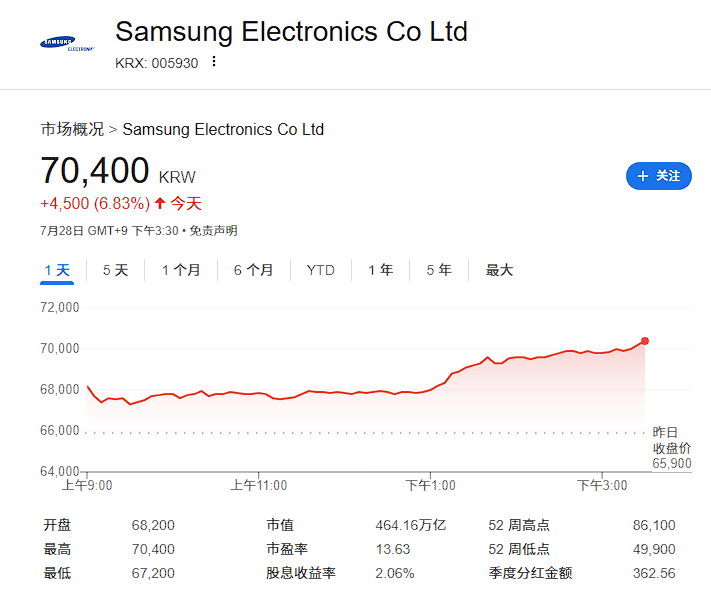
Core Viewpoint - Samsung Electronics has secured a significant chip manufacturing agreement worth 22.8 trillion KRW (approximately 16.5 billion USD) with Tesla, marking a pivotal moment for the company as it aims to enhance its semiconductor business and regain market confidence [1][2]. Group 1: Agreement Details - The contract with Tesla represents 7.6% of Samsung's projected revenue for 2024 and will be effective from July 24, 2023, until December 31, 2033 [1]. - The agreement involves the production of Tesla's AI6 chips, with Samsung currently manufacturing the AI4 chips, while the AI5 chips are produced by TSMC [1][2]. Group 2: Market Reaction - Following the announcement, Samsung's stock price surged by 6.8%, reaching its highest level since September of the previous year, while suppliers like Soulbrain saw stock increases of up to 16% [2]. - Tesla's stock also experienced a pre-market rise of 1% in response to the news [2]. Group 3: Strategic Importance - Elon Musk emphasized the strategic significance of the deal, suggesting that the actual output could exceed the stated contract value, and he will personally oversee the chip production process to optimize it [2]. - This contract is seen as a crucial opportunity for Samsung to improve its chip manufacturing capabilities, which have been underutilized and facing losses [2]. Group 4: Competitive Landscape - Samsung's market share in the global chip foundry sector has declined, with its share dropping from 8.1% to 7.7%, contrasting sharply with TSMC's dominant 67.6% share [3]. - The new agreement is viewed as a signal of market confidence in Samsung's upcoming manufacturing technologies, particularly in the development of next-generation 2nm process semiconductors [3].

股价大涨!三星收获特斯拉芯片大单
证券时报· 2025-07-28 11:29
Core Viewpoint - Samsung Electronics has secured a significant chip manufacturing agreement worth 22.8 trillion Korean Won (approximately $16.5 billion) with Tesla, which is expected to boost Samsung's revenue and stock price significantly [2][5]. Group 1: Agreement Details - The contract with Tesla represents 7.6% of Samsung's projected revenue for 2024 and will be effective from July 24, 2023, until December 31, 2033 [2]. - Elon Musk confirmed that the order pertains to Tesla's FSD (Full Self-Driving) chips, specifically the AI6 chip, while the AI5 chip is produced by TSMC [3][4]. Group 2: Market Impact - Following the announcement, Samsung's stock rose by 6.8%, reaching its highest level since September of the previous year, while suppliers like Soulbrain saw stock increases of up to 16% [5]. - Tesla's stock also experienced a pre-market increase of 1% after the news [5]. Group 3: Strategic Importance - Musk emphasized the strategic significance of the deal, suggesting that the actual output could exceed the stated contract value [4]. - The agreement is seen as a potential catalyst for Samsung's chip manufacturing business, which has been struggling with underutilization and losses [6][12]. Group 4: Competitive Landscape - Samsung's market share in the global chip foundry sector has declined, with its share dropping from 8.1% to 7.7%, contrasting with TSMC's dominant position of 67.6% [10]. - Both Samsung and TSMC are advancing next-generation semiconductor technologies, including the development of 2nm processes, with this agreement signaling market confidence in Samsung's upcoming manufacturing capabilities [11].


马斯克确认特斯拉与三星达成165亿美元协议 将生产下一代AI6芯片
Sou Hu Cai Jing· 2025-07-28 08:04
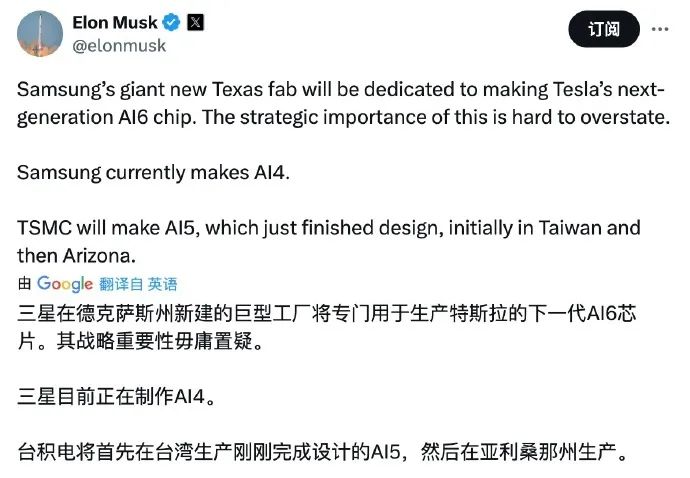
C114讯 7月28日消息(苡臻)今日,马斯克在个人社交平台上确认与三星已达成165亿美元协议,后者 将为特斯拉生产半导体。 据可靠消息,三星所生产的芯片的主要用途是为特斯拉电动车提供高性能自动驾驶芯片和AI计算模 块,将涵盖下一代FSD系统和Optimus机器人所需算力。 马斯克在X上发帖称:"三星在德克萨斯州巨型新工厂将制造特斯拉的下一代AI6芯片。其战略重要性怎 么强调都不为过。"并称"台积电将先在台湾生产刚刚设计完成的AI5芯片,然后在亚利桑那州生产。" 三星的芯片业务(即设备解决方案部门)涵盖存储芯片、系统大规模集成电路(System LSI)和代工部 门。其中,存储芯片业务贡献了芯片总营收的约四分之三,LSI 部门则负责逻辑芯片设计。 值得一提的是,三星电子此前披露的第二季度财报显示,公司4月至6月营收达到74万亿韩元,营业利润 同比减少55.94%,为4.6万亿韩元。三星将其业绩不佳归咎于:负责芯片业务的设备解决方案(DS)部 门业绩持续低迷等影响,整体业绩低于预期。包括晶圆代工业务和系统LSI的非存储器部门和闪存芯片 (NAND)业务持续亏损等。 此外,三星电子于今日早些时候宣布,已签署价值1 ...
165亿美元芯片大单!特斯拉给了三星,马斯克:我将亲自参与提升生产效率
Hua Er Jie Jian Wen· 2025-07-28 07:02
Core Insights - Samsung Electronics has secured a $16.5 billion chip manufacturing contract with Tesla, with CEO Elon Musk confirming that this amount is just the minimum and that he will personally participate in enhancing production efficiency [1][7][5] - The contract, valued at 22.8 trillion Korean won, will last until the end of 2033 and marks a significant breakthrough for Samsung in the competitive foundry market, providing an opportunity to re-establish itself in AI chip manufacturing [1][10][12] - Following the announcement, Samsung's stock price surged by 6.8%, reaching its highest level since September of the previous year [1] Contract Details - The Texas factory of Samsung will specifically produce Tesla's next-generation AI6 chips, while Samsung is currently responsible for the AI4 chips and TSMC is manufacturing the recently designed AI5 chips [3][4] - Musk emphasized that Tesla will assist in maximizing production efficiency at the Samsung factory, which is conveniently located near his residence [5] Strategic Importance - This chip deal is not merely about hardware manufacturing; it is crucial for Musk's broader vision of integrating AI into Tesla's future developments, particularly in autonomous driving and humanoid robots [1][8] - Musk has projected that if Tesla successfully executes its plans in humanoid robots and autonomous driving, the company's valuation could reach between $25 trillion and $30 trillion [8] Market Context - Samsung's foundry business has been struggling with underutilization of capacity, while TSMC holds a dominant market share of 67.6% in the global foundry market, compared to Samsung's 7.7% [10][11] - The new contract is expected to boost Samsung's foundry sales by 10% annually and may encourage other fabless companies to sign new contracts [10][12] Competitive Landscape - The timing of this contract is critical for Samsung, as the company is expected to report a significant decline in profits due to weak foundry orders and competition in the AI chip market [11] - Samsung is currently lagging behind competitors like SK Hynix and Micron in the high-bandwidth memory (HBM) segment, which is essential for AI chipsets [11]
亚洲首个跨境输电的新能源项目投运;傲鲨发布消费级VIATRIX增程动力外骨骼机器人丨智能制造日报
创业邦· 2025-07-28 03:05
Group 1 - The first cross-border renewable energy project in Asia, the Mengsong 600 MW mountain wind power project, has commenced commercial operation with the first batch of 300 MW installed capacity. This project is the largest single wind power project in Southeast Asia and is led by China Electric Power Construction [1] - The launch of the consumer-grade exoskeleton robot VIATRIX by Aoshark at the 2025 World Artificial Intelligence Conference (WAIC) features an adaptive AI algorithm and a floating hip joint structure, aimed at enhancing user performance in various activities [1] - The first satellite communication rescue practice in the industry was successfully conducted with the Wanjie M9 vehicle, which utilized satellite communication to request emergency assistance in a remote area where cellular signals were unavailable [1] Group 2 - Suiruan Technology announced the release of its next-generation AI chip, Suiruan L600, which is designed for high-performance AI computing with a storage capacity of 144 GB and a storage bandwidth of 3.6 TB/s, significantly surpassing the performance of Nvidia's H20 GPU [1]


疯狂内卷,客户砍单,成熟制程太难了
半导体行业观察· 2025-07-28 01:32
Core Viewpoint - The semiconductor industry is facing significant challenges due to a combination of factors including the end of the tariff-induced inventory buildup, weaker-than-expected recovery in end-user applications such as mobile, networking, and automotive, and continued pressure from the appreciation of the New Taiwan Dollar [2][3]. Group 1: Market Conditions - Major IC design companies are reportedly cutting wafer foundry orders for mature processes by 20% to 30% in Q3 compared to Q2, indicating a significant correction in demand [2][3]. - The automotive market is particularly weak, impacting demand for mature processes, with major chip manufacturers warning of poor market conditions [3][4]. Group 2: Financial Impact - The capacity utilization rate for mature process foundries is expected to drop from around 70% in the first half of the year to approximately 60% or lower in the second half [4]. - UMC and World Advanced are projected to see their gross margins decline, with UMC's gross margin potentially falling to 25% in the second half of the year [3][4]. - Powerchip has reported a net loss of NT$0.8 per share for Q2, marking its seventh consecutive quarter of losses, with continued pressure expected in the second half [3][4]. Group 3: Industry Outlook - The semiconductor industry is primarily supported by AI demand, with TSMC performing well, while other mature process foundries are struggling due to weak consumer and automotive sector demand [4].


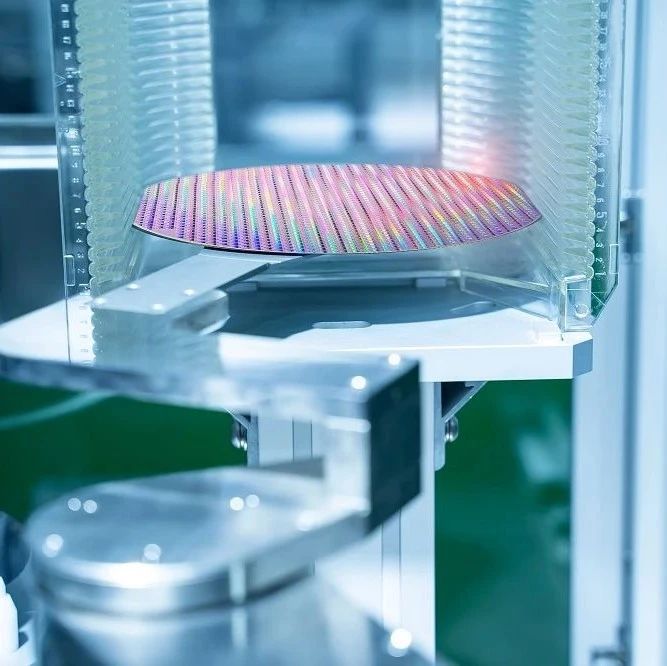
日韩股市高开,三星电子上涨
news flash· 2025-07-28 00:10
三星电子股价涨3.5%,此前与一家全球大型公司签订22.8万亿韩元的芯片制造协议。 日经225指数高开0.04%,韩国首尔综指高开1%。 ...
结构性分化行情开启,7月28日,A股市场将继续上攻?
Sou Hu Cai Jing· 2025-07-27 17:30
Group 1 - The U.S. has lifted the EDA software export ban to China, not due to China's technological advancements, but because of the U.S. being constrained by China's dominance in rare earth materials [1] - The impact of restricting EDA software exports would severely affect China's chip manufacturing and automation industries, as they rely heavily on this software for product development [1] - Although China has its own EDA software, it still lags behind the top U.S. software, and the costs associated with switching to domestic software would be burdensome for many small and medium-sized enterprises [1] Group 2 - The Shanghai Composite Index fell by 0.33% to 3593 points, while the Shenzhen Component Index and the ChiNext Index also experienced slight declines [3][7] - The market is currently undergoing a normal adjustment after a period of growth, with a target to break through last year's high of 3674 points [3] - The trading volume decreased to 1.81 trillion yuan, down by 584 billion yuan from the previous trading day, indicating a market correction with over 2700 stocks declining [3] Group 3 - The Federal Reserve is not expected to cut interest rates in July, with predictions pushing the potential rate cut to September [5] - The rise in the Shanghai Composite Index since April has been partly driven by expectations of interest rate cuts, but the potential for further gains is limited as these expectations are already priced in [5] - As mid-year earnings reports are released, companies with disappointing results are likely to emerge, which may negatively impact the index's performance [5]
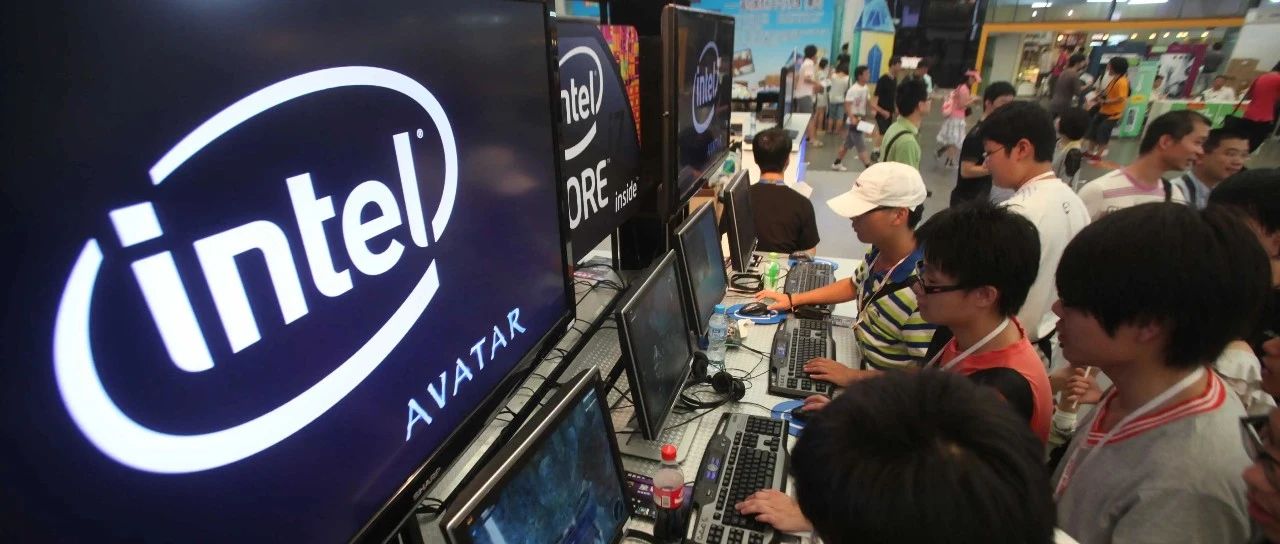
英特尔收缩全球产能引发市场担忧
第一财经· 2025-07-26 05:02
Core Viewpoint - Intel has announced a significant shift in its operational strategy, including halting projects in Germany and Poland, consolidating operations in Costa Rica to larger facilities in Vietnam and Malaysia, and slowing down the construction of its Ohio factory to align spending with market demand. The company is also considering stopping the development of its next-generation chip, 14A, which could heavily impact the U.S. semiconductor industry and increase reliance on overseas production [1][2]. Summary by Sections Company Strategy - Intel plans to focus on the development of the 14A chip and is seeking large external customers to ensure the economic viability of this project. If significant external clients are not secured, the company may pause or terminate the 14A development [2]. - The new CEO, Pat Gelsinger, is implementing a restructuring plan aimed at reducing the workforce by approximately 15%, with expectations to lower the total number of employees to around 75,000 by the end of the year. The company has already completed a significant portion of this workforce adjustment [2][3]. Financial Performance - Intel's stock price dropped by 8.5% to $24.20 following the announcement of these strategic changes. However, the stock has seen a cumulative increase of about 13% this year and a 19% rise since Gelsinger's appointment in March [2][4]. - The company is on track to meet its operational spending target of $17 billion by 2025, indicating a focus on financial discipline amid restructuring efforts [2]. Market Reaction - Despite the recent stock price drop, Intel's stock had previously experienced a significant decline of 60% in 2024, marking its worst annual performance. The market remains concerned about the effectiveness of Intel's transformation efforts [4].