
餐饮服务

Search documents
百胜中国9月15日斥资320万美元回购7.29万股
Zhi Tong Cai Jing· 2025-09-16 09:28
Group 1 - Yum China (09987) announced a share buyback on September 15, 2025, spending HKD 6.2626 million to repurchase 18,400 shares at a price range of HKD 338.6 to 342.6 per share [1] - On the same date, the company also repurchased 72,900 shares for USD 3.2 million, with a price range of USD 43.54 to 44.15 per share [1]
同庆楼(605108.SH):公司认为高德扫街榜的入选可提升同庆楼品牌的可信度和口碑
Ge Long Hui· 2025-09-16 08:43
Group 1 - The core viewpoint of the article is that Tongqinglou (605108.SH) has been recognized in the Gaode Street Scanning List, which is expected to enhance the brand's credibility and reputation [1] Group 2 - The company has stores in Hefei, Wuhu, Chuzhou, Fuyang, Anqing, Nanjing, Wuxi, and Changzhou that have been selected for the Gaode Street Scanning List [1]

雷军:小米 17 全面对标 iPhone;罗永浩邀贾国龙直播;中美就 TikTok 达成基本共识|极客早知道
Sou Hu Cai Jing· 2025-09-16 02:00
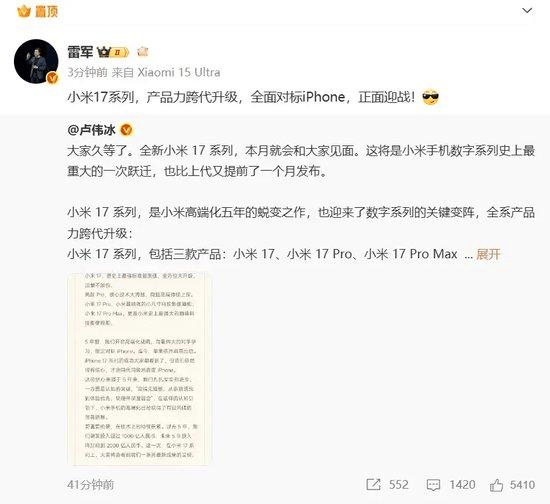
Group 1 - Xiaomi's founder Lei Jun announced that the new Xiaomi 17 series will directly compete with the iPhone, marking a significant upgrade in product capabilities [2][4] - The Xiaomi 17 series includes three models: Xiaomi 17, Xiaomi 17 Pro, and Xiaomi 17 Pro Max, with a naming convention similar to the iPhone 17 series [5] - Xiaomi has been pursuing a high-end strategy for five years, learning from its greatest competitor, Apple, and is confident in facing the iPhone head-on [4] Group 2 - Amazon Web Services (AWS) denied reports of layoffs in its Greater China region, stating that the reports were grossly inaccurate and that the company continues to actively recruit talent in China [14] - Despite the denial, AWS has faced restructuring, with some departments experiencing layoffs affecting hundreds of positions [16] Group 3 - OpenAI's chairman Brett Taylor discussed the current "AI bubble," describing it as a "virtuous cycle" that will create significant economic value in the future, similar to the internet boom of the late 20th century [27][29] - Taylor acknowledged the risks associated with the AI industry but emphasized that these risks are minor compared to the opportunities available [29]



罗永浩质疑西贝预制菜缴税问题,专家详解
Di Yi Cai Jing· 2025-09-16 01:45
Core Viewpoint - The controversy surrounding the tax implications of using pre-prepared food ingredients by the restaurant brand Xibei has garnered significant public attention, particularly following comments from entrepreneur Luo Yonghao regarding potential tax discrepancies related to the use of these ingredients [1]. Tax Rate Application - Xibei applies a 6% VAT rate for dining services, regardless of whether pre-prepared ingredients are used, as long as the food is consumed on-site [1][3]. - The current tax regulations state that takeaway food from restaurants is also subject to the same 6% VAT rate, unless the food is sold without any processing, which would then incur a higher VAT rate of 13% [1][3]. Expert Opinions - Experts, including Professor Ge Yuyu and Tian Zhiwei, suggest that the likelihood of Xibei using pre-prepared food to evade taxes is low, as the law mandates that food produced by the restaurant, whether for dine-in or takeaway, is taxed at 6% [4]. - Tian Zhiwei emphasized that for a restaurant to evade taxes through pre-prepared food, it would need to sell unprocessed items directly to consumers, which does not appear to be the case with Xibei's operations [4].
“乐品上海”餐饮消费券本周六起报名摇号 新增“满200元减60元”一档
Jie Fang Ri Bao· 2025-09-16 01:34
Group 1 - The core point of the article is the introduction of new dining consumption vouchers in Shanghai, which includes a "200 yuan off 60 yuan" offer, aimed at boosting consumer spending in the restaurant sector [1] - The vouchers will be distributed through an "online registration and lottery" system, with registration open from September 20 to September 22, and results announced by September 24 [1] - Four types of vouchers are being offered: 60 yuan for a minimum spend of 200 yuan, 90 yuan for 300 yuan, 180 yuan for 500 yuan, and 400 yuan for 1000 yuan [1] Group 2 - Consumers can register for the vouchers via UnionPay, Alipay, and WeChat, and must use the vouchers within their validity period, which is from October 1 to October 31 [1] - The vouchers can be redeemed automatically at participating merchants by presenting the payment code from the respective payment platforms [1]
8月社零增速放缓至3.4%,西贝致歉表示进行调整 | 财经日日评
吴晓波频道· 2025-09-16 00:21
Group 1 - In August, China's retail sales growth slowed to 3.4% year-on-year, with total retail sales reaching 39,668 billion yuan [2] - Excluding automobiles, retail sales increased by 3.7% year-on-year, indicating a gradual recovery in consumer spending, although the pace is slowing [2] - The service sector showed slight improvement, with the Ministry of Commerce planning to introduce policies to boost service consumption in September [2][3] Group 2 - The China Automotive Industry Association released guidelines for supplier payment practices, aiming to standardize payment terms and reduce financial pressure on suppliers [4] - Major automakers, including SAIC and BYD, have committed to shortening payment terms to 60 days, which may impact their cash flow management [4][5] - The domestic passenger car sales growth is slowing, and the cessation of price competition may challenge the competitiveness of many unprofitable new energy vehicle companies [5] Group 3 - In August, housing prices in major cities continued to decline, but the rate of decline is narrowing, indicating a potential stabilization in the real estate market [6][7] - Real estate investment remains weak, and the industry faces significant challenges, necessitating timely policy support to stabilize the market [7] Group 4 - The "2025 China Top 500 Enterprises" list was released, showing total revenue of 110.15 trillion yuan, with a net profit of 4.71 trillion yuan, reflecting growth in both metrics [8][9] - The list indicates a stable structure in large enterprises, with state-owned enterprises dominating the top positions, while private enterprises like JD.com are gaining ground in the digital economy [8][9] Group 5 - Recent trends show a rise in the issuance of large-denomination certificates of deposit (CDs) by banks, with interest rates approaching 2%, indicating a strategy to attract deposits amid low net interest margins [14][15] - The issuance of these CDs is not necessarily a signal of an interest rate hike but rather a response to the need for banks to bolster their deposit base [14][15] Group 6 - The stock market showed mixed performance, with the Shanghai Composite Index declining by 0.26% while the ChiNext Index rose by 1.52%, reflecting a volatile market environment [16][17] - Market sentiment is affected by uncertainties in U.S.-China trade negotiations, suggesting a need for new narratives to boost investor confidence [17]

8点1氪:西贝官方发布致歉信,罗永浩宣布“停战”;海南航空回应“乘客向工作人员下跪求助”事件;小米跳过16系列直接官宣小米17
36氪· 2025-09-16 00:09
Group 1 - The core viewpoint of the article revolves around the conflict between Luo Yonghao and Xibei, with Luo deciding to abandon further pursuit of Xibei but continuing with a collective lawsuit regarding the use of pre-prepared dishes [3][5][16] - Xibei issued an apology letter on September 15, promising to adjust multiple dishes to be made fresh in-store instead of using pre-prepared ingredients [5][17] - Luo Yonghao expressed dissatisfaction with Xibei's handling of the situation, stating that he would have sought justice if he had pursued the matter further [5][16] Group 2 - Xibei's apology letter was initially deleted and then reissued, with a notable change in the wording of a quote from its founder, which included the term "abuse" in quotation marks [5] - Multiple Xibei locations confirmed they received notifications about the adjustments, with some already implementing changes such as using non-GMO oil and fresh vegetables [17] - Luo Yonghao mentioned that the marketing consulting firm, Hua Yu Hua, which has worked with Xibei for 10 years, has apologized to him, indicating a resolution to that part of the conflict [16]





8点1氪|西贝官方发布致歉信,罗永浩宣布“停战”;海南航空回应“乘客向工作人员下跪求助”事件;小米跳过16系列直接官宣小米17
3 6 Ke· 2025-09-16 00:05
Group 1 - Xibei Restaurant issued an apology letter committing to adjust multiple dishes to be prepared on-site rather than in a central kitchen [2][3] - Following the apology, Luo Yonghao announced he would not pursue legal action against Xibei, despite feeling that a personal apology was not given [2][3] - Several Xibei locations confirmed they received notifications regarding the adjustments to food preparation [15] Group 2 - Nvidia is under further investigation by the Market Regulation Administration for violating antitrust laws [8] - The total revenue of the 2025 China Top 500 Enterprises reached 110.15 trillion yuan, showing an increase from the previous year [8] - The threshold for entering the Top 500 list has risen for 23 consecutive years, now standing at 47.96 billion yuan [8] Group 3 - Xiaomi announced it will skip the 16 series and directly launch the Xiaomi 17 series, aiming to compete directly with Apple's iPhone [7] - Tesla's stock price rose by 6% in pre-market trading after Elon Musk purchased over 2.5 million shares, valued at approximately $1 billion [17] - Major US stock indices closed higher, with Google surpassing a market capitalization of $3 trillion [18]

西贝发布道歉信,公布九项调整措施;美团Keeta正式在科威特启动运营
Mei Ri Jing Ji Xin Wen· 2025-09-15 23:24
Group 1 - Meituan's international delivery brand Keeta officially launched operations in Kuwait on September 15, marking its third entry into the Gulf region after Saudi Arabia and Qatar. The company aims to deeply integrate into the local ecosystem rather than simply replicating its business model [1] - SF Express's local delivery service "SoFast" has launched in Macau, following its entry into Hong Kong last year. The service has partnered with the largest local lifestyle service platform, "Aomi App," to enhance resource integration and optimize delivery services [2] - Xibei Catering Group issued an apology letter on September 15, announcing nine adjustment measures to be implemented by October 1, 2025. These include switching to non-GMO soybean oil for all dishes and using fresh, hand-cut fish for children's meals, reflecting the company's responsiveness to market and consumer demands [3] Group 2 - Meituan plans to use Keeta as a foothold to deepen its presence in the Middle East while exploring additional overseas markets [1] - The launch of "SoFast" in Macau is expected to enhance SF Express's brand influence and market share in the region [2] - Xibei's adjustments indicate a shift towards meeting consumer preferences and aligning with market trends, particularly in the context of the ongoing competition in the prepared food sector [3]

前瞻全球产业早报:西贝正式道歉,承诺部分菜品调整为门店现做
Sou Hu Cai Jing· 2025-09-15 23:18
Economic Indicators - In August, the industrial added value above designated size grew by 5.2% year-on-year, with a month-on-month increase of 0.37% [1] - From January to August, the industrial added value increased by 6.2% year-on-year [1] Policy Developments - New policies to promote private investment are being formulated, including minimum shareholding requirements for private investment in major projects in sectors like railways, nuclear power, and oil and gas pipelines [1] - Beijing's GDP is expected to exceed 5 trillion yuan by the end of the 14th Five-Year Plan in 2025 [1] Industry Innovations - Shanghai is accelerating the development and application of AI technologies in the high-end medical device industry, focusing on building a high-quality health corpus and promoting smart product upgrades [1] Corporate Actions - Xibei Restaurant Group announced adjustments to its menu, including using non-GMO soybean oil and preparing certain dishes fresh in-store by October 1, 2025 [2] - Xiaomi's upcoming smartphone series, renamed from Xiaomi 16 to Xiaomi 17, aims to compete directly with the iPhone [3] - 17 major automotive companies, including BYD and NIO, are committed to a payment initiative to enhance collaboration with suppliers [4] Market Trends - Nvidia is under investigation for violating antitrust laws related to its acquisition of Mellanox Technologies [3] - Tesla's German factory plans to increase production due to strong sales data [11] - Apple's first smart glasses are expected to launch within the next 12 to 16 months [7]