教育文化娱乐

Search documents
招银理财权益投资部总经理戴康:流动性行情逻辑未改 锚定“AI+”“服务业+”双主线
Shang Hai Zheng Quan Bao· 2026-02-03 18:19
Core Viewpoint - Market sentiment oscillates between extreme optimism and pessimism, with extreme points often signaling reversals. Current market volatility reflects the need for investors to navigate the "price and value expectation gap" [1] Group 1: Market Dynamics - The current A-share market is experiencing a volatile pattern with accelerated sector rotation, driven by liquidity similar to the conditions seen in 2014-2015, characterized by low interest rates, policy encouragement, and clear industrial trends [1][2] - The global liquidity remains relatively loose, and the narrative surrounding AI has not shifted, providing a foundation for the continuation of the current market trend [1] - The China Securities Regulatory Commission's emphasis on preventing large market fluctuations suggests a more gradual market evolution, which may solidify the foundation for long-term healthy development [2] Group 2: External Risks - There is a need to be cautious of potential external economic recession risks, particularly regarding the U.S. economy, which is showing significant "K-shaped" differentiation. While a "soft landing" is possible, the risk of a "hard landing" remains a critical external variable affecting global liquidity and risk appetite [2] Group 3: Market Structure Changes - The A-share market is undergoing profound changes in its ecosystem, with increasing influence from domestic insurance funds and quantitative strategies, as well as a shift towards industry-focused investments rather than individual stocks [2] - The focus on high-quality development is shifting economic growth from reliance on "traditional engines" to fostering "emerging momentum," with greater emphasis on growth potential, technological barriers, and industry chain positions [2] Group 4: Investment Strategies - The "global barbell strategy," supported by factors such as de-globalization, debt cycles, and AI industry trends, is recommended for constructing resilient asset allocations. This strategy involves positioning at both ends: stable assets to withstand uncertainty and high-growth elastic assets [2][3] - On the stable asset side, attention is drawn to short-duration bonds with high sovereign credit value, commodities like copper and gold, and high-dividend stocks in the AH market [3] - On the elastic asset side, there is a sustained focus on Chinese tech stocks driven by the AI industry wave and self-controlled industrial chains, with significant breakthroughs in domestic AI narrowing the cognitive gap with U.S. tech industries [3] Group 5: Long-term Investment Focus - "AI+" and "service industry+" are identified as two key long-term investment themes, with "AI+" expected to empower various sectors and "service industry+" having broad prospects to optimize industrial structures and create jobs [4] - In the "service industry+" sector, there is a consensus on the hard logic of technological advancements driving productive services, while areas like healthcare and education, which cater to significant demographic needs, present substantial long-term investment opportunities [4] Group 6: Identifying Expectation Gaps - The core of investment lies in recognizing the differences between price and value, focusing on identifying expectation gaps within a highly consensus-driven market [5] - The evolving requirements for analysts emphasize macro vision, forward judgment, and independent thinking, necessitating continuous adaptation and reflection to navigate changing market conditions [5]
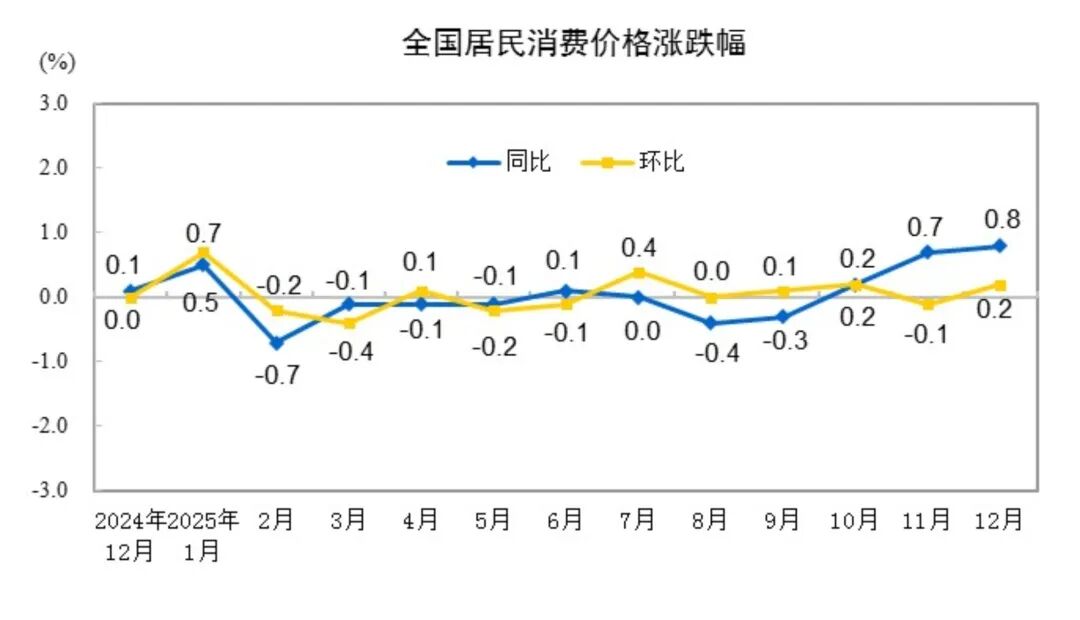
同比上涨0.8%
Zhong Guo Ji Jin Bao· 2026-01-09 02:33
Core Viewpoint - In December 2025, the national consumer price index (CPI) increased by 0.8% year-on-year, with urban areas rising by 0.9% and rural areas by 0.6% [1][7]. Group 1: Year-on-Year Price Changes - The CPI for December 2025 showed a year-on-year increase of 0.8%, with food prices rising by 1.1% and non-food prices by 0.8% [1][7]. - Among food items, fresh vegetable prices surged by 18.2%, contributing approximately 0.39 percentage points to the CPI, while pork prices fell by 14.6%, reducing the CPI by about 0.20 percentage points [3][7]. - Other categories showed mixed results, with healthcare prices increasing by 1.8% and transportation costs decreasing by 2.6% [3][7]. Group 2: Month-on-Month Price Changes - In December, the CPI increased by 0.2% month-on-month, with food prices rising by 0.3% and non-food prices by 0.1% [1][5]. - Fresh fruit prices rose by 2.6% month-on-month, contributing approximately 0.05 percentage points to the CPI, while meat prices, including pork, saw a decline [5][7]. - Other categories experienced varied changes, with other goods and services prices increasing by 2.8% and housing costs decreasing by 0.1% [5][7]. Group 3: Annual Overview - For the entire year of 2025, the national consumer price index remained unchanged compared to the previous year [1][7]. - Food prices overall decreased by 1.5% year-on-year, while non-food prices increased by 0.4% [7][8]. - The overall inflationary pressure was relatively stable, with significant fluctuations observed in specific categories such as fresh vegetables and pork [3][7].

“十五五”规划系列报告(八):提高消费率:“口径”的意义
Minsheng Securities· 2025-11-08 08:20
Group 1: Importance of Improving Consumption Statistics - Improving consumption statistics is crucial for accurately observing the resident consumption rate and guiding policy direction[1] - Recent efforts have been made to enhance consumption statistics, including the release of service retail data in August 2023[1] - The government has initiated actions to improve comprehensive consumption statistics, aiming for a more targeted approach in stimulating consumption[1] Group 2: Comparison with Other Economies - Comparing consumption statistics between China and the U.S. reveals significant differences, with U.S. residents' per capita consumption approximately ten times that of China[1] - The U.S. enjoys a price advantage in consumer price index (CPI) compared to China's overall price levels, affecting consumption rates[2] - Service consumption in China is a major bottleneck, with only 46.1% of consumption expenditure allocated to services compared to 68.5% in the U.S.[20] Group 3: Statistical Methodology Challenges - China's statistical methods for financial services and insurance are inadequate, leading to underreported service consumption[22] - The narrow scope of service consumption statistics in China fails to capture the full value of public service subsidies, affecting data comparability[25] - The transition from depreciation cost method to market-based virtual rent method for housing services in 2023 aims to better reflect actual consumption value[26] Group 4: Risks and Considerations - There are risks associated with discrepancies between service consumption data and actual figures, potentially affecting policy effectiveness[31] - The progress of improving consumption statistics may not align with expectations, complicating efforts to enhance consumption rates[31] - Achieving higher consumption rates requires not only improved statistics but also policies that enhance consumer willingness and capacity[31]
国家统计局答记者问:我国工业消费供求改善 燃油小汽车价格收窄
Sou Hu Cai Jing· 2025-09-15 13:52
Core Insights - The National Bureau of Statistics reported that in August, the Consumer Price Index (CPI) showed a year-on-year decline of 0.4%, reversing from a flat reading in the previous month, primarily due to high base effects from the previous year [5][6] - The core CPI, excluding food and energy, increased by 0.9% year-on-year, marking a continuous expansion in price increases for four consecutive months, driven by rising industrial consumer goods and service prices [5][6] Economic Indicators - In August, the CPI remained flat month-on-month, compared to a 0.4% increase in July, with food prices rising by 0.5% and non-food prices declining by 0.1% [3][6] - Food prices saw a year-on-year decline of 4.3% in August, with significant drops in pork, fresh vegetables, and eggs, each exceeding 10% [5][6] Industrial and Service Prices - Industrial consumer goods prices, excluding energy, rose by 1.5% year-on-year in August, an increase of 0.3 percentage points from the previous month, with home appliances and entertainment goods contributing to this rise [6] - Service prices increased by 0.6% year-on-year in August, reflecting a steady upward trend, influenced by increased demand for high-quality social services and summer travel [6] Policy and Market Outlook - The government aims to continue expanding domestic demand and implementing consumption-boosting initiatives, while also addressing capacity management in key industries to promote reasonable price recovery [6]

8月份我省CPI同比下降0.9
Liao Ning Ri Bao· 2025-09-15 01:08
Core Insights - In August, Liaoning's Consumer Price Index (CPI) decreased by 0.9% year-on-year, which is 0.5 percentage points lower than the national average, ranking 30th nationwide [1] - The core CPI, excluding food and energy prices, increased by 0.8% year-on-year, with the growth rate expanding by 0.3 percentage points compared to the previous month [1] - The average CPI from January to August fell by 0.2% compared to the same period last year, which is 0.1 percentage points lower than the national average, ranking 21st nationwide [1] Year-on-Year Price Changes - In August, the prices of eight major categories of goods and services showed a trend of "four increases, three decreases, and one stable" [1] - Other goods and services increased by 9.1% - Daily necessities and services rose by 1.7% - Clothing prices increased by 1.4% - Education, culture, and entertainment prices rose by 0.5% - Medical care prices decreased by 0.3% - Transportation and communication prices fell by 2.7% - Food, tobacco, and alcohol prices decreased by 3.6% - Housing prices remained stable [1] Month-on-Month Price Changes - In August, the month-on-month price changes in the eight major categories of goods and services showed a trend of "two increases, three decreases, and three stable" [1] - Prices for transportation and communication, as well as education, culture, and entertainment, increased - Prices for medical care, clothing, and daily necessities and services decreased - Prices for other goods and services, food, tobacco, and alcohol, and housing remained stable [1]
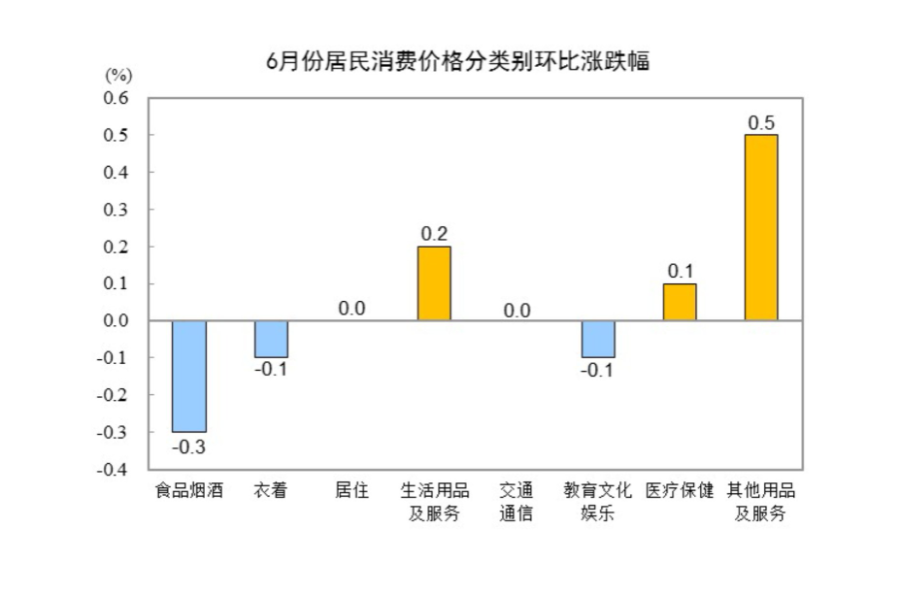
国家统计局:6月份食品烟酒类价格环比下降0.3%,影响CPI下降约0.09个百分点
news flash· 2025-07-09 01:34
Core Insights - In June, the prices of food, tobacco, and alcohol decreased by 0.3% month-on-month, contributing to a decline in the Consumer Price Index (CPI) by approximately 0.09 percentage points [1] Price Changes in Food Categories - Fresh fruit prices fell by 3.3%, impacting the CPI by a decrease of about 0.07 percentage points [1] - Egg prices decreased by 2.9%, contributing to a CPI decline of approximately 0.02 percentage points [1] - Meat prices dropped by 0.6%, with pork prices specifically declining by 1.2%, affecting the CPI by a decrease of around 0.02 percentage points [1] - Fresh vegetable prices increased by 0.7%, leading to a CPI increase of about 0.01 percentage points [1] - Seafood prices also rose by 0.7%, contributing to a CPI increase of approximately 0.01 percentage points [1] Other Price Categories - Among the other seven major categories, three saw price increases while two remained stable and two decreased [1] - Prices for other goods and services, daily necessities, and healthcare rose by 0.5%, 0.2%, and 0.1% respectively [1] - Housing and transportation communication prices remained unchanged [1] - Clothing, education, culture, and entertainment prices decreased by 0.1% [1]
增量政策的愿望清单(民生宏观陶川团队)
川阅全球宏观· 2025-04-10 13:35
Core Viewpoint - The article emphasizes the transition from stabilizing the market to stabilizing the economy, highlighting the need for timely policy implementation to mitigate economic downward pressure and avoid secondary risks [1]. Group 1: Economic Stabilization Strategies - The article suggests that the government has sufficient policy tools to stabilize the economy, with a focus on enhancing domestic demand as a key component of economic recovery [1][4]. - It discusses the importance of "internal circulation" in the context of increasing external uncertainties, indicating that investment in human resources is becoming increasingly significant [1]. - The article outlines two main directions for policy efforts: enhancing existing policies and exploring potential in service consumption sectors, particularly in education, culture, and entertainment [4]. Group 2: Employment and External Risks - The article highlights the critical importance of employment stability, especially in light of U.S.-China trade tensions, which have increased the risks associated with employment in industries with high foreign trade dependence [7]. - It notes that the manufacturing sector has a foreign trade dependence exceeding 13%, indicating that export downturns could exacerbate operational pressures on companies and affect hiring needs [8]. - The article mentions that the government aims to introduce incremental policies to stabilize employment and increase income, with a focus on timely implementation [7][8]. Group 3: Policy Support and Economic Impact - The article estimates that the U.S. tariffs on China could reduce revenue for large industrial enterprises by approximately 1.4 percentage points, with a potential loss of over 2 million jobs in the application sector [8]. - It suggests that the government may increase support for key industries, particularly high-tech manufacturing sectors such as computers, electrical machinery, and automotive [9]. - The potential incremental policies could include measures like re-loans, fiscal subsidies, and tax reductions, with an estimated support of no less than 1.2 trillion yuan for affected industries [11].