
财政收支

Search documents
11月财政数据点评:紧平衡下关注短期支出端增量政策
LIANCHU SECURITIES· 2025-12-22 09:02
Report Summary 1. Report Industry Investment Rating No relevant information provided. 2. Core Viewpoints As of now, the growth rate of fiscal revenue and expenditure is running weakly. Compared with the budget target at the beginning of the year, it shows the characteristics of "slightly exceeding the revenue target, lagging expenditure progress, and expanding revenue - expenditure gap of government - managed funds". Although the general public budget revenue has exceeded the target, the lagging expenditure progress leads to low efficiency of fiscal funds use. The expanding revenue - expenditure gap of government - managed funds reflects the fragility of land finance. In the future, under the tight fiscal balance, both the revenue and expenditure sides face multiple pressures. In the short term, the focus is on the efficiency of fund implementation. Incremental policies around accelerating fund allocation and promoting the formation of physical workload are expected, which will strongly support fiscal expenditure and economic recovery in the first quarter across the year [1]. 3. Summary by Related Catalogs Fiscal Revenue - The growth rate of fiscal revenue has been running at a low level and slightly exceeded the growth target at the beginning of the year. From January to November, the growth rate of general public budget revenue was 0.8%, 0.1% higher than the predetermined target. The overall revenue growth continued the low - level operation trend. Structurally, the differentiation between central and local revenues increased, with the decline of central revenue expanding and the growth rate of local revenue improving slightly, providing some support for the overall revenue. In terms of rhythm, the completion progress of fiscal revenue was 91.2%, slightly lower than the historical average (91.7%) but slightly higher than the same period in 2024 (90.5%). Overall, fiscal revenue maintained a steady recovery trend, but the progress was slightly behind expectations, mainly affected by factors such as insufficient economic recovery resilience, tax structure differentiation, and weakening non - tax revenue support [2]. - The growth rate of tax revenue continued to improve, while the decline of non - tax revenue expanded, showing obvious structural differentiation. The growth rate of tax revenue increased by 0.1 percentage points to 1.8%, indicating enhanced tax source resilience. Non - tax revenue had negative growth for 7 consecutive months, and the decline further expanded, dragging down the overall fiscal revenue growth rate. Among major taxes, the growth rates of domestic VAT and corporate income tax declined marginally, which was consistent with weak domestic demand and enterprise profit pressure; personal income tax remained the same as the previous value, indicating limited improvement in residents' income; consumption tax increased slightly, showing certain consumption resilience. The shock - strengthening of the equity index drove the stamp duty to maintain a relatively high growth rate. Among foreign - trade - related taxes, the decline of export tax rebates expanded, and the increase of tariffs narrowed, indicating pressure on exports. The decline of vehicle purchase tax expanded, reflecting the weakening of automobile consumption. The growth rates of land value - added tax and deed tax were continuously in the negative growth range, indicating that real - estate transactions and investments were still in the bottom - exploring stage [3]. Fiscal Expenditure - The growth rate of fiscal expenditure declined continuously, and the pressure on local expenditure was significant. From January to November, the growth rate of fiscal expenditure was 1.4%, with a decline of 0.6 percentage points, significantly lower than the predetermined target of 4.4% at the beginning of the year. In terms of central and local levels, the growth rate of central expenditure decreased slightly by 0.1 percentage points to 6.2%, with a continuous decline for 6 months; the growth rate of local expenditure decreased to 0.6%, the lowest in the year, reflecting a significant increase in local fiscal expenditure constraints. The decline in local expenditure was related to the high base last year on the one hand, and reflected the characteristics of marginal weakening in the second half of the year due to the front - loaded fiscal efforts on the other hand [4]. - In terms of expenditure structure, the decline of infrastructure - related expenditure expanded, and the growth rate of livelihood expenditure slowed down from a high level. The growth rates of expenditure on agriculture, forestry, and water affairs and urban and rural community affairs both declined and reached the lowest in the year, dragging down the infrastructure investment growth rate. The obvious contraction of infrastructure expenditure might be related to insufficient connection of new project reserves and more funds being used for debt resolution. In terms of livelihood expenditure, the growth rate of social security and employment expenditure slowed down for 3 consecutive months but still remained at a relatively high level; the growth rate of education expenditure slowed down marginally for 8 consecutive months, indicating that the fiscal expenditure structure was gradually transitioning from bottom - supporting expansion to constraint balance [4]. Government - Managed Funds - The revenue and expenditure of government - managed funds were under pressure, and there was a disconnection between the issuance and use of special bonds. The decline of land transfer revenue continued to expand, dragging down the growth rate of government - managed funds revenue from - 2.8% to - 4.9% (the predetermined target was 0.7%). The growth rate of government - managed funds expenditure decreased marginally to - 15.4% (the predetermined target was 23.1%), and the growth rate slowed down for 4 consecutive months. The growth rates of government - managed funds revenue and expenditure were significantly lower than the targets at the beginning of the year by 0.7% and 23.1% respectively. The lagging expenditure progress was mainly due to the mismatch between the issuance of special bonds by local governments and project implementation. Although the issuance progress of local government special bonds reached 101.6% and the progress of new special bonds was 97% (the historical average was 95.3%), the insufficient land revenue restricted the local supporting fund expenditure ability. Coupled with the fact that some projects were not ready for timely construction, the fund expenditure progress was lagging [5].
11月财政数据点评:财政的四大发力点
Shenwan Hongyuan Securities· 2025-12-18 07:10
Revenue and Expenditure Overview - In the first 11 months of 2025, the national general public budget revenue was 200,516 billion yuan, a year-on-year increase of 0.8%[6] - National general public budget expenditure reached 248,538 billion yuan, with a year-on-year growth of 1.4%[6] Fiscal Trends - In November, broad fiscal expenditure showed improvement with a year-on-year decline of 1.7%, a significant narrowing of 17.5 percentage points compared to October[7] - Broad fiscal revenue in November fell by 5.2% year-on-year, a further decline of 4.6 percentage points from October's -0.6%[7] Budget Completion and Support - The budget completion rate for broad fiscal expenditure in November rose to 8%, up from 5.6% in October, indicating a year-end acceleration in spending[7] - The completion rate for broad fiscal revenue was 7%, consistent with the previous year and the five-year average[16] Factors Affecting Revenue - The decline in revenue is partly due to high base effects and ongoing weakness in land finance, with November's general public budget revenue showing a minimal change of -0.02% year-on-year[9] - Land finance continues to be a drag, with land transfer income remaining in negative growth territory[9] Future Fiscal Focus - Future fiscal priorities may include maintaining necessary fiscal deficits, standardizing tax incentives, addressing local fiscal difficulties, and encouraging local debt management[3] - The emphasis will be on resolving issues related to local hidden debts and supplementing local financial resources[15] Expenditure Insights - General fiscal expenditure in November showed a year-on-year decline of 3.7%, but this was a significant improvement from October's decline of over 6 percentage points[29] - Health and technology-related expenditures saw notable increases, with year-on-year growth rates of 32.5% and 27.4%, respectively[29] Government Fund Performance - Government fund expenditure turned positive in November, reaching a growth of 2.8%, a significant recovery from previous declines[32] - The budget completion rate for government fund expenditure was 9.3%, below the five-year average of 10%[20]
财政部:1-10月国有土地使用权出让收入24982亿元
Jing Ji Guan Cha Bao· 2025-11-18 09:49
Summary of Fiscal Revenue and Expenditure (January to October 2025) Core Insights - The overall public budget revenue for the first ten months of 2025 shows a slight increase, while non-tax revenue has declined, indicating mixed fiscal health. [1][2] Group 1: Public Budget Revenue - Total public budget revenue reached 186,490 billion yuan, reflecting a year-on-year growth of 0.8% [1] - Tax revenue amounted to 153,364 billion yuan, with a year-on-year increase of 1.7% [1] - Non-tax revenue was 33,126 billion yuan, showing a decline of 3.1% year-on-year [1] - Central government public budget revenue was 81,856 billion yuan, down 0.8% year-on-year [1] - Local government public budget revenue was 104,634 billion yuan, up 2.1% year-on-year [1] Group 2: Public Budget Expenditure - Total public budget expenditure reached 225,825 billion yuan, with a year-on-year growth of 2% [1] - Central government public budget expenditure was 34,727 billion yuan, increasing by 6.3% year-on-year [1] - Local government public budget expenditure was 191,098 billion yuan, reflecting a year-on-year increase of 1.2% [1] Group 3: Government Fund Budget Revenue - Government fund budget revenue totaled 34,473 billion yuan, down 2.8% year-on-year [2] - Central government fund budget revenue was 3,618 billion yuan, up 1.6% year-on-year [2] - Local government fund budget revenue was 30,855 billion yuan, down 3.3% year-on-year, with land use rights transfer revenue at 24,982 billion yuan, decreasing by 7.4% year-on-year [2] Group 4: Government Fund Budget Expenditure - Government fund budget expenditure reached 80,892 billion yuan, showing a significant year-on-year increase of 15.4% [2] - Central government fund budget expenditure was 8,564 billion yuan, reflecting a year-on-year increase of 2.2 times [2] - Local government fund budget expenditure was 72,328 billion yuan, up 7.3% year-on-year, with related expenditures for land use rights transfer at 33,752 billion yuan, down 6.5% year-on-year [2]
透过数据看8月份国家“钱袋子”收支情况 “增长、平稳、良好”释放积极信号
Yang Shi Wang· 2025-09-18 04:02
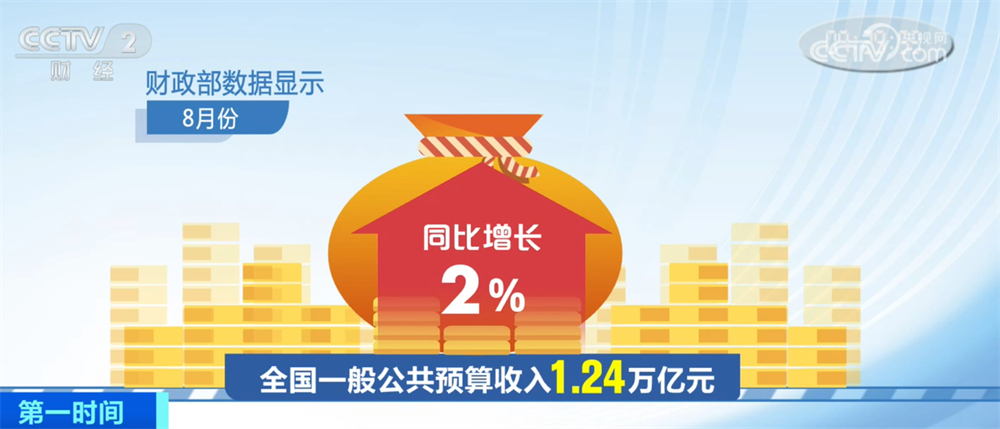
Group 1 - The core viewpoint of the news is that China's fiscal revenue and expenditure data for the first eight months of 2023 shows a slight increase in revenue and a stable growth in expenditure, indicating a gradual recovery in the economy [1][3][4]. Group 2 - From January to August, the national general public budget revenue reached approximately 14.82 trillion yuan, reflecting a year-on-year growth of 0.3%, with an increase of 0.2 percentage points compared to the previous month [4]. - In August alone, the national general public budget revenue was 1.24 trillion yuan, showing a year-on-year increase of 2%, continuing the growth trend [1]. - Cumulatively, tax revenue for the first eight months was 12.11 trillion yuan, which is an increase of 26 billion yuan or 0.02% compared to the same period last year, marking the first positive growth in cumulative tax revenue [3]. Group 3 - National general public budget expenditure from January to August totaled 17.93 trillion yuan, with a year-on-year growth of 3.1%, ensuring adequate funding for key areas such as education, social security, and health [6]. - Expenditure in key sectors like education, social security and employment, and health care grew by over 5% year-on-year [6]. - The issuance and utilization of bond funds by various fiscal departments accelerated, with 3.39 trillion yuan spent from government fund budgets, driving a 30% increase in government fund budget expenditure [6]. Group 4 - Tax types such as domestic value-added tax, domestic consumption tax, and personal income tax maintained stable growth, while corporate income tax also achieved positive growth [7]. - Industries such as equipment manufacturing and modern services showed strong tax performance [7].

中国财政系列十五:财政收入边际改善,支出保持高增
Hua Tai Qi Huo· 2025-08-20 02:29
Report Industry Investment Rating - Not provided in the content Core Viewpoints - In 2025 from January to July, the general public budget revenue showed a nominal growth pressure, with the progress at 61.8%, slightly lower than the average of the past five years. The cumulative growth rate turned positive for the first time this year, mainly relying on the high growth of stamp duty and the recovery of value - added tax and enterprise income tax, but the sustainability of the improvement in the fiscal revenue structure needs further observation. Meanwhile, the CPI in July was flat year - on - year, maintaining low - inflation characteristics [3]. - The general public budget expenditure accelerated its expansion. The progress from January to July was 54.1%, slightly lower than the average of the past five years by 0.6 percentage points. The expansion was mainly reflected in areas such as debt interest payments, social security, and education expenditures. Although infrastructure - related expenditures declined, the overall broad - based fiscal expenditure remained in an expansion trend driven by ultra - long - term special treasury bonds and special bonds [4]. - The government - funded budget revenue was in a contraction range, with the progress in the first half of 2025 at 37%, lower than the average of the past five years by 3.2 percentage points. From January to July, the national government - funded budget revenue decreased by 0.7% year - on - year. However, the decline in state - owned land use right transfer revenue narrowed significantly compared with the same period last year. The expenditure progress in the first half of 2025 accelerated to 86.9%, much higher than the average of the past five years. From January to July, the national government - funded budget expenditure increased by 31.7% year - on - year, with the funds mainly invested in major project construction and the "two new" fields, providing strong support for the economy [5]. Summary by Relevant Catalogs General Public Budget Revenue - From January to July 2025, the national general public budget revenue was 13.5839 trillion yuan, a year - on - year increase of 0.1% (previous value: - 0.3%). Tax revenue was 11.0933 trillion yuan, a year - on - year decrease of 0.3% (previous value: - 1.2%); non - tax revenue was 2.4906 trillion yuan, a year - on - year increase of 2% (previous value: 3.7%). Central revenue decreased by 2% year - on - year (previous value: - 2.8%), and local revenue increased by 1.8% year - on - year (previous value: 1.6%) [35]. - Main tax revenue items: domestic value - added tax was 4.2551 trillion yuan, a year - on - year increase of 3% (previous value: 2.8%); domestic consumption tax was 1.0213 trillion yuan, a year - on - year increase of 2.1% (previous value: 1.7%); enterprise income tax was 3.0566 trillion yuan, a year - on - year decrease of 0.4% (previous value: - 1.9%); personal income tax was 0.9279 trillion yuan, a year - on - year increase of 8.8% (previous value: 8%); import VAT and consumption tax decreased by 6.1% year - on - year (previous value: - 6.1%), and customs duties decreased by 6.5% year - on - year (previous value: - 7.7%); export tax rebates increased by 9.7% year - on - year (previous value: 11.6%); urban maintenance and construction tax increased by 2.7% year - on - year (previous value: 2.7%); vehicle purchase tax decreased by 18.4% year - on - year (previous value: - 19.1%); stamp duty increased by 20.7% year - on - year (previous value: 19.7%), among which securities trading stamp duty increased by 62.5% year - on - year (previous value: 54.1%); resource tax decreased by 1.6% year - on - year (previous value: - 2.4%); among land and real - estate - related taxes, deed tax decreased by 15% year - on - year (previous value: - 14.8%), property tax increased by 11.2% year - on - year (previous value: 12%), urban land use tax increased by 5.8% year - on - year (previous value: 5.8%), land value - added tax decreased by 17.8% year - on - year (previous value: - 17.6%), and arable land occupation tax increased by 3.1% year - on - year (previous value: 2.4%); environmental protection tax increased by 12.5% year - on - year (previous value: 16.4%); other tax revenues increased by 0.9% year - on - year (previous value: 0.7%) [36][42][43]. General Public Budget Expenditure - From January to July 2025, the national general public budget expenditure was 16.0737 trillion yuan, a year - on - year increase of 3.4% (previous value: 3.4%). Central expenditure increased by 8.8% year - on - year (previous value: 9%), and local expenditure increased by 2.5% year - on - year (previous value: 2.6%) [46]. - Main expenditure items: education expenditure was 2.4438 trillion yuan, a year - on - year increase of 5.7% (previous value: 5.9%); science and technology expenditure was 0.533 trillion yuan, a year - on - year increase of 3.2% (previous value: 9.1%); culture, tourism, sports, and media expenditure was 0.2012 trillion yuan, a year - on - year increase of 5.3% (previous value: 5%); social security and employment expenditure was 2.7621 trillion yuan, a year - on - year increase of 9.8% (previous value: 9.2%); health expenditure was 1.2402 trillion yuan, a year - on - year increase of 5.3% (previous value: 4.3%); energy conservation and environmental protection expenditure was 0.2949 trillion yuan, a year - on - year increase of 4.3% (previous value: 5.9%); urban and rural community expenditure decreased by 3.5% year - on - year (previous value: - 4.2%); agricultural, forestry, and water expenditure decreased by 7.7% year - on - year (previous value: - 7.8%); transportation expenditure decreased by 3.3% year - on - year (previous value: 3.1%); debt interest payment was 0.7573 trillion yuan, a year - on - year increase of 6.4% (previous value: 6.1%) [47][55][56]. Government - Funded Budget Revenue - From January to July 2025, the national government - funded budget revenue was 2.3124 trillion yuan, a year - on - year decrease of 0.7% (previous value: - 2.4%). Central revenue increased by 8.8% year - on - year (previous value: 4.8%), and local revenue decreased by 1.8% year - on - year (previous value: - 3.2%). The state - owned land use right transfer revenue was 1.695 trillion yuan, a year - on - year decrease of 4.6% (previous value: - 6.5%) [57]. Government - Funded Budget Expenditure - From January to July 2025, the national government - funded budget expenditure was 5.4287 trillion yuan, a year - on - year increase of 31.7% (previous value: 30%). Central expenditure increased by 4.5 times year - on - year (previous value: 6.2 times), and local expenditure increased by 18.1% year - on - year (previous value: 15.1%). The expenditure related to state - owned land use right transfer revenue was 2.3572 trillion yuan, a year - on - year decrease of 6.1% (previous value: - 6.4%) [58][59].
方正证券5月财政数据解读:财政支出维持力度保障经济增长
智通财经网· 2025-06-21 08:46
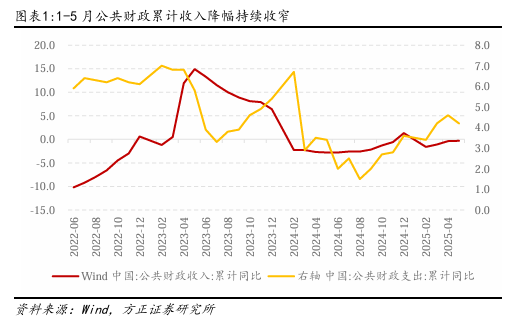
Summary of Key Points Core Viewpoint - The fiscal revenue and expenditure data for the first five months of the year indicate a mixed performance, with revenue slightly declining while expenditure shows growth, reflecting a stable fiscal environment despite challenges in revenue generation [1][2]. Group 1: Fiscal Revenue and Expenditure - From January to May, the national general public budget revenue reached 96,623 billion yuan, a year-on-year decrease of 0.3%, with the decline rate narrowing compared to the previous month [2][4]. - General public budget expenditure totaled 112,953 billion yuan, marking a year-on-year increase of 4.2%, although the growth rate has slightly decreased [2][4]. - In May alone, public fiscal revenue grew by 0.13% year-on-year, while public fiscal expenditure increased by 2.63%, both showing a certain degree of slowdown [4]. Group 2: Deficit and Budget Execution - The actual deficit from January to May reached 16,330 billion yuan, the highest in five years, compared to 11,447 billion yuan in the same period last year, representing a year-on-year increase of 4,883 billion yuan [5]. - The broad deficit, considering government funds, amounted to 32,972 billion yuan, up from 29,380 billion yuan last year, reflecting a year-on-year increase of 3,592 billion yuan [5]. - By the end of May, public fiscal revenue completed 43.9% of the annual budget, a 0.6 percentage point increase from last year, while public fiscal expenditure accounted for 38.0% of the budget, remaining stable compared to last year [6]. Group 3: Revenue Structure - Non-tax revenue showed a cumulative growth of 6.2%, although the growth rate has declined, while tax revenue decreased by 1.6%, with the decline rate narrowing [9]. - In May, tax revenue increased by 0.6% year-on-year, while non-tax revenue fell by 2.2% [9]. - Key tax categories showed varied trends, with corporate income tax declining by 2.5% year-on-year but at a reduced rate, while value-added tax increased by 2.4%, indicating improvement in corporate operations [9]. Group 4: Government Spending - Central government spending has shown significant growth, with May's expenditure rising by 11.04% year-on-year, outpacing local government spending growth of 10.1% [12]. - Expenditure in key areas such as science and technology grew by 20.15%, while cultural, tourism, and sports spending increased by 16.2% [12]. - Infrastructure spending in areas like energy conservation and environmental protection grew by 4.6%, although other sectors like transportation and rural affairs saw declines [12]. Group 5: Government Fund Budget - National government fund budget expenditure increased significantly, with a total of 32,125 billion yuan, reflecting a year-on-year growth of 16% [16]. - Government fund budget revenue reached 15,483 billion yuan, a year-on-year decrease of 6.9%, with local government fund income declining by 8.3% [16]. - Central government fund budget expenditure surged by 64.4%, while local government fund expenditure grew by 14.9% [16].

2025年1-4月财政收支数据解读:4月财政:广义收支两端共振改善
ZHESHANG SECURITIES· 2025-05-21 13:10
Revenue Insights - In April 2025, the national general public budget revenue reached 20,427 billion yuan, a year-on-year increase of 1.9%[3] - Tax revenue for April was 18,106 billion yuan, also up by 1.9% year-on-year, marking a recovery from a 2.2% decline in March[3] - Non-tax revenue increased by 1.7% year-on-year, totaling 2,321 billion yuan, reflecting a high base effect from the previous year[3] Expenditure Trends - National general public budget expenditure in April was 20,766 billion yuan, growing by 5.8% year-on-year[4] - For the first four months of 2025, total expenditure completed 31.5% of the annual budget, the fastest pace since 2020[4] - Key areas of expenditure included social security and employment (8.5% growth), education (7.4% growth), and health (3.9% growth), all exceeding the overall expenditure growth rate[4] Fiscal Policy and Market Outlook - The broad fiscal budget revenue completion rate for January-April was 25.5%, with a year-on-year growth of 2.7%[2] - The government is prepared to issue special bonds to address potential uncertainties, focusing on large-scale equipment updates and consumer goods replacement programs[2] - The bond market is expected to maintain a loose monetary policy, with a potential 50 basis points reserve requirement ratio cut and a 20 basis points interest rate reduction[2] Government Fund Budget Performance - In April, the government fund budget revenue grew by 8.1%, marking the first positive growth of the year[7] - Land use rights transfer income in April increased by 4.3% year-on-year, indicating a gradual recovery in the real estate market[7] - For the first four months, government fund budget expenditure totaled 26,136 billion yuan, a year-on-year increase of 17.7%[10]