地方财政困难

Search documents
“地方附加税”改革将启
第一财经· 2026-03-22 15:57
Core Viewpoint - The article discusses the introduction of a new local tax, the Local Surcharge Tax, aimed at addressing local fiscal difficulties and enhancing local financial autonomy in China. This reform is part of a broader effort to improve the local tax system and expand local tax sources [3][4]. Group 1: Background and Rationale - The Local Surcharge Tax is proposed to replace existing fees related to urban maintenance and education, consolidating them into a single tax to simplify the tax system [3][6]. - Since the transition from business tax to value-added tax in 2016, local governments have faced increasing fiscal pressures due to the loss of traditional tax bases and various economic challenges [5][4]. - The introduction of the Local Surcharge Tax is seen as a way to provide local governments with more financial independence and stability, allowing them to set tax rates within certain limits [5][12]. Group 2: Challenges and Considerations - The reform involves complexities such as changes in tax bases, rate adjustments, and coordination with other fiscal measures, indicating that it will not be a straightforward process [3][8]. - There are concerns that local governments may engage in "race-to-the-bottom" competition by lowering tax rates to attract investment, potentially exacerbating economic disparities between regions [8][9]. - The article highlights the need for careful consideration of tax rate settings to avoid excessive taxation in less developed areas while ensuring that economically stronger regions do not set rates too low [11][12]. Group 3: Financial Implications - Estimates suggest that if the Local Surcharge Tax is set at higher rates, it could generate significant revenue, potentially exceeding 1.65 trillion yuan, making it a crucial component of local fiscal restructuring [11][12]. - The article emphasizes that while the Local Surcharge Tax will contribute to local revenue, it should not be the sole source of funding; instead, it should be part of a comprehensive approach to fiscal management [13][12]. - Future considerations for the Local Surcharge Tax include its application primarily to benefit-producing purposes, such as infrastructure and workforce training, to enhance compliance and create a sustainable fiscal environment [13].


求解“地方财政困难”
Jing Ji Guan Cha Bao· 2025-12-20 05:38
Core Viewpoint - The central economic work meeting emphasizes the importance of addressing local fiscal difficulties, indicating a shift towards systematic solutions for these issues, particularly in the context of increasing rigid expenditure and limited revenue growth [2][3][12]. Group 1: Local Fiscal Challenges - Local fiscal difficulties are characterized by insufficient liquidity and a stark contrast between limited fiscal revenue and unlimited rigid expenditures, particularly affecting grassroots fiscal conditions [2][11]. - The decline in land transfer income and the increasing burden of social welfare expenditures contribute to the worsening fiscal situation, with local governments struggling to meet the "three guarantees" (ensuring livelihood, salaries, and operational stability) [4][11]. - The phenomenon of "middle-region" fiscal challenges is prevalent, where regions like Liaoning face significant fiscal difficulties despite being classified as eastern provinces, highlighting horizontal fiscal imbalances [6][11]. Group 2: Revenue and Expenditure Dynamics - Local government revenues are under pressure from declining tax income, reduced land sales, and limited non-tax revenue sources, leading to a reliance on debt financing to cover expenditures [7][11]. - The fiscal growth and expenditure gap is widening, with increasing debt repayment obligations exacerbating the fiscal strain, particularly in regions with weaker industrial bases [5][11]. - The overall local government debt reached 53.7 trillion yuan by September 2025, with debt service payments growing faster than total expenditure, raising concerns about fiscal sustainability [10][11]. Group 3: Policy Responses and Recommendations - The central government is expected to implement measures to enhance local fiscal sustainability, including increasing transfer payments, optimizing expenditure structures, and reforming the fiscal system [12][15]. - Recommendations for local governments include focusing on regional industrial upgrades, improving budget performance management, and strictly managing debt to prevent the accumulation of hidden liabilities [15]. - A systematic approach to resolving local fiscal difficulties is necessary, involving both immediate liquidity support and long-term structural reforms to enhance local revenue generation capabilities [13][14].
求解“地方财政困难”,不只是搞定钱的事
经济观察报· 2025-12-20 05:21
Core Viewpoint - The article emphasizes the urgent need to address local fiscal difficulties in China, highlighting the contradiction between limited fiscal revenue and unlimited rigid expenditures, particularly at the grassroots level, which has led to a long-term "emergency fiscal phenomenon" [1][3][4]. Group 1: Current Fiscal Challenges - Local fiscal difficulties are characterized by insufficient liquidity and a stark contrast between limited fiscal income and increasing rigid expenditures [3][4]. - The fiscal situation is particularly dire in "medium regions," where areas like Liaoning face significant challenges despite being classified as eastern provinces [4][9]. - The "three guarantees" (ensuring livelihood, wages, and operational stability) are becoming increasingly difficult to maintain, with some regions transitioning to a "five guarantees" model that includes debt repayment and clearing arrears [7][8]. Group 2: Revenue and Expenditure Dynamics - Local government revenues are under pressure due to declining tax income, reduced land transfer revenues, and limited non-tax income sources [11][16]. - For instance, a specific eastern county's tax revenue is projected to drop from 2.7 billion yuan in 2023 to 2.3 billion yuan in 2025, while expenditures related to social welfare are expected to rise by 300 million yuan during the same period [7][11]. - The reliance on land sales for revenue is diminishing, with land transfer income in 2025 expected to be 2.91 trillion yuan, a 10.7% decrease year-on-year [11]. Group 3: Debt and Financial Management - As of September 2025, the total local government debt reached 53.7 trillion yuan, with debt repayment pressures increasing [15][16]. - The article notes that the growth of debt repayment expenditures is outpacing overall expenditure growth, indicating a rising financial burden on local governments [14][15]. - The central government has initiated measures to alleviate local debt pressures, including a 500 billion yuan allocation to support local fiscal stability [17][18]. Group 4: Policy Recommendations - Experts suggest a multi-faceted approach to address local fiscal challenges, including enhancing liquidity, allowing local governments more control over fiscal resources, and implementing debt restructuring measures [18][20]. - Recommendations also include increasing transfer payments, optimizing expenditure structures, and gradually reforming the fiscal system to create stable local tax sources [20][21]. - The need for tailored solutions based on regional economic conditions is emphasized, with different strategies required for eastern, central, and western regions [20].

数据点评 | 财政的四大发力点(申万宏观·赵伟团队)
赵伟宏观探索· 2025-12-18 16:03
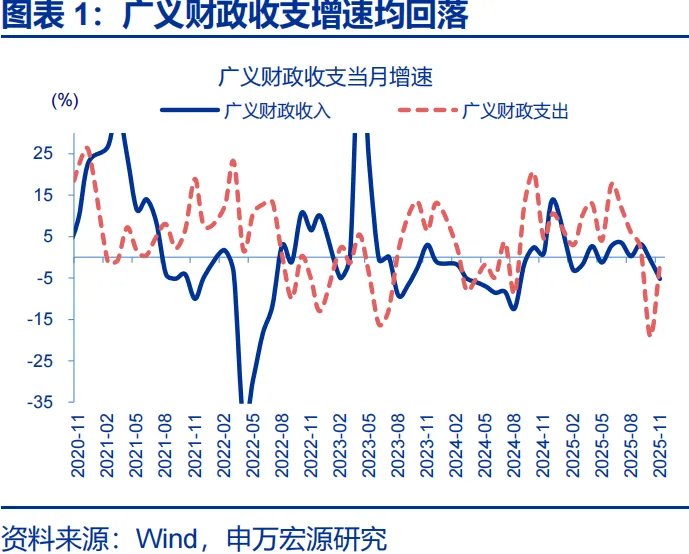
Core Viewpoint - The focus of future fiscal revenue and expenditure may be on maintaining deficits, standardizing tax incentives, supplementing local financial resources, and resolving hidden debts [2][48]. Group 1: Fiscal Revenue and Expenditure Overview - In the first eleven months of 2025, the national general public budget revenue reached 200,516 billion yuan, a year-on-year increase of 0.8%, while expenditure was 248,538 billion yuan, up 1.4% year-on-year [6][47]. - The divergence in fiscal revenue and expenditure in November showed improved expenditure but pressured income, with broad fiscal expenditure down 1.7% year-on-year, a significant narrowing of the decline by 17.5 percentage points compared to October [2][7]. - Broad fiscal revenue fell by 5.2% year-on-year in November, further declining by 4.6 percentage points from October [2][50]. Group 2: Factors Influencing Fiscal Performance - The divergence in fiscal revenue is partly due to base disturbances and the ongoing drag of land finance, with November 2024 broad fiscal revenue showing a recovery of 11% year-on-year, creating high base pressure [8][48]. - The income growth rate weakened, further constraining overall financial expansion space, while the low performance of land finance persisted [2][8]. Group 3: Support for Fiscal Expenditure - The 5,000 billion yuan limit on local special bonds and the implementation of financial tools became significant supports for broad fiscal expenditure in November, with government fund expenditure turning positive [10][49]. - Despite the ongoing drag from land finance and short-term pressure on income, the fiscal expenditure growth rate is expected to continue recovering due to the support from the local debt limit [10][49]. Group 4: Future Fiscal Strategy - Looking ahead to 2026, the focus of fiscal revenue may emphasize maintaining necessary fiscal deficits and standardizing tax incentives and fiscal subsidy policies [13][48]. - The expenditure side will prioritize addressing local fiscal difficulties and urging local governments to actively manage debts, targeting both the stock of hidden debts and the flow issues of local financial resources [13][48].

申万宏源:财政的四大发力点
Xuan Gu Bao· 2025-12-18 11:22
Core Viewpoint - The focus of future fiscal revenue and expenditure may be on maintaining deficits, standardizing tax collection, supplementing local financial resources, and resolving hidden debts [2][3][18] Fiscal Revenue and Expenditure Overview - In the first eleven months of 2025, the national general public budget revenue was 200,516 billion yuan, a year-on-year increase of 0.8%, while the expenditure was 248,538 billion yuan, up 1.4% year-on-year [5] - In November, the broad fiscal expenditure showed a year-on-year decline of 1.7%, a significant narrowing of the decline by 17.5 percentage points compared to October, while the broad fiscal revenue fell by 5.2%, further declining by 4.6 percentage points from October [2][6] Revenue and Expenditure Dynamics - The divergence in fiscal revenue and expenditure is partly due to base disturbances and the ongoing drag from land finance [11][19] - The government fund revenue in November saw a year-on-year decline of 15.8%, although the decline was narrowed by 2.6 percentage points compared to October [24][29] - The general fiscal expenditure budget completion rate in November was 8%, lower than the five-year average of 8.4% [38] Support for Fiscal Expenditure - The 5,000 billion yuan local special bond limit and the implementation of financial tools have become important supports for broad fiscal expenditure in November [15][49] - The government fund expenditure turned positive in November, reaching a growth of 2.8%, significantly improving from a negative growth in October [38][49] Future Fiscal Strategy - The fiscal revenue strategy for 2026 may focus on maintaining necessary fiscal deficits and addressing local fiscal difficulties while encouraging local governments to actively manage debts [18][19]

11月财政数据点评:财政的四大发力点
Shenwan Hongyuan Securities· 2025-12-18 07:10
Revenue and Expenditure Overview - In the first 11 months of 2025, the national general public budget revenue was 200,516 billion yuan, a year-on-year increase of 0.8%[6] - National general public budget expenditure reached 248,538 billion yuan, with a year-on-year growth of 1.4%[6] Fiscal Trends - In November, broad fiscal expenditure showed improvement with a year-on-year decline of 1.7%, a significant narrowing of 17.5 percentage points compared to October[7] - Broad fiscal revenue in November fell by 5.2% year-on-year, a further decline of 4.6 percentage points from October's -0.6%[7] Budget Completion and Support - The budget completion rate for broad fiscal expenditure in November rose to 8%, up from 5.6% in October, indicating a year-end acceleration in spending[7] - The completion rate for broad fiscal revenue was 7%, consistent with the previous year and the five-year average[16] Factors Affecting Revenue - The decline in revenue is partly due to high base effects and ongoing weakness in land finance, with November's general public budget revenue showing a minimal change of -0.02% year-on-year[9] - Land finance continues to be a drag, with land transfer income remaining in negative growth territory[9] Future Fiscal Focus - Future fiscal priorities may include maintaining necessary fiscal deficits, standardizing tax incentives, addressing local fiscal difficulties, and encouraging local debt management[3] - The emphasis will be on resolving issues related to local hidden debts and supplementing local financial resources[15] Expenditure Insights - General fiscal expenditure in November showed a year-on-year decline of 3.7%, but this was a significant improvement from October's decline of over 6 percentage points[29] - Health and technology-related expenditures saw notable increases, with year-on-year growth rates of 32.5% and 27.4%, respectively[29] Government Fund Performance - Government fund expenditure turned positive in November, reaching a growth of 2.8%, a significant recovery from previous declines[32] - The budget completion rate for government fund expenditure was 9.3%, below the five-year average of 10%[20]
数据点评 | 财政的四大发力点(申万宏观·赵伟团队)
申万宏源宏观· 2025-12-18 06:51
Core Viewpoint - The focus of future fiscal revenue and expenditure may be on maintaining deficits, standardizing tax collection, supplementing local financial resources, and resolving hidden debts [2][48] Group 1: Fiscal Revenue and Expenditure Overview - In the first eleven months of 2025, the national general public budget revenue reached 200,516 billion yuan, a year-on-year increase of 0.8%, while expenditure was 248,538 billion yuan, up 1.4% year-on-year [1][6] - In November, the broad fiscal expenditure showed a significant improvement with a year-on-year decline of -1.7%, narrowing the drop by 17.5 percentage points compared to October, while fiscal revenue fell by -5.2%, a further decline of 4.6 percentage points [2][7][50] Group 2: Factors Influencing Fiscal Performance - The divergence in fiscal revenue and expenditure is partly due to base disturbances in the revenue side and the ongoing drag from land finance [2][8] - The broad fiscal revenue in November 2025 saw a year-on-year decline of -5.2%, with government fund revenue down by -15.8% and general fiscal revenue at -0.02% [4][14] Group 3: Support for Fiscal Expenditure - The 5,000 billion yuan limit on local special bonds and the implementation of financial tools have become important supports for broad fiscal expenditure in November [3][10] - The government fund expenditure turned positive in November, reaching a growth of 2.8%, significantly improving from a negative position in October, attributed to the 5,000 billion yuan local special bond limit [39][50] Group 4: Future Fiscal Strategy - Looking ahead to 2026, the fiscal revenue focus may include maintaining necessary fiscal deficits, standardizing tax incentives, addressing local fiscal difficulties, and urging local governments to actively manage debts [13][49] - The central economic work conference indicates that the revenue side will emphasize maintaining necessary fiscal deficits and standardizing tax incentives and fiscal subsidy policies [2][48]

西南财经大学报告测算:县市财政自给率平均约38%
Di Yi Cai Jing· 2025-12-15 13:05
Core Insights - The central economic work conference highlighted the need to address local fiscal difficulties for the first time, emphasizing the importance of ensuring basic public services and financial sustainability at the local government level [2][6]. Group 1: Fiscal Conditions - There is a significant disparity in fiscal self-sufficiency among local governments, with an average fiscal self-sufficiency rate of approximately 38% across 2,774 county-level regions, ranging from as low as 1% in some areas to as high as 252% in others [1][5]. - Local fiscal difficulties are exacerbated by external demand pressures, insufficient domestic demand, and weak expectations, leading to increased challenges in maintaining sustainable local government finances [1][5]. Group 2: Revenue and Expenditure Challenges - Local governments face growing revenue challenges due to declining contributions from traditional industries and a slowdown in real estate and construction sectors, while emerging industries are not yet generating sufficient tax revenue [3][5]. - On the expenditure side, mandatory spending on basic public services, salaries, and social welfare continues to rise, with over 80% of local budget expenditures allocated to these areas as of November [3][5]. Group 3: Proposed Solutions - The central government plans to implement more proactive fiscal policies, potentially increasing the fiscal deficit and issuing long-term bonds to alleviate local fiscal pressures [6][7]. - Enhancing local fiscal autonomy is crucial, with recommendations to reform the local tax system, including the adjustment of shared tax ratios and the consolidation of various local taxes to improve revenue generation [7][8]. - Local governments are encouraged to optimize spending by adopting zero-based budgeting practices and eliminating inefficient expenditures to improve fiscal sustainability [8][9].
中央首提解决地方财政困难
Di Yi Cai Jing Zi Xun· 2025-12-12 07:33
Core Insights - The central government has emphasized the need to address local fiscal difficulties for the first time in history during the recent Central Economic Work Conference, highlighting the importance of ensuring basic public services and financial stability at the grassroots level [2][3]. Group 1: Local Fiscal Challenges - Local fiscal expenditures have consistently exceeded revenues, necessitating reliance on central government transfers and debt to cover deficits. In the first ten months of this year, local public budget revenues were approximately 10.5 trillion yuan, a year-on-year increase of 2.1%, while expenditures reached about 19.1 trillion yuan, up 1.2% [3]. - The decline in real estate market revenues has significantly impacted local government finances, with land transfer income expected to drop to about 4.8 trillion yuan in 2024, a decrease of approximately 45% from the peak of 8.7 trillion yuan in 2021 [3][4]. - Many local governments are facing severe fiscal pressures, with some even experiencing wage arrears due to insufficient funds to maintain basic operations and services [4]. Group 2: Policy Responses and Reforms - The central government is pushing for reforms to improve the local tax system, including the gradual transfer of certain consumption tax revenues to local governments, which could increase local fiscal autonomy [6][7]. - The government aims to enhance the matching of fiscal rights and responsibilities at the local level, with nearly 50% of county-level governments having a fiscal self-sufficiency rate below 30% [5]. - Experts suggest that increasing central transfer payments and raising local debt limits are essential to address the fiscal shortfalls caused by the real estate downturn, thereby restoring local governments' capacity to stimulate economic growth [10][11]. Group 3: Future Outlook - The anticipated increase in the total scale of new government debt for next year is expected to be around 15 trillion yuan, higher than this year's approximately 13 trillion yuan, to support local fiscal needs [10]. - Local governments are also encouraged to optimize their fiscal structures by enhancing the management of existing assets and reducing unnecessary expenditures to improve the efficiency of fiscal fund usage [10][11].

中央首提解决地方财政困难
第一财经· 2025-12-12 07:26
Core Viewpoint - The central government has emphasized the need to address local fiscal difficulties, marking a significant shift in focus during the recent Central Economic Work Conference, which aims to ensure the basic financial security of local governments and improve the local tax system [3][5][10]. Group 1: Local Fiscal Challenges - Local fiscal expenditures generally exceed revenues, necessitating reliance on central government transfers and debt to cover deficits. In the first ten months of this year, local public budget revenues were approximately 10.5 trillion yuan, a year-on-year increase of 2.1%, while expenditures reached about 19.1 trillion yuan, up 1.2% [5][6]. - The decline in real estate-related tax revenues and land sales has significantly impacted local government finances, with land sale revenues dropping from a peak of 8.7 trillion yuan in 2021 to about 4.8 trillion yuan in 2024, a decrease of approximately 45% [5][6]. - Local governments are facing increasing pressure to maintain basic public services, with some regions experiencing salary delays due to insufficient fiscal resources [6][7]. Group 2: Tax System Reforms - The central government plans to enhance the local tax system, focusing on three key areas: shifting the consumption tax collection to local levels, improving the value-added tax refund policies, and consolidating local additional taxes [11][12]. - The government aims to increase local fiscal autonomy by allowing local authorities to set specific tax rates within certain limits, thereby enhancing their revenue-generating capabilities [11][12]. - The proposed reforms include optimizing the sharing ratio of shared taxes, which could potentially increase local governments' share of revenue from major tax categories like value-added tax and corporate income tax [12]. Group 3: Recommendations for Improvement - Experts suggest that to alleviate local fiscal pressures, the central government should increase transfer payments and raise local debt limits, thereby restoring local governments' capacity to stimulate economic growth [14][15]. - There is a call for the central government to gradually assume responsibilities for social security, public safety, and infrastructure projects to reduce the fiscal burden on local governments [15]. - Local governments are encouraged to enhance revenue through asset management and tax collection while optimizing expenditure structures to improve the efficiency of fiscal resource utilization [14][15].