
铜铝行业

Search documents
铜铝周报:宏观回暖,有色普涨-20251222
Bao Cheng Qi Huo· 2025-12-22 09:59
Group 1: Report Industry Investment Rating - No relevant content Group 2: Core Viewpoints of the Report - Copper: After the Bank of Japan's interest rate hike, the macro environment improved, and copper prices rose with increasing positions. Last week, copper prices first declined and then rebounded, with the trading volume increasing as prices rose. High copper prices have suppressed consumption, leading to a continuous weakening of the basis and monthly spreads, with a clear pattern of near - term weakness and long - term strength in futures prices. The 2026 copper concentrate long - term processing fee benchmark was set at $0/ton and $0/lb. In the short term, macro factors are driving copper prices up, with strong upward momentum, and the industry is following passively. Keep an eye on the pressure at the $12,000 mark for LME copper and the RMB 95,000 mark for SHFE copper. [5] - Aluminum: After the Bank of Japan's interest rate hike, the macro environment improved, and aluminum prices rose with increasing positions. Last week, aluminum prices first declined and then rebounded, similar to copper. After the interest rate hike on Friday, the market sentiment improved, and aluminum prices increased with positions, recovering the losses of the week. As aluminum prices rise, downstream sentiment is turning more cautious. The substitution of aluminum for copper in the home appliance industry is expected to increase, giving a strong consumption outlook for aluminum, which may also make long - term aluminum prices stronger than near - term ones. Technically, keep an eye on the high - level pressure in early December. [6] Group 3: Summary of Each Section According to the Table of Contents 1 Macro Factors - After the Bank of Japan's interest rate hike last Friday, it was a relief for the US dollar, and short - term market liquidity increased. The US dollar index and copper prices rebounded simultaneously. [10] 2 Copper 2.1 Quantity and Price Trends - Last week, copper prices first declined and then rebounded, and the trading volume increased as prices rose. High copper prices have suppressed consumption, leading to a continuous weakening of the basis and monthly spreads, with a clear pattern of near - term weakness and long - term strength in futures prices. [5] 2.2 Copper Ore Shortage - Last week, copper ore port inventories continued to rise from a low level and were approaching the same level as previous years. On December 19, Mysteel's copper ore port inventory was 680,000 tons, a weekly increase of 16,000 tons. The short - term increase in port inventories has slowed down, and the overall level is still at a low level compared to previous years. The 2026 copper concentrate long - term processing fee benchmark was set at $0/ton and $0/lb. [25] 2.3 Electrolytic Copper Inventory Accumulation - On December 18, Mysteel's electrolytic copper social inventory was 174,500 tons, a weekly increase of 3,300 tons, and the COMEX + LME inventory was 623,800 tons, a weekly increase of 10,700 tons. Short - term copper price increases have significantly suppressed downstream consumption, leading to an increase in inventories. However, there has been a clear divergence in domestic and overseas inventories since December, which may be due to stronger domestic industrial demand and overseas weakness, or may be digested through exports. [27] 2.4 Downstream Primary Processing - In November, the capacity utilization rate of copper products rebounded month - on - month, indicating that downstream acceptance increased after copper prices reached a high and then declined in November. As copper prices broke through upwards at the end of November, it is expected that downstream sentiment will turn more cautious again, and the capacity utilization rate in December may decline significantly. SMM predicts that the total output of the copper rod industry in December will decrease by 45,000 tons month - on - month to 1 million tons. In terms of the operating rate, the operating rate of electrolytic copper rod enterprises was 65.07%, a month - on - month decrease of 1.58 percentage points and a year - on - year decrease of 7.53 percentage points; the operating rate of recycled copper rod enterprises was 19.61%, a month - on - month decrease of 4.23 percentage points and a year - on - year decrease of 16.73 percentage points. [29] 3 Aluminum 3.1 Quantity and Price Trends - Last week, aluminum prices first declined and then rebounded, similar to copper. After the interest rate hike on Friday, the market sentiment improved, and aluminum prices increased with positions, recovering the losses of the week. As aluminum prices rise, downstream sentiment is turning more cautious, and the spot discounts of LME aluminum and SHFE aluminum remain weak. [6] 3.2 Upstream Industry Chain - On December 12, the aluminum ore port inventory was 26.08 million tons, a decrease of 355,400 tons from the previous week and an increase of 8.69 million tons compared to the same period in 2024. Last week, alumina showed signs of stabilizing after fluctuations but remained weak overall. The improvement in the macro environment has stabilized it, but the weak industrial fundamentals have led to its weak performance. The strong aluminum prices and weak alumina prices have widened the profit margins of electrolytic aluminum plants. [44][45] 3.3 Slowdown in Electrolytic Aluminum Inventory Reduction - On December 18, Mysteel's electrolytic aluminum social inventory was 561,000 tons, a decrease of 18,000 tons from the previous week; the overseas electrolytic aluminum inventory was 526,200 tons, an increase of 700 tons from the previous week. Global electrolytic aluminum inventories are in a state of slow reduction at a low level, which provides strong industrial support for aluminum prices. [48] 3.4 Downstream Primary Processing - Last week, the processing fee of aluminum rods increased, indicating a recovery in downstream demand and a strong willingness of the downstream industry to replenish inventories at a low level. On December 18, the aluminum rod inventory was 100,700 tons, an increase of 14,200 tons from the previous week. The slight increase in aluminum rod inventory last week corresponded to the increase in processing fees, as aluminum rod production enterprises replenished inventories at a low price. [52][54] 4 Conclusion - Copper: Last week, copper prices first declined and then rebounded, and the trading volume increased as prices rose. In the short term, macro factors are driving copper prices up, with strong upward momentum, and the industry is following passively. Keep an eye on the pressure at the $12,000 mark for LME copper and the RMB 95,000 mark for SHFE copper. - Aluminum: Last week, aluminum prices first declined and then rebounded, similar to copper. The substitution of aluminum for copper in the home appliance industry is expected to increase, giving a strong consumption outlook for aluminum, which may also make long - term aluminum prices stronger than near - term ones. Technically, keep an eye on the high - level pressure in early December. [58]
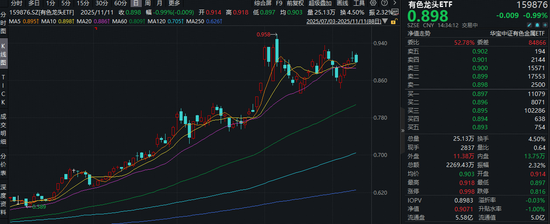
金价连涨3日!美联储官员力挺降息!国成矿业二连板,有色龙头ETF仍在所有均线上方,上行动能强劲
Xin Lang Ji Jin· 2025-11-11 07:08
Group 1: Gold Market Insights - Gold prices continue to rise, with COMEX gold reaching $4155 per ounce, marking a three-day increase [1] - The U.S. government shutdown has lasted 40 days, with President Trump indicating a potential resolution is near [1] - The Federal Reserve is expected to lower interest rates by at least 25 basis points, with a 50 basis point cut deemed appropriate [1] - The People's Bank of China has increased its gold holdings for the 12th consecutive month, supporting the macroeconomic foundation for gold prices [1] - Citic Securities identifies five categories of downward risks for gold prices, which are currently not significant [1] Group 2: Non-Ferrous Metals Sector - Analysts suggest focusing on the entire non-ferrous metals sector rather than individual metals, with positive macroeconomic expectations from U.S.-China trade talks [2] - Continuous interest rate cuts by the Federal Reserve and potential liquidity improvements are expected to benefit copper and aluminum prices [2] - The lithium sector is experiencing strong demand due to energy storage needs and anticipated purchasing tax changes for electric vehicles, leading to increased lithium prices [2] Group 3: ETF Performance and Market Trends - The non-ferrous metals ETF (159876) saw an early gain of over 1% but later adjusted to a decline of 0.99%, maintaining a strong technical position above moving averages [3] - Key stocks in the ETF include Guocheng Mining and Huayu Mining, which have shown significant gains, while companies like Zhongfu Industrial and Tianqi Lithium have faced declines [3] - The non-ferrous metals sector is characterized by varying degrees of market performance, suggesting a diversified investment approach may be beneficial [5]




瑞银:铜铝金属基本面稳中向好,上调中国宏桥(01378)目标价至28港元
智通财经网· 2025-10-10 06:11
Group 1: Industry Overview - UBS reports that the fundamentals of China's copper and aluminum metal industry are stable with a positive outlook [1] - Industrial metal prices are supported by macroeconomic factors rather than physical market supply tightness, including US interest rate cuts, a weaker dollar, confidence in aluminum trade, and potential additional stimulus measures from China [1][2] - The overall outlook for industrial metals is improving, with short-term demand slowdown risks easing and mid-term fundamentals for copper and aluminum remaining attractive [1][2] Group 2: Copper Outlook - The copper market fundamentals remain stable, with prices supported by macroeconomic factors despite reduced trade due to US tariffs in Q3 [2] - UBS expects that by 2026/2027, copper prices will rise due to limited mine supply growth, pressure on refined output, strong long-term growth drivers (electrification, technology), and a recovery in traditional demand drivers [2] - UBS raises its copper price forecasts for 2025/2026 from $4.24/lb to $4.37/lb and from $4.68/lb to $4.80/lb, translating to $9,634/ton and $10,582/ton respectively [2] Group 3: Aluminum Outlook - Aluminum demand is mixed, but supply is constrained, with limited production growth in China and elsewhere [3] - UBS raises its aluminum price forecasts for 2025/2026 from $1.11/lb to $1.17/lb and from $1.16/lb to $1.18/lb, which corresponds to $2,579/ton and $2,600/ton respectively [3] - Following the upward revision of copper, aluminum, and gold price forecasts, UBS has increased the earnings expectations and target prices for related concept stocks, including a 5% increase in earnings expectations for China Hongqiao and a 4% increase in target price to HKD 28 [3]
美联储降息,影响几何?
Sou Hu Cai Jing· 2025-09-17 07:45
Core Viewpoint - The market is increasingly discussing the potential interest rate cuts by the Federal Reserve, with significant attention on the upcoming monetary policy decision that could impact various asset classes and present investment opportunities [1][2]. Group 1: Federal Reserve Rate Cut Expectations - CICC believes there is a high probability of the Federal Reserve restarting interest rate cuts this month, with market expectations for a rate cut in September exceeding 90%, and probabilities for cuts in October and December also above 70% [3]. Group 2: Impact on Chinese Assets - The Federal Reserve's rate cut may help alleviate external constraints on China's monetary policy, allowing for a "moderately loose monetary policy" [4]. - A weaker dollar resulting from the rate cut could lead to a relative appreciation of the RMB, impacting export-oriented and overseas enterprises, while reducing repayment pressure for companies with dollar-denominated debt [4]. - The rate cut is expected to promote global capital reallocation, potentially benefiting Chinese assets as global liquidity is released [5]. Group 3: Stock Market Focus - CICC highlights several stock market sectors to watch, including foreign-invested heavy stocks, which may see marginal impacts from global capital reallocation due to the Fed's rate cut [6]. - Companies that may benefit from RMB appreciation, particularly those with significant dollar-denominated debt, are also of interest [7]. - Sectors sensitive to policy changes, such as finance and certain consumer goods, may present short-term opportunities if growth-stabilizing policies are intensified [8]. Group 4: Commodity Market Insights - CICC anticipates upward price movements for copper and aluminum, driven by macroeconomic shifts and strong domestic demand, with the Fed's rate cut potentially acting as a catalyst [10]. - The demand for copper and aluminum is expected to remain robust, with no signs of a drastic decline in demand during the peak season [11]. - In the gold market, the Fed's rate cut expectations may provide short-term support, particularly if the U.S. economy shows signs of slowing [12][14]. - For oil, CICC has adjusted its global supply surplus expectations and maintains a price range forecast of $65-$70 per barrel for Brent crude, citing various market dynamics [15].

关税冲击下,沪铜伦铜承压
Bao Cheng Qi Huo· 2025-07-14 12:46
1. Report Industry Investment Rating No relevant content provided. 2. Core Views of the Report - Copper: The US plans to impose a 50% tariff on all imported copper starting from August 1st, causing pressure on both Shanghai and London copper prices. Last week, Shanghai copper witnessed a significant decline with reduced positions and lower market attention. The market is concerned about the upcoming tariff implementation, which may lead to a closure of the US import window and a notable drop in US imports. As a result, supply in non - US regions may increase, causing the prices of London and Shanghai copper to fall. The spot premium of London and Shanghai copper decreased significantly last week, indicating a relief in the shortage of spot copper. In the short term, due to the tariff impact, copper prices have dropped to the June price center. With positive domestic macro - expectations, a general rise in commodities and the stock market, and strong industrial support, Shanghai copper may receive strong support, and the LME import loss is narrowing rapidly. Technically, both Shanghai and London copper have strong support at the June price center [3][60]. - Aluminum: Last week, aluminum prices rebounded to previous highs, and the trading volume also increased, showing strong performance in the non - ferrous metals sector. The improvement in the domestic macro - environment has largely boosted aluminum prices, as commodities and the stock market generally rose last week, especially the black metal sector. In the industry, as the prices of alumina and coal continue to rebound, the cost of electrolytic aluminum plants has increased, and the profit margin at the high level has declined. The downstream is in the off - season of consumption, and combined with the rising aluminum prices, the destocking of electrolytic aluminum has slowed down, and the inventory of aluminum rods at a low level has continued to rise, which has a certain drag on aluminum prices. With a good domestic macro - atmosphere, aluminum prices are expected to maintain a strong trend, and attention should be paid to the pressure at the previous high [4][60]. 3. Summary According to the Directory 3.1 Macro Factors - Local time on July 12th, US President Trump announced on the social media platform "Truth Social" that starting from August 1st, 2025, the US will impose a 30% tariff on products imported from Mexico and the EU [8]. 3.2 Copper 3.2.1 Volume - Price Trends - No specific text description of trends, but figures show copper futures prices, Shanghai - London ratio, 1 electrolytic copper premium/discount seasonality, Shanghai copper positions, COMEX non - commercial long net positions, etc [10][11][13][14]. 3.2.2 Continuous Decline in Copper Ore Processing Fees - Since January, copper ore processing fees have been continuously decreasing, reflecting both the tight supply of copper ore and the over - capacity of smelting. The port inventory of domestic copper ore is similar to that of the same period last year, indicating an expected tight supply of domestic ore and that the low TC is mainly due to over - capacity in smelting [24]. 3.2.3 Slowing Down of Electrolytic Copper Destocking - The destocking of domestic and overseas electrolytic copper has slowed down, as shown by the data of domestic electrolytic copper social inventory and overseas futures inventory (COMEX + LME) [28][29]. 3.2.4 Downstream Initial Segment - The monthly capacity utilization rate of copper downstream industries is presented, including copper rods, tubes, bars, and strips [31][32]. 3.3 Aluminum 3.3.1 Volume - Price Trends - No specific text description of trends, but figures show aluminum prices, Shanghai - London ratio, London aluminum premium/discount, Shanghai aluminum monthly spread, etc [33][34][38][40]. 3.3.2 Upstream Industrial Chain - Figures show the port inventory of bauxite and the price of alumina [46][49]. 3.3.3 Slowing Down of Electrolytic Aluminum Destocking - The destocking of domestic and overseas electrolytic aluminum has slowed down, as shown by the data of overseas electrolytic aluminum inventory (LME + COMEX) and domestic electrolytic aluminum social inventory [50][51]. 3.3.4 Downstream Initial Segment - The capacity utilization rate of aluminum rods, the processing fee of 6063 aluminum rods, and the inventory of 6063 aluminum rods are presented [53][57][58]. 3.4 Conclusion - The conclusion is consistent with the core views of the report, emphasizing the impact of the US copper tariff on copper prices and the influence of domestic macro - environment and industrial factors on aluminum prices [60].