供应担忧

Search documents
化工日报:地缘消息反复,PTA价格回落-20260401
Hua Tai Qi Huo· 2026-04-01 05:11
1. Report Industry Investment Rating No information provided. 2. Core View of the Report - The market focus is on the Iran situation, with rising crude oil prices due to tensions. The PXN of PX has been significantly compressed, and the supply interruption in the Middle East has pushed up the price of naphtha. However, the weak downstream polyester demand restricts the upward momentum of PX. The PTA load has decreased, and there has been inventory accumulation from March to April. But with cost support, the PTA trend is strong, and the processing fee is compressed. In the long - term, as the cycle of concentrated capacity release ends, the PTA processing fee is expected to gradually improve [1]. - The polyester operating rate is 86.8% (down 0.8% month - on - month), and the loads of polyester and weaving have decreased. The downstream price has difficulty rising, and the production and sales of filament have been continuously sluggish. The inventory of filament and staple fiber has begun to accumulate, and there is a negative feedback of production reduction. If the cost - side price remains high, the downstream production reduction may increase [2]. - For PF, the spot production profit is - 117 yuan/ton (up 14 yuan/ton month - on - month). The downstream is in a wait - and - see attitude, with moderate restocking at the stage low and less high - level transactions. The short - fiber factory's device has been started, and the load has increased. Due to weak sales, the factory inventory has increased, and the processing difference fluctuates greatly. For PR, the spot processing fee of bottle chips is 1107 yuan/ton (up 194 yuan/ton month - on - month). Affected by the situation in the Middle East and the Strait of Hormuz, the upstream raw materials have reduced production and load, and the price of polyester raw materials has risen significantly. The price of polyester bottle chip factories has mostly followed the increase. The load of polyester bottle chip devices has remained stable with a slight increase, and the further improvement space is temporarily limited. The mainstream factories have cut some contract volumes, the circulating supply is still tight, the inventory of bottle chip factories remains low, and the bottle chip factories mainly support the price [2]. - The strategy is to cautiously go long and hedge PX/PTA/PF/PR at low prices. Before seeing actual troop withdrawal or negotiations, the shipping in the Strait of Hormuz is still difficult to be smooth, and there are still cost support and supply concerns. However, there is negative feedback on the demand side, and the current trading is difficult. It is not advisable to chase up or kill down. Attention should be paid to further changes in the start - up of Japanese and Korean refineries [3]. 3. Summary According to the Directory 3.1 Price and Basis - Figures include TA main contract, basis, and inter - period spread trends; PX main contract trend, basis, and inter - period spread; PTA East China spot basis; and short - fiber 1.56D*38mm semi - bright natural white basis [7][9][14] 3.2 Upstream Profit and Spread - Figures include PX processing fee PXN (PX China CFR - naphtha Japan CFR), PTA spot processing fee, South Korean xylene isomerization profit, and South Korean STDP selective disproportionation profit [16][18] 3.3 International Spread and Import - Export Profit - Figures include toluene US - Asia spread (FOB US Gulf - FOB South Korea), toluene South Korea FOB - Japan naphtha CFR, and PTA export profit [23][25] 3.4 Upstream PX and PTA Start - up - Figures include China's PTA load, South Korea's PTA load, Taiwan's PTA load, China's PX load, and Asian PX load [26][29][31] 3.5 Social Inventory and Warehouse Receipts - Figures include PTA weekly social inventory, PX monthly social inventory, PTA total warehouse receipts + forecast volume, PTA warehouse warehouse receipt inventory, PX warehouse receipt inventory, and PF warehouse receipt inventory [37][39][40] 3.6 Downstream Polyester Load - Figures include filament production and sales, short - fiber production and sales, polyester load, direct - spinning filament load, polyester staple fiber load, polyester bottle chip load, filament DTY factory inventory days, filament FDY factory inventory days, filament POY factory inventory days, Jiangsu and Zhejiang loom operating rate, Jiangsu and Zhejiang texturing machine operating rate, Jiangsu and Zhejiang dyeing operating rate, filament FDY profit, and filament POY profit [47][49][57] 3.7 PF Detailed Data - Figures include polyester staple fiber load, polyester staple fiber factory equity inventory days, 1.4D physical inventory, 1.4D equity inventory, recycled cotton - type staple fiber load, raw - recycled spread (1.4D polyester staple - 1.4D imitation large - chemical fiber), pure polyester yarn operating rate, pure polyester yarn production profit, polyester - cotton yarn operating rate, and polyester - cotton yarn processing fee [68][75][78] 3.8 PR Fundamental Detailed Data - Figures include polyester bottle chip load, bottle chip factory bottle chip inventory days, bottle chip spot processing fee, bottle chip export processing fee, bottle chip export profit, East China water bottle chip - recycled 3A - grade white bottle chip, bottle chip next - month spread (next month - base month), and bottle chip next - next - month spread (next - next month - base month) [88][92][94]
长丝大厂减产扩大,关注实际落地
Hua Tai Qi Huo· 2026-03-26 06:30
Report Industry Investment Rating - Not provided in the content Core Viewpoints - The market focus is on the Iran situation, with rising crude oil prices due to tensions. PXN has been significantly compressed, and concerns about supply disruptions are pushing up naphtha prices, while PX's upward momentum is limited by poor downstream polyester demand. The situation's impact on PX load and inventory is expanding [1]. - PTA's cost is supported, but it's in a state of inventory accumulation. In the long - term, PTA processing fees are expected to improve after the end of the capacity expansion cycle. The polyester and weaving loads are stable, but downstream price increases are weak, and there are more voices of production cuts [2]. - PF has negative production profits, with heavy downstream wait - and - see mentality. PR's processing fees are still relatively high, and the inventory of bottle - chip factories remains low [3]. - For trading strategies, it is recommended to cautiously go long on PX/PTA/PF/PR for hedging. It is not advisable to chase up or sell down due to the complexity of the current market [4]. Summary by Directory Price and Basis - Figures show TA and PX's main contract trends, basis, and inter - period spreads, as well as PTA's East China spot basis and short - fiber basis [9][10][15] Upstream Profits and Spreads - Include PX processing fees, PTA spot processing fees, South Korean xylene isomerization profits, and South Korean STDP selective disproportionation profits [17][21] International Spreads and Import - Export Profits - Cover toluene's US - Asia spread, toluene's South Korean FOB - Japanese naphtha CFR spread, and PTA export profits [23][25] Upstream PX and PTA Start - up - Display the operating loads of PTA and PX in China, South Korea, and Taiwan [26][29][31] Social Inventory and Warehouse Receipts - Show PTA's weekly social inventory, PX's monthly social inventory, and various warehouse receipt inventories [36][38][39] Downstream Polyester Load - Include long - filament and short - fiber sales, polyester load, and various factory inventory days and operating rates in the downstream [46][48][56] PF Detailed Data - Provide information on polyester staple fiber load, inventory days, and related production data [68][77][80] PR Fundamental Detailed Data - Include polyester bottle - chip load, inventory days, processing fees, and export profits [87][89][93]
PX供应继续下降,长丝产销局部好转
Hua Tai Qi Huo· 2026-03-24 06:26
Report Industry Investment Rating No relevant information provided. Core Viewpoints of the Report - Tension in the Iran situation has led to rising crude oil prices, with the focus of the market remaining on the situation in Iran. The PXN of PX has been significantly compressed, and the supply disruption in the Middle East has continuously pushed up the price of naphtha. However, the poor downstream polyester demand has limited the upward momentum of PX. The influence of the Iran situation is gradually expanding, and the traffic volume in the Strait of Hormuz remains low. Under the concern of supply disruption, the PX spot shows a Back structure, and the floating price is relatively strong. Recently, affected by the concern about the stability of raw material supply, the PX load has decreased, and the de - stocking amplitude has increased. If the raw material supply continues to be affected, the impact on refineries in other countries will also continue to expand [1]. - For PTA, the spot basis is -73 yuan/ton (with a month - on - month change of +1 yuan/ton), the spot processing fee is 231 yuan/ton (with a month - on - month change of +37 yuan/ton), and the processing fee of the main contract on the disk is 318 yuan/ton (with a month - on - month change of +20 yuan/ton). The weaving and polyester loads are recovering, and the PTA load has decreased but the impact is smaller than that of PX. It continued to accumulate inventory in March, but the PTA trend is relatively strong under cost support, and the processing fee is compressed. Currently, the supply of goods is relatively abundant, and the spot basis is running weakly. The market is debating which has a greater impact, supply reduction or demand suppression. In the medium and long term, as the cycle of concentrated capacity release ends, the PTA processing fee is expected to gradually improve, and the long - term expectation is still good [2]. - In terms of demand, the polyester operating rate is 87.6% (with a month - on - month increase of 0.9%). The polyester and weaving loads are stable, but the downstream prices are slow to follow the increase, and the acceptance of high - priced raw materials is not high. There are more voices of production reduction. Recently, the sales of filament have been continuously sluggish, and the inventory of filament and staple fiber has accumulated rapidly. The polyester load is lower than that of the same period last year. If the downstream continues not to replenish inventory, the load may decrease [2]. - For PF, the spot production profit is -267 yuan/ton (with a month - on - month change of -310 yuan/ton). The downstream has a strong wait - and - see attitude, with moderate replenishment at periodic lows and less high - level transactions. The short - fiber factory's equipment has been started, and the load has increased. Due to the weak sales, the factory inventory has increased, and the processing difference fluctuates greatly. Attention should be paid to the recovery of traffic in the Strait of Hormuz [3]. - For PR, the spot processing fee of bottle chips is 992 yuan/ton (with a month - on - month change of -246 yuan/ton). Affected by the situation in the Middle East and the Strait of Hormuz, the upstream raw materials have experienced production cuts and load reductions, and the prices of polyester raw materials have risen significantly. The prices of polyester bottle chip factories mostly follow the increase. The operating load of polyester bottle chip equipment has increased slightly and remained stable, and the overall supply has increased slightly. However, mainstream factories have cut some contract volumes, and the circulating supply of goods is still tight. The inventory of bottle chip factories remains at a low level, and the processing fee has retreated but is still relatively high [3]. - The strategy suggests cautious bottom - fishing long - hedging for PX/PTA/PF/PR. Before seeing actual troop withdrawals or negotiations, the shipping in the Strait of Hormuz is still difficult to be smooth, and cost support and supply concerns still exist, but there is a negative feedback expectation on the demand side. Currently, the trading difficulty is relatively large, and it is not advisable to chase up or kill down. The supply affects the 5 - 9 positive spread of PX, and attention should be paid to the traffic situation in the Strait of Hormuz [4]. Summary by Directory Price and Basis - The report includes figures on the TA main contract, basis, and inter - period spread trends; PX main contract trends, basis, and inter - period spread; PTA East China spot basis; and short - fiber 1.56D*38mm semi - bright white basis, with data sources including CCF and the Huatai Futures Research Institute [8][9][14] Upstream Profits and Spreads - Figures cover PX processing fee PXN (PX China CFR - naphtha Japan CFR), PTA spot processing fee, South Korean xylene isomerization profit, and South Korean STDP selective disproportionation profit, with data sources such as CCF, Tonghuashun, and the Huatai Futures Research Institute [16][20] International Spreads and Import - Export Profits - It includes figures on the toluene US - Asia spread (FOB US Gulf - FOB South Korea), toluene South Korea FOB - Japan naphtha CFR, and PTA export profit, with data sources from Longzhong, Tonghuashun, CCF, and the Huatai Futures Research Institute [22][24] Upstream PX and PTA Start - up - Figures show the PTA load in China, South Korea, and Taiwan, as well as the PX load in China and Asia, with data sources from CCF and the Huatai Futures Research Institute [25][30] Social Inventory and Warehouse Receipts - It includes figures on PTA weekly social inventory, PX monthly social inventory, PTA total warehouse receipts + forecast volume, PTA warehouse receipt inventory, PX warehouse receipt inventory, and PF warehouse receipt inventory, with data sources from Zhuochuang Information, Tonghuashun, Longzhong, and the Huatai Futures Research Institute [35][38] Downstream Polyester Load - Figures cover the sales of filament and short - fiber, polyester load, direct - spinning filament load, polyester staple fiber load, polyester bottle chip load, filament factory inventory days, and the operating rates of Jiangsu and Zhejiang looms, texturing machines, and printing and dyeing machines, with data sources from CCF and the Huatai Futures Research Institute [45][55] PF Detailed Data - It includes figures on polyester staple fiber load, polyester staple fiber factory equity inventory days, 1.4D physical inventory, 1.4D equity inventory, recycled cotton - type staple fiber load, raw - recycled spread, pure polyester yarn operating rate, pure polyester yarn production profit, polyester - cotton yarn operating rate, polyester - cotton yarn processing fee, pure polyester yarn factory inventory available days, and polyester - cotton yarn factory inventory available days, with data sources from CCF, Tonghuashun, Longzhong, and the Huatai Futures Research Institute [67][74][83] PR Fundamental Detailed Data - Figures show the polyester bottle chip load, bottle chip factory bottle chip inventory days, bottle chip spot processing fee, bottle chip export processing fee, bottle chip export profit, East China water bottle chips - recycled 3A - grade white bottle chips, bottle chip next - month spread, and bottle chip next - next - month spread, with data sources from CCF, Tonghuashun, Longzhong, and the Huatai Futures Research Institute [86][93]
流通货源偏紧,瓶片大幅上涨
Hua Tai Qi Huo· 2026-03-17 08:15
1. Report Industry Investment Rating - No information provided 2. Core Viewpoints - On March 12, the main contracts of PR/MEG rose by 7.44% and 3.31% respectively. The domestic EG start - up rate decreased by over 10% from the end - of - February high, and the overseas EG load is also at a low level. The expected EG imports in April are reduced to around 35 - 400,000 tons, and the EG inventory inflection point may have appeared [1]. - Affected by the Iran situation, the crude oil price has risen. The PX supply problem has further intensified, with the PX load decreasing and the de - stocking amplitude increasing. The PTA load has decreased but less than PX, and it continued to accumulate inventory in March, but the PTA trend is strong under cost support [2]. - The polyester start - up rate is 86.7% (a month - on - month increase of 2.6%), and the polyester and weaving loads are recovering. However, the downstream price increase is weak, and the inventory of filament and staple fiber has begun to accumulate. The PF spot production profit is - 101 yuan/ton (a month - on - month decrease of 84 yuan/ton), and some yarn mills plan to reduce production or switch to other products. The PR spot processing fee is 1,571 yuan/ton (a month - on - month increase of 135 yuan/ton), and the short - term price increase is smooth with a strong processing fee expected [3]. - For trading strategies, it is advisable to cautiously go long and hedge PX/PTA/PF/PR at low prices. For cross - varieties, go long on the PR processing fee and pay attention to the supply recovery situation. There is no cross - period strategy [4]. 3. Summary by Directory Price and Basis - The report includes figures on the TA main contract, basis, and inter - period spread trends; PX main contract trends, basis, and inter - period spread; PTA East China spot basis; and short - fiber 1.56D*38mm semi - bright natural white basis [9][10][15] Upstream Profits and Spreads - Figures cover PX processing fee PXN, PTA spot processing fee, South Korean xylene isomerization profit, and South Korean STDP selective disproportionation profit [17][19] International Spreads and Import - Export Profits - It includes figures on the toluene US - Asia spread, toluene South Korea FOB - Japan naphtha CFR, and PTA export profit [24][26] Upstream PX and PTA Start - up - Figures show the PTA load in China, South Korea, and Taiwan, as well as the PX load in China and Asia [27][30][32] Social Inventory and Warehouse Receipts - Figures are presented for PTA weekly social inventory, PX monthly social inventory, PTA total warehouse receipts + forecast volume, PTA warehouse receipt inventory, PX warehouse receipt inventory, and PF warehouse receipt inventory [37][39][40] Downstream Polyester Load - Figures include filament sales, staple fiber sales, polyester load, direct - spinning filament load, polyester staple fiber load, polyester bottle - chip load, filament factory inventory days, and the start - up rates of Jiangsu and Zhejiang looms, texturing machines, and printing and dyeing machines [48][50][58] PF Detailed Data - Figures cover polyester staple fiber load, polyester staple fiber factory equity inventory days, 1.4D physical inventory, 1.4D equity inventory, recycled cotton - type staple fiber load, pure polyester yarn start - up rate, pure polyester yarn production profit, polyester - cotton yarn start - up rate, and polyester - cotton yarn processing fee [70][77][79] PR Fundamental Detailed Data - Figures include polyester bottle - chip load, bottle - chip factory bottle - chip inventory days, bottle - chip spot processing fee, bottle - chip export processing fee, bottle - chip export profit, the price difference between East China water bottle chips and recycled 3A - grade white bottle chips, and bottle - chip inter - month spreads [89][91][96]
供应担忧再现推升锂价
Zhong Xin Qi Huo· 2026-02-26 13:37
Report Industry Investment Rating - The report suggests a "buy-on-dips" strategy for lithium carbonate [9] Core Viewpoints - Zimbabwe's suspension of ore exports may strengthen regulatory oversight of mineral resources, and if the suspension is prolonged, it could affect China's Q2 imports and lift the price floor [7][9] - The fundamentals of lithium carbonate are relatively strong, and capital flows and sentiment significantly influence prices. In January - February, supply was resilient and demand was good, with the market in tight balance and some destocking of social inventories. After the Lunar New Year, both supply and demand recovered, and sentiment improvement added upward momentum [8][9] - In the near term, with supply - demand balance, post - holiday sentiment recovery, and the approaching peak demand season, lithium carbonate prices are expected to fluctuate with a firm bias, and it's advisable to buy on dips [9] Summary by Related Catalogs Price Movement - After the Chinese New Year holiday, lithium carbonate futures rose sharply. As of February 26, the main contract recovered to around RMB 170,000 - 180,000/t. On February 25, Zimbabwe announced an immediate suspension of exports of raw ore and lithium concentrates [5][6] Commentary and Outlook - Zimbabwe's move to suspend ore exports is likely to strengthen resource control. In 2025, China imported 1.2 million tons of lithium ore from Zimbabwe, accounting for 15.5% of total imports. In 2026, its supply is expected to reach 180 kt LCE, about 15 kt LCE per month [7][9] - In January - February, lithium resource supply was strong despite some maintenance and production cuts, and demand was good with downstream restocking. After the Lunar New Year, supply and demand both recovered, and sentiment improved [8][9]
供应担忧仍存,锡价大幅上涨
Zhong Xin Qi Huo· 2026-02-25 07:29
Report Summary 1. Report Industry Investment Rating No information provided. 2. Core View - In the short - term, with supply tightening, tin prices are expected to fluctuate strongly, with an estimated price range of 360,000 - 500,000 yuan per ton. It is recommended to focus on the low - buying and long - position strategy. - In the medium - term, if the resumption and new production in major producing areas go smoothly, tin supply and demand may ease slightly but remain in a tight - balance state, with high supply risks and high - level price fluctuations. - In the long - term, with limited growth in ore supply and strong demand, the tin price center is expected to show an upward trend [5]. 3. Summary by Relevant Catalogs Latest Dynamics and Reasons - On February 25, 2026, tin prices rose significantly. By noon, the main contract of Shanghai tin futures rose 6.09% to 4,102.07 yuan per ton. The reasons are supply concerns and positive market sentiment. - Indonesia is studying a ban on the export of various raw materials including tin in the coming years, which intensifies long - term supply concerns. - In the Democratic Republic of the Congo, the security situation in the east is severe, and local tin ore supply is at risk of disruption [3]. Fundamental Situation - The domestic tin ore supply is tight, which restricts refined tin production. As of February 13, the processing fees for 60% and 40% grade tin ores are 10,000 yuan/ton and 14,000 yuan/ton respectively, remaining at a relatively low level. - In January, domestic refined tin production was 14,382 tons, a year - on - year decrease of 2.74%. The operating rate of domestic tin smelters was 56.8%, a month - on - month decrease of 5.9 percentage points. - Recently, the visible tin inventory has increased. As of February 23, the Shanghai tin warehouse receipt inventory was 11,781 tons, and the LME tin inventory was 7,655 tons [4].
资金涌入有色板块,“金属风暴”席卷全球商品市场
Di Yi Cai Jing· 2026-01-15 02:26
Group 1: Market Overview - The global metal futures market has started 2026 strongly, with significant inflows into the non-ferrous metal sector driven by supply concerns and capital market dynamics [1] - Prices of copper and nickel have surged due to supply disruptions, with analysts indicating that the sustainability of this price increase will depend on global economic recovery and supply-demand rebalancing [1][2] Group 2: Nickel Market Dynamics - Nickel prices have reached a new high, primarily due to production cuts in Indonesia, the world's largest nickel supplier, which plans to reduce its output target from 379 million tons to 250 million tons, a decrease of 34% [2] - Despite the anticipated demand of 3.82 million tons and production of 4.09 million tons in 2026, the market is currently experiencing a supply surplus, with high inventory levels exerting long-term pressure on prices [2][3] Group 3: Copper Market Dynamics - Copper prices have also reached record highs, with a cumulative increase of over 5% since the beginning of 2026, driven by structural supply shortages and accelerating demand from sectors like electrification and data centers [4] - Events such as strikes at Canadian copper mines and delays in production at other sites have heightened concerns over copper supply [4][5] Group 4: Investment Trends - Significant capital has flowed into the non-ferrous metal sector, with various ETFs seeing substantial net inflows, indicating strong investor interest [7][8] - The domestic market has seen a historical breakthrough in the non-ferrous metal sector, with a 94.73% increase in the sector's A-share market in 2025, and many stocks doubling in value [7] Group 5: Future Outlook - Analysts suggest that macroeconomic factors, including lower-than-expected U.S. inflation data and geopolitical uncertainties, will continue to support the valuation of the non-ferrous metal sector [8] - The Chinese government's encouragement of mergers and restructuring in key industries like aluminum and copper smelting is expected to enhance industry concentration and pricing power, providing a long-term boost to the sector [8]
美元走强拖累期铜下滑,但供应担忧抑制铜价跌幅【1月13日LME收盘】
Wen Hua Cai Jing· 2026-01-14 00:56
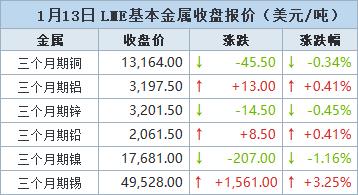
Core Viewpoint - LME copper prices declined due to a stronger US dollar, but supply concerns and speculative interest limited the drop in prices [1][4]. Group 1: Copper Market Analysis - On January 13, LME three-month copper fell by $45.5, or 0.34%, closing at $13,164.0 per ton [1][2]. - Over the past 12 months, LME copper has surged by 45%, reaching a record high of $13,387.50 last week [5]. - Concerns about supply disruptions in copper mining and expectations of a supply shortage this year have contributed to the price increase [5]. - The premium for LME spot copper over the three-month contract rose to $64 per ton, the highest in a month, compared to just $3 a week prior [5]. Group 2: Other Base Metals Performance - LME three-month aluminum increased by $13, or 0.41%, closing at $3,197.5 per ton [6]. - LME three-month zinc decreased by $14.5, or 0.45%, closing at $3,201.5 per ton [7]. - LME three-month lead rose by $8.5, or 0.41%, closing at $2,061.5 per ton [8]. - LME three-month nickel fell by $207, or 1.16%, closing at $17,681.0 per ton [9]. - LME three-month tin increased by $1,561, or 3.25%, closing at $49,528.0 per ton [10]. Group 3: Economic Indicators - The US dollar index strengthened, making dollar-denominated commodities more expensive for buyers using other currencies [4]. - The US Consumer Price Index for December rose by 2.7% year-on-year, aligning with economists' expectations and significantly above the Federal Reserve's target [3][5]. - The National Mining Association of Chile (Sonami) projected that Chile's copper production will range between 5.5 to 5.7 million tons by 2026, up from last year's estimate of 5.4 million tons [5].

能源化策略:地缘?撑油价,化??估值追?需谨慎
Zhong Xin Qi Huo· 2026-01-13 08:01
1. Report Industry Investment Rating No relevant content found. 2. Core View of the Report - The geopolitical risks continue to support crude oil prices, and the chemical industry is over - valued, so it should be treated with a volatile mindset. The industry may continue to fluctuate strongly, but it is not recommended to chase more [2][3][4]. 3. Summary by Related Catalogs 3.1 Crude Oil - **View**: Geopolitical factors continue to disrupt, and attention should be paid to risks in Iran. The supply pressure persists, but the geopolitical premium fluctuates. The price of oil will continue to fluctuate under the balance of oversupply and frequent geopolitical disruptions. Short - term focus is on the risk of price surges related to Iranian geopolitics [4][7]. - **Logic**: Expectations of increased sanctions by the US on Russia or Iran fuel supply concerns, and the situation in Iran is highly uncertain. The US - Venezuela crude oil trade may increase, and there may be a potential impact of Venezuelan sanctioned oil on the compliant oil market. Geopolitical prospects in Russia - Ukraine, Iran, and Venezuela are the core factors affecting crude oil supply expectations [7]. - **Outlook**: Volatile. Supply pressure continues, but the geopolitical premium is unstable, so it should be viewed as volatile in the short term [4][7][8]. 3.2 Asphalt - **View**: The asphalt futures price is oscillating in an over - valued range [4]. - **Logic**: OPEC+ will suspend production increases in Q1. The US is cooperating with Venezuela to receive its oil, and partial sanctions on Venezuela are lifted. This supports asphalt costs but may lead to sufficient supply in the long - term. Hainan's asphalt production has increased significantly, and the supply - demand situation is weak with inventory accumulation and reduced demand [9]. - **Outlook**: Oscillating downward. The absolute price of asphalt is over - valued, and its medium - to long - term valuation is expected to decline [9]. 3.3 High - Sulfur Fuel Oil - **View**: The price of high - sulfur fuel oil futures has declined due to the pressure from Venezuelan heavy oil [4]. - **Logic**: OPEC+ suspends production increases in Q1. Venezuela will transfer 30 - 50 million barrels of oil to the US, increasing heavy - oil supply. The demand for high - sulfur fuel oil is suppressed by high - level floating storage in the Asia - Pacific region, and its substitution by natural gas and photovoltaic energy [9]. - **Outlook**: Volatile. The expected increase in Venezuelan oil production will put long - term pressure on high - sulfur fuel oil, but short - term support comes from the US - Iran conflict [11]. 3.4 Low - Sulfur Fuel Oil - **View**: The price of low - sulfur fuel oil futures is oscillating upward [4]. - **Logic**: It follows the upward trend of crude oil. There are some supporting factors, but it also faces challenges such as reduced shipping demand, substitution by green energy, and high - sulfur fuel substitution. Its valuation is low and it is expected to follow crude oil price movements [12]. - **Outlook**: Volatile. It is affected by green fuel substitution and limited high - sulfur substitution demand, but its current low valuation means it will fluctuate with crude oil [12]. 3.5 Methanol - **View**: Methanol is expected to be stable with a weakening trend, as inventory pressure is significant and MTO demand is weak [4]. - **Logic**: The domestic supply is relatively abundant, while downstream demand is weak. Port inventory is high, and there are plans for some MTO plants to shut down, which may further weaken demand [28]. - **Outlook**: Weakening in the short term [28]. 3.6 Urea - **View**: The actual trading volume has slowed down, and urea is oscillating and consolidating [4]. - **Logic**: The supply remains at a high level of around 200,000 tons per day, while the procurement from traders and compound fertilizer factories has slowed down, resulting in a lack of trading enthusiasm [29]. - **Outlook**: Oscillating. Without a significant change in fundamentals, the market is closely related to order transactions. It may be stable with a weakening trend in the short term [29]. 3.7 Ethylene Glycol - **View**: The arrival of foreign vessels is concentrated, and inventory tank capacity is tight [4]. - **Logic**: The recent arrival of a large number of vessels has led to a significant increase in inventory, causing the spot basis to weaken and reducing traders' willingness to hold goods [20][22]. - **Outlook**: The price will be range - bound in the short term, and the long - term inventory pressure is still large, so the rebound height is limited [22]. 3.8 PX - **View**: The loosening of polyester demand exerts pressure on upstream raw materials [4]. - **Logic**: International oil prices are rising, and naphtha prices are increasing due to cost factors. Although PTA demand provides some support, the supply from domestic and foreign PX plants is increasing. The short - term PX profit is adjusting downward from a high level [13]. - **Outlook**: The PX price is expected to be range - bound in the short term, and attention should be paid to the support around 7000 - 7100 yuan/ton. The profit decline is limited [13]. 3.9 PTA - **View**: There are concentrated reports of polyester production cuts, putting pressure on the basis and processing fees [4]. - **Logic**: The upstream cost still provides some support, and the PTA supply - demand situation is currently stable. However, the concentrated production cuts in the downstream polyester industry may lead to a weaker basis and limited processing fee space [14]. - **Outlook**: The price will fluctuate with costs. In the medium term, consider going long on the TA05 contract on dips, and short - term shorting in the 5200 - 5300 yuan/ton range. Look for positive spreads on TA05 - 09 on dips [15]. 3.10 Short - Fiber - **View**: The price fluctuation has narrowed, and the sales are stable [4]. - **Logic**: The cost of upstream polyester raw materials has slightly declined, and the short - fiber price is range - bound. The downstream sales have improved slightly, and the market demand is stable [23][24]. - **Outlook**: The short - fiber price will follow the movement of upstream raw materials, and the processing fee is under some pressure [24]. 3.11 Bottle Chip - **View**: More plants are under maintenance in January, and profit support is strengthening [4]. - **Logic**: The price of upstream raw materials has slightly declined, and the bottle - chip market price has followed the cost movement. The market trading atmosphere is average, and the profit is expected to recover. The inventory is expected to decline smoothly before the festival, and the processing fee has stronger support [25]. - **Outlook**: The absolute price will fluctuate with raw materials, and the processing fee has stronger support at the bottom [25]. 3.12 Styrene - **View**: Driven by exports and a positive market atmosphere, styrene has been oscillating strongly recently [4]. - **Logic**: Exports are good, with confirmed exports of 48,000 tons in January and 12,000 tons in February. Port inventory has decreased, and market sentiment is positive. Macro and crude oil factors are also positive. The supply - demand situation is favorable in January, but there may be a risk of price correction if there is an unexpected increase in supply [18]. - **Outlook**: If there is no significant increase in supply or major negative news from crude oil, it will remain oscillating strongly in the short term, driven by repeated export news [18]. 3.13 PVC - **View**: There is a short - term "rush to export", which supports PVC [4]. - **Logic**: The export tax rebate for PVC will be cancelled on April 1st, leading to a short - term "rush to export". However, the long - term inventory pressure is large. Domestically, supply elasticity has increased, while overseas, the US Olin VCM plant has restarted. Downstream demand is seasonally weak, and the sustainability of "rush to export" orders is uncertain [37]. - **Outlook**: The short - term "rush to export" supports the price, but the long - term price may face pressure due to the possible poor sustainability of exports and high inventory [38]. 3.14 Caustic Soda - **View**: It has a low valuation and weak expectations, and is operating weakly [4]. - **Logic**: The production remains high, and inventory pressure is large. Demand from the alumina industry is weak, and non - aluminum downstream demand is also poor. Although the price of liquid chlorine limits the decline of caustic soda, the overall supply - demand situation is under pressure [39]. - **Outlook**: The supply - demand situation remains under pressure, and the price is expected to be weakly oscillating, with the decline limited by liquid chlorine [39]. 3.15 LLDPE - **View**: Driven by a positive macro sentiment, LLDPE is oscillating upward [33]. - **Logic**: Oil prices are oscillating, and geopolitical factors continue to affect supply expectations. The futures price has rebounded slightly due to macro expectations and positive market sentiment, but the profit of various production methods has slightly recovered, and the downstream demand is in the off - season [33]. - **Outlook**: Volatile in the short term [33]. 3.16 PP - **View**: Boosted by the macro environment but with reduced downstream trading volume, PP is oscillating upward [34]. - **Logic**: Oil prices are oscillating, and geopolitical factors affect supply expectations. The macro environment is positive for PP, but the downstream is in the off - season, and the trading volume has decreased after the price rebound. The short - term maintenance rate has slightly decreased [34]. - **Outlook**: Volatile in the short term [34]. 3.17 PL - **View**: Some downstream plants have restarted, and PL is oscillating upward [35]. - **Logic**: PDH maintenance expectations provide support. Propylene enterprise inventory is controllable, and downstream demand has increased slightly. However, the demand is still limited in the off - season [35]. - **Outlook**: Volatile in the short term [35]. 3.18 Indexes - **Comprehensive Index**: The commodity index, the commodity 20 index, the industrial products index, and the PPI commodity index all showed an upward trend on January 12, 2026, with increases of 1.57%, 1.85%, 1.27%, and 1.31% respectively [287]. - **Energy Index**: On January 12, 2026, the energy index was 1102.68, with a daily increase of 0.36%, a 5 - day increase of 1.45%, a 1 - month increase of 0.52%, and a year - to - date increase of 1.48% [288].
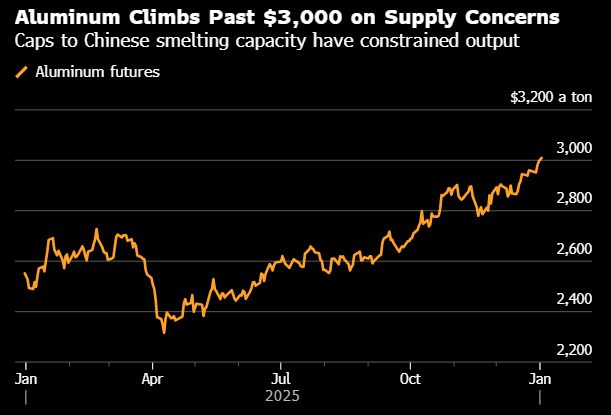
供应担忧致铝价自 2022 年以来首次站上 3000 美元关口
Xin Lang Cai Jing· 2026-01-02 10:39
Core Viewpoint - Aluminum prices have surpassed $3,000 per ton, reaching a three-year high, driven by tightening supply outlook and optimistic long-term demand expectations [1] Group 1: Aluminum Market - The increase in aluminum prices is attributed to China's control over electrolytic aluminum production and high electricity prices in Europe, which are limiting local production and continuously reducing global inventories [1] - The demand outlook from the construction and renewable energy sectors remains strong, contributing to the bullish sentiment in the aluminum market [1] - Aluminum futures have seen a cumulative increase of 17% in 2025, marking the highest rise since 2021 [1] Group 2: Other Metals - Copper prices have recorded the largest annual increase since 2009 due to supply shortages, with a slight rise of 0.5% to $12,487.00 per ton [1] - Nickel prices surged by 1.2% to $16,845.00 per ton, influenced by the delay in mining operations approval for Indonesia's Vale, which has halted mining activities [1] - Iron ore futures in Singapore rose by 0.3% to $105.65 per ton [1]