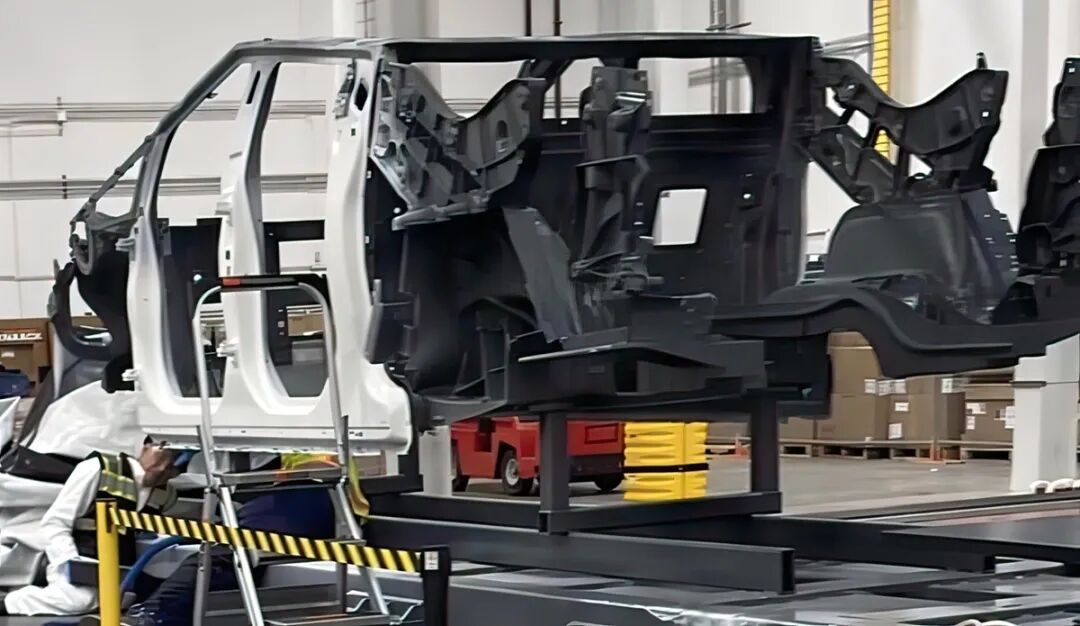
人形机器人(Optimus)

Search documents
马斯克2026最新访谈:未来3-7年,一场“超音速海啸”变革将至
Sou Hu Cai Jing· 2026-01-20 15:48
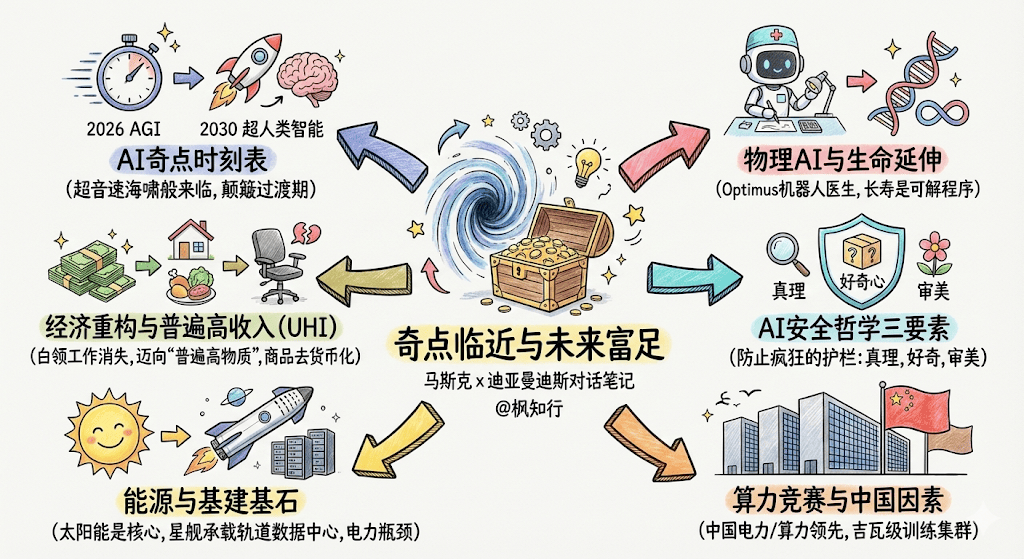
Core Insights - Elon Musk predicts that humanity is currently at a "singularity" moment, transitioning from a scarcity economy to an abundance economy over the next 3-7 years [3][4][16] - Musk emphasizes the importance of AI and robotics as a "supersonic tidal wave" that will drastically change the landscape of work and society [4][9] - The conversation highlights a shift in Musk's perspective on AI safety, advocating for core values of truth, curiosity, and aesthetics to guide AI development [8][93] AI and Robotics - Musk believes that by 2026, general artificial intelligence (AGI) will be achieved, which is a more aggressive timeline than most experts predict [4][6][90] - By 2030, the total intelligence of AI is expected to surpass that of all humanity combined [5][21][92] - The transition period will be turbulent, with many white-collar jobs being replaced by AI, particularly those that do not involve physical tasks [9][10][12] Economic Paradigm Shift - Musk introduces the concept of "Universal High Stuff" as a solution for a future where jobs may disappear, contrasting it with the traditional idea of universal basic income (UBI) [16][87] - As labor and intelligence costs approach zero, the prices of goods will drop significantly, leading to a potential economic transformation [17][18][21] - The future wealth gap may shift from basic survival needs to ownership of scarce resources [21][22] Energy and Infrastructure - Musk identifies electricity supply as the new physical bottleneck for AI development, rather than chip production [22][23][98] - The concept of "orbital data centers" is proposed to leverage solar energy in space, which could provide a sustainable solution for high-energy AI computations [25][26][29][72] - Musk predicts that China will surpass the U.S. in AI capabilities due to its superior energy output and solar infrastructure [30][31][98] Healthcare and Robotics - Musk forecasts that humanoid robots will surpass human surgeons in precision and knowledge within 3-5 years [32][94] - The cost of medical services is expected to decrease significantly as robotics and AI take over surgical tasks, making high-quality healthcare accessible to all [33][35][94] Future Timeline - A timeline of key predictions includes: - 2025: Launch of Starship V3 and Colossus 2 supercomputing cluster [37] - 2026: Birth of AGI [90] - 2030: AI intelligence surpasses that of humanity [5][21] - 2030s: Deployment of orbital data centers and emergence of a society characterized by abundance [37]

1万亿美元的工资?马斯克“万亿美元薪酬方案”获批,但条件吓死个人了
Sou Hu Cai Jing· 2025-11-08 12:14
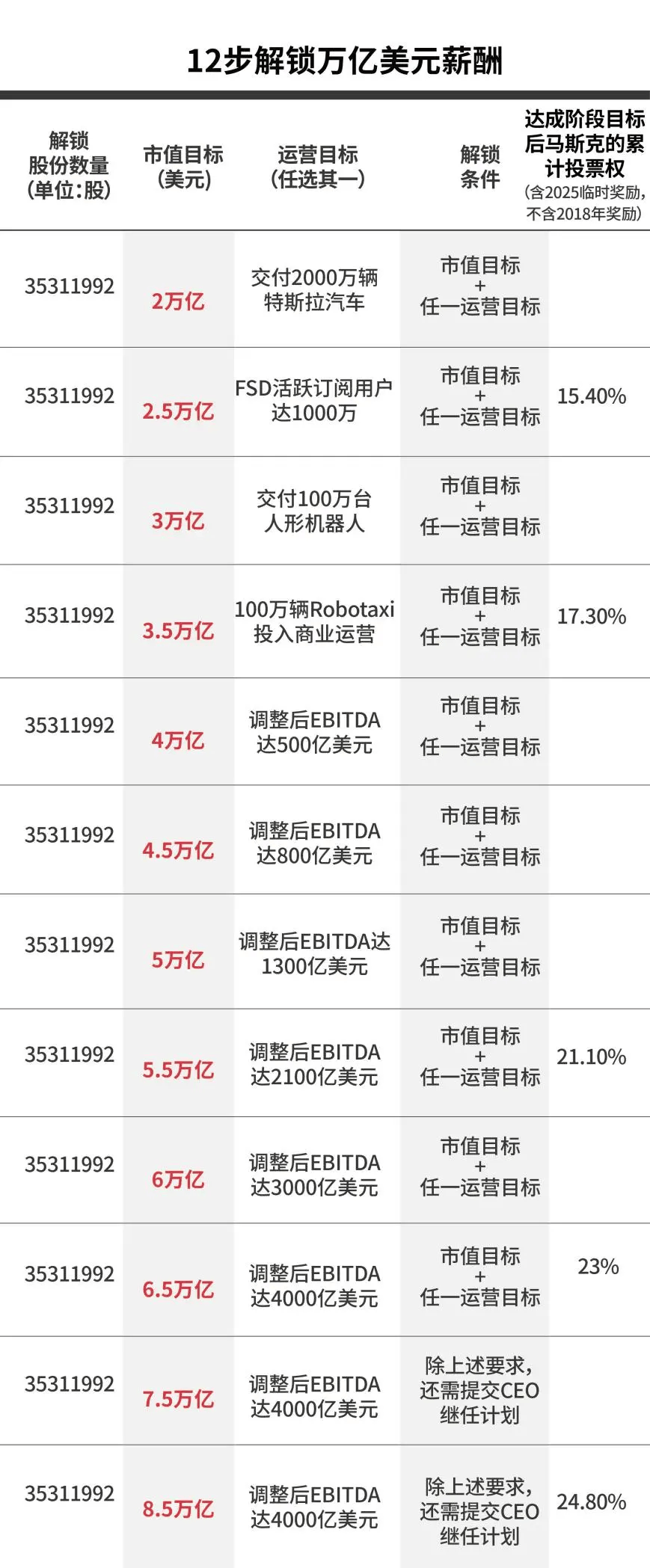
Core Viewpoint - Tesla shareholders approved Elon Musk's $1 trillion compensation plan with over 75% support, paving the way for Musk to potentially become the world's first trillionaire [1][2] Compensation Plan Details - The compensation plan includes a ten-year performance-based agreement where Musk can earn up to 423.7 million restricted stock units, representing approximately 12% of the company's adjusted total shares [3][5] - The plan is structured around 12 performance milestones that must be achieved, divided into market capitalization thresholds and operational milestones [3][7] Market Capitalization Goals - The first phase requires Tesla's market capitalization to increase from approximately $1.5 trillion to $2 trillion, with subsequent phases increasing by $500 billion until reaching $8.5 trillion [6][9] - Achieving the final market cap of $8.5 trillion represents a 470% increase from the current valuation, necessitating a compound annual growth rate of 19% [7][9] Operational Milestones - Operational targets include delivering 20 million Tesla vehicles, achieving 10 million active Full Self-Driving (FSD) subscriptions, delivering 1 million humanoid robots, and deploying 1 million Robotaxis into commercial operation [6][7] - The plan also stipulates that Tesla's annual adjusted EBITDA must reach $400 billion, with specific quarterly performance requirements for the last three targets [7][9] Shareholder Sentiment - The approval of the compensation plan reflects a divided sentiment among retail investors, with some viewing it as a necessary recognition of Musk's contributions to Tesla's success [3][4] - A personal investor indicated that their decision to hold shares is directly tied to Musk's continued leadership, emphasizing the importance of his role in Tesla's future [4]

南财快评|马斯克获“万亿薪酬”,是市场在为创新下注
2 1 Shi Ji Jing Ji Bao Dao· 2025-11-07 08:25
Core Viewpoint - Tesla's unprecedented $1 trillion compensation plan for Elon Musk represents a radical experiment in governance for innovative companies, aiming for a significant increase in market value and profit through transformative business models and technological advancements [1][4]. Group 1: Compensation Plan Details - The ten-year performance-based agreement requires Tesla's market value to rise from $1.1 trillion to $8.5 trillion and annual profits to reach $400 billion, necessitating breakthroughs in four core areas: automotive, Full Self-Driving (FSD), Robotaxi, and humanoid robots [1]. - Achieving the $400 billion profit target is deemed nearly impossible through traditional vehicle sales alone, as even reaching 20 million cumulative deliveries at a 5% net profit margin would fall short [1][2]. Group 2: Business Model Transformation - To meet these ambitious goals, Tesla must fundamentally shift its business model from selling products to providing services, creating a sustainable revenue stream akin to "Apple on wheels" [2]. - The interconnected nature of Tesla's four goals forms a reinforcing ecosystem, where each vehicle acts as a data collection node, enhancing the value of FSD technology and contributing to the development of Robotaxi and humanoid robots [2]. Group 3: Competitive Advantage - Tesla's true competitive advantage lies in its extensive real-world driving data network, having collected over 10 billion miles of autonomous driving data, which is significantly greater than its competitors [2]. - The exponential difference in data volume is expected to translate into superior algorithm performance, potentially enabling Tesla to achieve significant advancements [2]. Group 4: Challenges and Market Dynamics - The compensation plan's success hinges on Tesla's ability to simultaneously expand production, innovate core technologies, and increase profits, which presents inherent contradictions in traditional industry logic [3]. - China is identified as a crucial factor in overcoming these challenges, being the largest market for new energy vehicles and possessing a complete supply chain, with Tesla's Shanghai factory serving as its most efficient production base [3]. Group 5: Entrepreneurial Spirit and Market Perception - The $1 trillion compensation plan reflects the market's valuation of "super entrepreneurial spirit," recognizing that visionary entrepreneurs like Musk redefine industry boundaries and drive significant change [4]. - The plan illustrates society's willingness to invest in those who challenge conventional limits, as the potential success of such entrepreneurs could benefit humanity as a whole [4]. Group 6: Implications for Chinese Enterprises - Tesla's compensation strategy offers valuable insights for Chinese companies, particularly in balancing innovation with risk while maintaining entrepreneurial spirit within corporate governance [5]. - Regardless of its outcome, Musk's compensation plan is a milestone in business history, exploring how incentive design can drive industry transformation and influence the evolution of global innovation sectors [5].
马斯克获“万亿薪酬”,是市场在为创新下注
2 1 Shi Ji Jing Ji Bao Dao· 2025-11-07 08:17
Core Insights - Musk's trillion-dollar compensation plan represents a milestone in business history, serving as an experiment in innovative corporate governance and a potential paradigm shift in the industry [1][5] - The plan requires Tesla to achieve a market value increase from $1.1 trillion to $8.5 trillion and an annual profit of $400 billion, alongside breakthroughs in four core business areas: automotive, FSD, Robotaxi, and humanoid robots [1][2] Group 1: Compensation Plan Details - The ten-year performance-based agreement is not merely a salary incentive but a blueprint for value creation and valuation logic in the digital economy [1] - Achieving the $400 billion annual profit target is unlikely through traditional vehicle sales alone, necessitating a fundamental shift in Tesla's business model [2] Group 2: Business Model Transformation - Tesla must transition from selling products to providing services, creating a sustainable revenue model akin to "Apple on wheels" [2] - The four targeted areas form an interdependent ecosystem, where each Tesla vehicle acts as a data collection node, enhancing the overall value through technology and data reuse [2] Group 3: Competitive Advantage - Tesla's competitive edge lies in its extensive real-world driving data network, having collected over 10 billion miles of autonomous driving data, which is significantly more than its competitors [2] - The exponential difference in data volume is expected to translate into superior algorithm performance, potentially enabling Tesla to achieve significant advancements [2] Group 4: Challenges and Opportunities - The agreement poses a daunting challenge for Tesla to simultaneously expand production, innovate core technologies, and increase profits, which traditionally conflict with one another [3] - China is identified as a crucial factor in overcoming these challenges, being the largest market for new energy vehicles and possessing a complete supply chain [3] Group 5: Entrepreneurial Spirit and Market Valuation - The compensation plan reflects the market's pricing experiment for "super entrepreneur spirit," recognizing the unique vision and risk tolerance of founder-type entrepreneurs like Musk [4] - At least 50% of Tesla's trillion-dollar market value is attributed to the "Musk premium," indicating that the market is betting on the potential for transformative change rather than current performance [4] Group 6: Implications for Chinese Enterprises - Tesla's compensation scheme offers valuable insights for Chinese companies on balancing innovation and risk while maintaining entrepreneurial spirit within corporate governance [5] - The plan raises questions about how innovative companies can design incentive mechanisms that promote industry revolutions and long-term value creation [5]
日进2亿美元?马斯克天价薪酬如何影响特斯拉?
Huan Qiu Wang Zi Xun· 2025-11-07 06:40
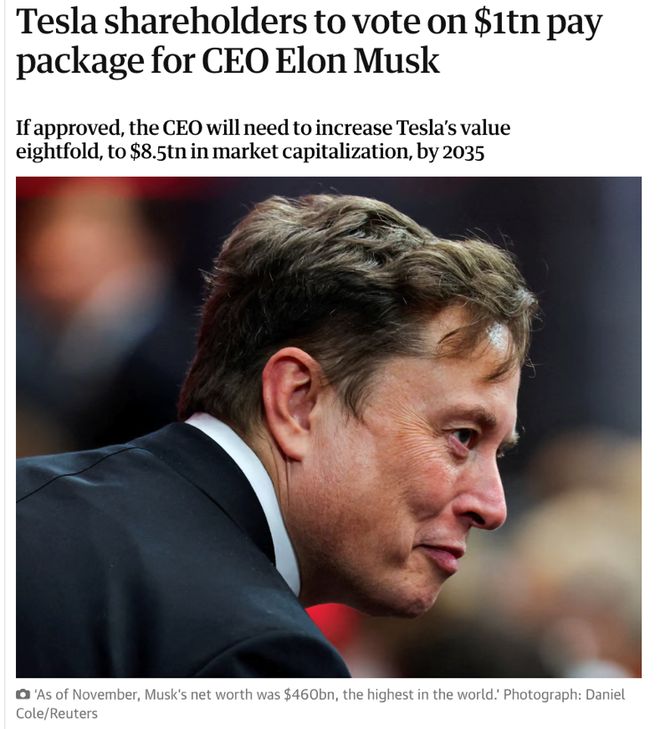
Core Points - The Tesla annual shareholder meeting on November 6 approved Elon Musk's 2025 compensation plan, allowing him to earn up to $1 trillion if he meets specific operational goals, despite opposition from entities like the Norwegian sovereign wealth fund [1][9][13] - This approval reflects shareholders' confidence in Musk's leadership as Tesla transitions into an era dominated by artificial intelligence and robotics, highlighting a preference for founder-driven leadership over institutional constraints [1][9][15] Summary by Sections 2018 Compensation Plan Context - The 2018 compensation plan for Musk was a ten-year performance-based stock option scheme, which was initially approved by shareholders but later overturned by a Delaware court due to concerns over the board's independence and information disclosure [5][6] - The court ruled that the process lacked fairness and transparency, leading to the plan's invalidation [6] 2025 Compensation Plan Details - The new 2025 compensation plan emphasizes stock options over cash, with 12 performance milestones tied to market value and operational achievements, potentially granting Musk 12% of Tesla's shares, valued at approximately $1 trillion [13][14] - Key operational targets include delivering 20 million electric vehicles, deploying 1 million robotaxis, and achieving $400 billion in profit over four consecutive quarters [13][14] Shareholder Reactions and Concerns - While supporters argue that the plan aligns Musk's incentives with long-term company performance, critics express concerns about the potential dilution of shares and the concentration of power in Musk's hands [10][14] - The plan's approval is seen as a commitment to Tesla's future in AI and robotics, reducing uncertainty about the company's strategic direction [15] Governance and Future Implications - The shareholder vote is viewed as a significant moment in corporate governance, balancing the need for founder leadership with the necessity of institutional checks [15] - The outcome suggests that if the plan had been rejected, it could have jeopardized Musk's continued leadership and the execution of Tesla's long-term strategy [15]
北美观察丨日进2亿美元?马斯克天价薪酬如何影响特斯拉?
Yang Shi Xin Wen· 2025-11-07 06:18
Core Points - The Tesla annual shareholder meeting on November 6 approved Elon Musk's 2025 compensation plan, allowing him to earn up to $1 trillion if he meets specific operational goals [1][7][15] - The approval reflects shareholders' confidence in Musk's leadership as Tesla transitions into an era dominated by artificial intelligence and robotics [1][7] - The plan is a response to the Delaware court's annulment of Musk's 2018 compensation package, which was deemed unfair due to lack of independent oversight [4][5] Summary by Sections Compensation Plan Details - The new compensation plan emphasizes stock options over cash, with a total of approximately 423.7 million shares available, unlocked in 12 tiers based on achieving market and operational milestones [13][14] - If all performance targets are met, Musk could receive 12% of the company, valued at around $1.02 trillion, although the actual value after costs may be about $878 billion [14] Historical Context - The 2018 compensation plan was initially approved by shareholders but was later overturned by a court ruling that found the process lacked fairness and transparency [4][5] - The court's decision highlighted that the 2018 vote was not "clean," as it did not adequately separate interested parties from those without a stake in the outcome [5] Shareholder Perspectives - Supporters of the new plan argue it aligns Musk's incentives with long-term company performance, particularly in areas like full self-driving technology and robotics [7][15] - Critics, including the Norwegian sovereign wealth fund and advisory firms, raised concerns about the potential for significant dilution of shares and the concentration of power in Musk's hands [8][12] Future Implications - The approval of the compensation plan is seen as a commitment to Musk's vision for Tesla's future, reducing uncertainty about the company's strategic direction [15] - The board views this as a necessary step to ensure Musk remains at the helm during critical developments in AI and robotics [15][18]
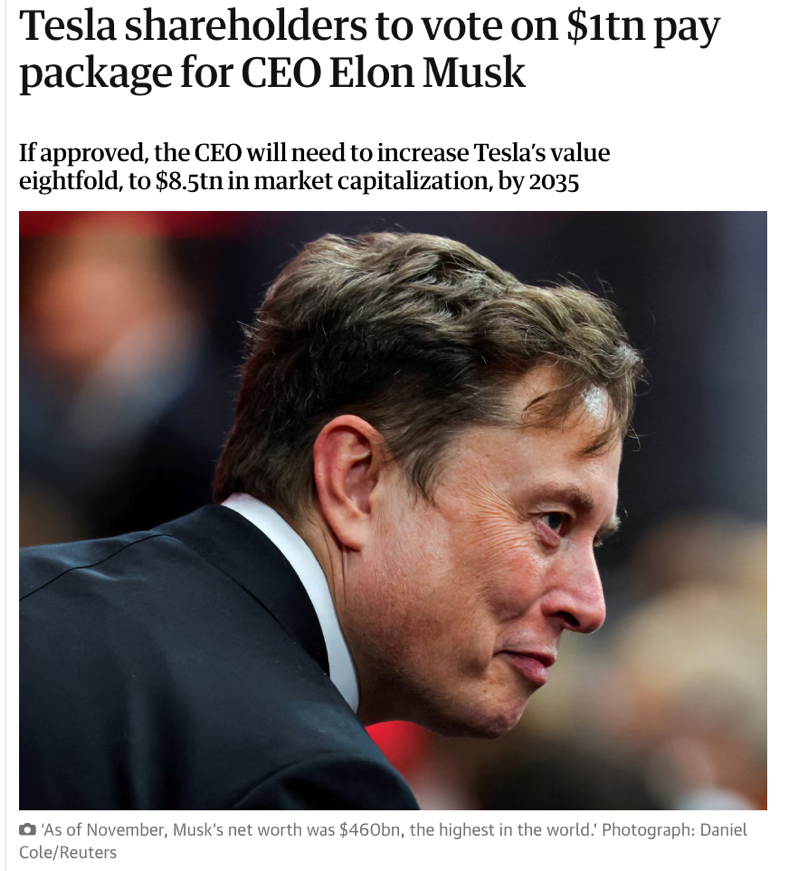
现场爆发热烈欢呼,马斯克“万亿美元薪酬方案”获批,超7成特斯拉股东支持!美联储降息大消息,美股全线下跌
Mei Ri Jing Ji Xin Wen· 2025-11-07 01:28
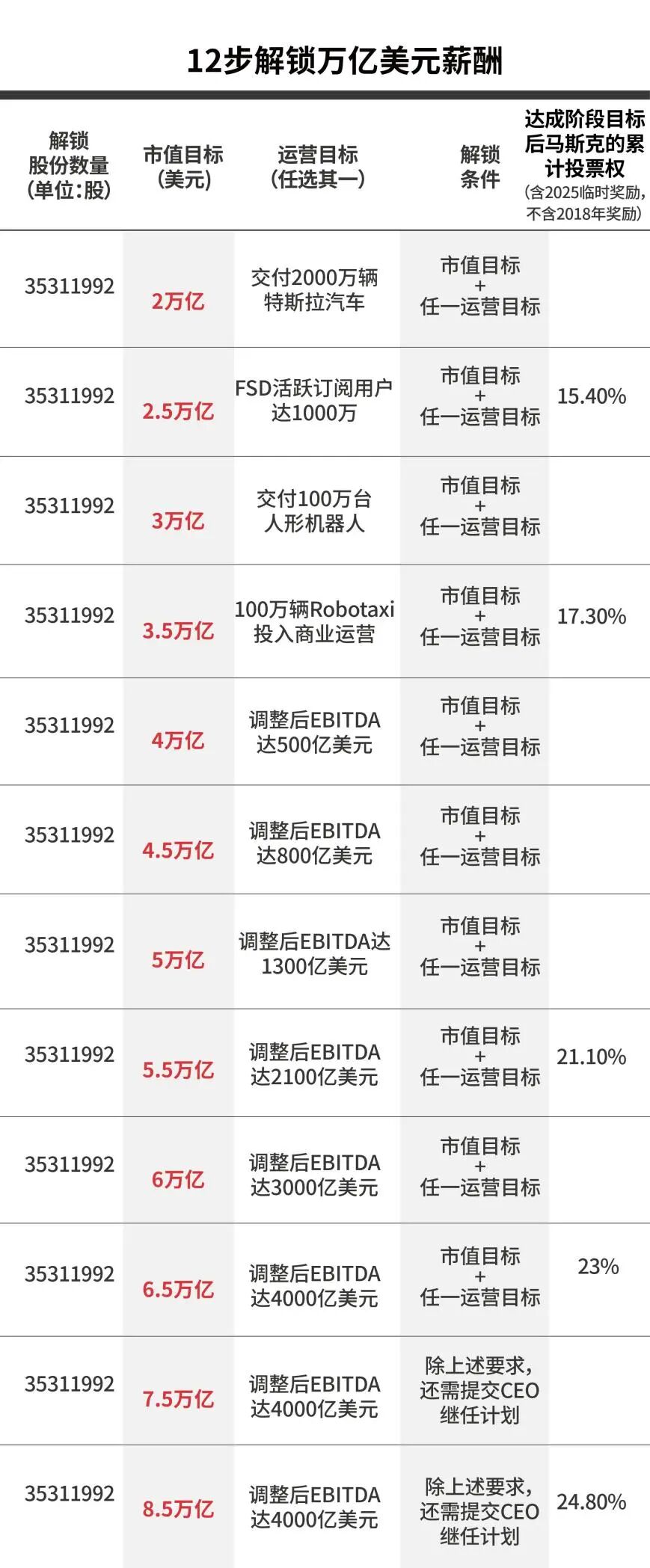
Core Viewpoint - Tesla shareholders approved Elon Musk's $1 trillion compensation plan with over 75% support, leading to a 1.69% increase in Tesla's stock price post-announcement [1] Group 1: Compensation Plan Details - The compensation plan is structured as a 10-year performance-based agreement, granting Musk up to 423.7 million restricted stock units, approximately 12% of the adjusted total shares [3][4] - To unlock these shares, Musk must meet 12 sets of escalating performance targets, categorized into market capitalization thresholds and operational milestones [3][7] Group 2: Performance Targets - The first phase requires Tesla's market capitalization to increase from approximately $1.5 trillion to $2 trillion, with subsequent phases increasing by $500 billion until reaching $6.5 trillion, and then $1 trillion increments up to $8.5 trillion [6][9] - Operational milestones include delivering 20 million vehicles, achieving 10 million active Full Self-Driving (FSD) subscriptions, delivering 1 million humanoid robots, and deploying 1 million Robotaxis in commercial operation [7][9] Group 3: Investor Sentiment - Retail investors show divided opinions; some view the compensation plan as recognition of Musk's contributions and essential for Tesla's future, while others express concerns about the potential impact of Musk's departure on their investments [3][1] - Morgan Stanley warned that a rejection of the compensation plan could be interpreted as a "vote of no confidence" in Musk, potentially leading to a stock sell-off and a decline of over 10% in Tesla's share price [2]
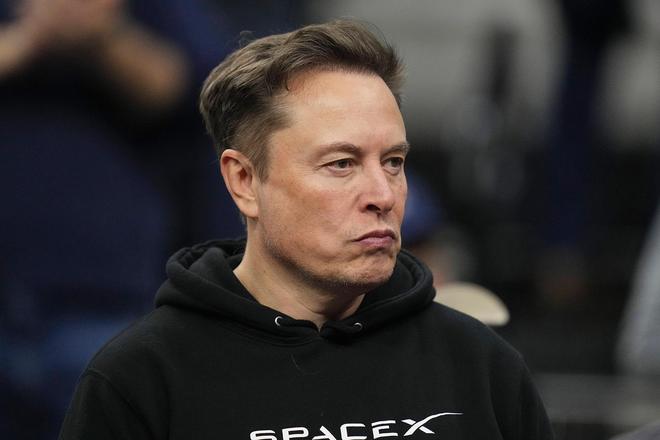
决定特斯拉命运的投票!马斯克“万亿美元薪酬方案”引股东论战,散户喊“他离职我清仓”,有机构斥其“为权力付费”
Mei Ri Jing Ji Xin Wen· 2025-11-06 11:32
Core Viewpoint - The focus of Tesla's annual shareholder meeting is a controversial compensation plan for Elon Musk, potentially worth up to $1 trillion in stock incentives, facing significant opposition from institutional investors and some retail shareholders [1][2][4]. Institutional Investor Opposition - Norges Bank Investment Management, the world's largest sovereign wealth fund, has publicly stated its opposition to Musk's compensation plan, citing concerns over its scale, dilution risk, and reliance on key personnel [2]. - Calpers, the largest public pension fund in the U.S., also criticized the plan for being excessively high compared to peers and for concentrating power [2]. - Thomas DiNapoli, New York State Comptroller, labeled the proposal as "paying for power rather than performance" and urged shareholders to oppose the re-election of all directors seeking reappointment [4]. Retail Investor Sentiment - Retail investors are divided; some view the compensation plan as essential for retaining Musk, while others express strong discontent, linking their investment decisions to Musk's actions and statements [5][6]. - A retail investor holding 4,000 shares indicated that Musk's departure would lead to a complete sell-off of their holdings, emphasizing Musk's critical role in Tesla's success [5]. - Conversely, another long-term investor criticized Musk's behavior, arguing it has damaged Tesla's reputation and sales potential, advocating for a change in leadership [6]. Board and Musk's Defense - Tesla's board has launched a public relations campaign to support Musk's compensation plan, emphasizing his irreplaceable role in the company's future [7]. - Musk has personally engaged in defending the proposal, labeling critics as "corporate terrorists" and suggesting that the vote outcome could impact the future of civilization [9]. - Despite significant opposition from major institutional investors, market predictions indicate a high probability (96%) of the proposal's approval [9][11]. Compensation Plan Details - The compensation plan involves granting Musk up to 423.7 million restricted stock units, contingent on achieving specific market capitalization and operational milestones over a ten-year period [16][21]. - The first milestone requires Tesla's market value to increase from approximately $1.5 trillion to $2 trillion, with subsequent phases increasing the target by $500 billion, ultimately aiming for $8.5 trillion [21][22]. - Operational goals include delivering 20 million vehicles, achieving 10 million active FSD subscriptions, and launching 1 million Robotaxi units into commercial operation [23].
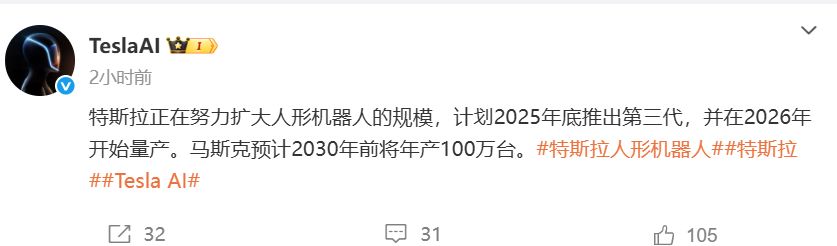
特斯拉宣布:第三代人形机器人明年量产!马斯克预计2030年前将年产100万台
Mei Ri Jing Ji Xin Wen· 2025-09-30 08:42
Group 1: Tesla's Robot Development - Tesla is working to scale up its humanoid robot production, aiming to launch the third generation by the end of 2025 and start mass production in 2026, with a target of producing 1 million units annually by 2030 [1] Group 2: Executive Compensation Plan - Tesla's board has proposed a new compensation plan for CEO Elon Musk, potentially worth around $1 trillion, marking the largest executive compensation plan in U.S. corporate history [3][4] - The plan is a ten-year "performance-based" agreement, granting Musk up to 423.7 million restricted stock units, approximately 12% of the company's adjusted total shares, to be released in 12 tranches [4][10] Group 3: Performance Targets - The 12 performance targets are divided into two categories: market capitalization thresholds and operational milestones [5] - The first phase requires Tesla's market capitalization to increase from approximately $1.1 trillion to $2 trillion, with subsequent phases increasing by $500 billion until reaching $6.5 trillion, and then by $1 trillion for the final two phases, targeting a total of $8.5 trillion [10] - Operational milestones include delivering 20 million Tesla vehicles, achieving 10 million active Full Self-Driving (FSD) subscriptions, delivering 1 million humanoid robots, and deploying 1 million Robotaxis for commercial operation [10]

从造车迈向“造人”,特斯拉下一个十年大计出炉
3 6 Ke· 2025-09-30 01:21
Core Insights - The article discusses Tesla's ambitious plans, including a $1 trillion compensation incentive for CEO Elon Musk, aimed at transforming the company's market value of $8.5 trillion [12][14][18] - The production and delivery of the Cybertruck have faced significant delays and challenges, with only 46,000 units delivered by mid-2023 despite a target of 2 million pre-orders [1][3] - Tesla's shift towards artificial intelligence and robotics, particularly with projects like Cybercab and Optimus, indicates a strategic pivot away from traditional vehicle manufacturing [19][23][28] Group 1: Compensation Plan - Tesla's board has approved an unprecedented 10-year compensation plan for Musk, potentially worth $1 trillion if all performance milestones are met [12][14] - The plan includes 12 market value targets starting at $2 trillion, operational goals such as delivering 20 million vehicles, and profitability targets based on EBITDA [16][18] - A minimum market value threshold of $2 trillion must be achieved for Musk to receive any compensation, ensuring alignment with Tesla's long-term growth [18][19] Group 2: Production Challenges - The Cybertruck's final production model has deviated from its original design, returning to traditional structures due to production limitations and battery supply issues [3][5] - The Semi Truck has also faced delays, reducing its potential impact in the commercial vehicle market [5][6] - Tesla's overall vehicle production has entered a plateau phase, with a significant drop in sales across various markets [36][39] Group 3: Strategic Shift - Tesla is increasingly positioning itself as a provider of AI and robotics solutions, moving beyond its core automotive business [19][23][28] - The company aims to integrate AI into its existing product lines, with a focus on sustainable development and innovation [28][30] - The Shanghai Gigafactory is expected to play a crucial role in Tesla's future operations, particularly in the Asia-Pacific market [39][40]