
企业级固态硬盘(SSD)

Search documents
三星电子第四季度营业利润创新高,年度营业利润首次被SK海力士超越
Xin Lang Cai Jing· 2026-01-28 23:45
Core Viewpoint - Samsung Electronics reported record operating profit and sales in Q4 2025, driven by strong sales of high-end semiconductor products, including High Bandwidth Memory (HBM), amid the global growth of artificial intelligence (AI) [1][7]. Group 1: Financial Performance - The operating profit for Q4 2025 reached 20.07 trillion KRW (approximately 13.9 billion USD), compared to 6.49 trillion KRW in the same period last year, marking a significant increase [1][7]. - Revenue for the same quarter grew by 23.8% year-on-year, totaling 93.83 trillion KRW [1][7]. - The net profit for Q4 2025 was 19.64 trillion KRW, reflecting a 153.3% increase compared to Q4 2024 [2][8]. Group 2: Business Segments - The Device Solutions (DS) division, responsible for chips, achieved an operating profit of 16.4 trillion KRW in Q4 2025, a record high, significantly up from 2.9 trillion KRW in the previous year, driven by strong sales of general DRAM and HBM products [2][8]. - The Device Experience (DX) division, which includes mobile and TV businesses, reported an operating profit of 1.3 trillion KRW in Q4 2025 [3][9]. - Specifically, the mobile business generated an operating profit of 1.9 trillion KRW, down from 2.1 trillion KRW in the same quarter last year, while the home appliance segment incurred an operating loss of 600 billion KRW, compared to a profit of 2 trillion KRW in Q4 2024, primarily due to global tariff issues [4][10]. Group 3: Annual Performance - For the full year 2025, Samsung Electronics reported a net profit of 45.2 trillion KRW, representing a year-on-year growth of 31.2% [5][11]. - The annual operating profit was 43.6 trillion KRW, up 33.2% year-on-year, with total sales increasing by 10.9% to 333.6 trillion KRW [6][12]. - This marked the first time Samsung's annual operating profit fell below that of SK Hynix, which reported an operating profit of 47.2 trillion KRW for the previous year [6][12].
5个月涨10倍!“U盘牛夫人”变身“AI小甜甜”
华尔街见闻· 2026-01-25 10:49
Core Viewpoint - SanDisk has transformed from a struggling legacy storage card company to the best-performing stock in the S&P 500, achieving nearly 1000% returns in a short period due to a surge in AI applications and the resulting demand for storage chips [2][5][6]. Group 1: Market Dynamics - The dramatic shift in SanDisk's fortunes is attributed to a bottleneck in computing power driven by the surge in AI applications, leading to a reassessment of storage chip demand [5][10]. - Since September, the prices of memory chips have skyrocketed due to the urgent need for "context" storage, with NAND flash prices increasing over 300% and DRAM costs rising approximately 280% [12][13]. - This supply-demand imbalance has granted storage manufacturers like SanDisk significant pricing power, allowing them to escape previous market stagnation [8][9]. Group 2: Financial Performance - SanDisk's stock price has surged, reaching an all-time high with a 976% increase since last August, adding over $50 billion to its market capitalization [6][22]. - Analysts predict that SanDisk's adjusted earnings per share will grow over 170% year-on-year, with sales expected to increase by about 40% [30]. - Bernstein Research has identified SanDisk as a "top pick" for 2026, citing unprecedented NAND shortages and price increases, with strong demand anticipated to last for at least six quarters [30]. Group 3: Competitive Position - SanDisk's success is attributed to its enterprise SSD business aligning with the needs of large-scale AI cloud computing firms and a long-standing joint venture with Kioxia that provides cost advantages [22]. - The company has outperformed competitors like Micron and South Korea's SK Hynix, which also saw significant stock price increases of 40% and 56%, respectively [18][21]. Group 4: Market Sentiment and Investor Behavior - Elliott Management, a prominent hedge fund that pushed for SanDisk's spin-off, missed out on most of the stock's gains, having sold its shares before the recent price surge [24][27]. - Despite capturing some of the rebound in September, Elliott's shares would have appreciated significantly had they held onto them, highlighting the unpredictable nature of the AI-driven market [28][29].


5个月10倍!闪迪从“U盘牛夫人”变身“AI小甜甜”
Hua Er Jie Jian Wen· 2026-01-25 03:40
Core Insights - SanDisk has transformed from a struggling legacy storage card company to the best-performing stock in the S&P 500, achieving nearly 1000% returns in just five months due to an unexpected market surge driven by AI applications [1][4]. Group 1: Market Dynamics - The surge in demand for AI applications has shifted the focus to storage chips, leading to a significant increase in memory chip prices since September, with NAND flash prices rising over 300% and DRAM costs increasing by approximately 280% [4][5]. - The unexpected demand for "context" storage has created a new technology bottleneck, as highlighted by industry leaders, emphasizing that without storage, AI cannot function effectively [5]. Group 2: Financial Performance - SanDisk's stock price has skyrocketed, reaching an all-time high, with a market capitalization increase of over $50 billion since last year [4]. - Analysts predict that SanDisk's adjusted earnings per share will grow by over 170% year-on-year, with sales expected to surge by about 40% [9]. Group 3: Competitive Advantage - SanDisk benefits from operational leverage, allowing it to convert additional sales from price increases into profits without incurring extra costs for hiring or equipment [7]. - The company's long-standing joint venture with Kioxia provides a cost advantage, enabling it to acquire core NAND chips at lower prices than competitors [7]. Group 4: Investment Sentiment - Elliott Management, which pushed for SanDisk's spin-off, missed out on significant gains as it sold its shares before the recent price surge, highlighting the unpredictable nature of market movements [8]. - Bernstein Research has identified SanDisk as a top pick for 2026, citing unprecedented NAND shortages and price increases, with strong demand expected to persist for at least six quarters [9].

涨价潮不止,存储芯片再爆发!
Ge Long Hui· 2026-01-16 07:57
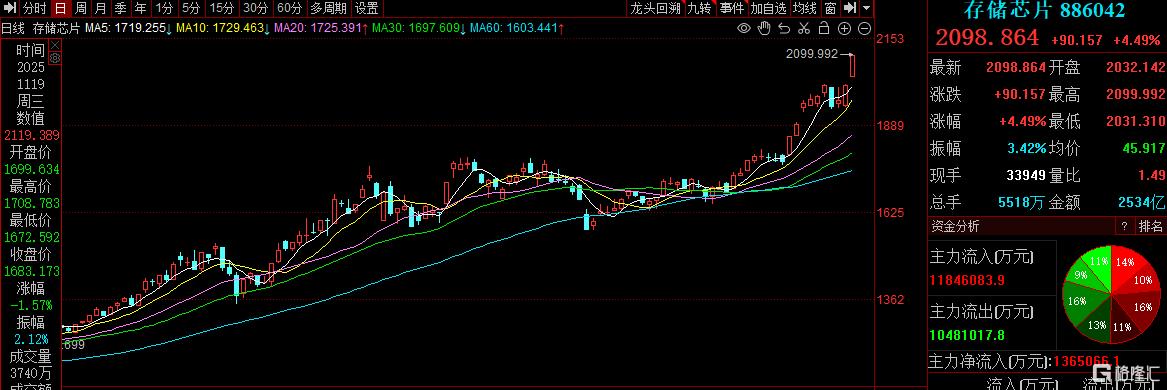
Group 1: Market Trends - The prices of memory modules and hard drives have surged significantly, increasing by three to four times compared to last year, with daily price hikes of approximately 40 yuan [1][6] - The A-share storage chip sector index rose over 4% today, accumulating a rise of over 18% for the year [2] - The storage stocks in the U.S. market have collectively surged, with major players like SanDisk and Western Digital reaching new highs, which has positively influenced A-share storage stocks [1] Group 2: Individual Stock Performance - Notable individual stock performances include Jin Tai Yang reaching a 20% limit up, while Baiwei Storage and Jingce Electronics rose over 16%, and Huicheng Co. and Blue Arrow Electronics increased over 9% [4] - Baiwei Storage's stock price increased by 16.87% to 183.52, while Jingce Electronics rose by 15.85% to 138.16 [5] Group 3: Price Increases and Demand Drivers - Since September 2025, DDR5 memory prices have increased by over 300%, while DDR4 prices have risen by over 150% [7] - AI servers are consuming 53% of the global monthly memory production capacity, with demand for memory in AI servers being 8-10 times that of regular servers, leading to a significant squeeze on consumer-grade memory supply [7] - The storage market is currently in a "super bull market," surpassing historical highs from 2018, driven by increasing demand from AI and server capacity [7] Group 4: Company Earnings Forecasts - Baiwei Storage expects to achieve revenues between 10 billion to 12 billion yuan for 2025, representing a year-on-year growth of 49.36% to 79.23%, with net profits projected to increase by 427.19% to 520.22% [9] - The company anticipates a quarterly revenue of 3.425 billion to 5.425 billion yuan in Q4 2025, with net profits expected to grow by 1225.40% to 1449.67% [10] Group 5: Analyst Upgrades - Bernstein has significantly raised SanDisk's target price from $300 to $580, citing an unprecedented storage super cycle driven by AI [11] - Wells Fargo has also increased target prices for several storage companies, including SanDisk and Western Digital, reflecting the bullish outlook on the storage sector [12]


涨价潮不止,存储芯片继续爆发!
Ge Long Hui· 2026-01-16 07:25
Core Viewpoint - The memory and storage prices are experiencing significant increases, with prices rising three to four times compared to last year, driven by high demand from AI servers and a "super bull market" in the storage sector [1][6]. Group 1: Market Performance - The A-share storage chip sector index surged over 4% today, with a cumulative increase of over 18% this year [2]. - Individual stocks such as Jintaiyang and Baiwei Storage reached their daily limit, with Baiwei Storage and Jingce Electronics rising over 16% [4][5]. Group 2: Price Trends - DDR5 memory prices have increased by over 300% since September 2025, while DDR4 memory prices have risen by over 150% [6]. - AI servers are consuming 53% of global memory monthly production capacity, significantly impacting consumer-grade memory supply [6]. Group 3: Company Performance - Baiwei Storage forecasts a revenue of 10 billion to 12 billion yuan for 2025, representing a year-on-year growth of 49.36% to 79.23%, with net profit expected to increase by 427.19% to 520.22% [8]. - Other companies in the market are also expected to see significant profit increases, with predictions of over 100% growth for several storage-related stocks [8]. Group 4: Analyst Predictions - Bernstein raised SanDisk's target price from $300 to $580, citing an unprecedented storage super cycle driven by AI [9]. - Wells Fargo also increased target prices for several storage companies, including Western Digital and Micron Technology, reflecting the bullish outlook on the storage market [9].
闪迪:涨价,且必须全款!
美股IPO· 2026-01-11 01:23
Core Viewpoint - The storage market is entering a severe shortage phase driven by the explosive demand for AI servers and manufacturers' capacity shifts, leading to unprecedented contract terms and price increases [1][4]. Group 1: Market Dynamics - SanDisk plans to raise enterprise-grade NAND prices by over 100% month-on-month in March, breaking industry norms by requiring 100% cash prepayment from customers to secure long-term supply contracts [1][2]. - The demand for storage devices is rigid due to AI infrastructure development, prompting some cloud service providers to consider accepting stringent contract terms to avoid supply disruptions [2][6]. - The storage chip market is experiencing a supply-side transformation driven by AI, resulting in a strong seller's market where buyers must accept unprecedented terms [4][6]. Group 2: Price Trends - The price of enterprise-grade NAND is expected to rise sharply, with reports indicating a potential increase of over 100% in March for SSDs [2][7]. - The demand for enterprise storage is significantly influenced by NVIDIA's inference context memory storage platform, which requires substantial amounts of 3D NAND [7]. - There is uncertainty regarding how the doubling of enterprise-grade product prices will affect consumer-grade markets, but typically, consumer prices follow enterprise price trends due to shared production facilities [7]. Group 3: Supply Chain Challenges - Major storage manufacturers (Samsung, SK Hynix, Micron) have shifted their capacity allocation towards higher-margin HBM for AI applications, significantly reducing the production capacity for standard DDR4/DDR5 and NAND [8]. - This structural shortage has led to chaos in the supply chain, with tech giants like Google and Meta restructuring their procurement teams to secure supplies [9]. - Companies are stockpiling inventory to avoid price hikes and shortages, with some PC brands like Lenovo pre-ordering for 2026 [9].
闪迪(SNDK.US):涨价,且必须全款!
智通财经网· 2026-01-10 13:18
Core Viewpoint - The storage chip market is undergoing a significant transformation driven by AI demand, leading to a seller's market where buyers face unprecedented contract terms and price increases [1][4]. Group 1: Contractual Changes - SanDisk has introduced a "100% cash prepayment" requirement for customers to secure supply quotas for 1 to 3 years, breaking industry norms [1][4]. - This unconventional contract form poses significant cash flow challenges for buyers, as traditional payment methods typically involve installment payments or credit terms [4]. Group 2: Price Increases - SanDisk plans to raise prices for enterprise-grade SSDs by over 100% month-on-month in March, driven by short-term supply shortages and increasing mid-term demand from the AI sector [1][5]. - The demand for enterprise storage is significantly influenced by NVIDIA's inference context memory storage platform, which requires substantial amounts of 3D NAND [5]. Group 3: Supply Chain Dynamics - Major storage manufacturers (Samsung, SK Hynix, Micron) have shifted their production capacity towards higher-margin HBM for AI applications, leading to a structural shortage in standard DDR4/DDR5 and NAND production [6]. - Tech giants like Google and Meta are actively seeking additional capacity and hiring specialized procurement managers to strengthen their supply chain relationships [6]. - Panic buying is prevalent, with companies like Lenovo stockpiling inventory and placing orders for future needs to avoid price hikes and shortages [6].
闪迪:涨价,且必须全款!
Hua Er Jie Jian Wen· 2026-01-10 12:09
Core Insights - The storage chip market is undergoing a significant transformation driven by AI, leading to a seller's market where buyers face unprecedented terms [1] - SanDisk has introduced a "100% cash prepayment" contract model to secure supply for 1 to 3 years, which is a departure from traditional payment methods [3][4] - The price of enterprise-grade SSDs is expected to rise dramatically, with SanDisk planning a price increase of over 100% for high-capacity 3D NAND flash memory chips in March [5] Group 1: Contract Changes - SanDisk's new contract requiring full cash prepayment has disrupted industry norms, posing challenges to buyers' cash flow [3] - The demand for AI infrastructure is forcing some cloud service providers to consider accepting these stringent terms to avoid supply shortages [4] Group 2: Price Increases - The enterprise-grade storage segment is experiencing the most aggressive price hikes, with SanDisk's NAND prices projected to increase significantly [5] - NVIDIA's ICMS platform is identified as a key driver of enterprise storage demand, necessitating substantial 3D NAND consumption [5] Group 3: Supply Chain Dynamics - Major storage manufacturers are reallocating production capacity towards higher-margin HBM for AI applications, leading to a structural shortage in standard DDR4/DDR5 and NAND production [6] - This shift has caused chaos in the supply chain, with buyers increasingly willing to accept short contracts and high prices, even adopting a "buy at any price" mentality [6] Group 4: Market Behavior - Tech giants like Google and Meta are actively seeking additional storage capacity and are restructuring their procurement teams to strengthen ties with manufacturers [8] - Companies like Lenovo are stockpiling inventory and placing early orders to mitigate the impact of price increases and shortages [8]
新高!昨夜,欧美股市全线上涨!
证券时报· 2026-01-10 00:40
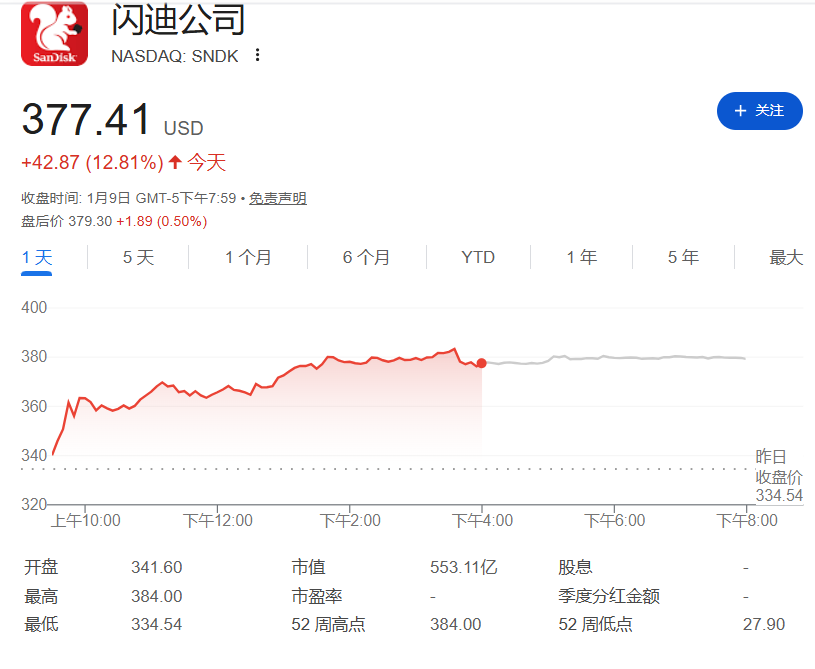
Market Performance - The Dow Jones Industrial Average and S&P 500 indices reached new all-time closing highs, with the Dow up 0.48% to 49,504.07 points and the S&P 500 up 0.65% to 6,966.28 points [1][2] - For the week, the Dow increased by 2.32%, the S&P 500 by 1.57%, and the Nasdaq by 1.88% [1] European Market - Major European indices also closed higher, with the German DAX up 0.53% to 25,261.64 points, the French CAC40 up 1.44% to 8,362.09 points, and the UK FTSE 100 up 0.8% to 10,124.60 points [2][3] - Weekly performance showed the DAX up 2.94%, CAC40 up 2.04%, and FTSE 100 up 1.74% [2] Chinese Stocks - The Nasdaq Golden Dragon China Index fell by 1.3%, with notable declines in stocks such as Atour down over 5% and Huya down over 4% [3] - Conversely, stocks like BrainCo surged over 10%, and BeiGene rose over 5% [3] Storage Sector - Storage concept stocks saw significant gains, with SanDisk up over 12% and Micron Technology up over 5% [6] - A report from Nomura Securities indicated that enterprise-level SSD NAND prices could increase by over 100% in the first quarter due to strong demand [6][7] Oil and Precious Metals - International oil prices rose, with WTI crude up 2.35% to $59.12 per barrel and Brent crude up 2.18% to $63.34 per barrel [9] - Precious metals also saw gains, with COMEX gold futures up 1.29% to $4,518.40 per ounce and silver up 6.18% to $79.79 per ounce [9] Employment Data - The U.S. non-farm payroll report showed a stable labor market, with a total increase of 58,400 jobs in 2025, averaging 4,900 jobs per month [9][10] - The unemployment rate stood at 4.4%, with notable sectoral disparities in employment changes [9][10]


存储芯片板块多股涨停!三星联席CEO警告:内存芯片短缺前所未有
2 1 Shi Ji Jing Ji Bao Dao· 2026-01-05 05:14
Group 1 - The A-share market experienced a strong start in 2026, with the Shanghai Composite Index returning to 4000 points, driven by a significant surge in the storage chip sector [1] - Notable stocks such as Yunhan Chip City and LeiKe Defense reached their daily limit up, while others like Jiangbolong and Shannon Chip Innovation saw increases exceeding 10% [1] - Samsung's co-CEO warned of an unprecedented and severe shortage of memory chips, which is expected to have an unavoidable impact on the prices of end products like smartphones [1] Group 2 - The AI boom continues to drive demand, with a forecast that the total investment in AI infrastructure by major North American cloud providers will reach a historical high of $600 billion in 2026 [2] - The global storage chip market is expected to remain in a supply-demand imbalance, with DRAM supply growth projected at 15% to 20% and demand growth at 20% to 25%, supporting price increases [2] - The supply tightness is anticipated to last until at least the end of 2026, with NAND prices expected to remain high due to increased requirements for enterprise SSDs driven by AI model training and inference [2] Group 3 - China's storage industry is making significant strides, exemplified by Changxin Technology's IPO application, which aims to raise up to 29.5 billion yuan [2] - Huawei has initiated the sixth "Olympus Award" with a prize pool of 3 million yuan to encourage research addressing fundamental challenges in data storage in the AI era [3] - Micron's recent financial results exceeded expectations, indicating that storage chip supply shortages will persist into 2026, benefiting companies like Micron [3] - The domestic storage equipment sector is positioned for growth, with increasing orders and a rising domestic production rate, particularly benefiting companies with strong market positions [3]