化工ETF(159870)

Search documents
量化择时周报:缩量信号近在咫尺,重回科技与周期-20260208
ZHONGTAI SECURITIES· 2026-02-08 10:43
Quantitative Models and Construction Methods Model Name: Industry Trend Allocation Model - **Model Construction Idea**: This model aims to identify industry trends and allocate investments accordingly[5][8][10] - **Model Construction Process**: - The model uses various indicators to assess industry trends, including market performance, valuation levels, and risk appetite. - It incorporates signals from different sub-models such as the Mid-term Distress Reversal Expectation Model, TWO BETA Model, and Performance Trend Model. - The Mid-term Distress Reversal Expectation Model waits for reversal signals in industries like liquor and real estate. - The TWO BETA Model recommends the technology sector and monitors opportunities in commercial aerospace. - The Performance Trend Model focuses on the computing power industry chain and oversold sectors like non-ferrous metals and chemicals. - **Model Evaluation**: The model is effective in identifying industry trends and making allocation recommendations based on various market signals[5][8][10] Model Name: Timing System - **Model Construction Idea**: This model aims to distinguish the overall market environment and provide timing signals for investment decisions[5][8][9] - **Model Construction Process**: - The model uses the distance between the long-term moving average (120 days) and the short-term moving average (20 days) of the WIND All A Index. - The latest data shows the 20-day moving average at 6787 and the 120-day moving average at 6338, with a difference of 7.08%. - The model also considers the market trend line, which is currently around 6780 points, and the profitability effect, which is -1.44%. - The model suggests that the market is in a shock pattern and monitors short-term risk appetite changes. - **Model Evaluation**: The model provides clear signals for market timing based on moving averages and other indicators[5][8][9] Model Backtesting Results - **Industry Trend Allocation Model**: - **PE Valuation Level**: 90th percentile, indicating a high level[8][10] - **PB Valuation Level**: 50th percentile, indicating a medium level[8][10] - **Position Recommendation**: 70% for absolute return products with WIND All A as the stock allocation subject[8][10] - **Timing System**: - **Moving Average Distance**: 7.08%, greater than the absolute value of 3%[5][8][9] - **Market Trend Line**: Around 6780 points[5][8][9] - **Profitability Effect**: -1.44%, indicating a temporary end to the upward trend[5][8][9] Quantitative Factors and Construction Methods Factor Name: Mid-term Distress Reversal Expectation Model - **Factor Construction Idea**: This factor aims to identify potential reversal signals in distressed industries[5][8][10] - **Factor Construction Process**: - The model monitors industries like liquor and real estate for reversal signals. - It uses various market indicators to assess the likelihood of a reversal. - **Factor Evaluation**: The factor is useful for identifying potential investment opportunities in distressed industries[5][8][10] Factor Name: TWO BETA Model - **Factor Construction Idea**: This factor aims to recommend sectors with high growth potential, such as technology[5][8][10] - **Factor Construction Process**: - The model focuses on the technology sector and monitors opportunities in commercial aerospace. - It uses market performance and other indicators to make recommendations. - **Factor Evaluation**: The factor is effective in identifying high-growth sectors and making investment recommendations[5][8][10] Factor Name: Performance Trend Model - **Factor Construction Idea**: This factor aims to identify sectors with strong performance trends[5][8][10] - **Factor Construction Process**: - The model focuses on the computing power industry chain and oversold sectors like non-ferrous metals and chemicals. - It uses performance indicators to make recommendations. - **Factor Evaluation**: The factor is useful for identifying sectors with strong performance trends and making investment recommendations[5][8][10] Factor Backtesting Results - **Mid-term Distress Reversal Expectation Model**: - **PE Valuation Level**: 90th percentile, indicating a high level[8][10] - **PB Valuation Level**: 50th percentile, indicating a medium level[8][10] - **TWO BETA Model**: - **PE Valuation Level**: 90th percentile, indicating a high level[8][10] - **PB Valuation Level**: 50th percentile, indicating a medium level[8][10] - **Performance Trend Model**: - **PE Valuation Level**: 90th percentile, indicating a high level[8][10] - **PB Valuation Level**: 50th percentile, indicating a medium level[8][10]
化工ETF(159870)强势超3%,顺周期轮动叠加印尼限产催化行业修复
Xin Lang Cai Jing· 2026-02-06 02:30
Group 1 - The chemical ETF (159870) shows strong recovery, indicating a consensus among investors, with noticeable market rotation before the holiday, particularly in cyclical sectors [1] - Local government meetings prioritize green development, with ongoing monitoring and transformation of high-energy-consuming industries, driving the chemical industry's upgrade [1] - The price of disperse dyes has increased by 1,000 yuan, supported by rigid downstream demand and low cost share, with strict safety and environmental regulations leading to fragile supply, suggesting a significant price increase across the dye industry chain [1] - The global fertilizer market is entering a high-price and tight balance phase, with continuous supply disruptions in overseas nitrogen and phosphorus fertilizers pushing prices higher, while potassium fertilizers are expected to exceed demand expectations [1] Group 2 - Since 2022, the overall profit of the chemical industry has been on a downward trend, with a cumulative profit decline of 8% year-on-year for chemical raw materials and products manufacturing from January to October 2025, and a 52% drop compared to the same period in 2022 [2] - The industry’s PPI index is expected to fall below zero in Q3 2024, indicating a bottoming out of the industry’s economic conditions, with a capacity utilization rate of 72.5%, down 3.5 percentage points year-on-year [2] - Northeast Securities highlights the electronic gas sector, noting that electronic specialty gases are critical for semiconductor manufacturing, requiring high purity standards and concentrated downstream applications in integrated circuits, which account for nearly 80% of global demand [2]
稀缺标的+资金流入 石油ETF鹏华(159697)领衔周期板块布局
Sou Hu Wang· 2026-02-05 09:31
Core Viewpoint - The cyclical sector is entering a new allocation window due to enhanced macroeconomic recovery expectations and stabilization of global commodity prices, with Penghua Fund offering a comprehensive ETF product matrix covering key cyclical sectors such as energy, chemicals, and non-ferrous metals [1] Group 1: ETF Product Matrix - Penghua Fund has launched four cyclical ETFs, forming a comprehensive layout of "oil + non-ferrous + industrial non-ferrous + chemicals," catering to diverse investor allocation needs [1][2] - The core product, the Oil ETF Penghua (159697), tracks the National Index of Oil and Gas, covering leading companies like China National Petroleum, China National Offshore Oil, and Sinopec, effectively capturing oil and gas industry cyclical opportunities [2] Group 2: Fund Performance and Market Recognition - As of February 5, 2026, Penghua's cyclical ETFs have shown significant net inflows, with the Oil ETF experiencing explosive growth from 207 million to 1.733 billion, reflecting a growth of over 700% [3] - The Chemical ETF (159870) has surpassed 33 billion, leading its category, while the Non-Ferrous ETF (159880) has seen stable inflows, with a net inflow of 305 million and a net return of 27.32% over the past 20 trading days [3] Group 3: Competitive Advantages - Penghua's cyclical ETFs possess significant index scarcity and first-mover advantages, creating differentiated competitive barriers [4] - The Oil ETF is the largest and earliest established among only three ETFs tracking the National Index of Oil and Gas, allowing for more precise tracking of industry performance [4][5] Group 4: Management and Investment Strategy - The four ETFs are managed by Yan Dong, a fund manager with 16 years of experience, who emphasizes the importance of "high-low switching" investment opportunities for 2026 [6] - The chemical sector is viewed as relatively undervalued, with potential for recovery driven by PPI improvements and ongoing "anti-involution" policies [6][7] Group 5: Institutional Consensus - Multiple institutions are optimistic about cyclical stock investment opportunities in 2026, with expectations of oil price rebounds due to geopolitical tensions and demand recovery [8] - The non-ferrous sector is anticipated to enter a bull market driven by monetary, demand, and supply factors, highlighting the investment value of non-ferrous mining companies [8] Group 6: Investment Opportunities - The Penghua Fund's cyclical ETF matrix has become a core tool for investors looking to allocate in commodities and upstream resources, with the Oil ETF being particularly noteworthy due to its explosive growth and unique index coverage [9]
化工ETF(159870)开盘涨近1%,10分钟获净申购超3.5亿,政策加码PVC无汞化,或带来落后产能出清打开盈利修复空间
Xin Lang Cai Jing· 2026-01-29 01:50
Group 1 - The Ministry of Ecology and Environment is accelerating the mercury-free transformation in the PVC industry, focusing on the development of mercury-free catalysts [1] - The transition to mercury-free production requires significant one-time capital expenditure, which may force some small and high-cost producers to exit the market, leading to a contraction in supply and an improvement in the overall supply-demand balance [1] - As of January 28, PVC prices were at 4,615 yuan/ton, with a price difference of -111.5 yuan/ton, indicating that prices and price differences are at the 4.3% and 13.6% percentiles since 2016 [1] Group 2 - The chemical industry is expected to see a cyclical turning point by 2026, with supply remaining tight under the third-generation refrigerant quota policy, benefiting leading companies like Juhua Co., Ltd. [2] - The industry is experiencing a recovery from its bottom, with companies like Baofeng Energy and New Chemical Materials showing differentiated performance due to new capacity releases or product price support [2] - Public funds have significantly increased their allocation to the chemical sector in Q4 2025, with a focus on leading stocks such as Wanhua Chemical and China National Offshore Oil Corporation [2]
环氧丙烷,草甘膦,丙烯酸板块大涨,化工ETF(159870)开盘获净申购超5000万份
Xin Lang Cai Jing· 2026-01-22 02:01
Group 1 - The global fertilizer market is entering a high-price and tight balance phase, with ongoing supply disruptions in overseas nitrogen and phosphate fertilizers leading to an upward shift in price levels. Potash is expected to see high cost-performance demand potentially exceeding expectations [1][2] - As of January 22, 09:44, the chemical ETF (159870.SZ) rose by 0.55%, and the related index for segmented chemicals (000813.CSI) increased by 0.74%. Key constituent stocks such as Wanhua Chemical rose by 1.07%, Jinhai Technology by 3.44%, Cangge Mining by 1.68%, Hebang Bio by 6.17%, and Hengli Petrochemical by 1.60% [1] - In the nitrogen fertilizer sector, due to risks in Iran and the Middle East, the FOB price for granular urea in the Middle East is currently between $420 and $430 per ton, while the CFR price for urea in Brazil and Southeast Asia is between $430 and $440 per ton. China will not lift urea exports during the spring plowing season, indicating that the global urea market has entered a new high-price platform [1] Group 2 - In the phosphate fertilizer sector, China's sulfuric acid exports halved from January to April, raising global phosphate production costs. From January to August, phosphate exports were suspended, reducing global phosphate supply. The CFR prices for MAP and DAP in Brazil have increased by approximately $40 per ton since the beginning of the year, currently ranging between $680 and $700 per ton, supported by rising sulfur/sulfuric acid costs [2] - For potash, the CFR prices in Brazil and Southeast Asia are currently between $360 and $380 per ton, showcasing a prominent cost-performance advantage compared to nitrogen and phosphate fertilizers. Institutions believe that the demand for potassium chloride may further replace nitrogen and phosphate fertilizers by 2%-3% [2] - Since 2024, there has been strong demand for potash from China, India, and Brazil, with current inventories at low levels, indicating significant potential for further increases in global potash prices [2]
化工ETF(159870)盘中净申购近4.4亿份,供需改善与减产共振驱动聚酯产业链利润修复
Xin Lang Cai Jing· 2026-01-14 03:54
Group 1 - The PX supply-demand pattern continues to improve, with no new production capacity expected before the end of 2026. Limited domestic PX capacity increase is anticipated next year, with Huajin's 2 million tons facility not expected to be operational until the end of next year, maintaining a rigid supply before then. Overseas refineries are experiencing strong oil product demand, with some chemical products being converted to refined oil, further squeezing PX supply [1] - On the demand side, two PTA facilities in India are gradually coming online, with one recently starting PX external procurement, contributing to demand growth. Recent futures and spot prices have surged, reflecting expectations of an optimized supply-demand pattern [1] - The reduction in long filament production has enhanced collaboration among leading companies, coupled with a gradual recovery in demand and smooth cost transmission. Last week, leading long filament companies reached a consensus on production cuts, planning a 10% reduction in POY and a 15% reduction in FDY, with price increases of 50 yuan/ton followed by another 100 yuan/ton. The current long filament operating rate is 89%, with POY/FDY inventory decreasing to 13-14 days, a reduction of about 4 days month-on-month, indicating strong demand [1] Group 2 - As of January 14, the chemical ETF (159870.SZ) rose by 1.18%, and its associated index, the segmented chemical index (000813.CSI), increased by 1.19%. Among major constituent stocks, Baofeng Energy rose by 5.52%, Junzheng Group by 10.10%, Tongkun Co. by 6.52%, Satellite Chemical by 3.85%, and Wanhua Chemical by 0.67%. During the trading session, net subscriptions exceeded 440 million shares, marking a push for 10 consecutive days of net subscriptions [2] - Related products include the chemical ETF (159870) and linked funds (Class A 014942, Class C 014943, Class I 022792). Related stocks include Wanhua Chemical (600309), Yilake Co. (000792), Cangge Mining (000408), Tianci Materials (002709), Hengli Petrochemical (600346), Juhua Co. (600160), Hualu Hengsheng (600426), Yuntianhua (600096), Baofeng Energy (600989), and Jinfat Technology (600143). A MACD golden cross signal has formed, indicating a positive trend for these stocks [3]
化工ETF(159870)今日获净申购超7.3亿份,近五日合计获净申购约21.48亿份
2 1 Shi Ji Jing Ji Bao Dao· 2026-01-07 08:42
Group 1 - The core viewpoint of the articles highlights a significant upward trend in the chemical sector, with major chemical stocks experiencing collective strength and a notable increase in the China Chemical Industry Theme Index [1] - Among the 86 monitored chemical products, 60% are projected to have average monthly export volumes in the top 80% of the last six years from January to August 2025, indicating a reshaping of the global chemical landscape [1] - The report suggests that due to profound geopolitical changes and technological advancements, resource products are transitioning from traditional "cyclical commodities" to "strategic assets," which may fundamentally alter their pricing logic [1] Group 2 - The chemical ETF (159870) recorded a trading volume of 1.16 billion yuan, ranking first among its peers, with a real-time premium rate of 0.06% [2] - The ETF has seen a net subscription of over 730 million units today and a total of approximately 2.148 billion units over the past five days, indicating strong investor interest [2] - The ETF closely tracks the China Chemical Industry Theme Index (000813.CSI), which selects larger, more liquid listed companies in the chemical sector to reflect the overall performance of the industry [2]
化工ETF(159870)涨超4%,主力资金早间净流入基础化工等板块
2 1 Shi Ji Jing Ji Bao Dao· 2026-01-06 05:45
Group 1 - The three major indices collectively rose, with the Shanghai Composite Index up 1.12%, the Shenzhen Component Index up 1.06%, and the ChiNext Index up 0.33% [1] - The CSI Subsector Chemical Industry Theme Index (000813.CSI) increased by 3.79%, with major constituents such as Hengli Petrochemical and Tongkun Co. rising over 9%, and Luxi Chemical and Xingfa Group rising over 8% [1] - Main capital inflows were observed in non-bank financials, non-ferrous metals, electronics, and basic chemicals sectors [1] Group 2 - The PVC main contract saw a daily increase of over 3%, with a cumulative rise of over 15% since mid-December last year [1] - Institutions predict that by 2026, the petrochemical and chemical industry will experience accelerated supply-side clearing, with low-efficiency capacity continuing to exit the market [1] - The chemical industry is expected to face a dual opportunity for cyclical recovery and industrial upgrading in 2026, with traditional demand anticipated to recover moderately due to the Fed entering a rate-cutting cycle and the "anti-involution" trend [1] Group 3 - The Chemical ETF (159870) rose by 4.08%, with a trading volume of 887 million yuan, and a net inflow of 188 million yuan on the previous trading day [2] - The Chemical ETF has seen net inflows for three consecutive trading days, totaling 485 million yuan [2] - The ETF closely tracks the CSI Subsector Chemical Industry Theme Index (000813.CSI), which reflects the overall performance of larger, more liquid listed companies in the chemical sector [2]
化工ETF(159870)涨近1%,电解液核心材料涨价潮进一步催化行情
Xin Lang Cai Jing· 2025-11-28 03:25
Group 1 - The lithium battery and solid-state battery sectors are currently gaining attention, with prices for 6F, VC, and battery-grade EC rising to 165,000, 170,000, and 5,900 per ton respectively [1] - As of November 28, the chemical ETF (159870.SZ) increased by 0.81%, and the related index for fine chemicals (000813.CSI) rose by 0.95%, with major constituents like Salt Lake Co. up 1.37% and Enjie Co. up 2.96% [1] - Research from brokerage firms indicates that the price increase for 6F, VC, and battery-grade EC is expected to continue, driven by strong downstream demand and rising upstream prices, enhancing price elasticity and sustainability [1] Group 2 - The price of 6F reached 165,000, with an average price of 138,000 in November, suggesting that profits for 6F companies may significantly exceed expectations [1] - In the case of VC additives, despite the recent resumption of production by Shandong Genyuan, its maximum monthly output is only around 2,000 tons, which has a limited impact on the market [1] - For solvent EC, battery-grade EC has risen to 5,900 per ton, with a cumulative increase of 25% this month, and factory inventories are at their lowest this year, allowing for upward price movement [1]
ETF日报-A股三大股指全线收跌,半导体ETF(159813)昨日获逆市净申购达5000万元
Xin Lang Cai Jing· 2025-11-21 01:28
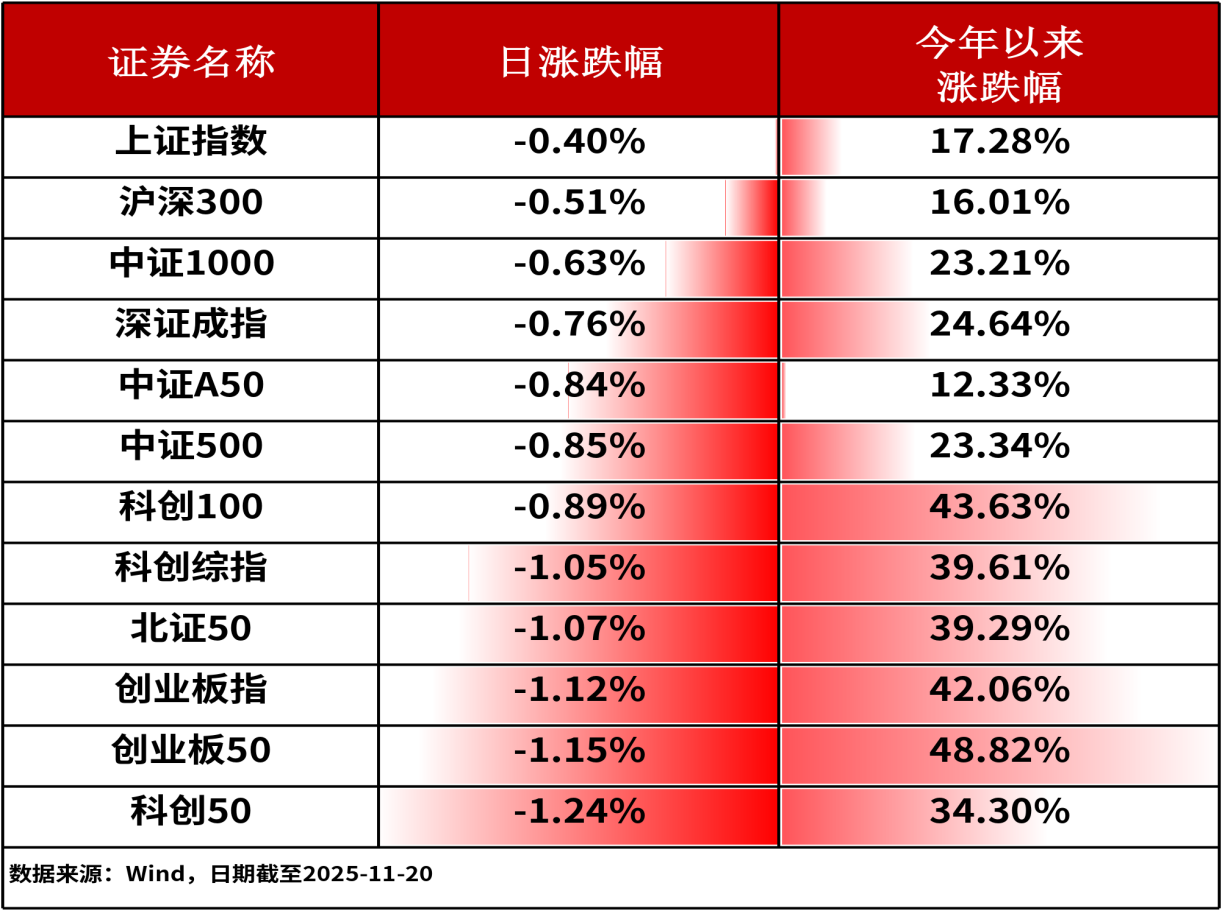
Market Overview - On November 20, A-shares experienced a decline across all major indices, with the Shanghai Composite Index falling by 0.40%, the Shenzhen Component Index down by 0.76%, and the ChiNext Index decreasing by 1.12% [1] - The overall market showed a correction trend, with only 1,453 stocks rising [1] - The total trading volume in the Shanghai and Shenzhen markets was 17,082 billion RMB, slightly lower than the previous trading day [1] Index Performance - The following indices showed daily and year-to-date performance: - Shanghai Composite Index: -0.40% (YTD: +17.28%) - Shenzhen Component Index: -0.76% (YTD: +24.64%) - ChiNext Index: -1.12% (YTD: +42.06%) - STAR Market 50 Index: -1.24% (YTD: +34.30%) [2] Sector Performance - The construction materials sector led with a gain of 1.40%, followed by the comprehensive sector at 0.87% and the banking sector at 0.86% [6] - Conversely, the beauty and personal care sector saw a decline of 2.39%, coal fell by 2.10%, and electrical equipment dropped by 1.96% [6] Fund Flows - In terms of ETF categories, significant net inflows were observed in: - Hong Kong Technology (+2.954 billion) - Semiconductor Chips (+1.164 billion) - STAR Market 50 (+1.082 billion) - Notable net outflows included: - CSI 300 (-1.208 billion) - Battery Storage (-0.660 billion) - Banking sector (-0.597 billion) [7] Industry Insights - In the chemical sector, the phosphate iron lithium industry is facing significant losses, prompting the China Chemical and Physical Power Industry Association to release a notification to regulate industry development and pricing [8] - The lithium battery industry is projected to see a 26.75% year-on-year increase in exports, with a total industry output value expected to exceed 3 trillion RMB [8] - In the new energy vehicle sector, a draft for government procurement standards has been proposed to ensure fair treatment of suppliers [9] AI and Semiconductor Developments - The U.S. government is set to launch an initiative named "Genesis Mission" to advance AI development, which is considered as significant as the Manhattan Project [10] - NVIDIA plans to adopt 12-inch silicon carbide substrates in its next-generation GPU chips to enhance performance [11]