德国债券

Search documents
美债成了烫手山芋?中国加速抛售美债,美专家:中国用新抛售方式
Sou Hu Cai Jing· 2026-02-11 21:01
Core Viewpoint - The total global holdings of U.S. Treasury bonds have reached a high of $9.36 trillion, but China's holdings have significantly decreased to $682.6 billion, marking a historic low since the 2008 financial crisis, indicating a strategic retreat from U.S. debt [1][3][5]. Group 1: China's Strategy - China's U.S. Treasury bond holdings have halved from $1.3 trillion in 2013 to $682.6 billion by November 2025, reflecting a calculated and strategic withdrawal rather than simple liquidation [5]. - In 2025, China briefly increased its holdings, but quickly reversed course, selling off $18.9 billion in March and $25.7 billion in July, showcasing a tactical approach of alternating between buying and selling [6]. - China has employed a unique strategy by providing low-interest loans in U.S. dollars to countries like Indonesia and Argentina, which then repay their debts to the U.S., effectively changing the creditor without causing market disruption [10][11]. Group 2: U.S. Debt Concerns - The U.S. federal debt has reached $38.4 trillion, with annual interest payments exceeding $1.2 trillion, raising concerns about the sustainability of U.S. financial practices [13]. - The downgrade of the U.S. credit rating by Moody's has exposed vulnerabilities in U.S. financial credibility, likening the situation to a "naked" display of its fiscal weaknesses [13]. Group 3: Global Reactions - While China is reducing its exposure to U.S. debt, Japan has increased its holdings to $1.2 trillion, and the UK has reached $888.5 billion, indicating a complex dynamic where allies are compelled to support U.S. debt despite their own economic challenges [19][21]. - The actions of Japan and the UK reflect a political obligation rather than a sound investment strategy, as they navigate the pressures of maintaining U.S. debt market liquidity [21]. Group 4: Shift in Investment Focus - China is diversifying its investments by increasing gold reserves, which have risen to 74.15 million ounces, and investing in high-credit bonds from Germany, France, and Canada, as well as in tangible assets in ASEAN countries [15][17]. - The rise of the Cross-Border Interbank Payment System (CIPS), with a transaction volume exceeding 120 trillion yuan, signals China's intent to establish its own financial framework independent of the U.S. dollar [23]. Group 5: Strategic Implications - The strategic retreat from U.S. debt and the shift towards gold and tangible assets reflect a broader trend among global central banks, indicating a growing distrust in the U.S. dollar [15][25]. - The subtle yet impactful strategies employed by China to reduce its reliance on U.S. debt without direct confrontation may signify a transformative shift in global financial power dynamics [25].

史无前例!德国上调明年发债规模至5120亿欧元,为基建和国防输血
Hua Er Jie Jian Wen· 2025-12-18 10:23
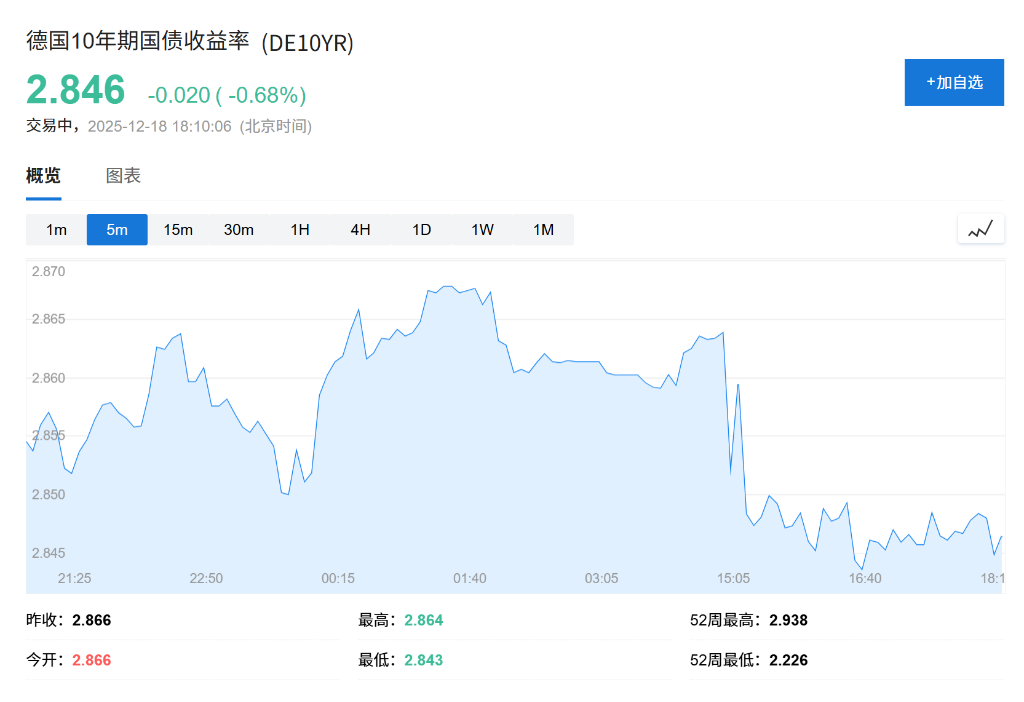
Core Viewpoint - Germany is planning its largest debt financing initiative in history, aiming to revitalize its economy through significant fiscal spending [1] Group 1: Debt Issuance Plans - The Federal Debt Agency (DFA) announced that Germany's federal debt issuance for next year will increase by 20%, reaching a record €512 billion (approximately $601 billion) [1] - This issuance is significantly higher than the €425 billion projected for 2025 and exceeds the previous peak of around €500 billion in 2023 [1] Group 2: Financing Strategy and Structure - The DFA plans to raise approximately €318 billion through capital market auctions and €176 billion through the money market, along with issuing green bonds between €16 billion and €19 billion [4] - To meet this unprecedented financing demand, Germany will introduce 20-year bonds for the first time and plans four syndicate issues through banks next year [4] - The government aims to invest €500 billion over the next decade to repair the country's infrastructure and has approved a €50 billion defense spending plan to address evolving security concerns in Europe [4] Group 3: Market Conditions and Economic Outlook - The expansion of debt issuance coincides with a steepening European yield curve, indicating rising long-term borrowing costs relative to short-term rates [5] - The premium for 30-year borrowing costs over 5-year rates has increased by nearly 60 basis points this year [5] - Despite market challenges and headwinds in major industrial sectors, Germany maintains the capacity to increase borrowing, with a debt-to-GDP ratio significantly below 100% [5] - The government anticipates a rebound in the economy in 2026, despite a projected growth of only 0.2% in 2025 [5]
日本投资者连续三月抛售海外股票 7月净撤资5364亿日元转战高收益债券
Zhi Tong Cai Jing· 2025-08-08 09:04
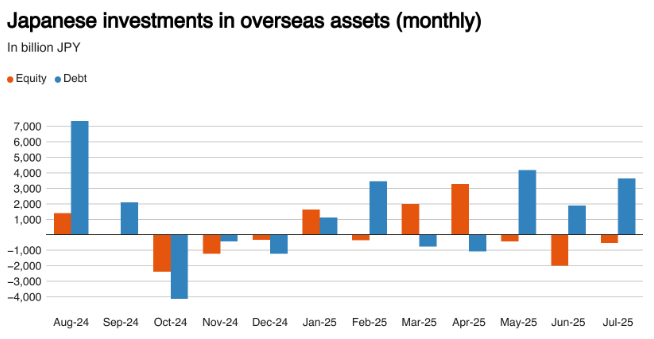
Group 1 - Japanese investors sold foreign stocks for the third consecutive month, withdrawing approximately 536.4 billion JPY (about 3.64 billion USD) in July, following a 1.99 trillion JPY sale in June due to high valuations after a significant stock market rise [1] - In contrast, Japanese investors purchased foreign bonds worth 3.63 trillion JPY in July, marking the third month of net buying, driven by a depreciation of the yen that increased yields [1] - The yen depreciated by about 4.5% against the dollar in July, representing the largest monthly decline since December 2024 [1] Group 2 - Japanese trust accounts (pension funds) also net sold foreign stocks for the third month, with a net sale of 1.52 trillion JPY in foreign equities and a net purchase of 419.6 billion JPY in long-term bonds [4] - The Bank of Japan, investment trust management companies, and insurance companies had net inflows into foreign stocks of 445.5 billion JPY, 333.5 billion JPY, and 207.1 billion JPY respectively in July [4] - The overseas bond market received 3.82 trillion JPY in Japanese long-term bond investments, while short-term notes saw a net withdrawal of 196.6 billion JPY [4]
日本释疑利率政策国际白银遇阻回落
Jin Tou Wang· 2025-06-10 02:35
Group 1 - The international silver price is currently trading below $36.30, with a recent opening at $36.72 per ounce and a current price of $36.43, reflecting a decrease of 0.83% [1] - The highest price reached today was $36.81 per ounce, while the lowest was $36.29 per ounce, indicating a short-term bearish trend in the silver market [1] - Recent data shows that Japan's Q1 actual GDP annualized contraction rate has narrowed to 0.2%, significantly improving from the initial value of -0.7%, which exceeded market expectations [2] Group 2 - The Japanese government is considering measures to strengthen fiscal credibility in response to rising government debt financing costs as interest rates increase [2] - Japan's government plans to initiate low-yield bond repurchase operations to alleviate pressure from soaring long-term bond yields, aligning with previous policies to reduce long-term bond supply [2] - Japanese investors significantly reduced their holdings in German bonds by 1.48 trillion yen in April, the highest since 2014, and also recorded the largest monthly sell-off of U.S. bonds in nearly six months, amounting to 1.07 trillion yen [2] Group 3 - The international silver price recently surged, breaking through $36.69 per ounce, marking a new high since 2012, with an intraday increase of 2.00% [3] - Key resistance levels for silver are identified at $37.00-$37.50 per ounce, with potential further challenges towards the $40 mark, while short-term support is noted at $35.50-$36.00 per ounce [3]
全球陷入债务反思,债市暴雷惨过希腊,为什么最先“倒下”的是日本?
Sou Hu Cai Jing· 2025-05-30 10:33
Core Viewpoint - Japan's bond market is facing a significant crisis, with concerns escalating over its debt situation, which is reportedly more severe than Greece's, while India is projected to surpass Japan in GDP by 2026 [1][5][15]. Group 1: Japan's Debt Crisis - Japan's government is primarily responsible for the current debt crisis, stemming from "Abenomics," which involved negative interest rates and extensive bond purchases by the Bank of Japan [5][15]. - The Bank of Japan holds 52% of the market share in Japanese government bonds, and its recent shift towards quantitative tightening has led to soaring bond yields [5][9]. - Japan's debt-to-GDP ratio stands at 260%, the highest among major economies, indicating significant room for bond yield increases compared to other countries [9][15]. Group 2: Market Reactions and Implications - The recent rise in Japan's 10-year bond yield to approximately 1.55% reflects a 44 basis point increase since early April, diverging from the Bank of Japan's policy rate [8][12]. - Concerns are growing regarding the potential for increased government borrowing due to upcoming elections, which could exacerbate the bond market's instability [8][12]. - The crisis in Japan's bond market may have broader implications for global financial stability, potentially triggering a financial crisis that could impact China, although China's risk exposure is mitigated by its strong foreign exchange controls [15][16]. Group 3: Global Context and Comparisons - The U.S. federal government's debt is projected to reach $36.2 trillion by the end of 2024, with foreign investors holding over $9 trillion, highlighting a global trend of rising debt levels [6][15]. - Germany, with a debt-to-GDP ratio below 100%, may emerge as a relative winner in the current debt crisis landscape, contrasting sharply with Japan's situation [13][15]. - The interconnectedness of global financial markets means that Japan's debt crisis could have ripple effects, influencing investor sentiment and market stability worldwide [16].