
悟能具身智能平台

Search documents
商汤“1+X”再落一子,王晓刚出任大晓机器人董事长
Nan Fang Du Shi Bao· 2025-12-04 14:29
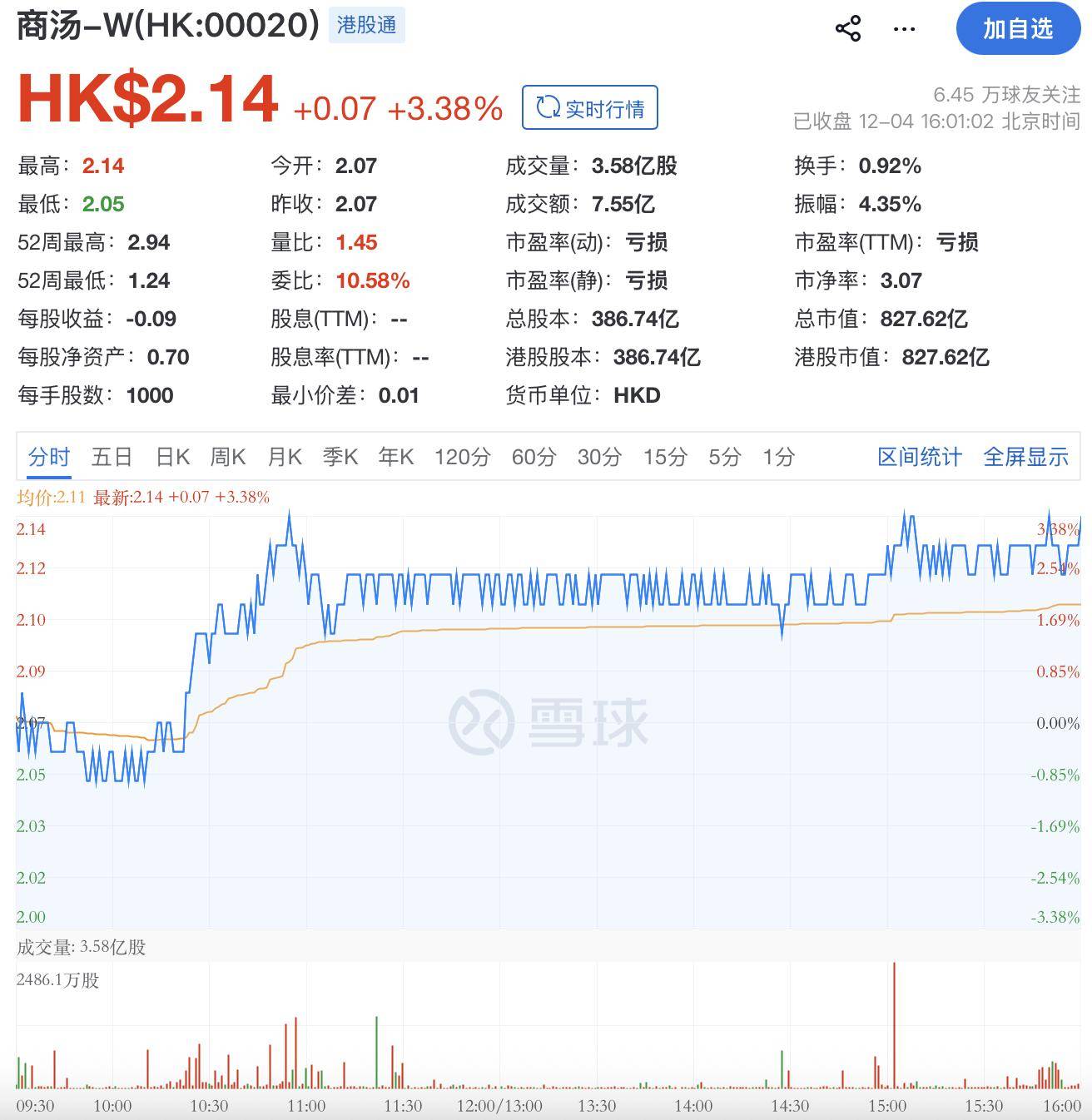
Core Viewpoint - SenseTime's "1+X" spin-off strategy marks a significant move in the embodied intelligence sector with the establishment of "Daxiao Robotics" led by co-founder Wang Xiaogang [2][3] Group 1: Company Developments - Wang Xiaogang has been appointed as the chairman of Daxiao Robotics, which is a key step in SenseTime's strategy to independently operate its embodied intelligence business [2][3] - The stock price of SenseTime (0020.HK) rose by 3.38% to HKD 2.14 following the announcement of this leadership change [2] - Daxiao Robotics is set to officially launch on December 18, introducing the first domestic open-source commercial application of the "Kairos 3.0" world model and the embodied super brain module A1 [2] Group 2: Strategic Implications - The spin-off of the embodied intelligence business is part of SenseTime's broader "1+X" organizational structure, which aims to create independent entities with their own management teams and financing channels [3] - As of early 2025, five ecological companies have completed financing under this new structure, indicating a successful implementation of the strategy [3] - Daxiao Robotics will leverage SenseTime's foundational AI capabilities while focusing on engineering and commercializing vertical scenarios, maintaining a synergistic relationship with the parent company [4] Group 3: Market Context - The embodied intelligence market in China is projected to reach CNY 400 billion by 2030 and exceed CNY 1 trillion by 2035, highlighting the growth potential in this sector [4] - Despite generating over 60% of SenseTime's revenue from generative AI, challenges such as data collection difficulties and complex long-tail scenarios remain in the embodied intelligence field [4]


商汤科技进军具身智能行业:“大晓机器人”对标Figure AI,股价上涨3.38%
Sou Hu Cai Jing· 2025-12-04 09:27
Industry Overview - The embodied intelligence industry is experiencing rapid growth, with a projected market size of 400 billion yuan by 2030 and over 1 trillion yuan by 2035 in China, driven by innovation and demand release [1] - The industry is expected to grow at an annual rate exceeding 50% in recent years [1] Company Developments - SenseTime's co-founder and executive director, Wang Xiaogang, has been appointed as the chairman of the embodied intelligence company "Daxiao Robot," which will launch several leading technologies and products on December 18 [1] - Following this announcement, SenseTime's stock price rose by 3.38%, closing at 2.14 HKD on December 4 [1] Technological Advancements - Daxiao Robot has assembled a team of top AI scientists and industry experts, including the chief scientist Tao Dacheng, an academician of the Australian Academy of Science, and award-winning professionals from prestigious universities [3] - The company focuses on embodied intelligence and has developed the ACE R&D paradigm, creating a comprehensive technology system based on visual data [4] - SenseTime has released and open-sourced the multi-modal model architecture NEO, providing robust technical support for applications in embodied interaction and video understanding [4] Strategic Positioning - SenseTime views embodied intelligence not as a trend but as a natural extension of its technological path, evolving from computer vision to multi-modal models and integrating various capabilities into the "Wuneng" platform [5] - The continuous technological breakthroughs and systematic integration of capabilities have become a rare resource among tech companies [5]
2025中国未来产业前沿进展:量子科技迅猛、脑机接口落地、具身智能蓬勃发展
3 6 Ke· 2025-11-17 04:08
Core Insights - The article emphasizes the importance of future industries driven by cutting-edge technologies, which are in the early stages of development and have significant strategic, leading, disruptive, and uncertain characteristics [1]. Government Initiatives - The Chinese government has issued multiple guiding documents to promote the development of future industries, focusing on six key areas: future manufacturing, future information, future materials, future energy, future space, and future health [2]. - The 2024 and 2025 State Council work reports highlight the need to cultivate emerging and future industries, including quantum technology and life sciences, and to establish growth mechanisms for future industry investments [2]. - The 15th Five-Year Plan emphasizes the exploration of diverse technology routes and typical application scenarios to drive new economic growth points in various future industries [2]. Industry Developments Quantum Technology - Quantum technology integrates principles of quantum mechanics with various scientific fields, aiming to revolutionize information processing and transmission [5]. - Significant advancements include the development of the "Zuchongzhi III" superconducting quantum computing prototype, which set new global records in quantum computing capabilities [6]. - By 2025, China is expected to lead in quantum computing, transitioning from "catching up" to "leading" in the field [7]. Biomanufacturing - Biomanufacturing utilizes biological processes for material processing and conversion, with applications in pharmaceuticals, new materials, and renewable energy [8]. - China has become the largest exporter of key enzyme preparations and gene components, holding a 29% share of the global market [9]. - The industry is characterized by the integration of AI in research and production, accelerating innovation and improving production efficiency [10]. Hydrogen and Nuclear Fusion Energy - Hydrogen energy is recognized as a crucial component of global energy transition, with China being the largest hydrogen producer [11]. - Major projects include the world's largest green hydrogen base and advancements in nuclear fusion technology, with significant milestones achieved in plasma control and fusion energy development [12][13]. Brain-Computer Interfaces - Brain-computer interfaces (BCIs) are emerging as transformative technologies, with successful trials and clinical applications in various fields [14][15]. - The development of both invasive and non-invasive BCIs is progressing rapidly, with applications in medical rehabilitation and research [18]. Embodied Intelligence - The embodied intelligence sector is witnessing rapid growth, particularly in robotics, with advancements in AI and sensor technologies [19][20]. - 2025 is seen as a pivotal year for humanoid robots transitioning from prototypes to mass production, with applications in various industries [21]. Sixth Generation Mobile Communication - The sixth generation (6G) mobile communication technology is expected to enhance performance metrics significantly compared to 5G, with various breakthroughs achieved in key technologies [22][23]. - Standardization efforts for 6G are underway in China, with commercial deployment anticipated around 2030 [23][24].
开源又赢闭源,商汤8B模型空间智能碾压GPT-5,AI看懂世界又进了一步
3 6 Ke· 2025-11-11 08:45
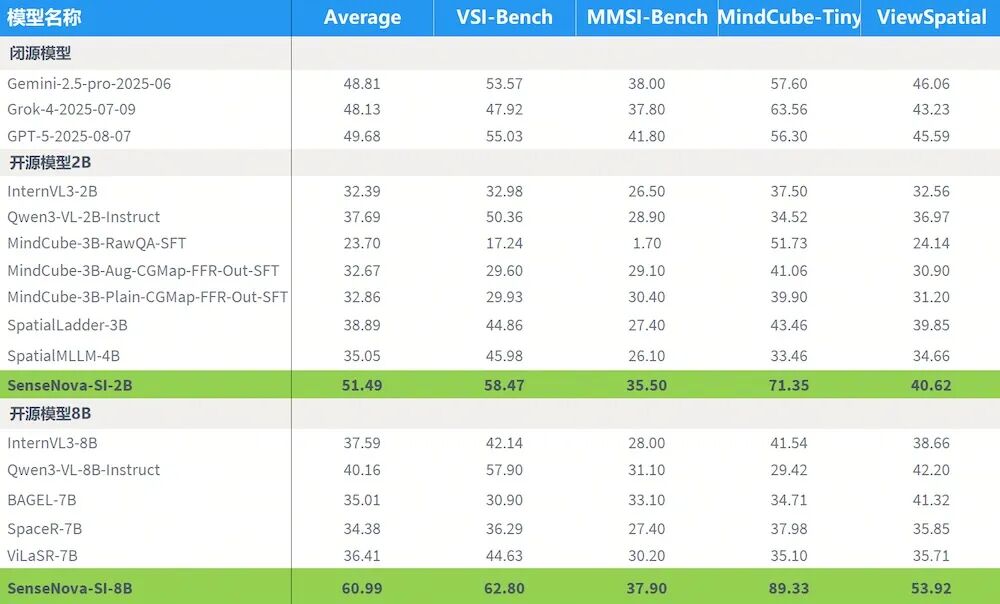
Core Insights - SenseNova-SI series models, released by SenseTime, demonstrate superior performance in spatial intelligence benchmarks, particularly the SenseNova-SI-8B model, which achieved an average score of 60.99, significantly outperforming other open-source models like Qwen3-VL-8B (40.16) and BAGEL-7B (35.01) [1][2] - The SenseNova-SI-8B model also surpasses closed-source models such as GPT-5 (49.68) and Gemini-2.5-Pro (48.81) while maintaining the same parameter scale of 8 billion [2] - The performance improvement is attributed to a systematic training design and the establishment of a "spatial capability classification system" by SenseTime, which expanded the scale of spatial understanding data and validated the existence of "scaling law" in this domain [2][5] Model Performance - SenseNova-SI-8B outperformed GPT-5 in various spatial reasoning tasks, showcasing its stability and accuracy in understanding spatial relationships [3][18] - In specific tests, SenseNova-SI-8B consistently provided correct answers while GPT-5 made errors in tasks involving perspective judgment and spatial reasoning [6][10][12][15][16] Technological Advancements - The training methodology for SenseNova-SI incorporates a comprehensive approach to spatial intelligence, categorizing it into six core dimensions: spatial measurement, reconstruction, relationships, perspective transformation, deformation, and reasoning [5] - The model's architecture supports the enhancement of spatial capabilities across various foundational models, indicating a versatile application potential [5] Strategic Implications - The launch of SenseNova-SI aligns with SenseTime's broader strategy in spatial intelligence, complementing their "Wuneng" embodied intelligence platform aimed at improving robots' understanding and adaptability in the physical world [19] - The introduction of the EASI spatial intelligence evaluation platform further supports the development and collaboration within the open-source ecosystem [19] Future Outlook - The ongoing development of spatial intelligence capabilities is crucial for advancing AI's understanding of the physical world, which is essential for applications in autonomous driving and robotics [24]
【热点评述】关注2025世界人工智能大会
乘联分会· 2025-09-12 08:47
Core Viewpoint - The 2025 World Artificial Intelligence Conference (WAIC) in Shanghai highlighted advancements in AI technology, particularly in the automotive sector, showcasing the integration of AI in various applications and the future of autonomous driving [3][12]. Group 1: AI and Autonomous Driving Developments - The "Shanghai High-Level Autonomous Driving Leading Area 'Mosu Zhixing' Action Plan" was released, aiming to establish a leading autonomous driving zone by 2027, covering 2,000 square kilometers and achieving 6 million passenger rides [5][12]. - Several companies, including SAIC, Pony.ai, Baidu, and Chery, provided L4-level autonomous driving shuttle services during the event, demonstrating the commercialization of autonomous driving [6][12]. Group 2: Company Showcases and Innovations - Geely showcased its full AI layout with new products like the Zeekr 9X and Lynk & Co 10EM-P, along with innovations in intelligent driving systems and AI wearable devices [7][12]. - Tesla presented its smart electric vehicles, humanoid robots, and advanced driver-assistance technologies, with plans to further implement these systems in China within the year [8][12]. - Yika Technology displayed its latest achievements in smart cockpit, assisted driving, and AI models, emphasizing the integration of AI in automotive applications [9][12]. Group 3: AI Models and Solutions - Various companies released AI models for different applications, such as MogoMind by Mushroom Car Union, which focuses on deep understanding of the physical world, and Hymala by Xijing Technology, designed for multi-modal logistics [10][12]. - Zebra Zhixing and Qualcomm introduced the world's first end-side multi-modal large model solution based on the Qualcomm 8397 platform, achieving 90% service closure on the vehicle side [11][12].


商汤王晓刚:世界模型将加快AI从数字空间进入物理世界,「悟能」想做那个桥梁
机器之心· 2025-08-12 07:34
Core Viewpoint - The article discusses the emergence of embodied intelligence and the significance of the "world model" as a core component in advancing AI towards human-like intelligence, highlighting the competitive landscape in the AI industry as it evolves towards embodied intelligence [1][2]. Industry Developments - Major companies like Google, Huawei, and ByteDance are launching various embodied intelligence platforms and models, indicating a rapid evolution in this field [3]. - SenseTime, leveraging its expertise in computer vision and multi-modal large models, aims to empower the industry through its "Wuneng" embodied intelligence platform, which integrates years of technological accumulation [3][5]. Technical Challenges - The industry faces challenges such as data scarcity, difficulty in large-scale production, and the need for generalization in embodied intelligence applications [5][13]. - The reliance on computer vision expertise is seen as a potential solution to enhance the learning of world models and improve the capabilities of embodied intelligence [14]. World Model Significance - The world model is recognized as a crucial element for predicting and planning in autonomous systems, enabling robots to interact intelligently with their environments [12][17]. - SenseTime's "Kaigu" world model is designed to provide extensive data and facilitate simulation-based learning, significantly reducing data collection costs [17][20]. Platform Features - The "Wuneng" platform offers a comprehensive approach by combining first-person and third-person perspectives for robot learning, enhancing the understanding of robot behavior [27][29]. - The platform aims to address the data challenges in the industry by providing synthetic data and facilitating the development of various robotic applications [26][31]. Future Implications - As embodied intelligence matures, it is expected to transform human-robot interactions and create new social networks involving robots, enhancing their roles in daily life [36][37]. - The integration of embodied intelligence into common environments like homes and workplaces is anticipated to unlock significant value and functionality [39].
AI动态汇总:智谱发布GLM-4.5,蚂蚁数科发布金融推理大模型Agentar-Fin-R1
China Post Securities· 2025-08-06 02:33
- The GLM-4.5 model, developed by Zhipu, integrates reasoning, coding, and intelligent agent capabilities into a single architecture. It employs a hybrid expert framework with 355 billion total parameters, activating only 32 billion parameters per inference to enhance computational efficiency. The training process includes three stages: pretraining on 15 trillion general text tokens, fine-tuning on 8 trillion specialized data, and reinforcement learning for multi-task alignment. The model achieves a 37% performance improvement in complex reasoning tasks through innovations like deep-layer prioritization and grouped query attention mechanisms [12][14][15] - GLM-4.5 ranks third globally in AGI core capability evaluations, with a composite score of 63.2. It outperforms competitors in tasks such as web interaction (26.4% accuracy in BrowseComp) and code repair (64.2 in SWE-bench Verified). The model demonstrates an 80.8% win rate against Qwen3-Coder in 52 real-world programming tasks, despite having half the parameters of DeepSeek-R1, showcasing its superior performance-to-parameter ratio [15][16][19] - The Agentar-Fin-R1 model, launched by Ant Financial, is a financial reasoning model based on the Qwen3 architecture. It features a dual-engine design: the Master Builder engine translates business logic into executable code, while the Agent Group engine uses consensus algorithms for multi-agent decision-making. The model is trained on a domain-specific corpus covering six major financial sectors, achieving a financial knowledge accuracy rate of 92.3% through weighted training algorithms [20][21][23] - Agentar-Fin-R1 excels in financial evaluations, scoring 87.70 in FinEval1.0 and 86.79 in FinanceIQ. It leads in tasks like risk pricing and compliance review, with a score of 69.93 in the Finova evaluation, surpassing larger general-purpose models. Its compliance system improves review efficiency by 90%, and its credit approval module reduces loan processing time from 3 days to 15 minutes while lowering bad debt rates by 18% [23][24][25] - The Goedel-Prover-V2 theorem-proving system, developed by Princeton, Tsinghua, and NVIDIA, uses an 8B/32B parameter model to achieve state-of-the-art results. It employs scaffolded data synthesis, validator-guided self-correction, and model averaging to enhance performance. The system achieves 88.1% Pass@32 accuracy on the MiniF2F benchmark, with the 8B model reaching 83.3% of the performance of the 671B DeepSeek-Prover-V2 while using only 1/100th of the parameters [58][60][61] - Goedel-Prover-V2 demonstrates exceptional efficiency, with its 32B model solving 64 problems in the PutnamBench competition at Pass@64, outperforming the 671B DeepSeek-Prover-V2, which required Pass@1024 to solve 47 problems. The system's iterative self-correction mode improves proof quality with minimal token consumption increase, and its training process is highly efficient, requiring only 12 hours per iteration on 4 H100 GPUs [60][61][63]
产业观察:【AI产业跟踪】字节开源AI Agent Coze
GUOTAI HAITONG SECURITIES· 2025-08-04 15:13
AI Industry Trends - ByteDance has open-sourced its AI Agent "Coze," which supports commercial use and has over 6,000 stars on GitHub, providing a platform for developing intelligent agents without coding[14] - The "Step 3" model by Jieyue features 321 billion total parameters and 38 billion activated parameters, achieving a 300% inference efficiency compared to DeepSeek-R1, with expected revenue of nearly $1 billion in 2025[11] - Ant Group released the financial reasoning model "Agentar-Fin-R1," which outperforms similar models in multiple financial evaluations and is based on a comprehensive financial dataset[16] AI Applications and Platforms - SenseTime launched the "Wuneng" embodied intelligence platform, featuring a multimodal reasoning model that improves cross-modal reasoning accuracy by 5 times compared to Gemini 2.5 Pro[8] - Huawei introduced the AI-Box platform, designed for lightweight edge deployment, supporting local execution of multimodal large models with low power consumption[9] - Tencent's Tairos platform offers modular services for multimodal perception and planning, focusing on enhancing robotic software capabilities[10] AI Model Developments - Zhiyuan released the GLM-4.5 model, which integrates reasoning, programming, and agent capabilities, achieving top performance in global open-source model benchmarks[17] - JD Cloud announced the open-source enterprise-level intelligent agent "JoyAgent," which supports multi-agent collaboration and has been tested in over 20,000 internal applications[18] - ByteDance and Nanjing University developed the CriticLean framework, improving the accuracy of mathematical formalization from 38% to 84%[19] Market Risks - AI software sales are below expectations, leading to adjustments in capital expenditure plans and slower iteration speeds for core AI products[34]


具身智能行业研究:智元宇树相继发布新品,文远Robotaxi 获沙特自驾牌照
SINOLINK SECURITIES· 2025-08-03 12:05
Investment Rating - The report indicates a strong upward trend in the automotive and robotics sectors, particularly highlighting the potential of intelligent driving and humanoid robots as key investment opportunities [3][4]. Core Insights - Intelligent Driving: The sector shows robust growth with increasing penetration rates for smart driving technologies and accelerated commercialization of Robotaxi services. WeRide has obtained the first autonomous driving license in Saudi Arabia, making it the only company with licenses in six countries [1][7]. - Robotics: The industry is experiencing steady growth, with new product launches from leading overseas companies expected to drive acceleration in the sector. The introduction of the "Lingqu OS" by Zhiyuan Robotics aims to create an open-source framework for embodied intelligence [2][14]. Summary by Sections Intelligent Driving - WeRide announced its Q2 financial results and received the first autonomous driving license for its Robotaxi in Saudi Arabia, marking a significant milestone in its global expansion [1][7]. - The establishment of the Changan Group as the third national automotive central enterprise in China, with a registered capital of 20 billion yuan, indicates a strengthening of the automotive industry [1][10]. - The launch of the Li Auto i8, the first mass-produced VLA electric SUV, signifies advancements in electric vehicle technology and market competition [1][8]. - NIO's L90 SUV saw a surge in orders on its first day of launch, reflecting strong market demand for new electric models [1][9]. Robotics - The humanoid robot R1 was launched by Yushun Technology at a starting price of 39,900 yuan, showcasing advancements in consumer-grade robotics [2][25]. - Zhiyuan Robotics introduced the "Lingqu OS," an open-source operating system aimed at enhancing the integration of robotic systems and driving breakthroughs in embodied intelligence technologies [2][28]. - The robotics sector is witnessing increased collaboration among companies, with strategic partnerships being formed to enhance product offerings and market reach [2][20]. Investment Recommendations - The report emphasizes that ROBO+ represents the strongest industrial trend in the automotive sector, with intelligent driving and humanoid robots being pivotal areas for growth. The penetration rate for advanced intelligent driving is expected to see explosive growth by 2025 [3][4]. - Key supply chain components such as chips, LiDAR, and optical devices are anticipated to experience significant growth, with recommendations to focus on leading companies in these fields [3][4]. - The second half of 2025 will be crucial for monitoring technological advancements and market dynamics in the robotics sector, particularly regarding new technologies and component pricing [3][4].

赛道Hyper | 落地:商汤推出悟能具身智能平台
Hua Er Jie Jian Wen· 2025-08-02 09:48
Core Viewpoint - SenseTime has launched the "Wuneng" embodied intelligence platform, which utilizes its embodied world model as the core engine to provide sensory, visual navigation, and multimodal interaction capabilities for robots and smart devices [1][2][10] Group 1: Technology and Functionality - The "Wuneng" platform is based on a complex dynamic system known as the embodied world model, which continuously learns and integrates vast amounts of data to create a digital mirror of the physical world [2][3] - The platform's sensory capabilities allow it to analyze environmental information by integrating various sensor data, enabling robots to recognize furniture layouts and household members in home settings [4] - The visual navigation function helps devices autonomously navigate by planning paths and avoiding obstacles, applicable in structured environments like warehouses [4] - Multimodal interaction supports both voice and visual commands, enhancing user experience by allowing devices to respond to voice instructions and recognize simple gestures [4][8] Group 2: Hardware Adaptability and Application - The platform is adaptable to various hardware, including humanoid robots and service robots, providing flexibility for different applications [5][6] - This adaptability allows for testing in various scenarios, offering technology integration options for hardware manufacturers [6][7] - The platform's ability to embed in edge-side chips reduces reliance on cloud computing, improving response times and functionality in unstable network conditions [8] Group 3: Market Impact and Future Development - The "Wuneng" platform represents a practical exploration of embodied intelligence, pushing the concept into real-world applications and providing new technological pathways for smart device development [11][14] - The platform's current capabilities offer potential for meeting user needs, with ongoing improvements aimed at enhancing user experience and stability [12][14] - Cost control is a critical factor in the platform's implementation, as integration and manufacturing costs will influence its widespread adoption [13][14] - The development of such platforms relies on the speed of technological iteration, market feedback, and the depth of industry collaboration, requiring time to demonstrate final effectiveness [15]