有色ETF银华

Search documents
一键把握核心资产 银华中证有色金属ETF联接基金正在发行
Zheng Quan Ri Bao Wang· 2026-02-26 11:10
Core Viewpoint - The overall metal sector showed a strong oscillating pattern during the Spring Festival holiday, driven by a dual focus on risk aversion and stagflation trading, with investors encouraged to seize opportunities in the metal sector [1] Group 1: Market Analysis - Multiple uncertainties in the global macro environment during the holiday period supported the price increase of metal assets, including both non-ferrous and precious metals [1] - According to Zhongyin Securities, by 2026, the market is expected to enter a "profit-driven upward phase," with domestic re-inflation narratives strengthening under the influences of "anti-involution" and expanding domestic demand [1] - The strong cyclical attributes of metal assets are anticipated to manifest, with financial attributes and industrial trends leading to revaluation opportunities [1] Group 2: Investment Opportunities - Investors are advised to consider industrial metals and minor metals as offensive strategies, while using precious metals as a defensive measure to effectively capture market opportunities [1] - The ongoing issuance of the Yinhua CSI Non-Ferrous Metal ETF linked fund provides a convenient investment tool for investors seeking exposure to resource assets [1] - This fund closely tracks the CSI Non-Ferrous Metal Index, allowing investors to easily access core assets in the non-ferrous industry [1] Group 3: Investment Strategy - Given the diverse subcategories and significant stock volatility within the non-ferrous industry, investors can leverage the Yinhua Non-Ferrous ETF and its linked fund to significantly reduce stock selection difficulty and trading costs [1] - This approach enables more efficient participation in the overall growth of the industry [1]

银价3天累计跌幅达40%,金价累计跌幅约20%
Shen Zhen Shang Bao· 2026-02-02 21:07
Group 1: Market Trends - International gold and silver prices experienced a significant drop, with gold futures falling below $4500 per ounce and silver futures dropping to $72.35 per ounce on February 2 [2] - In January, gold and silver prices surged, reaching historical highs of $5626.80 per ounce and $120.57 per ounce respectively, with monthly increases of approximately 29.89% and 72% [2] - Following the peak, gold and silver prices faced volatility, with gold prices declining by about 20% and silver by 40% over three days, erasing January's gains [2] Group 2: Stock Market Impact - The decline in gold and silver prices negatively impacted the stock market, with the Shanghai Composite Index closing down 2.48% on February 2 [4] - Precious metal stocks were heavily affected, with companies like Xiaocheng Technology (down 18.96%) and others experiencing significant losses, including 29 stocks hitting the daily limit down [4] - In the Hong Kong market, the Hang Seng Index fell by 2.23%, with notable declines in gold-related stocks [4] Group 3: Commodity Valuation Concerns - Citigroup's research indicated that gold valuations have reached extreme levels, with global gold expenditure as a percentage of GDP rising to 0.7%, the highest in 55 years [3] - A potential return to historical gold allocation ratios could lead to a significant price drop, with estimates suggesting a "halving" risk for gold prices [3] - The price of gold jewelry also saw a decline, with prices dropping to 1339 yuan per gram, a decrease of over 100 yuan from the previous day [3] Group 4: Regulatory Adjustments - The Shanghai Gold Exchange announced adjustments to the margin levels and price limits for silver contracts due to high volatility, increasing the margin from 20% to 26% [5] - The adjustments aim to mitigate market risks amid significant price fluctuations in silver [5] Group 5: Future Outlook - Some institutions believe the recent price corrections in gold and silver are temporary, with predictions of strong demand from central banks and expected net inflows into gold ETFs [5] - UBS forecasts a net purchase of 950 tons of gold by global central banks in 2026, indicating a strong appetite for gold reserves [5] - Analysts suggest that the recent price declines can be viewed as a market cooling phase rather than panic selling, which may help to stabilize the market for future growth [5]
贵金属“疯狂月”终结:金价3天跌20%,银价跌40%,月内涨幅被抹平
Sou Hu Cai Jing· 2026-02-02 10:48
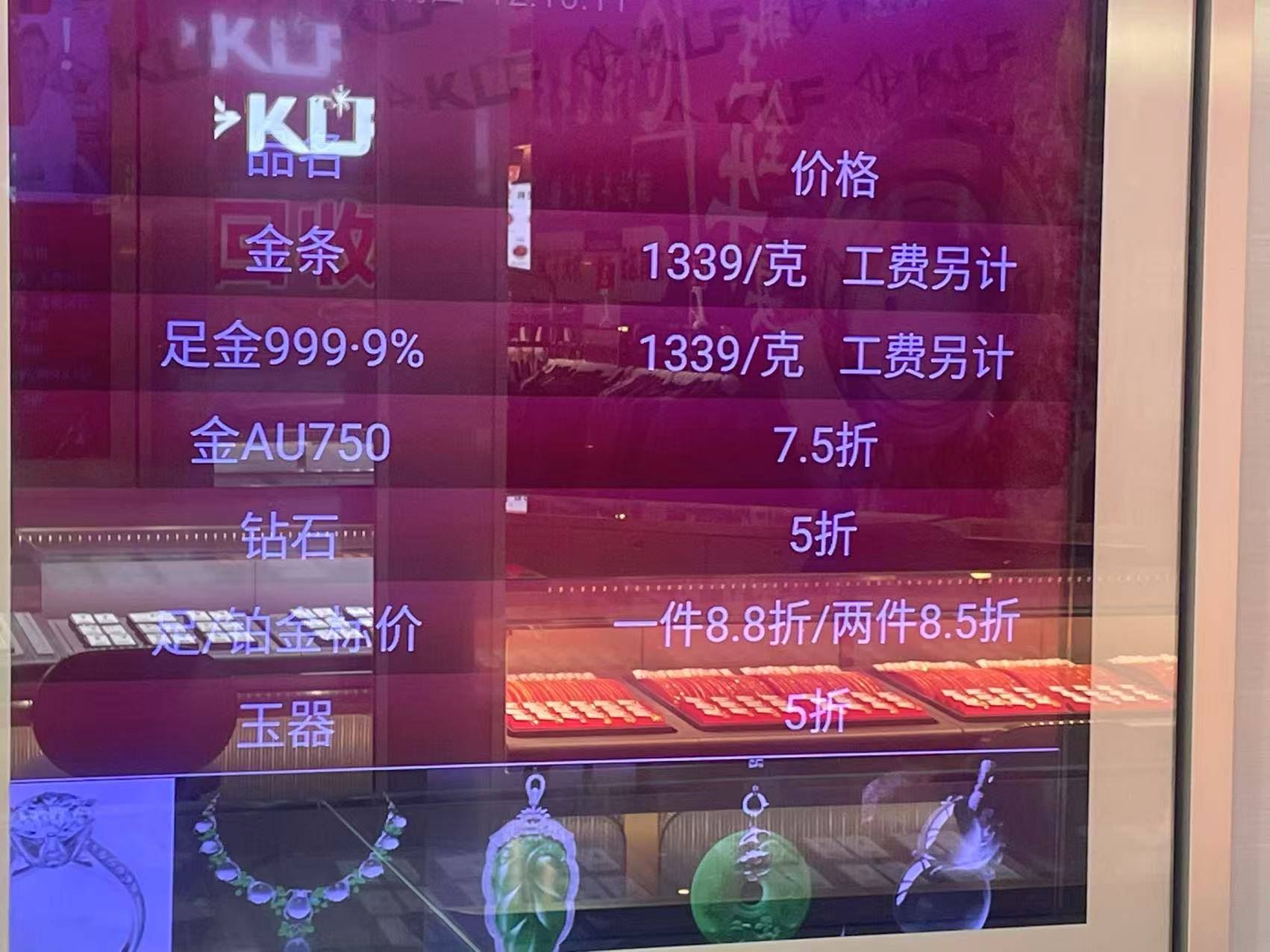
Group 1 - International gold and silver prices experienced a significant drop on February 2, with gold futures falling below $4,500 per ounce and silver futures dropping to $72.35 per ounce. This followed a record high in January where gold reached $5,626.80 per ounce and silver hit $120.57 per ounce, marking increases of approximately 29.89% and 72% respectively [1] - The domestic commodity futures market saw most major contracts decline, including metals like silver, nickel, copper, palladium, and platinum, as well as oil products. Bitcoin also fell to $74,532 per coin, the lowest since April 2025. Analysts noted that the previous surge in gold prices is now facing a severe "value reassessment" due to tightening global liquidity and the collective decline of Bitcoin and commodities [1] - On February 2, gold jewelry prices in Shenzhen dropped to 1,339 yuan per gram, a decrease of over 100 yuan from the previous day [3] Group 2 - Citigroup's latest commodity report warned that gold valuations have reached extreme levels, with global gold expenditure as a percentage of GDP soaring to 0.7%, the highest in 55 years. If the gold allocation ratio returns to its historical norm of 0.35%-0.4%, gold prices could face a "halving" risk [2] - The A-share market reflected the volatility in precious metals, with the Shanghai Composite Index closing down 2.48% on February 2. The precious metals sector was heavily impacted, with numerous stocks hitting the daily limit down, including companies like Xiaocheng Technology, which fell by 18.96% [5] - The Shanghai Gold Exchange announced adjustments to the margin levels and price limits for silver contracts due to significant price fluctuations. The margin for silver contracts was raised from 20% to 26%, and the price limit was adjusted from 19% to 25% [7] - Some institutions believe that the recent pullback in gold and silver prices is temporary. UBS forecasts that global central bank gold net purchases will reach 950 tons in 2026, indicating strong demand for gold reserves. Additionally, net inflows into gold ETFs are expected to reach 825 tons, significantly exceeding the average from 2010 to 2020 [7]

ETF收评 | 沪指下跌2%险守4000点,有色板块现跌停潮,黄金股ETF工银、黄金股票ETF等31只ETF跌停
Ge Long Hui· 2026-02-02 07:30
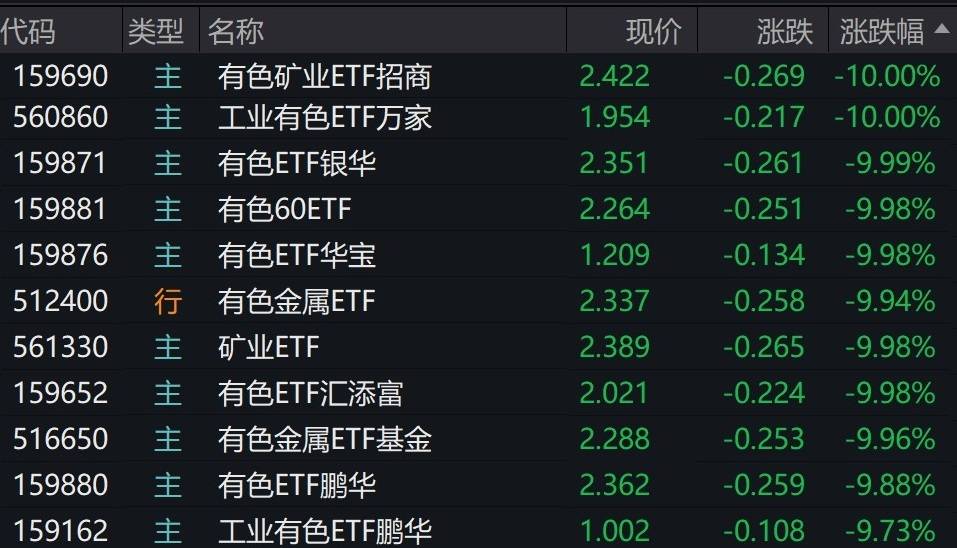
Market Performance - The three major A-share indices collectively declined, with the Shanghai Composite Index falling by 2.48%, the Shenzhen Component Index down by 2.69%, and the ChiNext Index decreasing by 2.46% [1] - The total trading volume in the Shanghai, Shenzhen, and Beijing markets was 26,066 billion yuan, a decrease of 2,558 billion yuan compared to the previous day, with over 4,600 stocks declining [1] Sector Performance - The sectors that experienced significant declines included precious metals, oil and gas extraction and services, chemicals, coal, steel, semiconductors, PEEK materials, and photolithography concept stocks [1] - In contrast, the liquor and electric grid equipment sectors showed strong performance [1] ETF Performance - The new economy ETF from Yinhua rose by 7.57%, while the food and beverage sector also saw gains, with the Penghua Fund liquor ETF and the Huabao food and beverage ETF increasing by 1.48% and 1.33%, respectively [1] - The electric grid equipment sector had a strong upward trend, with ETFs from Huaxia, Guangfa, and Guotai rising by 1.33%, 1.06%, and 1.01%, respectively [1] Specific Sector Issues - The non-ferrous sector faced a wave of limit-downs, with 30 non-ferrous themed ETFs, including the Industrial Bank gold stock ETF and the Yinhua non-ferrous ETF, hitting the limit down [2] - The semiconductor sector also saw a decline, with the China-Korea semiconductor ETF reaching its limit down [2]
有色金属概念股走弱,矿业、有色相关ETF跌超5%
Sou Hu Cai Jing· 2026-02-02 02:08
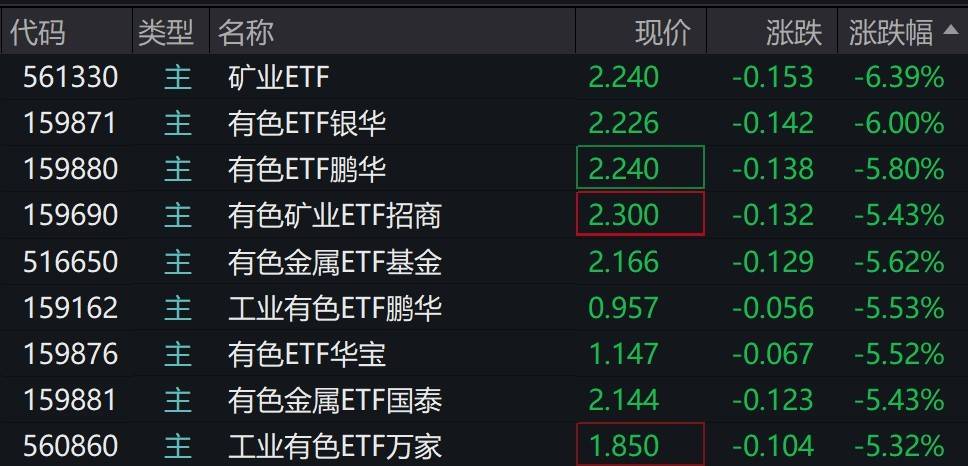
Group 1 - The core viewpoint of the news highlights a significant decline in the performance of non-ferrous metal stocks, with companies like Shandong Gold and Zhongjin Gold hitting the daily limit down, and Northern Rare Earth dropping over 5% [1] - Mining and non-ferrous related ETFs have also seen a decline of over 5% due to market influences [1] Group 2 - Recent reports indicate that not only precious metals like gold and silver have risen significantly, but industrial metals such as copper and aluminum, as well as energy metals like cobalt and lithium, have also shown good growth, with multiple metals reaching historical or phase highs [2] - The super cycle of non-ferrous metals is attributed to three main factors: the weakening trend of the dollar due to the Federal Reserve's interest rate cuts, supply-demand gaps caused by declining ore grades and rising marginal costs in major mines, and domestic policies aimed at optimizing excess capacity [2]






有色金属概念股走低,多只有色相关ETF跌停
Sou Hu Cai Jing· 2026-01-30 02:36
Group 1 - The core viewpoint of the news is that non-ferrous metal stocks have declined significantly, with companies like Luoyang Molybdenum, Huayou Cobalt, China Aluminum, Shandong Gold, Yun Aluminum, and Zhongjin Gold hitting their daily limit down [1] - Affected by the market trend, many non-ferrous related ETFs also experienced limit down [1] Group 2 - Recent reports indicate that not only precious metals like gold and silver have seen significant increases, but industrial metals such as copper and aluminum, as well as energy metals like cobalt and lithium, have also performed well, with multiple metals reaching historical or phase highs [2] - The reasons for the super cycle in non-ferrous metals are primarily threefold: first, the Federal Reserve's interest rate cut cycle has led to a weakening dollar, which supports the rise in non-ferrous metal prices denominated in dollars; second, there is a supply-demand gap, with industrial metals like copper facing supply pressures due to declining ore grades, rising marginal costs, and previous reductions in mining capital expenditures, while demand is driven by AI, new energy, and infrastructure construction; third, domestic "anti-involution" policies are optimizing excess capacity, which helps promote supply-demand balance [2]