
黄金股ETF工银

Search documents
大幅溢价!午后临时停牌
天天基金网· 2026-03-24 05:11
Core Viewpoint - The recent surge in oil and gas ETFs is primarily driven by ongoing geopolitical conflicts and significant capital inflows, leading to high premiums and volatility in these products [5][7]. Group 1: Market Performance - On March 23, several oil and gas ETFs experienced a trading halt after reaching their daily limit, with a notable rebound on March 24, where the S&P Oil & Gas ETF from Wanhua surged nearly 7% and the one from Jiashi rose over 5% [2][3]. - As of March 23, oil and gas ETFs have seen a net subscription of nearly 5.2 billion units in March alone, with specific funds like Guotai Zhongzheng Oil and Gas ETF and Penghua National Oil and Gas ETF attracting over 1 billion units each [7]. - The trading volume for the S&P Oil & Gas ETFs from Jiashi and Wanhua reached approximately 53.8 billion yuan and 42.8 billion yuan respectively in March [7]. Group 2: Investment Drivers - Analysts attribute the strong performance of oil and gas ETFs to the escalation of geopolitical tensions, which has heightened inflation expectations in the U.S. and increased uncertainty in global markets [9][10]. - The current macroeconomic uncertainty has made the oil and gas sector attractive due to its defensive characteristics and high dividend yields, resulting in a continuous influx of capital into these ETFs [10]. Group 3: Risks and Opportunities - The high premiums and volatility of oil and gas ETFs are notable, with a premium rate of around 33% for the S&P Oil & Gas ETF from Wanhua as of March 24 [7]. - If geopolitical tensions escalate further, oil prices may remain elevated; conversely, any signs of de-escalation could lead to a rapid correction in these products [5][12]. - Different types of oil and gas ETFs have shown varied performance due to their underlying assets, with upstream exploration and production companies benefiting the most from rising oil prices [13].

油气板块大涨!买哪只ETF?一文看懂!
Zhong Guo Ji Jin Bao· 2026-02-24 11:19
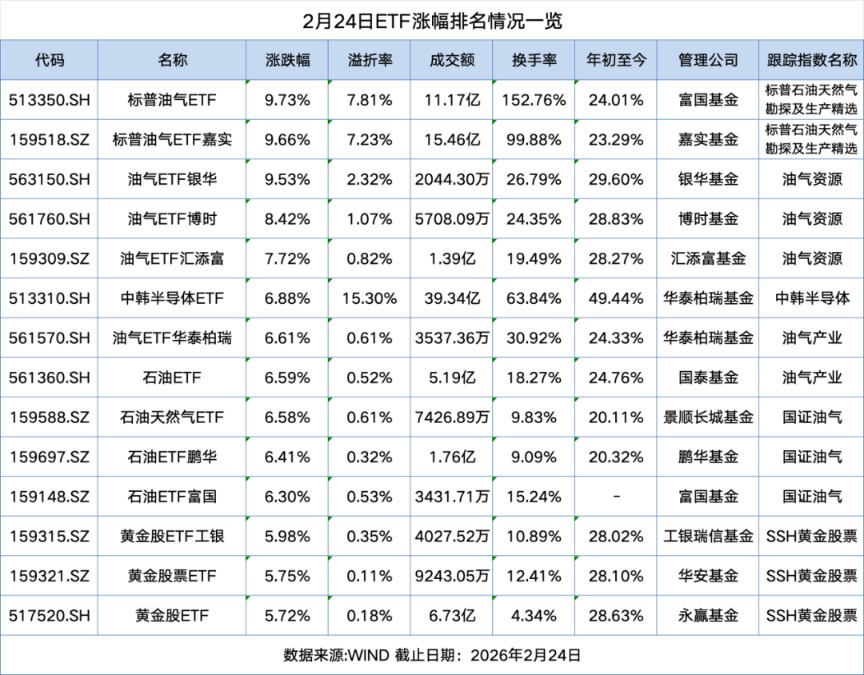
Core Viewpoint - The oil and gas sector has shown strong performance, with multiple oil ETFs leading the market on the first trading day after the Spring Festival, reflecting a significant increase in investor interest and market activity [1][4][10]. ETF Performance Summary - On February 24, a total of 919 ETFs rose, with the highest increase reaching 9.73%. The leading oil ETFs included: - The S&P Oil & Gas ETF (513350) increased by 9.73%, with a trading volume of 1.117 billion and a turnover rate of 152.76% [2][8]. - The S&P Oil & Gas ETF by Harvest Fund (159518) rose by 9.66%, with a trading volume of 1.546 billion and a turnover rate of 99.88% [2][8]. - Other notable increases included the Silverhua Oil & Gas ETF (563150) at 9.53% and the Bosera Oil & Gas ETF (561760) at 8.42% [6][7]. Market Trends - The oil and gas sector's strong performance is attributed to geopolitical risks and a tight supply-demand situation, leading to a significant rise in related stock prices and indices [10]. - The market is currently driven by geopolitical factors rather than supply-demand dynamics, with expectations of high volatility in oil prices in the near term [10]. ETF Index Tracking - There are four main oil and gas indices tracked by ETFs in the domestic market: - CSI Oil and Gas Resource Index (931248) - CSI Oil and Gas Industry Index (H30198) - National Oil and Gas Index (399439) - S&P Oil & Gas Exploration and Production Select Industry Index (SPSIOP) [5][17]. - The ETFs tracking these indices have shown similar performance, with the same fee structure and relatively close year-to-date returns [19]. Investor Considerations - Investors are advised to be cautious as the S&P Oil & Gas ETF has issued a premium risk warning, indicating that its market price is significantly higher than its indicative net asset value (IOPV), which could lead to potential losses if investments are made blindly [10].
有色金属中长期投资价值凸显,工银瑞信锻造多层次配置工具箱
Zhong Guo Jing Ji Wang· 2026-02-11 02:22
Core Viewpoint - The non-ferrous metals sector is positioned as a strategic resource supporting the green economy and high-end manufacturing, with long-term supply-demand dynamics remaining favorable despite recent market fluctuations [1] Active Management - ICBC Credit Suisse Asset Management has strategically allocated its active management products towards the non-ferrous metals sector, with the ICBC Core Opportunity Mixed Fund heavily investing in this area since Q1 2025, holding 7 out of its top 10 stocks in non-ferrous metals [1][2] - By mid-2025, the non-ferrous metals sector accounted for over half (54.40%) of the fund's stock investment value, demonstrating a sustained focus on this industry [1] - The fund manager reported significant net value growth rates of 48.91% over the past six months and 67.04% over the past year, outperforming benchmarks [2] Passive Tools - ICBC Credit Suisse offers efficient and transparent passive investment options in the non-ferrous metals sector, including a gold ETF that closely tracks domestic gold spot prices and a gold stock ETF that covers the entire gold industry chain [4][5] - The rare metals ETF focuses on rare metals processing and manufacturing, providing a distinct investment tool that emphasizes strategic metals while minimizing exposure to precious and industrial metals [4] Fee Structure - The management and custody fees for the gold ETF are among the lowest in the market at 0.2%, with similar low fees for the gold stock ETF and rare metals ETF, reflecting a commitment to cost efficiency for investors [5][6] Research and Development Strength - ICBC Credit Suisse's diversified approach in the non-ferrous metals sector showcases its robust research capabilities, with a comprehensive research system covering traditional industries and high-growth sectors like technology and healthcare [6][7] - The firm employs a platform-based, team-oriented, integrated, and multi-strategy research system to optimize product offerings and provide investors with a range of professional investment choices [7]
ETF收评 | A股缩量下跌,光伏板块回调,光伏ETF指数基金跌5.9%
Ge Long Hui· 2026-02-05 07:31
Market Overview - The three major A-share indices collectively declined, with the Shanghai Composite Index down 0.64%, the Shenzhen Component Index down 1.44%, and the ChiNext Index down 1.55% [1] - The North Stock 50 Index fell by 2.03%, and the total trading volume in the Shanghai, Shenzhen, and Beijing markets was 21,943 billion yuan, a decrease of 3,090 billion yuan compared to the previous day [1] - Over 3,700 stocks in the three markets experienced declines [1] Sector Performance - The photovoltaic industry chain saw a significant downturn, with related stocks experiencing notable declines [1] - Gold and base metal sectors also adjusted downwards, while semiconductor and computing hardware concept stocks showed marked decreases [1] - Conversely, the consumer sector performed well, with retail, duty-free shops, film, liquor, and tourism stocks all rising [1] ETF Performance - Hong Kong consumer stocks performed strongly, with the Hong Kong Stock Connect Consumer ETFs from Huitianfu, Fuguo Fund, and Yinhua Fund rising by 2.99%, 2.85%, and 2.52% respectively [1] - Bank stocks rebounded, with the Tianhong Bank ETF and the E-Fund Bank ETF increasing by 2.36% and 1.95% respectively [1] - International oil prices rose, leading to a 2.24% increase in the Jiashi S&P Oil and Gas ETF [1] Notable Declines - The photovoltaic sector led the declines, with the photovoltaic ETF index fund and the Huaxia photovoltaic ETF falling by 5.9% and 5.63% respectively [1] - The storage chip sector also declined, with the China-Korea semiconductor ETF down by 5.45% [1] - Gold stocks decreased, with the Industrial and Commercial Bank of China gold stock ETF dropping by 5.45% [1]
银价3天累计跌幅达40%,金价累计跌幅约20%
Shen Zhen Shang Bao· 2026-02-02 21:07
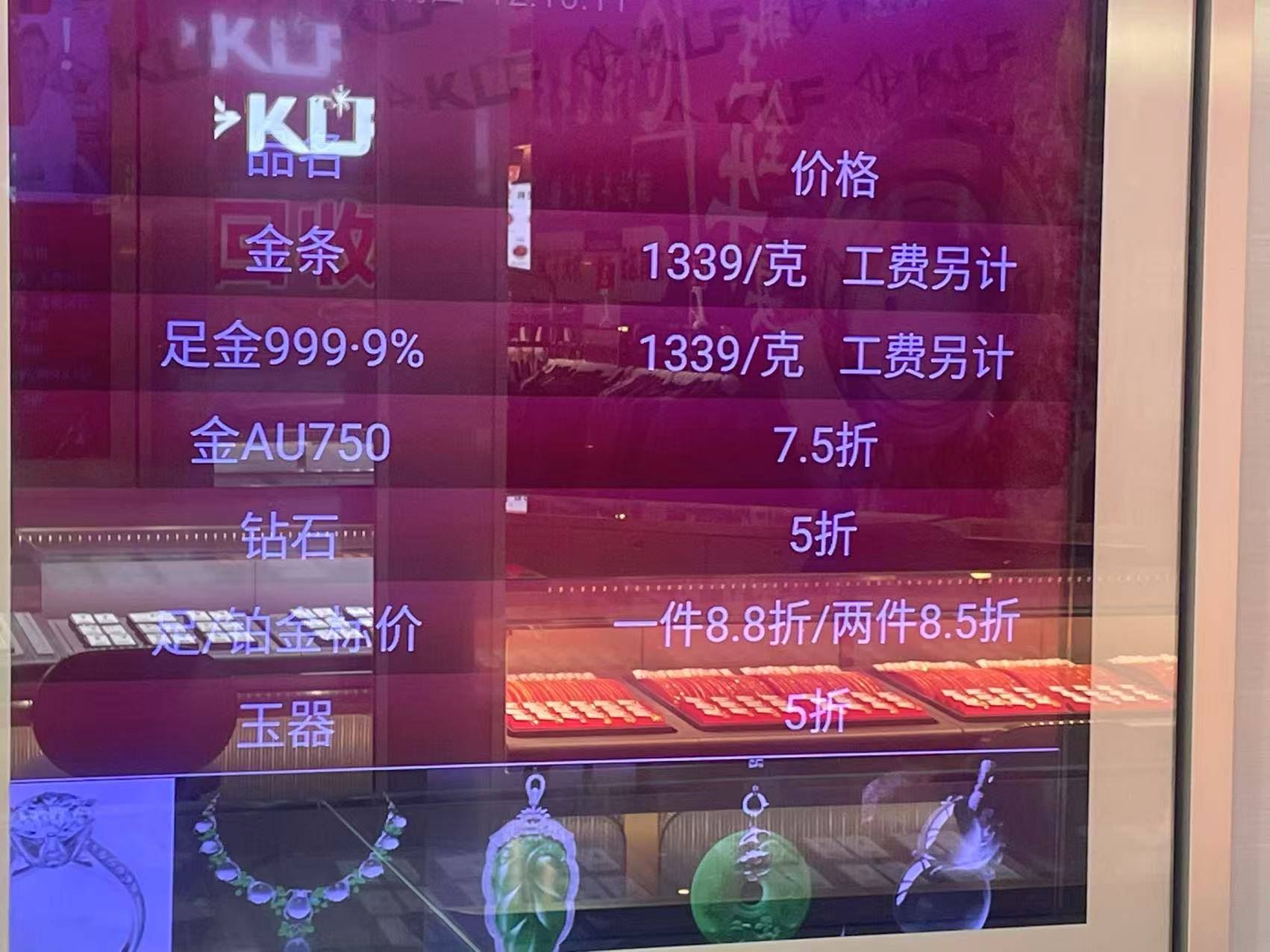
Group 1: Market Trends - International gold and silver prices experienced a significant drop, with gold futures falling below $4500 per ounce and silver futures dropping to $72.35 per ounce on February 2 [2] - In January, gold and silver prices surged, reaching historical highs of $5626.80 per ounce and $120.57 per ounce respectively, with monthly increases of approximately 29.89% and 72% [2] - Following the peak, gold and silver prices faced volatility, with gold prices declining by about 20% and silver by 40% over three days, erasing January's gains [2] Group 2: Stock Market Impact - The decline in gold and silver prices negatively impacted the stock market, with the Shanghai Composite Index closing down 2.48% on February 2 [4] - Precious metal stocks were heavily affected, with companies like Xiaocheng Technology (down 18.96%) and others experiencing significant losses, including 29 stocks hitting the daily limit down [4] - In the Hong Kong market, the Hang Seng Index fell by 2.23%, with notable declines in gold-related stocks [4] Group 3: Commodity Valuation Concerns - Citigroup's research indicated that gold valuations have reached extreme levels, with global gold expenditure as a percentage of GDP rising to 0.7%, the highest in 55 years [3] - A potential return to historical gold allocation ratios could lead to a significant price drop, with estimates suggesting a "halving" risk for gold prices [3] - The price of gold jewelry also saw a decline, with prices dropping to 1339 yuan per gram, a decrease of over 100 yuan from the previous day [3] Group 4: Regulatory Adjustments - The Shanghai Gold Exchange announced adjustments to the margin levels and price limits for silver contracts due to high volatility, increasing the margin from 20% to 26% [5] - The adjustments aim to mitigate market risks amid significant price fluctuations in silver [5] Group 5: Future Outlook - Some institutions believe the recent price corrections in gold and silver are temporary, with predictions of strong demand from central banks and expected net inflows into gold ETFs [5] - UBS forecasts a net purchase of 950 tons of gold by global central banks in 2026, indicating a strong appetite for gold reserves [5] - Analysts suggest that the recent price declines can be viewed as a market cooling phase rather than panic selling, which may help to stabilize the market for future growth [5]
贵金属“疯狂月”终结:金价3天跌20%,银价跌40%,月内涨幅被抹平
Sou Hu Cai Jing· 2026-02-02 10:48
Group 1 - International gold and silver prices experienced a significant drop on February 2, with gold futures falling below $4,500 per ounce and silver futures dropping to $72.35 per ounce. This followed a record high in January where gold reached $5,626.80 per ounce and silver hit $120.57 per ounce, marking increases of approximately 29.89% and 72% respectively [1] - The domestic commodity futures market saw most major contracts decline, including metals like silver, nickel, copper, palladium, and platinum, as well as oil products. Bitcoin also fell to $74,532 per coin, the lowest since April 2025. Analysts noted that the previous surge in gold prices is now facing a severe "value reassessment" due to tightening global liquidity and the collective decline of Bitcoin and commodities [1] - On February 2, gold jewelry prices in Shenzhen dropped to 1,339 yuan per gram, a decrease of over 100 yuan from the previous day [3] Group 2 - Citigroup's latest commodity report warned that gold valuations have reached extreme levels, with global gold expenditure as a percentage of GDP soaring to 0.7%, the highest in 55 years. If the gold allocation ratio returns to its historical norm of 0.35%-0.4%, gold prices could face a "halving" risk [2] - The A-share market reflected the volatility in precious metals, with the Shanghai Composite Index closing down 2.48% on February 2. The precious metals sector was heavily impacted, with numerous stocks hitting the daily limit down, including companies like Xiaocheng Technology, which fell by 18.96% [5] - The Shanghai Gold Exchange announced adjustments to the margin levels and price limits for silver contracts due to significant price fluctuations. The margin for silver contracts was raised from 20% to 26%, and the price limit was adjusted from 19% to 25% [7] - Some institutions believe that the recent pullback in gold and silver prices is temporary. UBS forecasts that global central bank gold net purchases will reach 950 tons in 2026, indicating strong demand for gold reserves. Additionally, net inflows into gold ETFs are expected to reach 825 tons, significantly exceeding the average from 2010 to 2020 [7]
ETF收评 | 沪指下跌2%险守4000点,有色板块现跌停潮,黄金股ETF工银、黄金股票ETF等31只ETF跌停
Ge Long Hui· 2026-02-02 07:30
Market Performance - The three major A-share indices collectively declined, with the Shanghai Composite Index falling by 2.48%, the Shenzhen Component Index down by 2.69%, and the ChiNext Index decreasing by 2.46% [1] - The total trading volume in the Shanghai, Shenzhen, and Beijing markets was 26,066 billion yuan, a decrease of 2,558 billion yuan compared to the previous day, with over 4,600 stocks declining [1] Sector Performance - The sectors that experienced significant declines included precious metals, oil and gas extraction and services, chemicals, coal, steel, semiconductors, PEEK materials, and photolithography concept stocks [1] - In contrast, the liquor and electric grid equipment sectors showed strong performance [1] ETF Performance - The new economy ETF from Yinhua rose by 7.57%, while the food and beverage sector also saw gains, with the Penghua Fund liquor ETF and the Huabao food and beverage ETF increasing by 1.48% and 1.33%, respectively [1] - The electric grid equipment sector had a strong upward trend, with ETFs from Huaxia, Guangfa, and Guotai rising by 1.33%, 1.06%, and 1.01%, respectively [1] Specific Sector Issues - The non-ferrous sector faced a wave of limit-downs, with 30 non-ferrous themed ETFs, including the Industrial Bank gold stock ETF and the Yinhua non-ferrous ETF, hitting the limit down [2] - The semiconductor sector also saw a decline, with the China-Korea semiconductor ETF reaching its limit down [2]
ETF午评 | 有色板块现跌停潮,黄金股ETF工银、黄金股票ETF跌停
Ge Long Hui· 2026-02-02 04:25
Market Performance - The Shanghai Composite Index fell by 1.32%, while the ChiNext Index decreased by 1.18% [1] - Significant declines were observed in gold and base metals, with oil, gas, coal, chemicals, and steel sectors also experiencing notable drops [1] - Agriculture, semiconductors, and real estate sectors showed considerable declines [1] Sector Highlights - The ultra-high voltage concept stocks rose against the trend, with active movements in the liquor, cultivated diamond, and AI application sectors [1] - In the ETF market, the New Economy ETF from Yinhua and the Education ETF from Bosera increased by 4.73% and 4% respectively [1] - The electric grid equipment sector saw strong gains, with ETFs from Huaxia, Guangfa, and Guotai rising by 2.72%, 2.28%, and 2.23% respectively [1] - The food and beverage sector also performed well, with the liquor ETF from Penghua and the food and beverage ETF from Huabao increasing by 1.85% and 1.55% respectively [1] - The photovoltaic sector was active, with the photovoltaic ETF from Yifangda rising by 1.15% [1] Declines in Specific Sectors - The metals sector faced a wave of limit-downs, with gold stock ETFs such as ICBC, gold stocks ETF, and gold stock ETF hitting the limit down [1] - The semiconductor sector experienced a downturn, with the China-Korea semiconductor ETF dropping by 7% [1]
黄金股ETF,批量跌停
Xin Lang Cai Jing· 2026-02-02 02:00
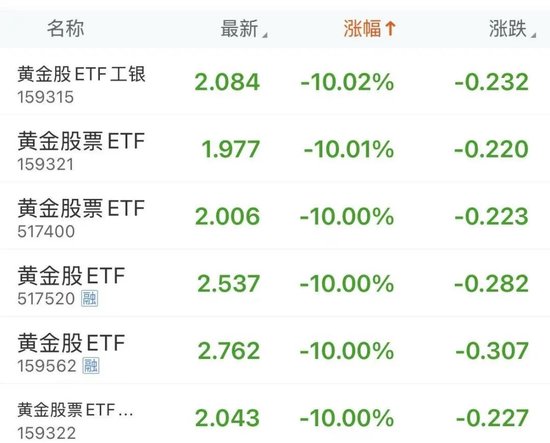
Core Viewpoint - The precious metals sector, particularly gold and silver, is experiencing significant declines, with multiple stocks and ETFs hitting their lower limits amid a market crash. Group 1: Market Performance - The precious metals sector opened significantly lower on Monday, with gold and silver stocks leading the decline, resulting in over thirty stocks hitting their daily limit down [1][8] - On January 30, the international precious metals market saw a dramatic drop, with spot gold peaking at a decline of over 12% and ultimately closing down by 9.52%. Spot silver experienced a peak drop of 36%, closing down by 26.9% [2][9] - The Shanghai gold futures contract saw a drop of over 15% at one point during the day, with the decline narrowing to 11.08% by the time of reporting [3][10] Group 2: ETF Performance - Multiple gold stock ETFs, including the Industrial and Commercial Bank of China Gold ETF, opened at their lower limits, with significant declines noted: - ICBC Gold ETF at 2.084, down 10.02% - Gold Stock ETF at 1.977, down 10.01% - Other ETFs also reported declines of around 10% [2][9] Group 3: Regulatory Response - The Shanghai Gold Exchange issued an urgent notice to adjust margin levels and price fluctuation limits for silver futures contracts due to the high volatility in silver prices [7][14]


ETF收评 | 金价站上5100美元,黄金股票ETF、黄金股票ETF基金飙涨8%
Ge Long Hui· 2026-01-26 08:43
Market Overview - The A-share market experienced a collective adjustment, with the Shanghai Composite Index down 0.09%, the Shenzhen Component Index down 0.85%, the ChiNext Index down 0.91%, and the Beijing Stock Exchange 50 Index down 1.45% [1] - The total trading volume in the three markets reached 32,806 billion yuan, an increase of 1,625 billion yuan compared to the previous day, with over 3,700 stocks in decline [1] Sector Performance - The sectors that saw gains included gold, non-ferrous metals, animal vaccines, insurance, oil and gas extraction and services, chemicals, and pork, with significant increases [1] - Conversely, sectors that faced declines included commercial aerospace, large aircraft, military equipment, photolithography machines, semiconductors, robotics, and quantum technology, with notable losses [1] ETF Performance - International gold prices surpassed 5,100 USD per ounce, leading to a surge in gold and non-ferrous resource stocks, with several gold stock ETFs, including Huaan Fund Gold Stock ETF and Ping An Fund Gold Stock ETF, rising over 8% [1] - The non-ferrous sector also saw a strong performance, with the non-ferrous mining ETFs from China Merchants and Guotai Fund increasing by 6.31% and 6.23%, respectively [1] - Oil and gas stocks performed robustly, with the energy ETF from GF rising by 4.39% [1] - The commercial aerospace sector experienced a significant downturn, with satellite ETFs and related funds declining by approximately 8% [1] - The semiconductor equipment sector also faced a decline, with the semiconductor equipment ETF dropping by 4% [1]