
植物奶

Search documents
维他奶营收下滑6%:核心市场失速与降本增效的平衡术
Xin Lang Cai Jing· 2025-12-05 08:47
Core Viewpoint - Vitasoy International reported a revenue of HKD 3.227 billion for the six months ending September 30, a 6% year-on-year decrease, while profit attributable to equity holders slightly increased by 1% to HKD 172 million, indicating a complex situation of declining revenue but stable profits due to cost control measures [1][2][8] Revenue and Profit Analysis - The revenue decline of HKD 2.16 billion, or 6%, was primarily driven by weakness in the core market, particularly in mainland China, which saw a revenue drop of 9.19% to HKD 1.778 billion [2][8] - Profit growth of 1% was achieved through a 7% reduction in total operating expenses to HKD 1.441 billion, with significant cuts in administrative expenses by 15% and marketing and distribution costs by 2% [2][8] Market Performance - The mainland market, contributing 55% of total revenue and 63.07% of net profit, faced a dual decline in revenue and profit, with net profit down 12.45% to HKD 192 million [2][8] - Other markets showed mixed results: Hong Kong and Macau revenue fell by 4% to HKD 1.112 billion, while Australia and New Zealand saw a 5% increase in revenue, although they still reported losses [3][9] Challenges in the Mainland Market - The primary issue in the mainland market is the inadequate response to channel transformation, as consumer preferences shift from traditional retail to e-commerce and new retail formats, leading to a 9.19% revenue decline [4][10] - Vitasoy's reliance on traditional channels has hindered its ability to adapt quickly to market changes, resulting in a significant impact on its performance [10][11] Competitive Landscape - The growth of core product categories, such as plant-based milk and tea, has slowed, exacerbating revenue pressures amid increasing competition from major players like Mengniu and Yili in the soy milk sector [5][11] - Vitasoy has adopted a "price reduction + innovation" strategy to maintain market share, which has led to lower product prices and increased promotional spending, ultimately affecting gross margins [5][11] Regional Challenges - The Hong Kong business faced challenges due to a sluggish recovery in the Macau retail market and tariff pressures on exports to the U.S., resulting in a 4% revenue decline [6][12] - While there are positive signs in overseas markets, such as a 5% revenue increase in Australia and New Zealand, these markets have not yet provided substantial support to offset declines in the mainland market [6][12]

营收、净利双双下滑,维他奶卖不动了?
Shen Zhen Shang Bao· 2025-11-28 05:11
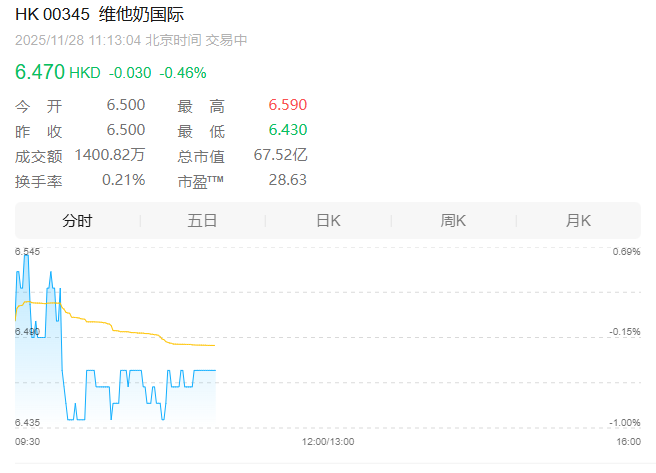
Core Viewpoint - Vitasoy International (00345.HK) reported a revenue of HKD 3.227 billion for the fiscal year 2025/2026, representing a 6% year-on-year decline, while net profit attributable to shareholders slightly increased by 1% to HKD 172 million due to cost-cutting measures [1] Group 1: Financial Performance - Revenue from mainland China decreased by 9.19% to HKD 1.778 billion, and net profit fell by 12.45% to HKD 192 million, accounting for approximately 55% of total revenue and 63.07% of net profit [1] - Revenue from Hong Kong (including Hong Kong SAR, Macau SAR, and exports) was HKD 1.112 billion, down 4% year-on-year, with net profit declining by 15.35% to HKD 135 million [2] - Total operating expenses decreased by 7% to HKD 1.441 billion, with marketing, sales, and distribution expenses down by 2% to HKD 976 million [2] Group 2: Market Dynamics - The slowdown in revenue from the mainland market is attributed to a deceleration in the growth of plant-based milk and tea products, with consumers shifting from traditional retail channels to various online platforms [1] - The company is focusing on low-sugar and no-sugar product innovations and accelerating channel optimization processes [2] Group 3: Management and Stock Performance - The mainland business has seen two leadership changes, while the 84-year-old second-generation family leader, Lo Yau Lee, has not yet retired [2] - As of the report date, Vitasoy's stock price was HKD 6.47 per share, with a market capitalization of HKD 6.752 billion, reflecting a cumulative decline of approximately 35% year-to-date [2]

大行评级丨麦格理:下调维他奶国际目标价至7.4港元 下调净利润预测
Ge Long Hui· 2025-11-26 07:37
Core Viewpoint - Macquarie's research report indicates that Vitasoy International's revenue in the mainland market for the third quarter has decreased by 9% year-on-year, with the plant-based milk category down by 10% and tea products up by 5%, showing a slowdown from double-digit growth in the same period last year [1] Group 1: Financial Performance - Revenue in the mainland market decreased by 9% year-on-year in Q3 [1] - Plant-based milk category revenue fell by 10% [1] - Tea category revenue increased by 5%, but growth has slowed compared to last year's double-digit figures [1] - Revenue in the Hong Kong market declined by 4% [1] Group 2: Management Insights and Future Plans - Management has observed a slight improvement in mainland market performance compared to the first half of the fiscal year [1] - The company plans to continue driving growth in the Hong Kong market [1] - There are plans to accelerate expansion into emerging channels such as online and snack chain stores [1] Group 3: Profit Forecast and Target Price - Macquarie has lowered Vitasoy's net profit forecasts for the fiscal years 2026 and 2027 by 16.3% and 13.3%, respectively [1] - The target price has been reduced from HKD 10 to HKD 7.4 [1] - The rating remains "Outperform" [1]
维他奶国际跌近3% 中期收入同比减少6% 内地市场收入跌9%
Zhi Tong Cai Jing· 2025-11-26 02:46
Core Viewpoint - Vitasoy International (00345) experienced a nearly 3% decline, reaching a new low of HKD 6.48 since late October last year, primarily due to weak performance in its mainland China business [1] Financial Performance - For the six months ending September 30, 2025, the company reported revenue of HKD 3.227 billion, a year-on-year decrease of 6% [1] - Gross profit was HKD 1.648 billion, down 7% compared to the previous year [1] - Profit attributable to equity holders was HKD 172 million, reflecting a year-on-year increase of 1% [1] Market Dynamics - The revenue decline of 6% was mainly attributed to challenging market conditions in mainland China [1] - Growth rates for plant-based milk and tea products are slowing in the mainland market, with consumers shifting from traditional retail channels to various online platforms, including social media and instant e-commerce platforms, as well as membership-based stores and chain snack shops [1] - The slowdown in traditional retail channels, which constitute a significant portion of the company's business, has not been fully offset by growth in e-commerce platforms and chain snack stores, leading to an overall revenue decrease of 9% [1]
港股异动 | 维他奶国际(00345)跌近3% 中期收入同比减少6% 内地市场收入跌9%
智通财经网· 2025-11-26 02:45
Core Viewpoint - Vitasoy International (00345) reported a decline in revenue and gross profit for the six months ending September 30, 2025, primarily due to weak market conditions in mainland China, leading to a nearly 3% drop in stock price, reaching a new low since October last year [1] Financial Performance - Revenue for the period was HKD 3.227 billion, a decrease of 6% year-on-year [1] - Gross profit amounted to HKD 1.648 billion, down 7% compared to the previous year [1] - Profit attributable to equity holders was HKD 172 million, reflecting a 1% increase year-on-year [1] Market Dynamics - The decline in revenue is attributed to the slowdown in the plant-based milk and tea product categories in mainland China, with consumers shifting from traditional retail channels to various online platforms, including social media and instant e-commerce platforms [1] - The traditional retail channels, which represent a significant portion of the company's business, are experiencing a slowdown, while growth in e-commerce platforms and chain snack stores has not fully offset this impact, resulting in an overall revenue decrease of 9% [1]
维他奶集团罗友礼:对持续扩大规模的长期潜力充满信心
Zheng Quan Shi Bao Wang· 2025-11-25 15:22
Core Viewpoint - Vitasoy International Holdings Limited reported a 6% decrease in revenue for the interim period ending September 30, 2025, primarily due to challenges in the mainland China market, while maintaining a gross margin of 51.1% and an operating profit margin of 7.6% [1] Group 1: Financial Performance - The company recorded a profit attributable to equity holders of HKD 172 million [1] - The board declared an interim dividend of HKD 0.04 per ordinary share, unchanged from the previous interim period [1] - The operating profit margin for the mainland China business was maintained at 11% due to cost optimization measures [2] Group 2: Market Performance - The mainland China business faced revenue decline due to shrinking traditional retail channel sales, although this was partially offset by robust growth in the omnichannel approach [1][2] - In Hong Kong, the beverage business continued to strengthen its leadership position in the non-alcoholic beverage market, despite challenges in the Vitasoy Tian Di business and export to the U.S. [2] - The Australian and New Zealand markets saw a 5% sales growth in local currency, with improved profitability and a significant reduction in operating losses to HKD 22 million [3] Group 3: Product Innovation and Strategy - The company focused on enhancing commercial execution and product innovation, leading to increased market share for Vitasoy's soy and plant-based milk products [1] - New product launches, such as Vitasoy's low-sugar white peach soy milk and lemon tea, contributed to market share growth in the ready-to-drink tea category [1][2] - In the Philippines, the plant-based category has been growing steadily at a double-digit rate, driven by oat and almond products [3]
植物奶风潮退去的背后:“牛奶替代品”策略失灵
Bei Ke Cai Jing· 2025-11-25 07:23
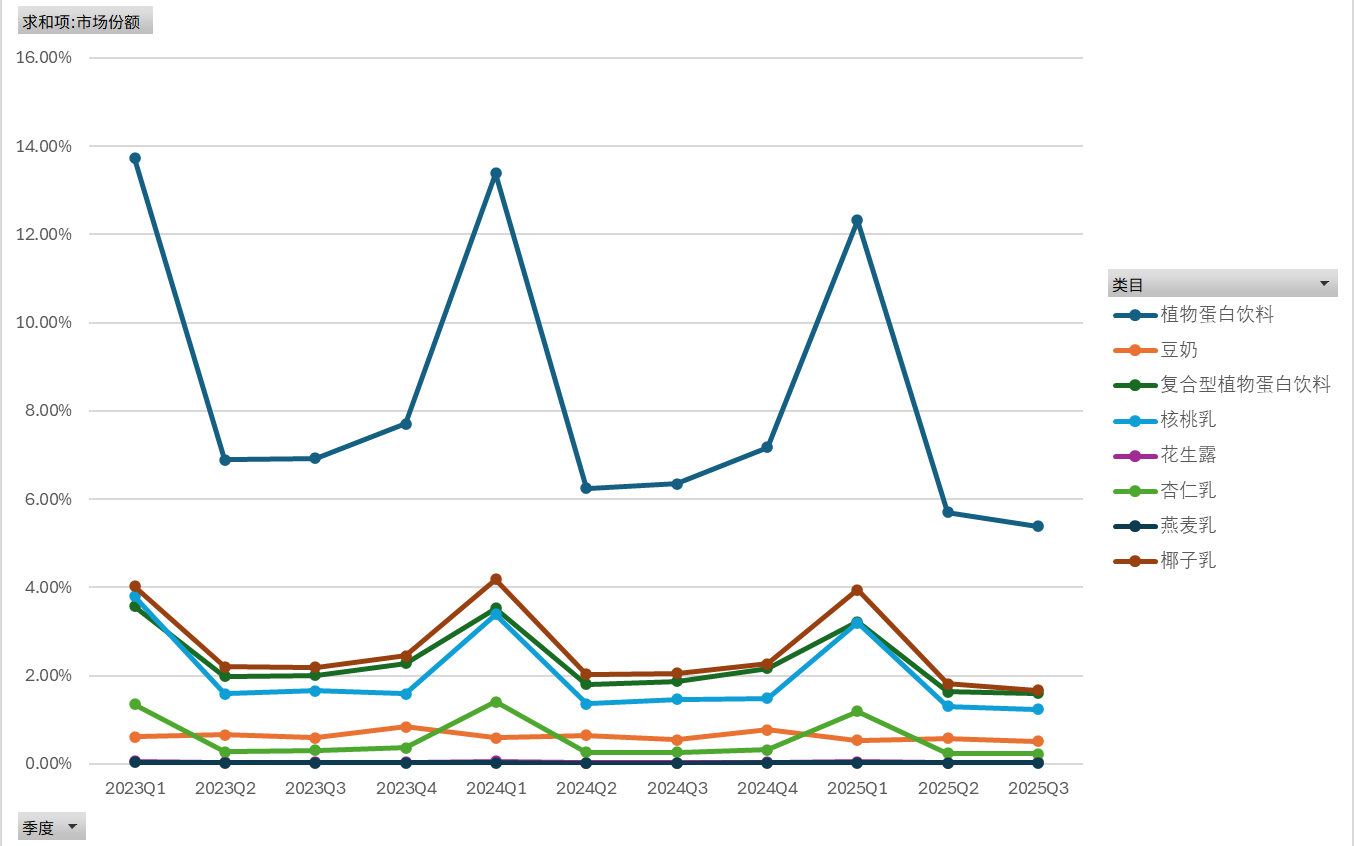
Core Insights - Oatly, the world's largest oat drink company, achieved profitable growth in Q3 2025, reigniting interest in the long-dormant plant milk market [1] - The plant milk market has seen a significant decline in investment and consumer interest since 2022, with a notable drop in market share and retail presence [4][6] Market Trends - The plant milk market experienced explosive growth from 2020 to 2021, with a market growth rate of 800% and a 900% increase in buyers [3] - However, investment activities in the plant milk sector have sharply decreased, with only 4 financing cases in 2022 and just 1 in 2023 [4] - The market share of plant milk in the packaged beverage sector fell from 13.72% in Q1 2023 to 5.38% in Q3 2025 [4] Consumer Behavior - Consumers are increasingly concerned about health and are shifting their preferences towards products that offer emotional value and functional benefits [2][13] - Over half of consumers perceive the price of oat milk as too high, with 58.9% indicating that the cost is a barrier to purchase [10] - The current consumption scenarios for plant milk largely overlap with those of traditional dairy, lacking distinct consumer demand [11] Company Performance - Oatly reported a revenue of $115 million in the Greater China market in 2024, a 7.8% decline year-on-year, but saw a 28.8% increase to $37.4 million in Q3 2025 [7] - Despite revenue growth, Oatly has struggled with profitability, only achieving its first profitable quarter in Q3 2024 [7] - Other domestic plant milk companies, such as Yangyuan and Chengde Lululemon, have also reported declines in plant milk sales, indicating a broader trend in the industry [8] Industry Challenges - The decline in the plant milk market is attributed to multiple factors, including taste acceptance, pricing, competition, and supply chain issues [9][12] - The competitive landscape has intensified, with traditional dairy brands entering the plant milk space, further squeezing profit margins [9][12] - The industry is undergoing a rationalization process, moving towards healthier and more sustainable growth rather than speculative expansion [12][14]
净亏扩大 别样肉客抛弃“肉”
Bei Jing Shang Bao· 2025-11-13 15:45
Core Viewpoint - Beyond Meat, known as the "first plant-based meat stock," reported a 14.73% decline in revenue for the first three quarters of 2025, with net losses widening, prompting a strategic shift to expand beyond plant-based meat products and seek new growth models [1][2]. Financial Performance - For the first three quarters, Beyond Meat achieved a total revenue of $214 million, a year-on-year decrease of 14.37%, and a net loss of $193 million, compared to a net loss of $115 million in the same period last year [1][2]. - In Q3 alone, revenue was $70.22 million, down 13.32% year-on-year, with a net loss of $111 million, significantly larger than the $26.58 million loss in the same quarter last year [1][2]. Sales Decline Factors - The revenue decline is attributed to a 10.3% decrease in product sales and a 3.5% drop in average selling price, influenced by reduced distribution points in U.S. retail channels and decreased sales to fast-food clients in international food service [2]. - Non-operating factors, including non-cash impairment charges related to certain long-term assets, contributed to the widening net loss [2]. Market Challenges - The current demand weakness for plant-based meat is believed to stem from the products' inability to meet mainstream market needs, as indicated by the product lifecycle theory, suggesting that plant-based meat remains in a niche market without a solid consumer base [2]. - Significant gaps in taste, price, and nutritional composition compared to real meat, along with stable or declining prices for traditional meat, further compress the market space for plant-based alternatives [2]. Strategic Shift - To address the current challenges, Beyond Meat is implementing a transformation plan, shifting focus from meat imitation to traditional plant proteins, and gradually phasing out the "Meat" label [4]. - This strategic pivot is seen as rational, aligning with health food trends and leveraging existing supply chains to enhance gross margins, while also exploring new product forms like ready-to-eat protein bars and plant-based milk [4].
从风口到谷底:美股植物奶肉概念股集体“脚踝斩”,热潮褪去后需求堪忧
Zhi Tong Cai Jing· 2025-10-20 13:05
Core Insights - The plant-based milk market, once a rapidly growing consumer category, is experiencing a decline due to increased competition and heightened price sensitivity among consumers [1] - Sales in the U.S. alternative milk sector fell by 4.4% last year, reaching $2.9 billion, marking the first decline in four years, with no recovery expected by 2025 [1] - Traditional dairy products are seeing faster growth compared to plant-based alternatives, with various types of milk, including lactose-free and whole milk, outpacing oat, almond, coconut, and soy substitutes [1] Company Insights - Oatly's stock has significantly dropped since its IPO in 2021, falling from a peak of $58 to the low teens [2] - Beyond Meat has also seen a drastic decline in its stock price, from nearly $240 to below $1 [2] - The market trend is shifting towards high-protein and gut health products, prompting mergers and acquisitions, such as PepsiCo's acquisition of Poppi and Danone's attempt to acquire Lifeway Foods, although the latter deal ultimately failed [2]


承德露露(000848):2025年中报点评:营收仍承压,新品初步贡献
Soochow Securities· 2025-08-28 14:19
Investment Rating - The investment rating for the company is "Buy" (maintained) [1] Core Views - The company reported a revenue of 1.384 billion yuan for the first half of 2025, a year-on-year decline of 15.30%, and a net profit attributable to shareholders of 258 million yuan, down 11.97% year-on-year [7] - The early Chinese New Year in 2025 and overall weak consumer sentiment have led to continued revenue pressure, although new water series products have begun to contribute [7] - The company has increased its marketing expenses, with sales expenses for the first half of the year reaching 281 million yuan, a year-on-year increase of 2.93% [7] - Cash flow remains strong, with cash received from sales in Q2 amounting to 432 million yuan, a year-on-year increase of 14.38% [7] - The company plans to repurchase at least 30 million shares, with 3 million shares repurchased by July 31, 2025, indicating a commitment to shareholder returns [7] - Revenue and profit forecasts have been adjusted downward for 2025 due to the "small year" phenomenon, with expected revenues of 2.921 billion yuan and net profits of 604 million yuan [7] Summary by Sections Financial Performance - Total revenue for 2023 is projected at 2.955 billion yuan, with a year-on-year growth of 9.76% [1] - The net profit attributable to shareholders for 2023 is estimated at 638.13 million yuan, reflecting a year-on-year increase of 6.02% [1] - The company expects a decline in revenue for 2025, with a forecast of 2.921 billion yuan, a decrease of 11.14% year-on-year [1] Market Position - The company's market capitalization is approximately 9.115 billion yuan, with a price-to-earnings ratio of 14.33 [4] - The stock price has fluctuated between 6.73 yuan and 11.31 yuan over the past year [4] Future Outlook - The company anticipates a return to growth in 2026, benefiting from a favorable Chinese New Year timing [7] - New product contributions are expected to increase, with ongoing monitoring of market performance [7]
