燃料电池商用车

Search documents
氢能周度观察(16):资源禀赋+政策协同+全链落地,川渝氢能潜力突出-20260401
Changjiang Securities· 2026-04-01 01:17
Investment Rating - The report indicates a positive investment outlook for the hydrogen energy sector, particularly in the Sichuan and Chongqing regions, which are expected to become key national hydrogen application pilot city clusters due to their resource endowment, policy synergy, and comprehensive chain implementation [4][10]. Core Insights - In March 2026, the Ministry of Industry and Information Technology, the Ministry of Finance, and the National Development and Reform Commission jointly announced the launch of a new round of national hydrogen energy pilot projects, with Sichuan and Chongqing positioned as potential leaders in this initiative [4][10]. - The Sichuan and Chongqing regions have a rich hydrogen resource base, including green, blue, and gray hydrogen supply systems, supported by significant hydropower and natural gas reserves [10]. - The policy framework in these regions emphasizes a collaborative approach, integrating provincial and municipal efforts to promote the hydrogen industry across the entire value chain [10]. - The infrastructure for hydrogen energy is being rapidly developed, with a network of hydrogen corridors and a growing number of hydrogen refueling stations planned to support the increasing adoption of fuel cell vehicles [10]. - The report highlights significant growth in fuel cell vehicle registrations in Sichuan and Chongqing, with projections indicating a cumulative insurance of 1,204 and 449 vehicles respectively from 2021 to 2025, reflecting a strong upward trend in adoption [10]. Summary by Sections Policy Initiatives - The report outlines various policy measures aimed at promoting hydrogen energy, including the establishment of a hydrogen energy industry development plan in Sichuan, which targets the deployment of 6,000 fuel cell vehicles and the construction of 60 hydrogen refueling stations by 2025 [11]. - In Chongqing, policies are in place to support the development of a comprehensive hydrogen refueling network, with plans to build 72 refueling stations by 2035, enhancing the region's hydrogen supply capacity [11]. Resource Endowment - Sichuan boasts over 100 million kilowatts of hydropower capacity, the highest in the country, and has significant potential for wind and solar energy, which can be harnessed for low-cost hydrogen production [10]. - The industrial by-product hydrogen production in Sichuan and Chongqing exceeds 20,000 and 13,000 tons annually, providing a low-cost hydrogen source for initial industry development [10]. Infrastructure Development - The report details the establishment of a hydrogen energy backbone network through various corridors and routes, enhancing transportation and distribution capabilities [10]. - As of September 2025, a total of 34 hydrogen refueling stations are expected to be operational in the Sichuan and Chongqing regions, with further expansions planned [10]. Industry Chain Completeness - The report notes the presence of leading enterprises in the hydrogen energy sector within Sichuan and Chongqing, covering key areas such as hydrogen production, storage, transportation, and fuel cell technology [10]. - Significant advancements in critical materials for hydrogen energy applications have been achieved, with ongoing efforts to accelerate industrialization [10].
东风集团股份H股即将正式退市!| 头条
第一商用车网· 2026-03-18 02:14
Core Viewpoint - Dongfeng Group is set to complete its privatization process, with its H-shares being delisted from the Hong Kong Stock Exchange, leading to 100% state-owned control by Dongfeng Company [1]. Group 1 - The Hong Kong Stock Exchange approved the delisting of Dongfeng Group's H-shares, effective from March 18, 2026 [1]. - Following the privatization, Dongfeng Group will simplify its governance structure and enhance decision-making efficiency, focusing resources on strategic emerging industries such as new energy and smart technology [4]. - The privatization plan includes the distribution of 79.67% equity in Lantu Automotive to all shareholders after delisting, with Lantu set to officially list on the Hong Kong Stock Exchange on March 19 [4]. Group 2 - Lantu Automotive, established in 2021, is positioned as Dongfeng's high-end new energy vehicle brand, playing a crucial role in Dongfeng's strategic mission to elevate its brand [4]. - The successful listing of Lantu Automotive on the Hong Kong Stock Exchange is a significant step in Dongfeng's transformation into a new energy technology enterprise, enhancing its financing channels and brand influence [4].


上汽红岩获得A轮融资!| 头条
第一商用车网· 2026-03-17 08:35
Group 1 - The core viewpoint of the article highlights that SAIC Hongyan Automobile Co., Ltd. has recently secured Series A financing, with investors including Chongqing Development Investment, Shanghai Automotive Industry Corporation, and Liangjiang Capital, although the financing amount has not been disclosed [1] - SAIC Hongyan, with a history of sixty years in the research, production, and sales of heavy trucks, is recognized as a significant player in China's heavy truck industry. The company is undergoing restructuring and actively attracting strategic investors, reflecting market and investor recognition of its brand value, technological accumulation, and development prospects [4] - Following its restructuring, the new Hongyan aims to leverage various resources to enhance its manufacturing experience and technological foundation in the heavy truck sector, accelerating product structure optimization and technological innovation to contribute to the high-quality development of China's commercial vehicle industry [4] Group 2 - The article mentions that on March 20, SAIC Hongyan will hold a product renewal and global partner summit in Chongqing, indicating ongoing efforts to strengthen its market position and partnerships [4] - The article also references significant developments in the commercial vehicle sector, including a 2.7 times increase in Qingling's sales, the emergence of pure electric traction vehicles with orders exceeding 20 million yuan, and favorable policies for fuel cell commercial vehicles from three ministries [9]

三部委发文!燃料电池商用车规模化迎来“天大”利好 | 头条
第一商用车网· 2026-03-16 09:47
Core Viewpoint - The article discusses the new opportunities for the development of hydrogen energy commercial vehicles following the announcement of a pilot program by the Ministry of Industry and Information Technology, the Ministry of Finance, and the National Development and Reform Commission to promote comprehensive hydrogen energy applications [1][5]. Summary by Sections Pilot Program Overview - The pilot program aims to promote the large-scale application of hydrogen energy across various scenarios, reduce costs, and support technological innovation in hydrogen energy equipment [1][5]. - The program will select urban clusters with strong industrial foundations and rich application scenarios to explore commercial pathways for hydrogen energy [2][6]. Goals and Targets - By 2030, the average price of hydrogen for end-use is expected to drop below 25 yuan per kilogram, with a target of around 15 yuan in some advantageous regions [2][6]. - The number of fuel cell vehicles is projected to double by 2025, aiming for a total of 100,000 vehicles [2][6]. Application Scenarios - Urban clusters are encouraged to prioritize applications in fuel cell vehicles, green ammonia, hydrogen-based chemical raw materials, hydrogen metallurgy, and hydrogen blending combustion [2][7]. - The focus will be on building hydrogen highways and corridors to facilitate the large-scale application of commercial vehicles, particularly in logistics and public transport [3][7]. Technical Requirements - Fuel cell commercial vehicles must meet specific technical standards, including a minimum hydrogen consumption rate and power density requirements [3][4]. - Vehicles should have a warranty of no less than five years or 200,000 kilometers [3]. Funding and Support - The central government will provide financial rewards to urban clusters based on their hydrogen application scenarios, with a maximum funding cap of 1.6 billion yuan per cluster over a four-year pilot period [4][11]. - The funding is intended to lower hydrogen costs and ensure effective transmission to end-user products [12]. Performance Evaluation - Each urban cluster must submit an annual self-evaluation report detailing progress, challenges, and future plans, which will be reviewed by relevant authorities [13]. - Performance evaluations will influence the allocation of reward funds, with a system in place for pre-allocation and subsequent settlement based on performance [13]. Implementation and Coordination - Provincial authorities are tasked with coordinating the pilot program, ensuring effective communication and collaboration among cities [14]. - Urban clusters are responsible for establishing leadership teams and work groups to oversee the implementation of the pilot program [14]. Supervision and Management - The three departments will provide ongoing guidance and support for the pilot program, with measures in place to address underperformance [15]. - Regular updates to technical requirements and pilot goals will be made based on technological advancements and industry developments [15].

氢能周度观察(8):2025年燃料电池商用车上险超1万辆,同比增52.5%-20260118
Changjiang Securities· 2026-01-18 13:16
Investment Rating - The report suggests a positive outlook for the fuel cell vehicle industry, recommending attention to companies involved in fuel cell systems, such as Yihuatong [3][8]. Core Insights - In 2025, the number of fuel cell commercial vehicles registered in China reached 10,778 units, marking a year-on-year increase of 52.5%. The total installed power reached 1,301 MW, up 59.8%, both hitting historical highs [3][6]. - The top three fuel cell system companies by installed capacity are Xiongtao Co., Bosch (China), and Weishi Energy. The leading automotive companies in terms of registrations are Chenglong, Yutong, and Haowo [3][6]. - The majority of fuel cell vehicle registrations are concentrated in Guangdong, accounting for 47% of the total [3][6]. Summary by Sections Market Performance - The fuel cell system manufacturing cost has significantly decreased from approximately 11,000 yuan/kW in 2019 to about 2,400-3,900 yuan/kW in 2024, with a compound annual decline rate of 17%-25% [10]. - December 2025 saw a peak in registrations, with 759 MW registered in that month alone, representing 58.3% of the annual total, driven by the end of the first round of demonstration policies [10]. Industry Dynamics - The fuel cell vehicle market is still in its early commercialization stage, characterized by high concentration but an unsettled competitive landscape. The market size remains relatively small, with orders often being sporadic and project-based [10]. - The top three companies in fuel cell systems by installed capacity in 2025 are Xiongtao Co. (224 MW), Bosch (China) (124 MW), and Weishi Energy (113 MW) [10]. Regional Focus - The Guangdong demonstration city cluster aims to promote over 10,000 fuel cell vehicles during the demonstration period, with significant policy support leading to a completion rate of 68% by the end of 2025 [10]. - Other regions such as Beijing-Tianjin-Hebei, Shanghai, and Henan have set ambitious promotion targets, with completion rates varying from 64% to 114% by the end of 2025 [10]. Future Outlook - The report maintains an optimistic view on the future development of the fuel cell industry, anticipating continued cost reductions driven by domestic material substitution, economies of scale, and technological improvements [10].

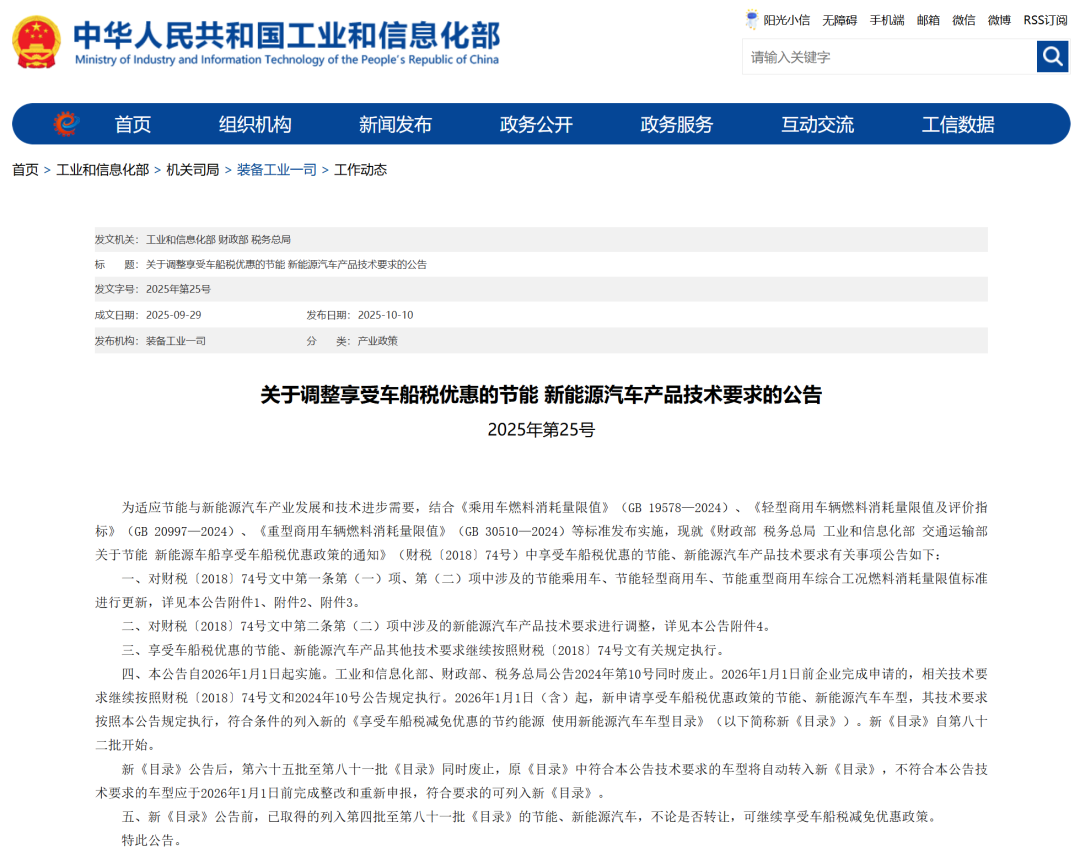
三部门,重磅发布!
Zhong Guo Ji Jin Bao· 2025-10-10 07:43
Core Viewpoint - The announcement from three departments regarding the adjustment of technical requirements for energy-saving and new energy vehicles aims to enhance the standards for vehicle tax exemptions, aligning with advancements in technology and promoting high-quality development in the industry [1][3][4]. Summary by Sections Announcement Details - The new regulations will take effect on January 1, 2026, and will replace the previous guidelines [3]. - New energy vehicles applying for tax exemptions must meet the updated technical requirements outlined in the new directory, which will be effective from the 82nd batch onwards [3]. - Vehicles listed in the previous directories (65th to 81st) that meet the new requirements will automatically transition to the new directory, while those that do not must rectify and reapply by the deadline [3]. Technical Requirements - The technical requirements for new energy passenger vehicles have been raised, including a minimum pure electric range of 100 kilometers for plug-in hybrid vehicles, up from the previous requirement of 43 kilometers [3][4]. - The adjustments are intended to ensure that policies keep pace with rapid advancements in vehicle range and engine technology [4]. Implications for the Industry - The changes are expected to encourage companies to increase R&D investments, phase out outdated products, and shift the industry focus from scale expansion to high-quality development [4]. - The updated standards are part of a broader strategy to stabilize long-term expectations for companies regarding policy support [4].