特殊膳食食品

Search documents
仙乐健康启动赴港上市:业绩“外热内冷” 拟剥离子公司“瘦身”
Sou Hu Cai Jing· 2026-01-13 08:18
Core Viewpoint - The company is initiating a plan to issue H-shares and list on the Hong Kong Stock Exchange, driven by a significant divergence in revenue growth between its domestic and international businesses, with international operations becoming the main growth engine while domestic operations face challenges [3][4]. Group 1: Financial Performance - In 2024, the company's international business revenue grew by 47.33% to 2.55 billion yuan, accounting for over 60% of total revenue, while domestic revenue declined by 10.28% [2][4]. - For the first half of 2025, the company reported total revenue of 2.04 billion yuan, a year-on-year increase of 2.57%, with net profit attributable to shareholders rising by 4.30% to 161 million yuan [4]. - The company's revenue from domestic operations in the first half of 2025 was 818 million yuan, down 1.63%, while international revenue was 1.22 billion yuan, up 5.58% [4]. Group 2: Strategic Initiatives - The company aims to deepen its global strategy and enhance its capital strength through the issuance of H-shares, which is seen as a pragmatic response to the sluggish growth in the domestic market [3][4]. - The company is also seeking investment or divestment opportunities for its subsidiary BFPC, which has been operating at a loss, to improve overall profitability and market competitiveness [9]. Group 3: Business Model and Market Position - The company operates in the CDMO (Contract Development and Manufacturing Organization) sector, providing a full range of services from product development to marketing support [8]. - Since its listing in 2019, the company has shown a trend of increasing revenue from 1.58 billion yuan to 4.21 billion yuan by 2024, with a notable shift in the revenue contribution from domestic to international markets [8].


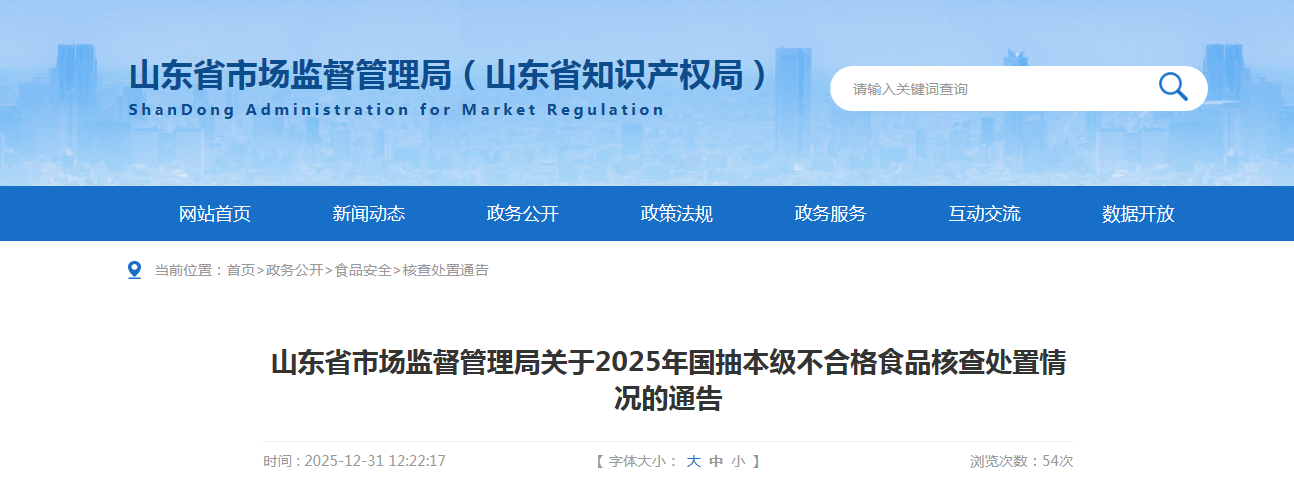
山东省市场监督管理局关于2025年国抽本级不合格食品核查处置情况的通告
Zhong Guo Zhi Liang Xin Wen Wang· 2026-01-07 06:09
Summary of Key Points Core Viewpoint - The Shandong Provincial Market Supervision Administration has reported on the inspection and handling of substandard food products in 2025, highlighting the completion of 100 tasks related to national-level food safety inspections and the measures taken to address identified issues [3]. Group 1: Inspection and Handling Results - A total of 100 tasks related to national-level substandard food inspections were completed in Shandong Province in 2025 [3]. - Out of these, 45 tasks were focused on production and entrusted production, with non-compliant products primarily including special dietary foods, edible agricultural products, convenience foods, and seasonings [3]. - The main issues identified included nutritional indicators not meeting standards in special dietary foods, pesticide and veterinary drug residues exceeding limits in edible agricultural products, and microbial indicators failing to meet requirements in convenience foods [3]. Group 2: Regulatory Actions and Outcomes - In the distribution and online sales sectors, 55 tasks were conducted, with over half of the non-compliant products being edible agricultural products with excessive pesticide residues [3]. - The total amount of non-compliant products recalled, removed from shelves, or sealed was 6.85 tons [3]. - A total of 87 cases were filed, resulting in fines and confiscations amounting to 837,300 yuan [3].
【图解】权威解读:5方面举措破解供需错配 最大程度激发消费潜力
Zhong Guo Jing Ji Wang· 2025-12-01 13:11
Core Viewpoint - The article discusses the implementation of a new plan aimed at addressing structural mismatches in supply and demand within China's consumer goods market, emphasizing the need to enhance adaptability between supply and consumer preferences to maximize consumption potential and promote economic circulation [3][6]. Group 1: Implementation Plan Overview - The Ministry of Industry and Information Technology, along with five other departments, has issued an "Implementation Plan" to enhance the adaptability of consumer goods supply and demand [3]. - The plan aims to address existing structural mismatches in various sectors of consumer goods [3]. Group 2: Key Measures Proposed - Five key measures are proposed to tackle supply-demand mismatches: 1. **Expand Incremental Supply**: Accelerate the application of new technologies and innovative models [7]. 2. **Deepen Existing Supply**: Increase the supply of specialized and new products, focusing on areas like green, health, rural, and national trends [11][12]. 3. **Precise Matching of Diverse Needs**: Address the differentiated needs of various age groups, including children and the elderly, through targeted actions [13][15][16]. 4. **Scene Empowerment**: Cultivate new consumption scenarios and business formats, promoting platforms for product launches and exhibitions [17][18][19]. 5. **Optimize Environment**: Create favorable conditions for development by leveraging new policies, enhancing financial support, and maintaining market order [21][22]. Group 3: Focus Areas for Development - The plan emphasizes the importance of aligning production with consumer preferences from the design stage, ensuring dynamic matching in quality, structure, and utility [5][6]. - It highlights the need for a comprehensive approach that includes user participation in design and the integration of artificial intelligence across the entire production and sales chain [12].

到2027年将形成3个万亿级消费领域——推动供给与消费良性互动、相互促进
Ren Min Ri Bao· 2025-11-29 02:52
Core Viewpoint - The implementation plan aims to enhance the adaptability of supply and demand in consumer goods, addressing structural mismatches and promoting high-quality consumption in China [1][2][4]. Group 1: Current State of Consumer Goods Supply - China's consumer goods supply has entered a new development stage characterized by high quality and reasonable pricing, meeting the basic needs of the population, although structural mismatches still exist in certain sectors [2][4]. - High-end brands in sectors such as jewelry, bags, and cosmetics are still relatively scarce, indicating a need for innovation and supply that aligns with the quality and personalization demands of consumers [2][4]. Group 2: Proposed Measures in the Implementation Plan - The plan outlines five key measures to address supply-demand mismatches, including expanding new technology applications, enhancing the supply of unique and new products, and accurately matching different demographic needs [3][4]. - Specific initiatives include promoting flexible production models, developing new product categories in health and green sectors, and creating new consumption scenarios and business models [3][4]. Group 3: Market Potential and Growth Areas - The plan anticipates the emergence of new consumption markets worth trillions of yuan, with goals to establish three trillion-level consumption fields and ten hundred-billion-level consumption hotspots by 2027 [5]. - Key areas identified for growth include elderly products, smart connected vehicles, and consumer electronics, with additional hotspots in children's products, smart wearables, cosmetics, fitness equipment, and more [5][6]. Group 4: Role of Technology and Innovation - The widespread application of artificial intelligence is transforming the consumer market, with a focus on integrating new technologies into the entire supply chain of consumer goods [7]. - The plan emphasizes the need for collaboration among various departments to ensure the effective implementation of policies that enhance the quality of supply and meet consumer demands [8][9]. Group 5: Economic Contribution and Future Goals - By 2030, the plan aims to establish a high-quality development pattern where supply and consumption interact positively, with a steady increase in consumption's contribution to economic growth [8]. - Recent data indicates that retail sales reached 36.6 trillion yuan in the first ten months of the year, reflecting a year-on-year growth of 4.4%, suggesting a stable development trend in consumer spending [8].

推动供给与消费良性互动、相互促进
Ren Min Ri Bao· 2025-11-28 09:47
Core Insights - The Ministry of Industry and Information Technology, along with five other departments, has issued an implementation plan aimed at enhancing the adaptability of supply and demand in consumer goods, further promoting consumption [1] Group 1: Supply and Demand Transformation - The current supply of consumer goods in China has entered a new development stage characterized by high quality and price, but structural mismatches in supply and demand still exist in certain areas [2] - The implementation plan proposes five measures to address these mismatches, including expanding new product supply and accelerating the application of new technologies and models [2][3] Group 2: Market Segmentation and Consumer Needs - The plan emphasizes the need to cater to diverse consumer needs across different age groups, including initiatives for children's safety and elderly-friendly products [3][5] - It aims to create new consumption scenarios and business models, promoting platforms for product launches and exhibitions [3][6] Group 3: Economic Contribution and Growth - By 2027, the plan aims to create three trillion-yuan-level consumption sectors and ten hundred-billion-yuan-level consumption hotspots, including areas like elderly products and smart connected vehicles [4] - The contribution of consumption to economic growth is expected to steadily increase, with a goal of achieving a high-quality development pattern by 2030 [7] Group 4: Quality and Safety Standards - The National Development and Reform Commission plans to enhance supply quality by focusing on technology leadership and improving brand standards [8] - The State Administration for Market Regulation is set to strengthen the quality and safety of consumer goods, particularly for vulnerable groups such as the elderly and children [8]
到2027年将形成3个万亿级消费领域 推动供给与消费良性互动、相互促进
Ren Min Ri Bao· 2025-11-28 02:12
Core Viewpoint - The implementation plan aims to enhance the adaptability of supply and demand in consumer goods, addressing structural mismatches and promoting high-quality consumption in China by 2027 [2][4]. Group 1: Implementation Measures - Five key measures are proposed to address supply-demand mismatches, including expanding new product supply, enhancing innovation in technology and models, and promoting flexible manufacturing [2][3]. - The plan emphasizes the development of new consumption scenarios and business models, such as curated retail and shared consumption, to foster a vibrant market environment [3][4]. Group 2: Market Potential - The plan anticipates the creation of three trillion-yuan-level consumption sectors and ten hundred-billion-yuan-level consumption hotspots by 2027, including areas like elderly products and smart connected vehicles [4][5]. - The consumer market is expected to diversify and show strong growth potential, particularly in cultural and creative products, which enhance cultural identity and satisfaction [4][6]. Group 3: Economic Contribution - By 2030, the plan aims to establish a high-quality development framework where supply and consumption interact positively, increasing consumption's contribution to economic growth [7][8]. - Recent data indicates a steady growth in retail sales, with a year-on-year increase of 4.4% in the first ten months of the year, reflecting a positive trend in consumer spending [7][8]. Group 4: Quality Improvement - The plan includes initiatives to improve the quality of consumer goods through technological innovation and enhanced standards, particularly focusing on the needs of vulnerable groups like the elderly and children [8][9]. - Regulatory bodies will strengthen the oversight of product quality and safety, ensuring that new products meet higher standards to adapt to changing consumer demands [8][9].
推动供给与消费良性互动、相互促进(权威发布)
Ren Min Ri Bao· 2025-11-27 22:30
Core Viewpoint - The implementation plan aims to enhance the adaptability of supply and demand in consumer goods, addressing structural mismatches and promoting high-quality consumption in China by 2027 [1][2][4]. Group 1: Supply and Demand Adaptability - The current supply of consumer goods in China has entered a new development stage, but structural mismatches still exist in high-end brands and innovative products [2][3]. - The implementation plan proposes five key measures to address these mismatches, including expanding new product supply, enhancing innovation, and promoting new manufacturing models [2][3]. Group 2: Market Potential and Growth - By 2027, the plan aims to create three trillion-yuan-level consumption sectors and ten hundred-billion-yuan-level consumption hotspots, including elderly products, smart connected vehicles, and consumer electronics [4][5]. - The consumer market is expected to show strong growth potential, with diverse and vibrant characteristics emerging in sectors like cultural and creative products [4][6]. Group 3: Consumer Needs and Trends - The plan emphasizes the importance of catering to diverse consumer needs across different age groups, promoting safety in children's products, and enhancing the quality of elderly care products [3][5]. - There is a focus on developing personalized and fashionable products that resonate with younger consumers, such as cultural and designer collaborations [5][6]. Group 4: Economic Contribution and Policy Support - The plan aims to establish a high-quality development pattern by 2030, enhancing the contribution of consumption to economic growth through coordinated efforts among various departments [7][8]. - Recent data shows that retail sales reached 36.6 trillion yuan in the first ten months of the year, with a year-on-year growth of 4.4%, indicating a stable consumer market [7][8].
六部委划重点:未来两年这些消费领域迈向万亿级
Xin Jing Bao· 2025-11-27 14:59
Core Viewpoint - The implementation plan aims to enhance the adaptability of supply and demand for consumer goods, promoting consumption through targeted policies and measures following the 20th National Congress of the Communist Party of China [1] Group 1: Policy Measures - The plan includes accelerating the innovation and application of new technologies and models, promoting flexible production, and expanding user participation in design [4] - It emphasizes the development of distinctive and new products, particularly in green, health, rural, and national trends, while enhancing the efficiency standards of consumer goods [4][5] - The initiative aims to match the diverse needs of different age groups, including children, students, and the elderly, through targeted actions and product development [5][6] Group 2: Consumer Experience Enhancement - The plan proposes the cultivation of new consumption scenarios and business formats, encouraging the launch of new products and exhibitions [5][9] - It aims to improve the quality and safety standards of products, particularly for vulnerable groups such as children and the elderly, by establishing strict quality standards and promoting high-quality product directories [6][11] Group 3: Market Environment Optimization - The initiative seeks to create a favorable development environment by leveraging financial support and combating illegal advertising and counterfeit products [5][13] - It emphasizes the importance of enhancing the international consumption environment by enriching the supply of quality products and services in key cities [9][11] Group 4: Technological Integration - The plan highlights the integration of artificial intelligence and other new technologies across the entire production and sales chain, aiming to improve efficiency and consumer experience [10][17] - It encourages the development of smart home products and health monitoring devices, particularly for the elderly, to enhance their quality of life [17][18]

工信部:针对新型和重点领域深挖存量,围绕差异化需求细分市场
2 1 Shi Ji Jing Ji Bao Dao· 2025-11-27 03:53
Core Viewpoint - The State Council's policy briefing on November 27 introduced measures to enhance the adaptability of consumer goods supply and demand, focusing on addressing mismatches in key areas and proposing initiatives to stimulate consumption [1] Group 1: Policy Measures - The implementation plan emphasizes deepening existing resources and expanding the supply of unique and new products [1] - Initiatives target new and key consumption areas such as green, health, rural, and national trends, including accelerating the R&D of special dietary foods and leisure sports products [1] - The plan includes promoting energy efficiency and water efficiency standards for consumer goods, as well as organizing exhibitions and outreach activities for quality products [1] Group 2: Market Segmentation - The policy aims to precisely match the diverse needs of different demographic groups, including children, students, and the elderly [1] - A three-year action plan for the safety of children's and students' products will be implemented, alongside upgrades for electronic information products to enhance user-friendliness [1] - Initiatives will also support independent designers and brands, promote quality elderly products, and advance home modifications for aging populations [1]
到2027年我国将形成3个万亿级消费领域和10个千亿级消费热点
Sou Hu Cai Jing· 2025-11-27 03:49
Core Viewpoint - The Chinese government aims to enhance the adaptability of consumer goods supply and demand through a new implementation plan, promoting high-quality development and increasing consumption's contribution to economic growth by 2030 [3][4]. Group 1: Implementation Plan Overview - The implementation plan, jointly issued by the Ministry of Industry and Information Technology and five other departments, was publicly released on November 26 [3]. - The plan sets two main development goals: to establish three trillion-level consumption sectors and ten hundred-billion-level consumption hotspots by 2027, and to create a high-quality development pattern of mutual promotion between supply and consumption by 2030 [3][4]. Group 2: Key Measures Proposed - The plan outlines five key measures to address supply-demand mismatches: 1. **Expand Incremental Supply**: Accelerate the application of new technologies and innovative models, promote flexible production, and integrate AI into the entire production and sales process [4]. 2. **Deepen Existing Supply**: Focus on developing products in emerging areas such as green and health products, and enhance standards for energy and water efficiency [4]. 3. **Segment Markets**: Tailor offerings to different demographic needs, including safety measures for children's products and upgrades for elderly-friendly products [4]. 4. **Empower Scenarios**: Foster new consumption scenarios and business models, including the establishment of platforms for product launches and exhibitions [4]. 5. **Optimize Environment**: Utilize new policies to strengthen financial support, promote quality Chinese consumer goods, and combat counterfeit products [4]. Group 3: Future Actions - The Ministry of Industry and Information Technology will collaborate with relevant departments to implement the plan, enhance resource investment, and provide policy support to boost consumption and stabilize growth [5].