
蛋黄酱

Search documents
年夜饭放冰箱连吃好几天,老人突然头晕抽搐!紧急进ICU
Xin Lang Cai Jing· 2026-02-26 04:14
Core Viewpoint - The article highlights the risks associated with consuming leftover food stored in the refrigerator, particularly focusing on Listeria monocytogenes, which can lead to severe health issues such as meningitis, especially in vulnerable populations like the elderly and pregnant women [1][2]. Group 1: Health Risks - Listeria monocytogenes can survive and grow in cold environments, including refrigeration and freezing, making it a significant food safety concern [2][4]. - The infection can lead to severe conditions such as meningitis and sepsis, with a mortality rate ranging from 20% to 30% for affected individuals [2][4]. - Vulnerable groups, including the elderly, pregnant women, and immunocompromised individuals, are at a much higher risk, with pregnant women facing a risk 13 to 100 times greater than the general population [5][6]. Group 2: Food Safety Guidelines - Certain foods are particularly prone to Listeria contamination, including long-stored leftovers, unpasteurized dairy products, and undercooked meats [7]. - It is crucial to separate raw and cooked foods, thoroughly reheat leftovers, and regularly clean the refrigerator to minimize contamination risks [9]. - High-risk individuals should avoid unpasteurized dairy products and undercooked foods to prevent infection [9][10]. Group 3: Symptoms and Medical Attention - Symptoms of Listeria infection can range from mild flu-like symptoms to severe neurological issues, necessitating immediate medical attention if severe symptoms occur [10][11]. - Healthy adults may experience mild symptoms, but the infection can be life-threatening for vulnerable populations, emphasizing the need for careful dietary practices [11].


三文鱼配牛油果 网红色拉搭配的健康法则
Xin Lang Cai Jing· 2026-01-07 06:53
Core Viewpoint - The article discusses the nutritional aspects and misconceptions surrounding salads, emphasizing that while they are perceived as healthy, they may not always provide balanced nutrition. Group 1: Popularity and Nutritional Potential of Salads - The popularity of salads is linked to modern demands for visual appeal, health labels, and convenience in dining [3] - A quality salad can offer significant nutritional benefits, including vitamins, minerals, dietary fiber, and high-quality proteins [3] Group 2: Nutritional Truths of Popular Combinations - The combination of salmon and avocado in salads provides healthy fats but requires careful portion control to avoid excessive calorie intake [4] - Processed ingredients like ham and cheese in salads often contain high sodium levels, necessitating caution in their consumption [4] Group 3: Common Pitfalls in Salad Consumption - Large portions of leafy greens may not equate to adequate vegetable intake, leading to insufficient dietary fiber [6] - Many salads either exclude carbohydrates or overload on various "healthy" grains, which can lead to imbalanced calorie intake [7] - Salad dressings can significantly increase calorie content, with common options like mayonnaise being particularly high in calories [8] - The cumulative effect of healthy fats from ingredients like avocado and nuts can lead to exceeding recommended fat intake [9] - Protein sources in salads are often minimal, which may not provide sufficient satiety and can lead to increased hunger shortly after eating [10] Group 4: Ideal Salad Composition - An ideal salad should include approximately 200 grams of vegetables to ensure adequate fiber and micronutrient intake [11] - Quality protein sources should be included in a palm-sized portion to enhance satiety [11] - A fist-sized portion of healthy carbohydrates should be incorporated for sustained energy [11] - Healthy fats should be used sparingly, such as a small amount of nuts or avocado [11] - Dressings should be light and used in moderation, preferably served on the side to control intake [11]

新华深读丨向油腻饮食说不
Xin Hua Wang· 2025-12-22 00:48
Core Viewpoint - The article highlights the rising health concerns associated with excessive oil consumption in China, where daily cooking oil intake significantly exceeds recommended levels, leading to various health issues including obesity and chronic diseases [10][13][15]. Group 1: Current Consumption Trends - The average daily cooking oil intake in China is 43.2 grams, which is about 33% higher than the recommended 25-30 grams [13][14]. - The total daily fat intake per person is 79.1 grams, exceeding the recommended 50-70 grams [13][14]. - In 2024, the estimated consumption of edible vegetable oil in China is projected to be 37.08 million tons, translating to an average per capita consumption of approximately 26.3 kilograms [13]. Group 2: Health Implications - Excessive oil consumption is linked to increased risks of hypertension, diabetes, and various cancers, with obesity being a significant public health issue in China [15][16][18]. - The prevalence of overweight and obesity among children and adults is alarming, with rates of 6.8% and 34.3% respectively [18][19]. - Long-term high oil intake can lead to metabolic diseases, including non-alcoholic fatty liver disease and type 2 diabetes [16][19]. Group 3: Cultural and Behavioral Factors - The preference for high-oil foods is deeply rooted in Chinese culinary traditions, where oil is seen as essential for enhancing flavor [21][22]. - Many consumers rely on intuition rather than measurement for oil usage, with 65% using personal experience to determine oil amounts [22][23]. - The shift from limited oil availability in the past to an abundance today has contributed to the current high consumption levels [24][25]. Group 4: Industry Response and Initiatives - A nationwide "reduce oil" campaign is being promoted, with guidelines suggesting daily oil intake should not exceed 25-30 grams [30][31]. - The food and restaurant industry is responding by offering smaller portion sizes and healthier cooking options, such as low-oil meals [33][35]. - Initiatives are being taken to educate consumers about healthier cooking practices and the importance of balanced oil consumption [30][31][38].
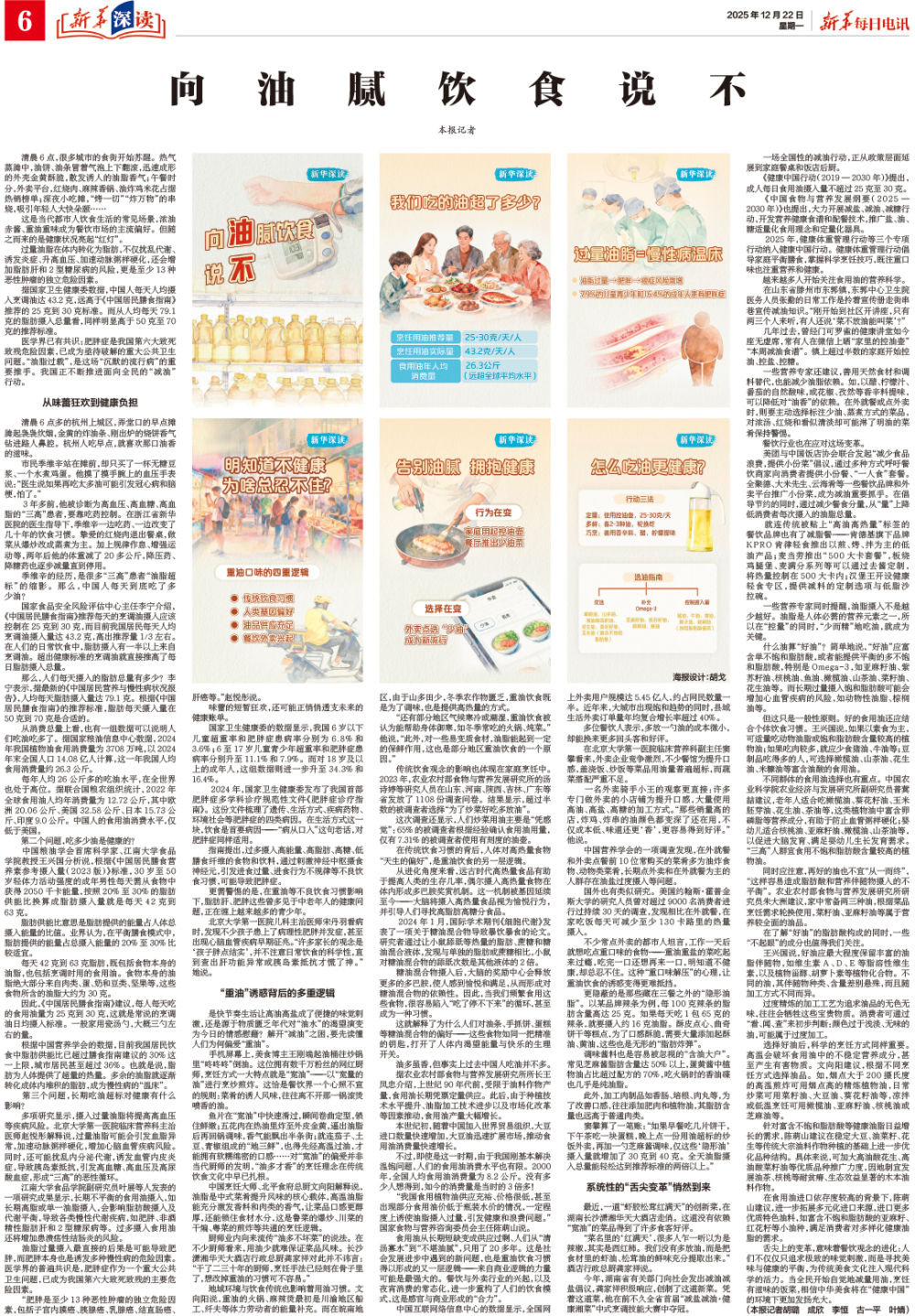
向油腻饮食说不
Bei Jing Ri Bao Ke Hu Duan· 2025-12-21 22:45
Core Viewpoint - The article highlights the growing concern over excessive oil consumption in China, which is linked to various health issues, including obesity and chronic diseases. The current average daily cooking oil intake is significantly above recommended levels, prompting a nationwide "reduce oil" initiative to address this public health challenge [1][3][17]. Group 1: Current Consumption and Health Risks - The average daily cooking oil intake in China is 43.2 grams, exceeding the recommended 25-30 grams by approximately one-third [3][4]. - The total daily fat intake per person is 79.1 grams, which is also above the recommended range of 50-70 grams [3][4]. - Excessive oil consumption is linked to serious health risks, including hypertension, diabetes, and various cancers, with obesity being a major public health issue in China [6][7][12]. Group 2: Dietary Trends and Cultural Influences - Traditional cooking practices favor high oil usage, with many consumers believing that more oil enhances flavor, leading to a cultural preference for "heavy oil" dishes [9][10]. - The rise of fast-paced lifestyles and the convenience of high-oil foods have contributed to the normalization of excessive oil consumption [8][14]. - The food delivery industry has further reinforced these trends, with many popular dishes being high in oil, salt, and sugar [14][19]. Group 3: Government Initiatives and Public Awareness - The Chinese government has initiated campaigns to promote reduced oil consumption, including guidelines that recommend daily oil intake not exceeding 25-30 grams [17][18]. - There is a growing public awareness regarding the health implications of high oil consumption, with more individuals adopting healthier cooking practices and dietary habits [18][19]. - The food and nutrition sector is responding to these changes, with restaurants and food services beginning to offer lower-oil options and smaller portion sizes [19][22]. Group 4: Future Directions and Recommendations - Experts suggest a balanced approach to oil consumption, emphasizing the importance of choosing healthier oils rich in unsaturated fats while reducing overall intake [20][21]. - There is a call for diversification in oil sources, promoting the cultivation of high-quality oilseed crops to meet the demand for healthier oils [22]. - The shift towards healthier eating habits is seen as a necessary evolution in Chinese culinary practices, aiming to balance taste and health [22].
2025年中国沙拉酱行业政策、产业链全景、运行现状及未来发展趋势研判:健康化迭代与功能化升级并行,沙拉酱市场规模有望达到152亿元[图]
Chan Ye Xin Xi Wang· 2025-10-01 02:09
Core Insights - The salad dressing industry in China is evolving towards healthier consumption, driven by national health policies promoting low-calorie, functional, and clean-label products [5][6][9] - The market size for salad dressing is projected to reach 13 billion yuan in 2024 and grow to 15.2 billion yuan by 2025, fueled by the expansion of the Western fast-food market and increasing demand for light meals [7][9] - The industry is characterized by a competitive landscape of foreign brands leading the market alongside the rise of domestic brands focusing on health, localization, and innovative flavors [11][12] Industry Overview - Salad dressing, known as "Salad Dressing," is a condiment made primarily from oil, vinegar, and various seasonings, used to enhance the flavor of salads and other foods [2][3] - The main categories of salad dressing include oil-vinegar types and thicker varieties like mayonnaise, which are used in various culinary applications [3][4] Policy Analysis - The Chinese government has implemented several health policies, including the "Healthy China 2030" initiative and the "Three Reductions" policy (reducing salt, oil, and sugar), which guide the salad dressing industry towards healthier formulations [5][6] Industry Chain - The salad dressing industry chain includes upstream suppliers of raw materials like oils and eggs, midstream manufacturers such as major food companies, and downstream retail channels including supermarkets and restaurants [6][9] Market Consumption Trends - The primary consumption of salad dressing is concentrated in Western fast-food restaurants, accounting for 43.28% of the market, with increasing household consumption as cooking diversity rises [6][9] - The light meal salad market is expected to reach 14.18 billion yuan in 2024, growing by 18.7% year-on-year, indicating a shift towards healthier eating habits [7][9] Competitive Landscape - The salad dressing market is dominated by foreign brands like Kewpie and Kraft Heinz, while domestic brands like Baoli Foods are gaining market share by aligning with health trends [11][12] - New entrants are focusing on niche markets with innovative, health-oriented products, enhancing competition in the industry [11][12] Future Development Trends - The salad dressing industry is expected to focus on three main areas: health and nutrition, flavor innovation, and environmental sustainability [13][15] - There will be a significant push towards low-calorie, low-fat, and functional products, alongside the introduction of diverse flavors that cater to local tastes [13][14] - Companies will increasingly adopt green practices in production and packaging, utilizing renewable energy and biodegradable materials to meet consumer demand for sustainability [15]

味可美以54亿元收购墨西哥合资子公司股权
Bei Jing Shang Bao· 2025-08-22 05:23
Group 1 - McCormick announced the acquisition of an additional 25% stake in its joint venture McCormick de Mexico for $750 million, increasing its ownership to 75% [1] - The acquisition aims to strengthen McCormick's leadership position in the seasoning and sauce market and expand its presence in the Latin American market [1] - McCormick de Mexico, established in 1947, has an annual sales revenue of approximately $810 million, with mayonnaise as its core product [1] Group 2 - The transaction is expected to be completed at the beginning of the fiscal year 2026, with funding sourced from a combination of cash and debt [1] - The impact on the company's net debt to adjusted EBITDA ratio is expected to be minimal [1]
