通义实验室

Search documents
阿里巴巴(BABA):港股公司点评:云业务加速增长,坚定投入
SINOLINK SECURITIES· 2026-03-20 14:54
Investment Rating - The report maintains a "Buy" rating for the company, expecting a price increase of over 15% in the next 6-12 months [5]. Core Insights - The company reported total revenue of 284.843 billion yuan for FY26Q3, representing a year-over-year increase of 2% (or 9% when excluding the disposal of Gaoxin Retail and Yintai) [2]. - Adjusted EBITA for the same period was 23.397 billion yuan, down 57% year-over-year, while adjusted net profit attributable to shareholders was 17.112 billion yuan, down 67% year-over-year [2]. - The domestic e-commerce sector showed relatively weak performance due to market conditions, with flash sales experiencing reduced losses. International e-commerce growth and profitability were also weak, impacted by various negative factors [3]. - The cloud business remains strong, with revenue growth of 36% year-over-year for FY26Q3, and the establishment of the ATH business group to accelerate AI investments [4]. Financial Summary - For FY2026-2028, the adjusted net profit is projected to be 74.752 billion yuan, 110.245 billion yuan, and 156.629 billion yuan, respectively, with corresponding adjusted PE ratios of 27.8, 18.9, and 13.3 times [5]. - The company’s revenue growth rates are forecasted at 3.28% for FY2026, 10.96% for FY2027, and 11.27% for FY2028 [10]. - The adjusted net profit growth rates are expected to be -52.67% for FY2026, 47.48% for FY2027, and 42.07% for FY2028 [10].

阿里的价值重估,还要给市场一点时间
晚点LatePost· 2026-03-20 14:04
Core Viewpoint - The article discusses Alibaba's challenges and strategies in the AI era, focusing on how the company aims to align its production relationships with advanced productivity and when AI investments will yield profits [3][4]. Group 1: Financial Performance and Market Perception - Alibaba's core e-commerce business is experiencing slower growth, while its AI-related products have shown strong revenue growth, with AI-related income increasing for ten consecutive quarters at triple-digit year-on-year rates [4]. - Alibaba Cloud's revenue grew by 36% in the latest quarter, with a projected compound annual growth rate of over 40% for external revenue over the next five years, aiming for $100 billion in annual revenue by 2031 [4][10]. - The market has been critical of Alibaba's significant investments in AI, questioning how these will impact its traditional cash cow businesses [3][4]. Group 2: Organizational Changes and Strategy - Alibaba established the ATH (Alibaba Token Hub) business group to streamline its internal production relationships and enhance its AI capabilities, focusing on creating, delivering, and applying tokens [5][6]. - The ATH group aims to break down departmental barriers and unify efforts towards a common goal of selling tokens, which is seen as a more profitable business model compared to selling computing power [6][7]. - The establishment of the ATH group signals a clear commercialization path for Alibaba's AI initiatives, emphasizing the importance of strong model capabilities to support various applications [7][8]. Group 3: Long-term Goals and Market Positioning - Alibaba's long-term goal includes achieving over $100 billion in annual revenue from cloud and AI commercialization within five years, with a target EBITA profit margin of 20% for Alibaba Cloud [10][11]. - The company is transitioning from selling resources to selling intelligence, indicating a shift in its business model that is expected to enhance cloud profitability over time [11]. - The integration of various business capabilities into the Wukong platform aims to position Alibaba as a core player in the B2B market, leveraging AI to improve operational efficiency for enterprises [9][10].


上海调降商业房首付比例,xAI大规模招募银行家 | 财经日日评
吴晓波频道· 2026-03-18 00:38
Group 1: Real Estate Market - Shanghai has lowered the minimum down payment ratio for commercial housing loans from 50% to 30%, marking the first adjustment in over a decade, aimed at stimulating the commercial real estate market [2][3] - The commercial real estate market is facing high inventory pressure due to overly optimistic early planning and weak demand absorption, necessitating the reduction in down payment requirements to enhance liquidity [2][3] - Beike's net income for 2025 showed a slight increase of 1.2% year-on-year to 946 billion yuan, despite a significant decline in Q4 revenue by 28.7% [8][9] Group 2: AI and Technology Developments - NVIDIA's CEO Jensen Huang announced that the flagship computing chips Blackwell and Rubin are expected to generate at least $1 trillion in revenue by the end of 2027, significantly up from the previous estimate of $500 billion by 2026 [4][5] - Alibaba has established the Alibaba Token Hub (ATH) to focus on the creation, delivery, and application of tokens, indicating a strategic shift towards AI and tokenization in its business model [6][7] - xAI is launching a large-scale recruitment drive for financial professionals to enhance its AI model Grok's capabilities in financial modeling, amidst a backdrop of high turnover among its founding team [10][11] Group 3: Financial Services and Market Trends - Ant Group's acquisition of Yao Cai Securities has been approved, allowing it to integrate securities trading services into its Alipay platform, thereby enhancing its financial service offerings [12][13] - The public fund distribution landscape is evolving, with Ant Fund leading in equity fund holdings, reflecting a shift in competitive dynamics among distribution channels [14][15] - The stock market experienced a decline, with the Shanghai Composite Index falling by 0.85%, as market sentiment remains cautious amid external uncertainties [16][17]



阿里突然成立新事业群,这是要摸着谷歌过河?
程序员的那些事· 2026-03-17 02:53
Group 1 - Alibaba announced the establishment of Alibaba Token Hub (ATH), led by CEO Wu Yongming, consolidating five major AI initiatives into a unified operation [1] - The move is seen as a strategic response to Google's previous integration of Brain and DeepMind, aimed at reducing internal conflicts and focusing resources [1] - Alibaba's approach is more aggressive, restructuring its AI framework around the concept of Token, which is viewed as the fuel and currency of the AI era [2] Group 2 - ATH has clear objectives: Tongyi is responsible for creating "fuel," MaaS for the "pipeline," Qianwen for consumer-facing applications, and Wukong for enterprise platforms, forming a complete closed loop from technology to business [2] - This adjustment elevates AI to the same strategic level as e-commerce and cloud services, indicating Alibaba's full commitment to the AI Agent era [2]
重磅!阿里成立Alibaba Token Hub事业群
是说芯语· 2026-03-16 23:53
Core Viewpoint - Alibaba has established the Alibaba Token Hub, led by CEO Wu Yongming, focusing on the creation, delivery, and application of Tokens as a core objective [2][3]. Group 1: Structure and Responsibilities - The Alibaba Token Hub includes several divisions: Tongyi Laboratory, MaaS business line, Qianwen Division, Wukong Division, and AI Innovation Division, covering a complete layout from foundational model research to AI applications for individuals and enterprises [2]. - Tongyi Laboratory is tasked with "creating Tokens" by developing leading multimodal models, while the MaaS business line is responsible for "delivering Tokens" as a large model service platform for enterprise clients [2]. - The Qianwen Division, Wukong Division, and AI Innovation Division focus on "applying Tokens," competing for AI entry points for both B-end and C-end users [2]. Group 2: Market Positioning and Strategy - The establishment of the Wukong Division marks its first public appearance, positioning itself as a "B-end AI native work platform," indicating Alibaba's intent to penetrate the B-end AI application market [2]. - The formation of the AI Innovation Division suggests that Alibaba may explore more attempts in the segmentation of AI applications and product forms, aiming to "quickly validate new models and new markets" [2]. Group 3: Industry Context and Future Outlook - Wu Yongming highlighted that the company is on the brink of an AGI explosion, with billions of AI Agents expected to support digital work, which will be powered by Tokens generated by models [3][4]. - By 2025, there may be more Agents and robots than the global population, indicating that Agents could become the primary consumers of Tokens, surpassing human engineers [4]. - Alibaba's shift to integrating AI around "Tokens" rather than just models or computing power signifies a transition from a focus on technological leadership to a pursuit of commercial application [5]. - The recent departure of Lin Junyang, head of the Qianwen large model technology, has raised discussions about the alignment of the Tongyi Laboratory's independence with the group's strategy, reflecting a strategic inclination towards collaboration between foundational models and application ends [5].

阿里CEO亲自带队,内部信称“历史性机遇”来了!
第一财经· 2026-03-16 16:02
Core Viewpoint - Alibaba has established the Alibaba Token Hub, led by CEO Wu Yongming, focusing on the creation, delivery, and application of Tokens, marking a strategic shift towards commercializing AI applications rather than just technological exploration [3][4]. Group 1: Alibaba Token Hub Structure - The Alibaba Token Hub includes several divisions: Tongyi Laboratory, MaaS business line, Qianwen Division, Wukong Division, and AI Innovation Division, covering a comprehensive layout from foundational model research to AI applications for both individual and enterprise users [3]. - Tongyi Laboratory is tasked with creating leading multimodal models, while the MaaS business line serves as a large model service platform for enterprise clients [3]. - The Wukong Division is positioned as a "B-end AI native work platform," indicating Alibaba's intent to deepen AI integration into enterprise workflows [3][4]. Group 2: Strategic Shift and Market Positioning - The establishment of the Alibaba Token Hub reflects a shift from a focus on foundational large models to a more application-driven approach, as Alibaba aims to compete in the rapidly evolving AI landscape [5][6]. - Wu Yongming highlighted the impending explosion of AGI, with billions of AI Agents expected to support digital work, emphasizing the historical opportunity presented by the Token-based model [4]. - The departure of Lin Junyang, the former head of Qianwen's large model technology, has sparked discussions about the alignment of strategic goals within Alibaba, suggesting a need for stronger collaboration between foundational models and application ends [5].

突发!阿里砸出 AI 新事业群,Token 成核心,悟空事业部首度亮相
程序员的那些事· 2026-03-16 13:37
Core Viewpoint - Alibaba has made a significant strategic adjustment in its AI operations by establishing the Token Hub business unit, signaling a strong push into the B-end market [1] Group 1: Organizational Changes - The new structure consolidates all AI efforts into a single unit, moving away from a fragmented approach to enhance collaboration and efficiency [1] - The Token Hub will oversee five major business areas: Tongyi Lab, MaaS, Qianwen, Wukong, and AI Innovation, covering a wide range of applications from models to platforms and both C-end and B-end scenarios [1] Group 2: Focus on B-end AI - The Wukong business unit is designated as a core component of DingTalk, focusing on creating an enterprise-level AI native platform that integrates AI capabilities into workflows [1] - This move addresses a critical gap in Alibaba's B-end AI offerings, aiming to enhance productivity and operational efficiency for businesses [1] Group 3: Strategic Intent - Alibaba emphasizes that tokens are the "universal fuel" of the AI era, and the establishment of the Token Hub aims to secure control over the core productivity of AI [1] - The organizational upgrade is designed to streamline technology, product development, and commercialization, with a clear goal of achieving scalable profitability [1]
阿里字节开启2026届校招,AI岗位占比超六成
Xin Lang Ke Ji· 2025-08-05 09:28
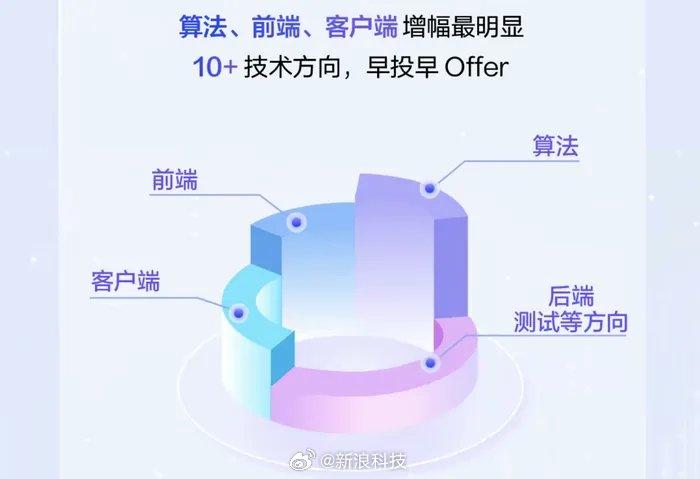
Group 1 - Major tech companies are initiating recruitment for the 2026 graduating class, with Alibaba starting its fall recruitment on August 5, offering over 7000 positions, with over 60% in AI-related roles [1] - ByteDance has also launched its campus recruitment for 2026 graduates, offering more than 5000 positions, marking a significant increase from the previous year's recruitment of over 4000 positions [1][2] - Alibaba's recruitment includes 15 business units, with a strong focus on AI, particularly in Alibaba Cloud, Alibaba International, DingTalk, and Gaode, where AI-related positions account for 80% and 75% respectively [1] Group 2 - Alibaba's recruitment targets graduates from November 2025 to October 2026, while ByteDance focuses on those graduating between September 2025 and August 2026 [2] - Taobao is expected to issue around 1000 offers, with over 90% in technical roles and nearly 50% in AI-related positions [2] - Ele.me is targeting a broader range of graduates from June 2024 to October 2026, primarily for product and R&D roles [3] Group 3 - The demand for AI and R&D talent is increasing rapidly, with a report indicating that the average monthly salary for AI engineers reached 21,319 yuan in the first week of spring recruitment 2025 [3] - McKinsey predicts that by 2030, the demand for AI professionals in China could reach 6 million, with a potential talent gap of 4 million [3] - Companies are intensifying their recruitment efforts to secure high-quality talent in response to the growing demand in the tech industry [3]
阿里巴巴开启2026届秋招,AI类岗位占比超6成
Sou Hu Cai Jing· 2025-08-05 03:58
Group 1 - Alibaba officially launched its fall 2026 campus recruitment, planning to issue over 7,000 offers [1] - The recruitment involves 15 business groups and companies under Alibaba, including Alibaba Group, Taotian, Alibaba Cloud, Alibaba International, Tongyi Laboratory, DingTalk, and Gaode [1] - This year's recruitment sees an increased proportion of AI-related positions, exceeding 60%, with some AI business departments having even higher ratios: 80% for Alibaba Cloud, Alibaba International, and DingTalk, and 75% for Gaode [1] Group 2 - New hires will have the opportunity to engage in multi-modal AI research and large model applications, including projects related to algorithm integration, digital humans, intelligent transportation, medical AI, and embodied intelligence [1]
为更多AI人才提供发展空间
Jing Ji Ri Bao· 2025-07-17 21:59
Group 1 - Alibaba Group is actively implementing a recruitment plan for 2025-2026 graduates, offering over 3,000 positions, with nearly 50% in AI-related roles [2] - The Chief Talent Officer of Alibaba, Jiang Fang, emphasized the company's commitment to attracting and nurturing talent in the AI field, aiming to provide ample development opportunities for young professionals [2] - Alibaba Cloud and Tongyi Laboratory are advancing a global talent recruitment project to attract individuals passionate about new technologies and innovation, with opportunities for graduates to participate in cutting-edge large model development [2] Group 2 - Ele.me announced the launch of its 2026 spring campus recruitment plan, with over 85% of positions in technology, and more than 30% directly related to AI algorithms [2] - Ele.me is set to initiate an AI algorithm competition focused on practical applications in elderly meal services, rider community services, and smart marketing, open to university students nationwide [3] - The competition is the first of its kind targeting college students, offering rewards and internship opportunities for winners, reflecting the industry's increasing focus on AI talent recruitment [3] Group 3 - The Director of the Digital Economy Integration and Innovation Development Center at Central University of Finance and Economics highlighted the importance of companies increasing their recruitment of AI talent in response to national policies promoting digital infrastructure and technological innovation [4] - The industry is shifting from a "blood transfusion" approach to a "blood production" mechanism in talent reserves, which is seen as an innovative measure to support the iterative development of human capital in the digital economy [4]