
防寒服

Search documents
2026春运|甘肃民航飞机维修甘南维修室攻坚2026春运保障
Zhong Guo Min Hang Wang· 2026-02-14 04:57
Core Viewpoint - The Gannan Maintenance Room is committed to ensuring safety and operational efficiency during the 2026 Spring Festival travel rush at the Gannan Xiahe Airport, which is located at a high altitude and faces severe winter conditions [1][4]. Group 1: Safety Measures - Safety is emphasized as the core baseline for Spring Festival operations, with a focus on proactive risk management and thorough inspections of critical systems such as oxygen, pressurization, anti-icing, and hydraulic systems [2]. - A comprehensive safety inspection was conducted to address potential hazards specific to high-altitude operations, ensuring compliance with high-altitude release standards [2]. Group 2: Equipment and Resource Management - The Gannan Maintenance Room undertook extensive maintenance and checks on all repair tools, testing equipment, and de-icing gear to ensure optimal performance under extreme conditions [2]. - Adequate winter supplies, including de-icing fluids and protective gear, were stockpiled to meet operational demands and safeguard personnel against cold and hypoxia [3]. Group 3: Personnel Commitment - Maintenance personnel are facing the challenges of cold and low oxygen levels but are dedicated to maintaining high operational standards and completing tasks efficiently [3]. - The team embodies a spirit of resilience and commitment, ensuring flight safety and providing a warm experience for travelers despite harsh working conditions [3][4].
2026年1月物价数据点评:“反内卷”与新质生产力发展并进
BOHAI SECURITIES· 2026-02-12 10:11
Group 1: CPI Analysis - In January 2026, the CPI increased by 0.2% year-on-year, a decrease from the previous value of 0.8%[11] - Core CPI's month-on-month growth reached its highest level in six months, driven by increased travel demand and rising international gold prices[4] - Food prices remained stable month-on-month, with fresh vegetable prices decreasing by 4.8%[14] Group 2: PPI Analysis - In January 2026, the PPI's year-on-year decline narrowed, while the month-on-month increase expanded[5] - Prices in the upstream raw materials sector turned from decline to increase due to the "anti-involution" effect, with basic chemical raw materials rising by 0.7%[25] - The month-on-month increase in production materials prices expanded, while living materials prices shifted from stable to rising[25] Group 3: Future Outlook - The CPI is expected to increase in February 2026, influenced by sufficient pig supply and potential price rises in fresh vegetables before the Spring Festival[16] - The PPI is projected to maintain a similar month-on-month increase in February, with a further narrowing of the year-on-year decline to around -1.0%[5] - Input inflation may rise in February, driven by ongoing "anti-involution" and the rapid development of new productive forces[26]
1月核心CPI温和上涨 节前重要民生商品量足价稳
Bei Jing Shang Bao· 2026-02-11 11:01
Group 1 - In January, the national consumer price index (CPI) increased by 0.2% year-on-year, with core CPI (excluding food and energy) rising by 0.8% [1][3] - The CPI increase was influenced by the Spring Festival timing and a significant drop in energy prices due to international oil price fluctuations [1][3] - The new base year for CPI and producer price index (PPI) is set to 2025, with the impact of this base year change on CPI and PPI monthly year-on-year indices averaging approximately 0.06 and 0.08 percentage points, respectively [1][8] Group 2 - Food prices decreased by 0.7%, contributing to a 0.11 percentage point decline in the year-on-year CPI, while non-food prices increased by 0.4% [4][5] - Core CPI showed a moderate increase, with a 0.3% month-on-month rise, marking the highest level in six months, driven by rising prices in travel and household services [5] - The PPI decreased by 1.4% year-on-year but increased by 0.4% month-on-month, marking four consecutive months of month-on-month increases [6][7] Group 3 - The new base year CPI classification includes adjustments to better reflect changes in consumer spending, with new categories added such as home security devices and internet medical services [8][9] - The overall weight changes in the CPI categories are minimal compared to the 2020 base year, with an increase in service weights and a decrease in consumer goods weights [9]


春节错月致1月CPI同比涨幅回落,反内卷带动相关领域价格改善
Di Yi Cai Jing· 2026-02-11 04:17
Group 1: Consumer Price Index (CPI) - In January, the CPI increased by 0.2% month-on-month and year-on-year, reflecting a decrease of 0.6 percentage points compared to December [1] - The decline in CPI is attributed to the Spring Festival timing and a significant drop in energy prices, which decreased by 5.0%, impacting CPI by approximately 0.34 percentage points [3] - Core CPI, excluding food and energy, rose by 0.8% year-on-year and 0.3% month-on-month, marking the highest increase in six months, indicating a steady recovery in consumer demand [3] Group 2: Producer Price Index (PPI) - The PPI rose by 0.4% month-on-month in January, marking the fourth consecutive month of increase, with an expansion of 0.2 percentage points from the previous month [5] - Factors contributing to the PPI increase include the ongoing construction of a unified national market and rising demand in certain industries [5] - Prices in sectors such as photovoltaic, battery, cement, and steel have shown positive improvements due to the "anti-involution" policies implemented last year [5] Group 3: Industry-Specific Price Changes - In January, prices for cement manufacturing and lithium-ion battery manufacturing increased by 0.1%, continuing a four-month upward trend [5] - The price of photovoltaic equipment and components shifted from a 0.2% decrease to a 1.9% increase, while basic chemical raw materials saw a 0.7% increase [5] - The prices of non-ferrous metal mining and smelting industries rose significantly, with silver smelting prices increasing by 38.2% and copper smelting by 8.4% [6] Group 4: Future Price Trends - The National Bureau of Statistics indicates that favorable factors for moderate price recovery are accumulating, supported by policies aimed at boosting consumption and stabilizing market expectations [6] - The implementation of coordinated fiscal and financial policies is expected to gradually expand consumer demand, providing a foundation for stable price operations [6] - Emphasis on industry self-regulation and capacity management is anticipated to further enhance price recovery in key sectors [6]
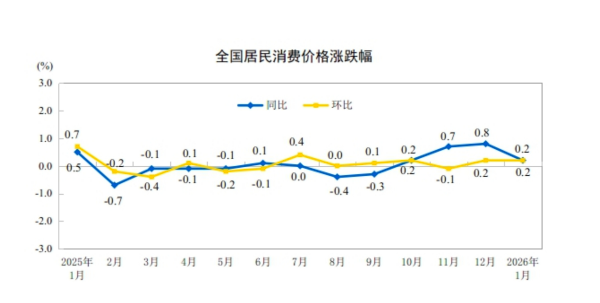
国家统计局解读2026年1月份CPI和PPI数据
Guo Jia Tong Ji Ju· 2026-02-11 01:43
Group 1 - The Consumer Price Index (CPI) increased by 0.2% month-on-month and year-on-year, while the core CPI, excluding food and energy, rose by 0.8% year-on-year [1][2] - The decline in food prices, particularly fresh vegetables and pork, contributed to a decrease in the CPI's year-on-year growth rate, with fresh vegetable prices rising by 6.9% and pork prices falling by 13.7% [1][2] - Energy prices decreased by 5.0% in January, impacting the CPI negatively by approximately 0.34 percentage points, with gasoline prices down by 11.4% year-on-year [1][2] Group 2 - The Producer Price Index (PPI) rose by 0.4% month-on-month, marking the fourth consecutive month of increase, with a narrowing year-on-year decline of 1.4% [2][3] - The increase in PPI was driven by the ongoing development of a unified national market, leading to price rises in sectors such as cement manufacturing and lithium-ion battery production [2][3] - Input factors influenced the price trends in domestic non-ferrous metals and petroleum-related industries, with non-ferrous metal mining prices increasing by 22.7% year-on-year [3][4]
中铁电气化局沈阳公司工会当好一线职工坚实后盾
Xin Lang Cai Jing· 2026-02-02 16:59
Core Viewpoint - The company is actively ensuring the well-being of frontline workers during harsh winter conditions by providing essential winter supplies and meals, thereby supporting ongoing construction projects [1][2]. Group 1: Employee Support Initiatives - The company’s union has conducted a "Winter Warmth Delivery" activity to provide frontline workers with winter supplies such as thermal clothing, gloves, and heat packs [1]. - Daily hot meals are prepared in the company cafeteria to ensure workers have access to nutritious food after their shifts [1]. - Specific winter support is tailored to different job roles, including windproof masks for high-altitude workers and thick cotton clothing for those working outdoors [1]. Group 2: Future Plans and Commitment - The union plans to continue its role as a bridge between management and workers, focusing on practical support and problem-solving for frontline employees [2]. - There will be ongoing research and assistance activities to better understand and meet the needs of workers, expanding the benefits provided to them [2].
更暖更轻 当航天材料遇到防寒服
Zhong Guo Xin Wen Wang· 2025-12-07 13:32
Core Viewpoint - The application of aerospace technology in civilian sectors is seen as a transformative opportunity, enhancing everyday life while promoting economic development through innovative materials and products [1][2] Group 1: Aerospace Technology in Civilian Use - Aerospace technology is being applied in various civilian sectors, including hydrogen energy, electromechanical equipment, and materials [1] - The commercialization of aerospace materials is viewed as an inevitable trend in economic development, providing better user experiences and making advanced materials accessible to the general public [1] Group 2: Product Innovations - Aerospace-grade insulation materials are being transformed into fibers or batting for textiles, resulting in high-performance winter clothing that offers superior warmth, better elasticity, and longer lifespan compared to conventional options [1] - The collaboration between Beijing Aerospace Kane New Materials Co., Ltd. and Beijing Xinrui Aisikan Technology Co., Ltd. aims to integrate aerospace materials technology with the health industry, marking a significant step in applying advanced materials to enhance public health [1] Group 3: Strategic Collaboration - The partnership focuses on deepening cooperation in new material research, health product innovation, and industry standard formulation, accelerating the transition of aerospace technology into health products [2] - The goal is to leverage Chinese aerospace manufacturing to upgrade the health industry and benefit a broader population [2]
国家粮食和储备局紧急向广西调运中央救灾物资 支持进一步做好救灾救助工作
Yang Shi Wang· 2025-10-24 15:47
Core Viewpoint - The National Grain and Reserves Administration has urgently allocated 30,000 pieces of disaster relief supplies to support the affected areas in Guangxi Baise due to ongoing flooding disasters [1] Group 1 - The emergency supplies include cotton tents, folding beds, towels, cotton quilts, cold-weather clothing, emergency lighting, and family emergency kits [1] - The allocation aims to assist local authorities in providing transitional aid and basic living guarantees for the affected population [1]
三部门调拨中央救灾物资支持广西进一步做好救灾救助工作
Xin Hua Wang· 2025-10-24 12:29
Core Viewpoint - The National Disaster Reduction and Relief Committee Office and the Ministry of Emergency Management have increased the allocation of disaster relief materials to areas affected by persistent flooding in Guangxi Baise, responding to the urgent needs for disaster relief and assistance [1] Group 1: Disaster Relief Efforts - A total of 30,000 pieces of central disaster relief materials, including cotton tents, folding beds, towels, cotton quilts, cold-weather clothing, emergency lighting, and family emergency kits, have been allocated to the disaster-stricken areas [1] - The emergency material support mechanism involves coordination with various organizations, including the China Red Cross Foundation, China Rural Development Foundation, One Foundation, and the Aide Foundation, to provide targeted assistance [1] Group 2: Additional Support - In addition to the central relief materials, 42,000 pieces of living supplies, such as emergency food, autumn clothing, relief family boxes, household generators, and water pumps, are being coordinated to support the local population during the transitional relief period and ensure basic living security [1]
多部门调拨中央救灾物资 支持广西进一步做好救灾救助工作
Zhong Guo Xin Wen Wang· 2025-10-24 08:45
Core Points - The National Disaster Reduction and Relief Committee Office and the Ministry of Emergency Management have increased the allocation of disaster relief materials to areas affected by persistent flooding in Baise, Guangxi, including 30,000 items such as cotton tents, folding beds, and emergency lighting [1] - In addition to the central disaster relief materials, 42,000 items of living supplies, including emergency food, autumn clothing, and household generators, are being coordinated through various foundations to support the affected population [1] Group 1 - The government is responding to the ongoing flooding disaster in Guangxi by enhancing the supply of essential relief materials [1] - A total of 30,000 central disaster relief items are being dispatched to support local recovery efforts [1] - Various organizations are collaborating to provide an additional 42,000 living supplies to assist affected families [1]