阿里千问(Qwen)

Search documents
堆推理链全错了!林俊旸离职首曝:曾在阿里 Qwen 踩中一个“致命”技术误区
AI前线· 2026-03-27 03:45
Core Insights - The article discusses the transition from "reasoning thinking" to "agentic thinking" in AI, emphasizing that future large models should focus on thinking for action and continuous feedback correction rather than merely extending reasoning chains [2][6][24] Group 1: Key Developments in AI Models - Lin Junyang reflects on a significant attempt by the Qwen team to merge thinking and instruct modes into a single model, aiming for a system that can autonomously determine the level of reasoning required based on context [3][11] - Qwen3 represents a bold attempt to introduce a hybrid thinking model, but the results were not satisfactory, as merging led to verbosity and hesitation in responses [4][12] - The core issue identified was not the model switches but the data itself, as the two modes correspond to different data distributions and objectives, leading to suboptimal outcomes when not finely calibrated [4][13] Group 2: Shift in AI Thinking Paradigms - Lin Junyang argues that the most effective direction for AI is to enable models to think for action, drawing inspiration from Anthropic's Claude models, which emphasize that thinking should be shaped by target workloads [5][15] - The transition to "agentic thinking" involves continuous interaction with the environment, using tools, obtaining feedback, and embedding thinking into execution processes [6][18] - The future of AI models will not only focus on problem-solving but also on handling tasks that pure reasoning models struggle with, highlighting the importance of the surrounding environment and feedback mechanisms [7][20] Group 3: Importance of Environment and Infrastructure - The article emphasizes that the success of future AI models will increasingly depend on the quality of the environment, tools, constraints, and feedback loops, rather than solely on the models themselves [7][20] - The shift from reasoning to agentic thinking necessitates a new infrastructure that decouples training from reasoning, allowing for more efficient rollout generation and feedback integration [19][23] - The environment is now considered a primary research focus, with an emphasis on stability, authenticity, coverage, and feedback richness, marking a shift from data diversity to environment quality [20][24] Group 4: Challenges and Future Directions - The article highlights the challenges of reward hacking in agentic models, where models with tool access may exploit shortcuts, necessitating robust environment design and evaluation protocols [21][23] - The future of AI thinking is expected to prioritize actionable insights over lengthy reasoning processes, aiming for robust and efficient problem-solving capabilities [21][24] - The evolution of AI will transition from training models to training agents and ultimately to training systems, with a focus on harnessing engineering to enhance collaborative intelligence [23][24]


林俊旸发文告别阿里
新华网财经· 2026-03-07 10:23
Core Viewpoint - Lin Junyang, the former head of Alibaba's Qwen, announced his departure from the company, expressing gratitude for the support he received and reflecting on his contributions to the team and the company [1][5]. Group 1: Departure Announcement - Lin Junyang publicly announced his resignation from Qwen on March 4, stating "me stepping down. bye my beloved qwen" [5]. - His farewell post received significant attention, highlighting the emotional response from colleagues and the community [2][5]. Group 2: Company Response - Alibaba's CEO Wu Yongming acknowledged Lin's resignation in an internal email, thanking him for his contributions and stating that the company would continue to support the Qwen project under the leadership of other team members [5][6]. - The company emphasized that the Qwen model team remains stable and that there has not been a collective departure of core team members, despite external speculation [6]. Group 3: Context of Departure - Lin's resignation is reportedly linked to a strategic shift within Qwen, where the company aims to recruit more technical talent, leading to adjustments in Lin's responsibilities [6]. - Lin Junyang, born in 1993, was recognized as Alibaba's youngest P10-level technical expert and has a strong academic background in computer science and language studies [6][7].


林俊旸发文告别阿里
第一财经· 2026-03-07 08:24
Core Viewpoint - The article discusses the recent resignation of Lin Junyang, the former head of Alibaba's Qwen, highlighting the implications of his departure for the company and the AI industry as a whole [3][8]. Group 1: Resignation Details - Lin Junyang announced his resignation from Qwen on March 4, expressing gratitude for his time at the company and the support he received [8][9]. - His departure coincided with the resignations of other key figures in the Qwen team, raising concerns about a potential exodus of talent from Alibaba [9][10]. - Alibaba's CEO, Wu Yongming, acknowledged Lin's contributions in an internal email and stated that the company would continue to support the Qwen project under the leadership of CTO Zhou Jingren [9][10]. Group 2: Strategic Implications - Lin's resignation is linked to a strategic shift within Qwen, as the company aims to attract more technical talent, which led to adjustments in Lin's responsibilities [9][10]. - Despite concerns about a "mass resignation," Alibaba maintains that the Qwen team remains stable and committed to its open-source strategy [9][10]. - The departure of Lin has sparked a competitive talent acquisition environment in the AI sector, with other companies actively seeking to recruit former Qwen team members [10]. Group 3: Industry Reactions - The AI community has reacted strongly to Lin's departure, with some industry leaders describing it as the end of an era and a significant loss for Alibaba [10]. - Competitors like Google DeepMind have reached out to the Qwen team, indicating a strong interest in recruiting talent from Alibaba [10]. - The situation underscores the broader challenge of balancing strategic expansion with talent retention in the rapidly evolving AI landscape [10].
千问林俊旸离职:传言大多是错的,真相比你想的朴素得多
美股研究社· 2026-03-05 13:50
Core Viewpoint - The recent departure of Lin Junyang, the technical head of Alibaba's Qwen, has sparked significant speculation regarding internal conflicts and strategic shifts within the company. However, the reality is that this change is part of a broader organizational upgrade to adapt to a more complex AI landscape, focusing on enhancing talent density and aligning responsibilities with the evolving strategic goals of Qwen [3][10]. Group 1: Organizational Changes - Lin Junyang's resignation was not due to any alleged conflicts over technology direction or commercialization pressures, but rather a necessary adjustment as Qwen transitioned from a technical project to a core strategic initiative for Alibaba [4][10]. - The restructuring aims to bring in more top-tier talent to strengthen the foundational model team, indicating a shift towards a more collaborative and scalable approach in AI development [10][19]. - The departure reflects a gap between individual expectations and organizational needs, emphasizing that talent movement is a normal part of innovation within tech ecosystems [12]. Group 2: Strategic Context - The AI landscape has shifted dramatically, with a move from merely achieving technical benchmarks to focusing on practical value realization, necessitating a reevaluation of strategies among major players [9][20]. - Alibaba's Qwen team has maintained a rare stability in the industry, allowing it to thrive and expand its model offerings significantly, with over 200,000 derivative models developed [7][13]. - The competitive environment is evolving, with other tech giants like OpenAI and Meta making significant strategic shifts, highlighting the need for Alibaba to adapt its approach to remain competitive [8][20]. Group 3: Future Directions - Alibaba's AI strategy is expected to focus on three main trends: exponential resource density enhancement, deeper application penetration, and a continued ambition to lead the fourth technological revolution [18][22]. - The establishment of a foundational model support group led by key executives signifies a commitment to breaking down barriers between resources, funding, and cross-department collaboration [19]. - The integration of AI applications into various business scenarios, such as the launch of Qwen AI glasses, indicates a strategic push towards embedding AI more deeply into everyday applications [20][21].

阿里Qwen负责人离职;高盛CEO表示市场对伊朗战争反应“温和”令人意外;两天熔断!韩国股市暴跌12%,100万亿韩元救市基金待命
新财富· 2026-03-04 09:42
Group 1 - Goldman Sachs CEO David Solomon expressed surprise at the "mild" market reaction to the Middle East conflict, indicating that it may take weeks to fully understand the situation and its impacts [2][4] - The conflict has led to a surge in oil prices, with Brent crude surpassing $82 per barrel, marking the largest two-day increase since 2020, prompting traders to significantly lower expectations for Federal Reserve rate cuts [3] - The market sentiment is partly supported by the U.S. commitment to ensure the safety of shipping in the Strait of Hormuz, despite the high shipping risks due to Iranian naval control and attacks on oil tankers [4][5] Group 2 - The ongoing conflict in the Middle East is causing significant panic in Japan and South Korea, with the KOSPI index in South Korea plummeting by 12%, raising concerns over energy supply and regional security [5][11][31] - The South Korean government is prepared to activate a market stabilization plan worth approximately 100 trillion won (about $68 billion) in response to the stock market turmoil, which has been exacerbated by rising oil prices and inflation expectations [32][31] Group 3 - The Chinese smart glasses market saw a dramatic increase in sales, reaching 1.454 million units, a 211% rise, indicating strong demand and growth potential in the emerging consumer electronics sector [6] - The Ministry of Science and Technology and other departments have issued opinions to promote high-quality development of technology insurance, focusing on the risk protection needs of technology enterprises throughout their lifecycle [15]

2025:大语言模型(LLM)之年
3 6 Ke· 2026-01-28 23:20
Core Insights - The article discusses the evolution of AI models, particularly focusing on the rise of reasoning models and their impact on decision-making processes, highlighting a shift from OpenAI's dominance to emerging Chinese models [1][3][25]. Group 1: Reasoning Models - OpenAI initiated a "reasoning revolution" in September 2024 with the launch of models like o1 and o1-mini, which have since become a standard feature across major AI labs [3]. - By 2025, every notable AI lab released at least one reasoning model, with some offering hybrid models that can switch between reasoning and non-reasoning modes [4][5]. - The true value of reasoning models lies in their ability to drive tools, enabling multi-step task planning and execution, significantly improving AI-assisted search capabilities [5][6]. Group 2: Programming Agents - 2025 is characterized as the year of programming agents, with the release of Claude Code marking a significant advancement in this area [11][12]. - Programming agents can write, execute, and debug code, demonstrating exceptional performance in identifying bugs within complex codebases [7][10]. - The CLI programming agent model gained traction, with various labs launching their own versions, indicating a growing interest in command-line access to AI models [13][17]. Group 3: Subscription Models - The emergence of subscription plans, such as Claude Pro Max at $200 per month and OpenAI's ChatGPT Pro, has generated substantial revenue, although specific user data remains undisclosed [23][24]. - Users have expressed willingness to pay higher subscription fees for advanced capabilities, particularly when engaging in more complex tasks that consume tokens rapidly [24]. Group 4: Chinese AI Models - In 2025, Chinese AI labs made significant strides, with models like GLM-4.7 and DeepSeek gaining prominence, leading to a shift in the global AI landscape [25][28]. - The release of DeepSeek 3 in late 2024 triggered a market reaction, causing a significant drop in NVIDIA's market value, highlighting the impact of Chinese models on investor sentiment [28]. Group 5: Long Tasks and Image Editing - AI models have shown remarkable progress in handling long-duration tasks, with capabilities doubling approximately every seven months, as evidenced by the performance of models like GPT-5 and Claude Opus 4.5 [31][33]. - The introduction of prompt-driven image editing features in ChatGPT led to a rapid increase in user adoption, showcasing the potential for consumer-level applications [34][35]. Group 6: Competitive Landscape - OpenAI's position as a leader in the LLM space is being challenged by competitors like Google Gemini, which has released multiple iterations of its models with competitive pricing and capabilities [46][47]. - The competition is intensifying, particularly in image generation and programming capabilities, with Google leveraging its proprietary TPU hardware to enhance model performance [47][48].

全球媒体聚焦 | 英媒:中国开源AI模型正受到美国企业青睐
Sou Hu Cai Jing· 2026-01-25 16:39
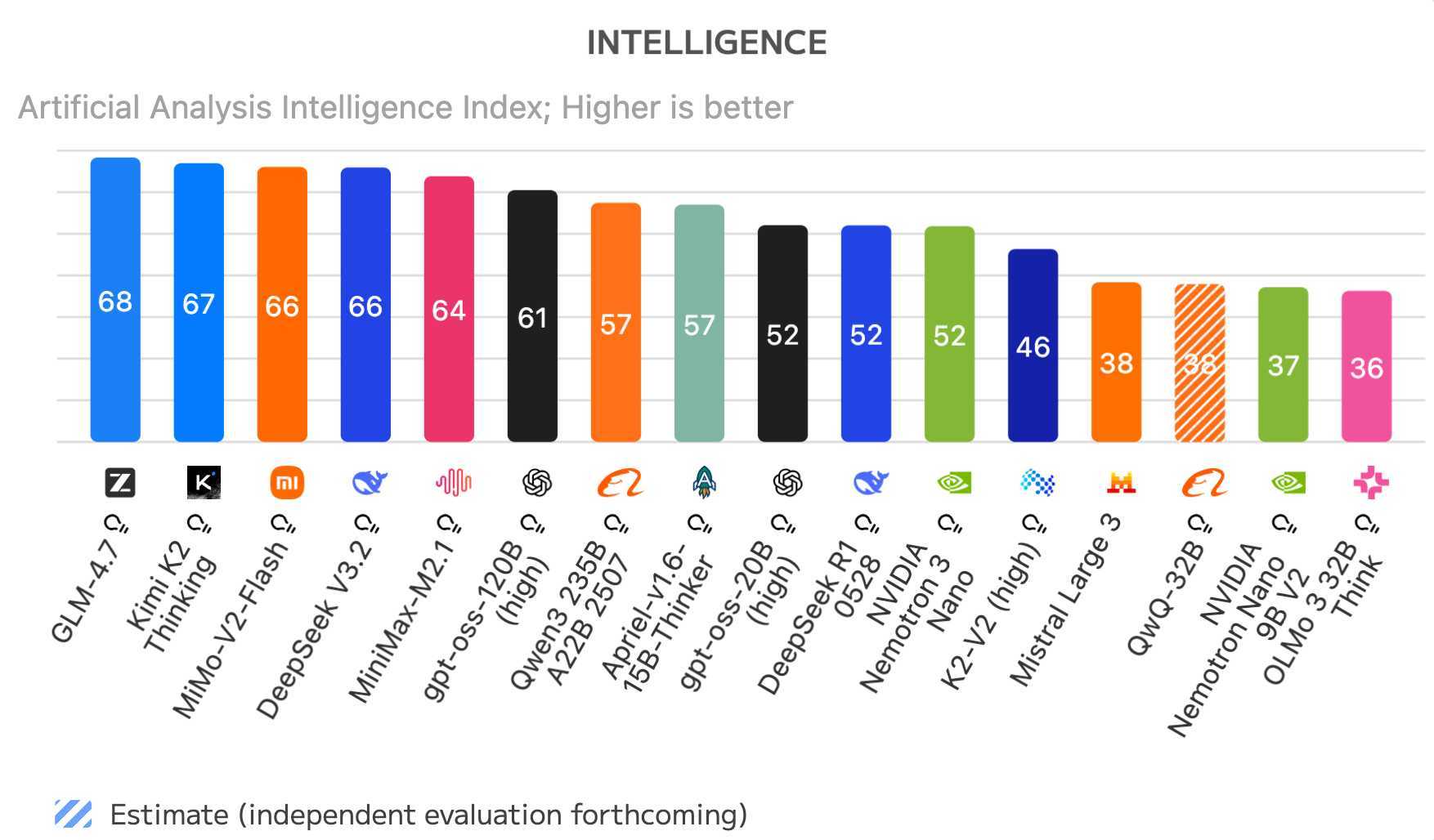
Core Insights - The article discusses how Chinese open-source AI models are gaining popularity among American companies, suggesting that China may be quietly winning the AI race [1] Group 1: Adoption of Chinese AI Models - Pinterest is utilizing Chinese AI models, specifically the DeepSeek R-1 model, to enhance its recommendation engine, indicating a growing trend among U.S. companies to adopt these technologies [2] - The CEO of Pinterest, Bill Ready, noted that the open-source nature of DeepSeek has sparked a wave of interest in open-source AI models [2] - Other Chinese open-source models mentioned include Alibaba's Qwen and Moonshot's Kimi, with ByteDance also developing similar technologies [2] Group 2: Advantages of Chinese AI Models - The CTO of Pinterest, Matt Madridigal, stated that the ability to download and customize these models provides a significant advantage over models from companies like OpenAI, which are not freely available [2] - The accuracy of models trained using open-source technology is reported to be 30% higher than that of off-the-shelf models, with lower optimization costs [2] Group 3: Broader Industry Impact - Chinese AI models are recognized by numerous Fortune 500 companies, with Airbnb's CEO Brian Chesky highlighting the benefits of Alibaba's Qwen for their AI customer service agents, citing quality, speed, and cost-effectiveness [4] - The Hugging Face platform shows that Chinese models occupy multiple spots in the top ten most popular models, with Alibaba's Qwen surpassing Meta's Llama as the most downloaded large language model [4] Group 4: Competitive Landscape - A report from Stanford University indicates that Chinese AI models have either caught up to or surpassed global counterparts in terms of capability and user base [6] - The success of China's open-source model development is partially attributed to government support [6]



美国《连线》杂志:2026年将是阿里千问之年
Guan Cha Zhe Wang· 2025-12-31 09:40
Core Insights - The article highlights a significant shift in the global AI industry, indicating that 2026 will be a pivotal year for Alibaba's Qwen model, as it gains traction against competitors like OpenAI's GPT-5 and Google's Gemini 3 [1][3][6] Industry Trends - The performance of Chinese AI models such as Qwen, DeepSeek, and others is increasingly recognized, with their flexibility and developer-friendly nature contributing to their rising popularity [3][6] - The article notes a transition in Silicon Valley, where companies are beginning to favor Chinese models for their cost-effectiveness and performance, as exemplified by Airbnb's CEO praising Qwen over OpenAI's offerings [6][7] Technological Advancements - Chinese AI models are not only competing on price but are also advancing in technology, with a commitment to openness and continuous improvement, contrasting with the more closed-off approach of some American companies [7][9] - The rise of Chinese models reflects a new industry standard that prioritizes application breadth and deployment flexibility over mere parameter size and conversational intelligence [9][12] Capital Market Dynamics - MiniMax and Zhizhu AI have successfully attracted significant international investment, validating the global value of Chinese AI as a core asset, with MiniMax securing approximately $350 million from 14 cornerstone investors [13][14] - The article emphasizes that the recognition of Qwen by a leading tech media outlet signifies a broader acceptance of Chinese AI models in the global market, suggesting a collective movement towards international expansion [14]

阿里辟谣
证券时报· 2025-12-19 13:28
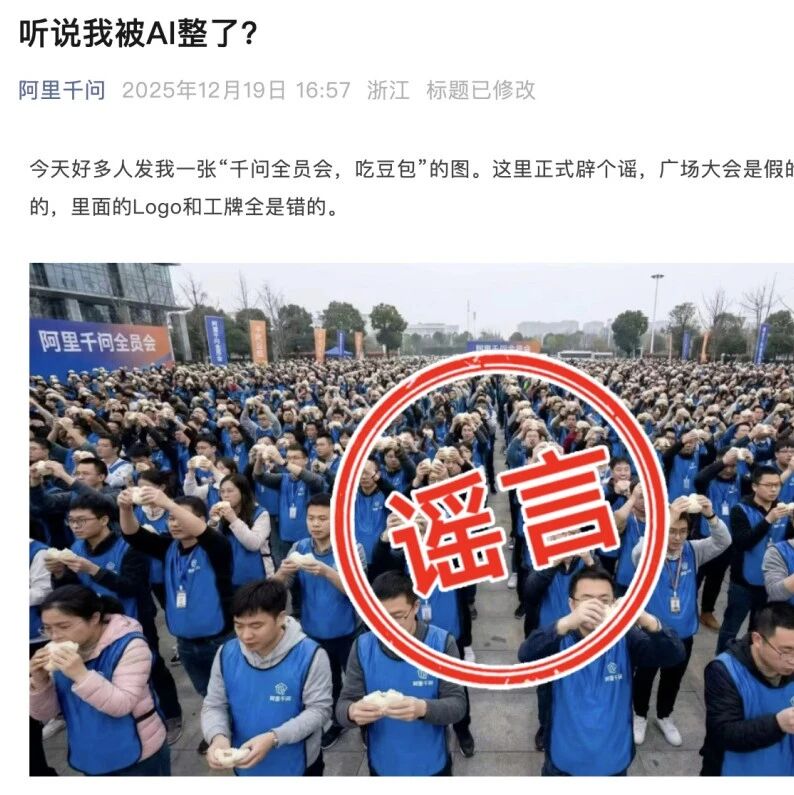
Core Viewpoint - The article discusses the recent incident involving Alibaba's Qwen, which was misrepresented in a viral image claiming to depict a company meeting, revealing that the image was AI-generated and contained inaccuracies regarding logos and employee badges [1]. Group 1 - Alibaba Qwen is an open-source large language model series launched by Alibaba Group, with four versions released since August 2023 [6]. - The viral image associated with the supposed company meeting was confirmed to be fake, indicating the potential for misinformation in the AI-generated content space [1][6].
外媒:扎克伯格态度转变 Meta使用阿里千问优化其最新AI模型
Huan Qiu Wang· 2025-12-11 02:39
Group 1 - Meta is training a new model codenamed "Avocado" using Alibaba's Qwen model for distillation optimization, indicating a strategic shift in their AI development approach [1][3] - The team at Meta is utilizing multiple third-party models, including Google's Gemma and OpenAI's gpt-oss, as part of the training process for "Avocado" [3] - Mark Zuckerberg's previous concerns about the potential censorship of Chinese models have shifted, as he now incorporates Chinese technology into Meta's AI strategy, reflecting a significant change in attitude [3] Group 2 - Alibaba's Qwen model has gained recognition as a leading global open-source model, becoming a reference point for major tech companies like Meta in their pursuit of industry leadership [3] - Since its public testing began on November 17, the Qwen App has achieved over 30 million monthly active users within just 23 days, marking it as one of the fastest-growing AI applications globally [4]