首艘电磁弹射型航母

Search documents
人民日报评论员:策马扬鞭 勇往直前
Ren Min Ri Bao· 2026-02-14 23:48
Core Viewpoint - The speech by General Secretary Xi Jinping emphasizes the importance of maintaining strategic determination and advancing step by step towards the goals of the "14th Five-Year Plan" while encouraging the nation to strive for a better future [1]. Group 1: Strategic Focus - The need to concentrate on internal affairs and respond to uncertainties with high-quality development is highlighted, especially in the context of trade wars and natural disasters [4]. - The emphasis on overcoming challenges and uncertainties under the centralized leadership of the Party is crucial for progress [4]. Group 2: Innovation and Technology - The recognition of the necessity for technological innovation as a path to future success is reinforced, with a focus on adapting to new technological revolutions and industrial changes [5]. - China's rapid rise in innovation capability is noted, with the country being recognized as one of the fastest-growing economies in terms of innovation [5]. Group 3: People-Centric Development - The tangible benefits to the public, such as increased subsidies and community support initiatives, reflect a commitment to improving people's lives [6]. - The connection between investing in both material and human resources is emphasized as essential for achieving the goals of the "14th Five-Year Plan" [6].
策马扬鞭 勇往直前
Ren Min Ri Bao· 2026-02-14 23:30
Core Viewpoint - The speech by General Secretary Xi Jinping emphasizes the importance of maintaining strategic determination and advancing step by step towards the goals of the "14th Five-Year Plan" while encouraging the nation to strive for a better future [1]. Group 1: Strategic Direction - The focus is on achieving high-quality development to address uncertainties in both domestic and international contexts, showcasing China's resilience and strength in the face of challenges such as trade wars and natural disasters [4]. - The leadership under the Communist Party is highlighted as crucial for overcoming obstacles and ensuring progress, with a call for greater courage to tackle risks and challenges [4]. Group 2: Innovation and Technology - The importance of innovation is underscored, with a recognition that technological advancement is essential for future development, as seen in China's rapid rise as one of the fastest-growing economies in terms of innovation [5]. - China's transition from being the "world's factory" to a "global innovation center" is noted, with foreign research institutions acknowledging China's unique path in technological advancement [5]. Group 3: Social Development and Welfare - The government has implemented various social welfare initiatives, such as increasing monthly subsidies for families and expanding community services, reflecting a commitment to improving the lives of citizens [6]. - The "14th Five-Year Plan" is described as both a development blueprint and a response to the needs of the people, emphasizing the importance of aligning development with public welfare [6].
向广大官兵和优抚对象致慰问信
Xin Lang Cai Jing· 2026-02-03 19:46
Core Viewpoint - The letter expresses sincere greetings and best wishes to military personnel, veterans, and their families, highlighting the achievements and contributions of the People's Liberation Army (PLA) and the armed forces in the past year [1][2][3] Group 1: Achievements and Contributions - In 2025, under the strong leadership of the Party Central Committee, significant progress was made in various sectors, including high-quality economic development and increased grain production [2] - The PLA and armed forces demonstrated political loyalty, engaged in military preparedness, and contributed to disaster relief efforts, showcasing their reliability and dedication to the nation [3] Group 2: Future Aspirations - The year 2026 marks the 105th anniversary of the Communist Party of China and the beginning of the 15th Five-Year Plan, calling for unity and commitment to the Party's leadership [3] - The letter emphasizes the importance of adhering to Xi Jinping's thoughts and enhancing national confidence and awareness to achieve future goals [3]
【好评中国】“新质造”加速破局,中国制造向强而进
Xin Lang Cai Jing· 2026-01-30 11:27
Core Viewpoint - China's manufacturing industry continues to hold the top position globally for 16 consecutive years, with a focus on high-end, intelligent, and green transformation, marking a shift from quantity to quality in manufacturing [1][3] Group 1: Manufacturing Scale and Transformation - China's manufacturing scale is expected to remain the largest in the world, with a significant shift towards high-end and intelligent production methods [1] - The value-added of equipment manufacturing and high-tech manufacturing is growing rapidly, indicating a move up the value chain [1] - Major achievements in manufacturing include advancements in high-speed trains, aircraft carriers, and drones, showcasing China's commitment to innovation and self-sufficiency [1] Group 2: Smart Manufacturing and Production Efficiency - The wave of smart manufacturing is reshaping production models, with hundreds of advanced smart factories established, leading to significant improvements in production efficiency and reduced product development cycles [2] - The integration of industrial internet and new technologies like AI and big data is driving a revolutionary leap in productivity, allowing China to compete on a global scale [2] Group 3: Green Manufacturing and Sustainability - China is moving away from traditional high-energy and high-emission practices, with a focus on sustainable development as a core competitive strategy [2] - The production of new energy vehicles has surpassed 16 million units, maintaining the world's leading position for 11 consecutive years, alongside rapid growth in green products like wind turbines and bio-based chemical fibers [2] Group 4: Commitment to Becoming a Manufacturing Powerhouse - China has officially entered the ranks of global manufacturing powers, alongside traditional leaders like Germany and Japan, driven by a complete industrial system and improved development quality [3] - The combination of policy, capital, technology, and talent is creating a strong synergy to propel China's manufacturing from isolated breakthroughs to systematic upgrades [3] - The sustained position as the world's largest manufacturer serves as a foundation for further advancements towards high-quality development [3]
我国将建一批具全球竞争力产业集群
Zhong Guo Zi Ran Zi Yuan Bao· 2026-01-30 07:24
Group 1 - The core viewpoint of the articles highlights the progress and strategic direction of central enterprises in China towards high-quality development by 2025, focusing on major national technological projects and advancements in various industries [1][2] - By 2025, central enterprises are expected to lead or participate in all 22 major national technological projects, achieving breakthroughs in 121 leading technologies, including the development of the first electromagnetic catapult aircraft carrier [1] - The construction of a modern industrial system is emphasized as a crucial support for advancing Chinese-style modernization, with significant progress in actions related to industrial renewal, future industries, and "AI+" initiatives [1] Group 2 - The State-owned Assets Supervision and Administration Commission (SASAC) will guide central enterprises to focus on intelligent, green, and integrated development, enhancing their advantages to build a modern industrial system that is self-controlled, safe, reliable, and competitive [2] - The key focus areas include "three concentrations," which involve adjusting existing structures and optimizing new investments to enhance the integrity, advancement, and safety of China's industrial system [2] - The main goal is to create a number of emerging pillar industries by establishing market-oriented and specialized state capital operation platforms, with a focus on sectors such as new energy, new energy vehicles, aerospace, and quantum technology, among others [2]
权威发布|两个万亿元,标注国资央企创新刻度
Ren Min Ri Bao· 2026-01-29 03:26
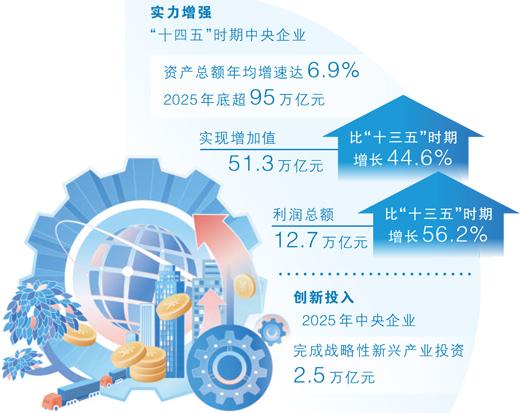
Core Insights - The State-owned Assets Supervision and Administration Commission (SASAC) announced that central enterprises are projected to achieve a total profit of 2.5 trillion yuan, fixed asset investment of 5.1 trillion yuan, and tax contributions of 2.5 trillion yuan by 2025, with total assets exceeding 95 trillion yuan by the end of 2025 [1] Group 1: Performance Metrics - During the 14th Five-Year Plan period, central enterprises' total assets increased from 70 trillion yuan to over 90 trillion yuan, with an average annual growth rate of 6.9% [3] - The added value of central enterprises reached 51.3 trillion yuan, a 44.6% increase compared to the previous five-year period [3] - Total profits for central enterprises amounted to 12.7 trillion yuan, reflecting a 56.2% growth from the 13th Five-Year Plan period [3] - Key product outputs, such as crude oil production, electricity generation, and electricity sales, saw increases of 24.7%, 38.2%, and 40.7% respectively compared to the previous five-year period [3] Group 2: Innovation and R&D - Central enterprises' R&D investment reached 1.1 trillion yuan in 2025, with the addition of 22 academicians and the establishment of 23 innovation consortia involving over 100 entities [4] - Cumulatively, R&D investment during the 14th Five-Year Plan exceeded 5 trillion yuan, with a 0.27 percentage point increase in R&D intensity [3][4] - Central enterprises led or participated in all 22 national major science and technology projects in 2025, achieving breakthroughs in 121 leading technologies [4] Group 3: Strategic Investments - By 2025, revenue from strategic emerging industries for central enterprises surpassed 12 trillion yuan, with a continuous annual growth of 1 trillion yuan [5] - Strategic emerging industry investments accounted for 41.8% of total investments, with over 10 trillion yuan invested since the beginning of the 14th Five-Year Plan [5] Group 4: Future Directions - In 2026, central enterprises will focus on increasing value-added growth to match national GDP growth, ensuring stable improvements in profit totals, operating revenue rates, and net asset returns [10] - Emphasis will be placed on enhancing technological innovation, with plans to increase the proportion of basic research investment and tackle key strategic technologies [10] - Central enterprises will also expand their mid-test verification platforms and increase procurement of first sets, batches, and versions to facilitate the conversion of innovative results into productive forces [10]
两个万亿元 标注国资央企创新刻度
Ren Min Ri Bao· 2026-01-29 01:42
Core Insights - The central enterprises in China are projected to achieve a total profit of 2.5 trillion yuan and fixed asset investment of 5.1 trillion yuan by 2025, with total assets exceeding 95 trillion yuan by the end of 2025 [1] Group 1: Scale and Performance - During the 14th Five-Year Plan period, the total assets of central enterprises increased significantly, reaching over 90 trillion yuan with an average annual growth rate of 6.9% [2] - The added value of central enterprises reached 51.3 trillion yuan, a 44.6% increase compared to the previous five-year period, while total profits grew by 56.2% to 12.7 trillion yuan [2] - Key product outputs, such as crude oil and electricity generation, saw substantial increases of 24.7% and 38.2% respectively during the same period [2] Group 2: Innovation and R&D Investment - Central enterprises invested over 5 trillion yuan in R&D during the 14th Five-Year Plan, with R&D intensity increasing by 0.27 percentage points and a nearly 50% rise in the number of technology talents [4] - By 2025, R&D investment is expected to reach 1.1 trillion yuan, with significant achievements in major technological projects and innovations [4] - Central enterprises are leading or participating in all 22 national major science and technology projects, overcoming 121 key technologies [4] Group 3: Strategic Emerging Industries - Revenue from strategic emerging industries is projected to exceed 12 trillion yuan by 2025, with a continuous annual growth of 1 trillion yuan [5] - Investment in strategic emerging industries will account for 41.8% of total investments, reflecting a shift towards new industry structures [5][6] - Central enterprises are focusing on sectors such as integrated circuits, biotechnology, and new energy vehicles, while also enhancing their positions in high-end equipment manufacturing and artificial intelligence [6] Group 4: Traditional Industry Transformation - Central enterprises are actively transforming traditional industries by establishing smart factories and promoting green technologies [7] - The construction of intelligent factories and the implementation of advanced technologies are opening new development spaces for traditional sectors [7] Group 5: Future Goals and Regulatory Framework - In 2026, central enterprises will enhance procurement efforts for first sets and batches of products, aiming for continuous growth in value added and alignment with national GDP growth [9][10] - A more precise evaluation system will be implemented to improve the quality and internal value of state-owned enterprises [10] - The focus will be on increasing high-quality technological supply and advancing original technology development [11]

两个万亿元,标注国资央企创新刻度
Ren Min Ri Bao· 2026-01-29 00:13
Core Insights - The central enterprises in China are projected to achieve a total profit of 2.5 trillion yuan and fixed asset investment of 5.1 trillion yuan by 2025, with total assets exceeding 95 trillion yuan by the end of 2025 [1] Group 1: Financial Performance - During the 14th Five-Year Plan period, the total assets of central enterprises increased significantly, with an average annual growth rate of 6.9%, reaching over 90 trillion yuan [2] - The added value of central enterprises reached 51.3 trillion yuan, a 44.6% increase compared to the previous five-year period [2] - Total profits for central enterprises during this period amounted to 12.7 trillion yuan, reflecting a 56.2% increase from the previous five years [2] Group 2: R&D and Innovation - Central enterprises are set to invest 1.1 trillion yuan in R&D by 2025, with significant achievements in innovation, including participation in 22 national major technology projects and overcoming 121 leading technologies [3] - Cumulatively, central enterprises invested over 5 trillion yuan in R&D during the 14th Five-Year Plan, with a nearly 50% increase in the number of scientific and technological personnel [2][3] Group 3: Strategic Emerging Industries - By 2025, revenue from strategic emerging industries is expected to exceed 12 trillion yuan, with a continuous annual growth of 1 trillion yuan [4] - Investment in strategic emerging industries will account for 41.8% of total investments, with cumulative investments exceeding 10 trillion yuan since the beginning of the 14th Five-Year Plan [4] Group 4: Technological Advancements - Central enterprises are actively embracing artificial intelligence and new infrastructure construction, enhancing their capabilities in various sectors such as energy and manufacturing [6] - The establishment of over 70 intelligent factories and the development of numerous advanced technology demonstration projects highlight the focus on high-end, intelligent, and green transformation [5] Group 5: Future Directions - In 2026, central enterprises will focus on ensuring continuous growth in added value and optimizing various financial metrics, including profit totals and labor productivity [8] - The emphasis will be on enhancing technological innovation, with plans to increase the proportion of basic research investment and tackle key technologies [8]
中央企业2025年成绩单发布 呈现哪些新变化?
Ren Min Ri Bao· 2026-01-28 23:08
Core Insights - The State-owned Assets Supervision and Administration Commission (SASAC) announced that central enterprises achieved a total profit of 2.5 trillion yuan, fixed asset investment of 5.1 trillion yuan, and tax contributions of 2.5 trillion yuan by 2025, with total assets exceeding 95 trillion yuan by the end of 2025 [2] Group 1: Scale and Performance - During the 14th Five-Year Plan period, the total assets of central enterprises increased significantly, with an average annual growth rate of 6.9%, reaching over 90 trillion yuan [3] - The added value of central enterprises reached 51.3 trillion yuan, a 44.6% increase compared to the previous five-year period, while total profits grew by 56.2% to 12.7 trillion yuan [3] - Key product outputs, such as crude oil production, electricity generation, and electricity sales, saw substantial growth of 24.7%, 38.2%, and 40.7% respectively [3] Group 2: Investment in Innovation - Central enterprises invested over 5 trillion yuan in R&D during the 14th Five-Year Plan, with R&D intensity increasing by 0.27 percentage points and the number of technology talents rising by nearly 50% [3] - By 2025, R&D investment is projected to reach 1.1 trillion yuan, with significant achievements including the addition of 22 academicians and the formation of 23 innovation consortia involving over 100 entities [4] Group 3: Strategic Emerging Industries - In 2025, revenue from strategic emerging industries exceeded 12 trillion yuan, with a continuous annual growth of 1 trillion yuan, and their share of total revenue increased by over 10 percentage points compared to 2022 [6] - Investment in strategic emerging industries reached 2.5 trillion yuan, accounting for 41.8% of total investments [6] Group 4: Traditional Industry Transformation - Central enterprises are focusing on upgrading traditional industries, establishing 70 advanced intelligent factories and 39 projects recognized as national green low-carbon technology demonstration projects [8] - The integration of AI technology is being actively pursued, with significant investments in new infrastructure and the development of large models to support various industries [9] Group 5: Future Directions - In 2026, central enterprises will enhance procurement of first sets and batches of products, aiming for continuous growth in value added and alignment with national GDP growth [10][11] - The focus will be on increasing high-quality technological supply, improving foundational research investment, and accelerating the transformation of innovative achievements into productive forces [11]
力促央企在发展新质生产力上积厚成势
第一财经· 2026-01-28 15:43
Core Viewpoint - The article emphasizes the significant progress made by state-owned enterprises (SOEs) in China regarding technological innovation and the development of new productive forces, highlighting the importance of sustained R&D investment and collaboration with social capital to achieve high-quality growth by 2025 [2][4]. Group 1: R&D Investment and Achievements - Over the past five years, SOEs have cumulatively invested more than 5 trillion yuan in R&D, with a projected investment of 1.1 trillion yuan in 2025, marking the fourth consecutive year of annual investment exceeding 1 trillion yuan [2]. - In 2025, the R&D intensity of SOEs is expected to reach 2.86%, surpassing the average R&D intensity of 500 top private enterprises at 2.77% [3]. - SOEs have led or participated in all 22 major national science and technology projects, achieving breakthroughs in 121 leading technologies and producing significant innovations such as the Tianwen-1 Mars mission and the first electromagnetic aircraft carrier [2][5]. Group 2: Strategic Focus and Collaboration - SOEs are encouraged to enhance their focus on key core technology breakthroughs and increase the proportion of basic research investment, aiming to produce more original and leading technological achievements [5]. - The establishment of the National Venture Capital Guiding Fund aims to attract social capital, with participation from local governments, SOEs, financial institutions, and private capital, potentially mobilizing trillions in social investment [4]. - SOEs are advised to optimize their innovation ecosystem and attract various innovative resources from across the country and globally [4]. Group 3: Talent Development and Mechanisms - In 2025, SOEs added 22 academicians, achieving the best historical level, and employed 1.44 million R&D personnel, accounting for one-fifth of the national total [7]. - To maintain and enhance talent advantages, SOEs should encourage existing talent to take bold actions and implement mechanisms that reflect the benefits of R&D outcomes to frontline researchers [7]. - Learning from private enterprises, SOEs need to gradually eliminate institutional barriers to foster a more conducive environment for innovation and talent development [7].