A100 GPU

Search documents
云巨头,为何倒向英伟达?
半导体行业观察· 2026-02-19 02:46
Core Viewpoint - The partnership between Meta Platforms and Nvidia signifies a shift in Meta's strategy, indicating that the company's previous open hardware plans are insufficient to meet urgent AI computing demands, leading to a reliance on Nvidia's technology for large-scale AI systems [2]. Group 1: Partnership Details - Meta's recent deal with Nvidia is significantly larger than previous collaborations, valued at hundreds of billions, highlighting the urgency of AI computing needs [2]. - The collaboration involves Meta purchasing millions of Nvidia's Blackwell and Rubin GPUs, with some deployed in Meta's data centers and others potentially rented from cloud partners [7][11]. - The initial deployment will focus on inference tasks, with a possibility of training tasks included, indicating a strategic shift towards large-scale mixed expert models [8]. Group 2: Technical Specifications - Meta operates a vast high-performance cluster that requires tight coupling between CPUs and accelerators, which Nvidia's Grace-Hopper superchip is designed to support [3]. - The partnership includes the first large-scale deployment of Nvidia's Grace CPU, which is expected to enhance Meta's computational capabilities significantly [9]. - The Grace CPU is already being utilized in various high-performance computing clusters, indicating its growing acceptance in the industry [9]. Group 3: Financial Implications - The total value of the GPU procurement could range from $110 billion to $167 billion, depending on the number of GPUs purchased, with a potential annual increase in GPU volume [11]. - Meta's capital expenditure budget for 2026 is projected to be $125 billion, emphasizing the financial commitment to enhancing its AI capabilities [12]. - The reliance on renting computing power could lead to higher operational costs, as rental expenses are significantly greater than direct purchases [11][12].


2026年度策略系列报告:中美AI产业或将再度向上
Huafu Securities· 2026-02-13 06:48
Group 1 - The core narrative of the report indicates that the AI industry in China and the US is in a transitional phase, moving from "upstream selling shovels" and "new technology demand" to "empowering the entire industry" [9][10] - Three types of companies are identified as potential beneficiaries of the technology revolution: 1) upstream core technology and equipment suppliers, 2) companies corresponding to new demands generated by new technologies, and 3) companies applying new technologies to existing industries for empowerment [2][30] - The report emphasizes that the current market for the AI industry in China is still primarily driven by valuation rather than performance, indicating that it has not yet entered the second phase of performance-driven growth [15][20] Group 2 - The report outlines a methodology based on three dimensions: macro narrative, stock price drivers, and financial screening, to identify companies that may benefit from the AI wave [21][24] - Revenue growth is highlighted as a leading indicator of whether a company is benefiting from the technology revolution, typically preceding profit jumps by about one quarter [74][77] - The report notes that two operational strategies can cause revenue signals to fail: transitioning to new technology businesses and making early investments, which may delay profit realization [82][86] Group 3 - Historical comparisons are made between the US internet revolution (1985-2005) and the mobile internet cycle in China (2007-2015), illustrating how valuation and profit transitions have occurred in past technology revolutions [32][43] - The report discusses the importance of cash flow and advance payments as more comprehensive and forward-looking indicators compared to revenue alone, aiding in the identification of companies with potential profit inflection points [74][80] - The analysis of representative companies from both the US and China during previous technology cycles shows that stock price movements often align with the phases of valuation expansion and profit realization [51][62]
Amazon, and Qualcomm stocks sink following earnings, bitcoin plunges
Youtube· 2026-02-05 23:54
Core Insights - The article discusses Amazon's significant increase in capital expenditures (capex), projecting it to reach $200 billion by 2026, which is substantially higher than previous estimates of around $140 billion and consensus estimates of approximately $146 billion [2][5][4] - The acceleration of Amazon Web Services (AWS) growth to 24% is highlighted as a positive aspect, exceeding market expectations of 21-22% [2][3] - The competitive landscape among major tech companies, including Google, Microsoft, and Meta, is driving aggressive investments in compute resources to meet rising AI demand [7][19] Capital Expenditures - Amazon's capex for 2026 is projected at $200 billion, representing a 50% increase from 2025, which itself was a 60% increase from 2024 [3][4] - Analysts had previously estimated a much lower capex, indicating a significant upward revision in spending expectations [5][2] - The high capex is seen as necessary for Amazon to capture AI demand and maintain its competitive edge [4][19] AWS Growth - AWS growth has accelerated to 24%, which is a critical metric for evaluating the effectiveness of Amazon's increased spending [2][12] - Analysts expect AWS growth estimates to rise further due to the substantial capex commitment [12] - AWS margins have been solid, hovering around the mid-30% range, with potential for further improvement [12][13] Competitive Landscape - Major tech companies are competing for compute resources, which are essential for sustaining market advantages in the AI space [7][19] - Amazon's previous underinvestment in compute resources is acknowledged, emphasizing the need for increased spending to avoid falling behind competitors [9][19] - The demand for compute resources remains high, with companies like Nvidia experiencing sustained demand for their products [9][19] Long-term Outlook - The long-term growth potential for Amazon is supported by its high-margin businesses, including AWS and advertising, which are expected to drive significant operating margin expansion over the next 5 to 10 years [23][24] - Amazon is projected to exceed $1 trillion in annual revenue within the next decade, indicating substantial earnings potential [24] - The perception of Amazon as playing catch-up in the AI space is acknowledged, but the company is making progress in scaling its capabilities [25][28]




substack.com-独角兽与蟑螂受祝福的欺诈迈克尔布瑞 --- Unicorns and Cockroaches Blessed Fraud
2025-12-01 00:49
Summary of Key Points from the Conference Call Industry Overview - The hyperscaler industry is experiencing significant capital expenditure, with plans exceeding $3 trillion on data centers over the next three years, which is more than double their combined cash flow [48][49] - A substantial portion (40-50%) of hyperscalers' capital expenditure is allocated to Nvidia GPUs/Servers, raising concerns about potential adjustments to financial statements and market values [49] Company-Specific Insights Nvidia - Nvidia's product cycle has shortened to just one year, indicating rapid technological advancements [5][6] - The CFO of Nvidia, Colette Kress, emphasized the long useful life of Nvidia's CUDA GPUs, which is a significant advantage in total cost of ownership (TCO) [12] - There are concerns regarding the depreciation practices of Nvidia's customers, with allegations that extending useful lives of chips may inflate profits and overvalue assets [10][29] Alphabet - In 2023, Alphabet changed its AI buildout depreciation policy to a longer 6-year useful life, resulting in a $3.9 billion increase in pre-tax income [50][51] - This change raises questions about the valuation of Alphabet's new AI infrastructure assets, which may be overvalued and face potential write-downs in the future [52] Amazon - Amazon extended the useful life of its assets from 4 to 6 years between 2020 and 2025 but reverted to 5 years in 2025 due to rapid technological advancements [54][55] Microsoft - Microsoft is also considering the pace of chip technology development, with CEO Satya Nadella expressing concerns about overbuilding infrastructure for rapidly evolving generations of Nvidia GPUs [60][61] - Despite this, Microsoft continues to depreciate chips and servers over 6 years, which may not align with the rapid advancements in technology [65] Financial Implications - The extension of useful lives for depreciation purposes can lead to reduced depreciation expenses and inflated profits, a practice that has historical precedents in corporate fraud [10][44] - The analysis indicates that the potential earnings overstatement for major companies like Microsoft, Meta, Amazon, and Alphabet could be significant, with estimates suggesting a range of 10% to 32% depending on the useful life of chips/servers [68] Additional Considerations - The competitive landscape is evolving, with well-funded companies like Alphabet, Amazon, and Microsoft posing challenges to Nvidia's market share [54] - The implications of these financial practices and market dynamics could lead to significant adjustments in asset valuations and earnings reports in the coming years [49][52][69]
大空头:独角兽与蟑螂:神圣骗局-做空英伟达
2025-11-26 14:15
Summary of Key Points from the Conference Call Industry and Company Involved - The discussion primarily revolves around the **semiconductor industry**, specifically focusing on **Nvidia** and its impact on major tech companies like **Meta**, **Alphabet**, and **Microsoft**. The broader context includes the **AI chip market** and the financial practices of large tech firms. Core Insights and Arguments 1. **Depreciation Practices**: Hyperscalers are extending the useful lives of chips and servers for depreciation purposes, despite investing heavily in new graphics chips with shorter product cycles. This practice can inflate profits and overvalue assets [4][10][54]. 2. **Nvidia's Product Cycle**: Nvidia's product cycle has shortened significantly, with the current cycle lasting only one year. This raises concerns about the sustainability of its revenue model as new products are released rapidly [4][8]. 3. **Financial Manipulation Risks**: Extending the useful life of assets is a common financial manipulation tactic that can lead to overvalued assets and overstated profits. This has historical precedence, as seen in the collapse of WorldCom [10][56]. 4. **Impact of AI Infrastructure Spending**: Major tech companies are planning to spend over **$3 trillion** on data centers in the next three years, which is more than double their combined cash flow. A significant portion of this expenditure is directed towards Nvidia products [54][55]. 5. **Alphabet's Depreciation Policy Change**: Alphabet's change in depreciation policy in 2023 to a six-year useful life resulted in a **$3.9 billion** increase in pre-tax income, showcasing how accounting practices can significantly impact financial statements [56][57]. 6. **Potential Overvaluation of Assets**: If the trend of extending useful lives continues, companies like Alphabet may face risks of overvalued AI infrastructure assets, leading to potential write-downs in the future [58][61]. 7. **Competitive Landscape**: The competition in the AI chip market is intensifying, with well-funded companies like Alphabet, Amazon, and Microsoft posing a threat to Nvidia's market share. Analysts need to consider this competitive pressure in their evaluations [62]. Other Important but Overlooked Content 1. **Nvidia's CEO Remarks**: Nvidia CEO Jen-Hsun Huang made controversial remarks about the future value of older products, suggesting that as new products are released, older models like the Hopper will lose value rapidly [7][8]. 2. **Investor Sentiment**: The market's reaction to Nvidia's financial practices and the broader implications for the tech industry reflect a growing concern among investors regarding the sustainability of current business models [32][56]. 3. **Spender Corp Example**: The hypothetical example of Spender Corp illustrates how companies might manipulate depreciation schedules to present better financial results, highlighting the ethical implications of such practices [48][52][53]. This summary encapsulates the critical discussions and insights from the conference call, emphasizing the financial strategies employed by Nvidia and its customers, as well as the broader implications for the semiconductor industry and investor sentiment.
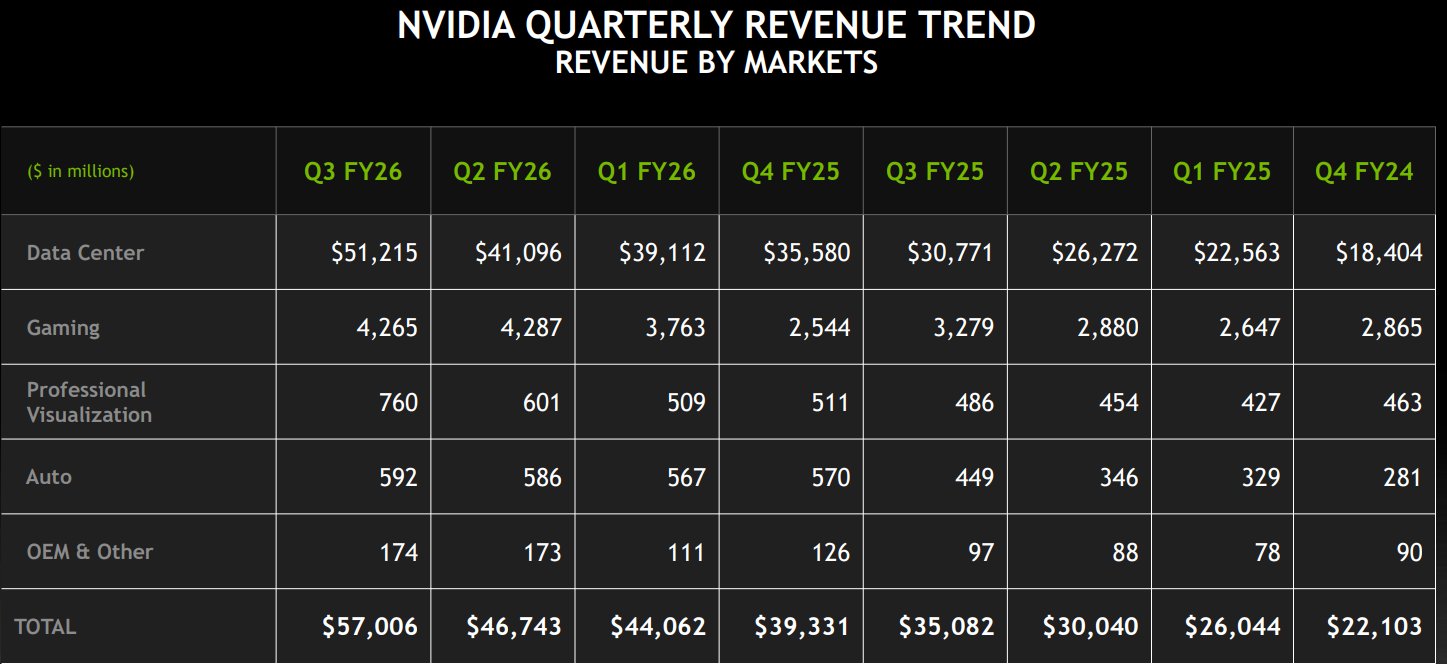
英伟达上季营收加速增长62%,本季指引再超预期,黄仁勋称“Blackwell销量远超预期”
硬AI· 2025-11-20 01:53
Core Viewpoint - Nvidia's third-quarter revenue growth accelerated for the first time in two years, with data center revenue reaching a record high, reflecting strong demand for AI infrastructure [2][11][12] Financial Performance - Revenue: In Q3, Nvidia reported revenue of $57.01 billion, a year-on-year increase of approximately 62%, surpassing analyst expectations of $55.19 billion [6][11] - EPS: The adjusted non-GAAP EPS for Q3 was $1.30, a 60% year-on-year increase, exceeding analyst expectations of $1.26 [7] - Gross Margin: The adjusted gross margin for Q3 was 73.6%, slightly below the expected 74.0%, but the guidance for Q4 indicates an increase to 75% [7][16] Segment Performance - Data Center: Q3 revenue from data centers was $51.2 billion, a 66% year-on-year increase, exceeding analyst expectations [8][12] - Gaming and AI PC: Revenue from gaming and AI PC was $4.3 billion, a 30% year-on-year increase [8] - Professional Visualization: Revenue was $760 million, a 56% year-on-year increase [8] - Automotive and Robotics: Revenue was $592 million, a 32% year-on-year increase [8] Guidance and Future Outlook - Revenue Guidance: For Q4, Nvidia expects revenue of $65 billion, indicating a year-on-year growth of over 65% [10][14] - Gross Margin Guidance: The expected gross margin for Q4 is 75%, marking the first year-on-year increase in six quarters [16] - Future Revenue Potential: Nvidia's CFO stated that new chips are expected to generate $500 billion in revenue over the next few quarters [18][19] Market Position and Strategy - Nvidia's strong customer base includes major companies like Microsoft, Amazon, Alphabet, and Meta, which collectively account for over 40% of its sales [18] - The company has secured $500 billion in chip orders for 2025 and 2026, indicating robust future demand [18][21] - Nvidia's strategy includes investing in AI infrastructure and maintaining strong partnerships to enhance its market position [21]

英伟达为全球市场送来大惊喜!
是说芯语· 2025-11-20 00:21
Core Viewpoint - Nvidia's recent financial results indicate strong demand for AI infrastructure, with revenue growth exceeding 60%, alleviating concerns about an AI bubble [1][12][14]. Financial Data Summary - **Revenue**: In Q3, Nvidia reported revenue of $57.01 billion, a year-over-year increase of approximately 62%, surpassing analyst expectations of $55.19 billion [4][12]. - **EPS**: The adjusted EPS for Q3 was $1.30, reflecting a 60% year-over-year growth, also exceeding analyst expectations [5]. - **Gross Margin**: The adjusted gross margin for Q3 was 73.6%, slightly below the expected 74.0% [5][16]. - **Operating Expenses**: Adjusted operating expenses were $4.215 billion, a 38% increase year-over-year [5]. Segment Performance - **Data Center**: Revenue from the data center segment reached $51.2 billion, a 66% year-over-year increase, exceeding analyst expectations [6][12]. - **Gaming and AI PC**: Revenue was $4.3 billion, a 30% increase year-over-year [7]. - **Professional Visualization**: Revenue was $760 million, a 56% increase year-over-year [7]. - **Automotive and Robotics**: Revenue was $592 million, a 32% increase year-over-year [7]. Guidance and Future Outlook - **Q4 Revenue Guidance**: Nvidia expects Q4 revenue to be around $65 billion, indicating a year-over-year growth of over 65% [10][14]. - **Gross Margin Guidance**: The expected gross margin for Q4 is 75%, which would mark the first year-over-year increase in six quarters [16]. - **Market Demand**: Nvidia's CFO indicated that the company has secured $500 billion in chip orders for 2025 and 2026, highlighting strong future demand [18][19]. Strategic Insights - Nvidia's customer base includes major tech companies like Microsoft, Amazon, Alphabet, and Meta, which collectively account for over 40% of its sales [17]. - The company is focusing on enhancing its competitive edge in the AI chip market, particularly in response to geopolitical challenges affecting its sales in China [20].

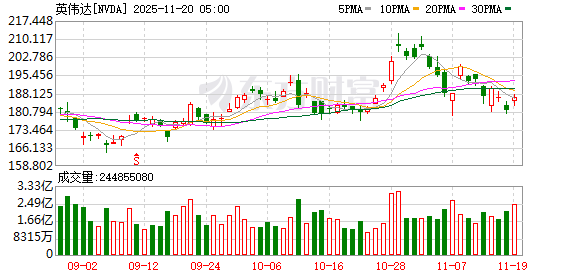
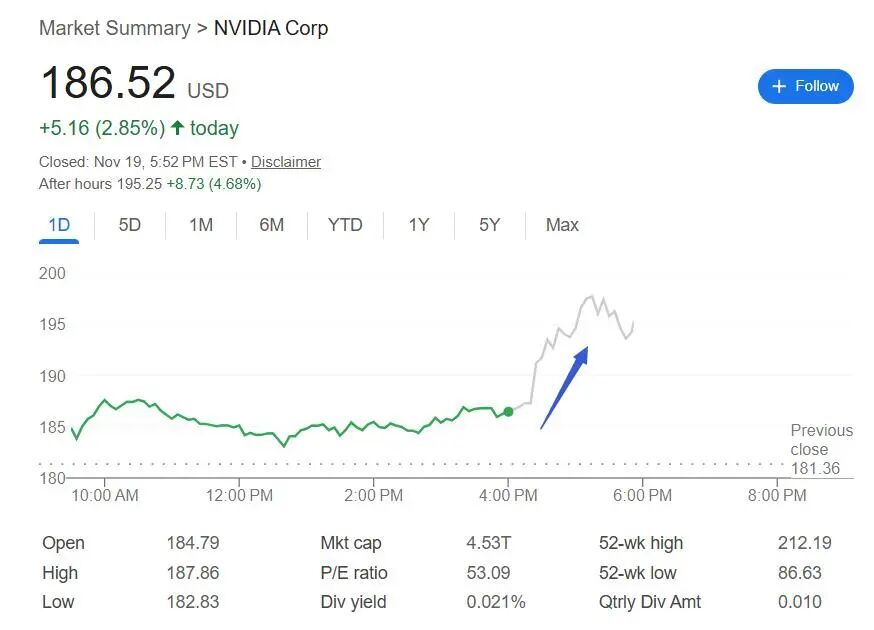
英伟达Q3财报全面超预期 盘后股价涨近5%
Xin Hua Cai Jing· 2025-11-20 00:18
Core Viewpoint - Nvidia reported better-than-expected Q3 earnings, alleviating concerns about an "AI bubble" and indicating strong demand for its AI chips [2][3]. Financial Performance - Q3 revenue reached $57.006 billion, a 62% increase year-over-year and a 22% increase quarter-over-quarter, surpassing analyst expectations of $54.92 billion [3]. - Net income for Q3 was $31.91 billion, up 65% from $19.31 billion year-over-year and up 21% from $26.42 billion quarter-over-quarter [4][6]. - Diluted earnings per share were $1.30, a 67% increase from $0.78 year-over-year and a 20% increase from $1.08 quarter-over-quarter [6]. Margin and Expenses - Q3 gross margin was 73.4%, down 1.2 percentage points year-over-year but up 1 percentage point quarter-over-quarter [5]. - Operating expenses for Q3 were $5.839 billion, an 8% increase quarter-over-quarter and a 36% increase year-over-year [4]. Business Segments - Data center revenue for Q3 was $51.2 billion, exceeding analyst predictions and growing 66% year-over-year [6]. - Gaming and AI PC revenue was $4.3 billion, a 30% increase year-over-year but a 1% decrease quarter-over-quarter [6]. - Professional visualization revenue was $760 million, up 56% year-over-year and 26% quarter-over-quarter [6]. - Automotive and robotics revenue was $592 million, a 32% increase year-over-year and a 1% increase quarter-over-quarter [6]. Future Outlook - Nvidia expects Q4 revenue to be approximately $65 billion, exceeding analyst expectations of $61.66 billion, with a projected gross margin of 74.8% [6]. - The company has repurchased $12.5 billion worth of stock and paid $243 million in dividends during Q3 [6]. Market Demand - Nvidia's CFO stated that the demand for their products continues to exceed expectations, with the cloud GPU being sold out [7]. - CEO Jensen Huang mentioned that AI has reached a "critical point" and reaffirmed the company's commitment to achieving $500 billion in revenue [7].
决定全球市场命运,英伟达送来大惊喜
3 6 Ke· 2025-11-20 00:14
Core Insights - Nvidia reported a significant revenue increase of 62% year-over-year for Q3 FY26, surpassing analyst expectations and indicating strong demand for AI infrastructure [4][10][14] - The company's CEO, Jensen Huang, emphasized that the latest Blackwell architecture chips are in high demand, with cloud GPUs sold out, countering concerns about an AI bubble [1][15] - Nvidia's cash reserves stand at $60.6 billion, providing ample support for ongoing AI applications in new economic sectors [1][4] Financial Performance - Revenue for Q3 FY26 reached $57.01 billion, exceeding the company's guidance and analyst expectations [4][10] - Non-GAAP EPS for Q3 was $1.30, a 60% increase year-over-year, also surpassing analyst predictions [4][10] - Adjusted gross margin for Q3 was 73.6%, slightly below expectations but still indicating strong profitability [4][10] Segment Performance - Data center revenue for Q3 was $51.2 billion, a 66% increase year-over-year, marking a record high for the segment [4][12] - Gaming and AI PC revenue reached $4.3 billion, a 30% increase year-over-year, although slightly below analyst expectations [5][12] - Professional visualization revenue was $760 million, up 56% year-over-year, exceeding analyst forecasts [6][12] - Automotive and robotics revenue was $592 million, a 32% increase year-over-year, but lower than expected [7][12] Guidance and Future Outlook - For Q4 FY26, Nvidia expects revenue to be around $65 billion, indicating a year-over-year growth of over 65% [10][13] - The company anticipates a gross margin of 75% for Q4, which would be the first year-over-year increase in six quarters [10][13] - Nvidia's CFO highlighted that the company has secured $500 billion in chip orders for 2025 and 2026, indicating strong future demand [15][16] Market Position and Strategy - Nvidia's customer base includes major tech companies like Microsoft, Amazon, Alphabet, and Meta, which collectively account for over 40% of its sales [15][16] - The company is focusing on enhancing its technology applications and exploring competitive data center products for the Chinese market [16]
当“AI泡沫论”萦绕之际 英伟达(NVDA.US)业绩破空! AI算力需求继续爆表 数据中心营收猛增66%
智通财经网· 2025-11-20 00:00
Core Viewpoint - Nvidia, known as the "superpower of AI chips," has provided a strong revenue outlook for the current quarter, exceeding market expectations, which counters recent concerns about an "AI bubble" and alleviates investor fears regarding a potential decline in global AI spending [1][2][3]. Group 1: Financial Performance - Nvidia's revenue for Q3 FY26 reached $57 billion, a 62% year-over-year increase and a 22% quarter-over-quarter increase, surpassing analyst expectations of $55.2 billion [4][12]. - The company's net profit for Q3 increased by 65% year-over-year to $31.9 billion, with operating profit also rising by 65% to $36 billion [4][12]. - Nvidia's data center business, which is crucial for AI infrastructure, generated $51.2 billion in revenue, reflecting a 66% year-over-year growth [12]. Group 2: Market Dynamics - The demand for AI computing power is surging globally, driven by significant investments from the U.S. government and tech giants in AI infrastructure [2][8]. - Nvidia holds a dominant 90% market share in the AI accelerator space, indicating strong ongoing demand for its AI GPUs [2][6]. - The recent performance of Nvidia has positively influenced the stock prices of other companies in the AI computing supply chain, such as TSMC, Broadcom, AMD, and Micron [1][4]. Group 3: Future Outlook - Nvidia forecasts total revenue of approximately $65 billion for Q4 FY26, significantly above Wall Street's average estimate of $62 billion, indicating robust demand for AI computing infrastructure [2][3]. - The company is expected to continue benefiting from the ongoing AI investment wave, with projections suggesting that the AI infrastructure investment could reach $3 trillion to $4 trillion by 2030 [16][20]. - Analysts are optimistic about Nvidia's future, with some raising target prices significantly, anticipating a market cap that could exceed $8 trillion [16].