
AI光模块

Search documents
未知机构:大摩闭门会在市场回调中如何把握AI光模块存储和硬件的投资机会260306-20260309
未知机构· 2026-03-09 02:05
Summary of Key Points from the Conference Call Industry and Company Overview - The conference focused on the technology hardware industry, particularly memory storage, CPU developments, and AI-related hardware such as optical modules and liquid cooling systems [1][2][9]. Core Insights and Arguments Memory Storage Industry - Recent fluctuations in memory prices have been influenced by geopolitical factors, particularly affecting South Korean memory stocks [2][10]. - Despite recent volatility, the memory shortage is expected to persist until 2028, with HBM4 technology led by Samsung maintaining a strong market position [2][10]. - Contract prices in the memory sector are anticipated to increase by 30%-50% quarter-over-quarter in Q2, with demand visibility extended through long-term agreements (LTA) until 2028 [2][10][11]. - Samsung Electronics is recommended as a top stock pick due to its competitive advantage in the HBM market and potential for capacity expansion [6][12]. CPU and Optical Engine Developments - The CPU market has gained significant attention, with NVIDIA and AMD being key players. NVIDIA's SpectrumX cabinets are expected to dominate data centers this year [2][7]. - Production of optical engines is projected to reach between 600,000 to 1,000,000 units, with demand for optical engines expected to hit 2 million units by 2027 [2][7][12]. - NVIDIA is set to release a new version of its Context Switch at the GTC event, with market growth for CLCPL switches projected to increase by 144% by 2030 [2][7][12]. AI Infrastructure and Cooling Technologies - The discussion highlighted advancements in AI infrastructure, particularly in liquid cooling and power technologies, with companies like Delta Electronics and Lite-On actively expanding to meet future demand [5][17]. - The introduction of high-voltage direct current (DC) power racks is anticipated to occur earlier than expected, with small-scale shipments of 800V DC products starting this year [5][17]. - Cooling stocks have regained market focus due to increased demand from AI applications, with expectations for significant growth in water cooling board usage [5][18]. Additional Important Insights - The relationship between CPUs and optical modules is evolving, with the market now recognizing the potential risks associated with CPU impacts on optical module investments [3][14]. - The optical module market is projected to grow from $18 billion to $50 billion between 2025 and 2028, indicating substantial growth potential [5][15]. - Investment recommendations include companies within the optical module supply chain such as Coherent in North America and Mark and VPEC in Taiwan, as well as TSMC in the CPU sector [5][16]. Conclusion - The conference provided a comprehensive analysis of the technology hardware sector, emphasizing the interconnectedness of memory storage, CPU advancements, and AI infrastructure. The insights shared indicate a positive outlook for specific stocks and sectors, driven by ongoing technological advancements and market demand.


全球科技 AI 光模块:增长逻辑胜于颠覆风险
2026-03-04 14:17
Summary of the Conference Call on AI Optical Modules Industry Overview - The AI optical module market is projected to grow significantly, with the total addressable market expected to increase from approximately $18 billion in 2025 to about $50 billion by 2028, driven primarily by advancements in AI data center architectures [1][16]. Key Insights - Concerns regarding the disruptive impact of Co-Packaged Optics (CPO) have been recognized and reflected in market valuations [8][16]. - The profitability from the ramp-up of 800G and 1.6T optical modules in 2026 is still underestimated by the market, which limits the risk of further valuation downgrades [8][16]. - The report reaffirms a preference for stocks that directly benefit from optical module demand, including companies like NewEase, LianYa, and Coherent [8][16]. - Long-term prospects for CPO development are viewed positively, with optimism for companies such as TSMC, ASE Technology, and others [8][16]. CPO Impact Analysis - The impact of CPO is acknowledged as a structural change, but its threat is more pronounced in the medium term rather than the short term. The dilution of optical module demand due to CPO is estimated to be about 3% in 2026 and 11% in 2027, primarily constrained by manufacturing yields, thermal complexity, cost premiums, ecosystem maturity, and maintenance risks [8][15]. - The likelihood of large-scale implementation of CPO before 2027-2028 is considered low, with initial applications focusing on ≥3.2T rather than the currently mainstream 800G and 1.6T [8][15]. Demand Growth Projections - Despite the potential impact of CPO, the demand for optical modules is expected to continue its exponential growth. The absolute shipment volume of 800G and 1.6T optical modules is projected to increase from approximately 20 million units in 2025 to about 80 million units by 2028 [8][16]. - Short-term deployments will be dominated by horizontal expansion, while vertical expansion scenarios will see a significant acceleration in optical interconnect penetration rates after 2027 as copper interconnects reach physical limits [8][16]. Scenarios for CPO Adoption - **Optimistic Scenario**: CPO adoption is delayed until after 2028, while Near-Package Optics (NPO) matures earlier. In the long term, optical modules are expected to maintain over 70% market share in high-end markets [8][16]. - **Base Case Scenario**: CPO begins to ramp up in 2027-2028, coexisting with optical modules during the transition to 3.2T generations [8][16]. - **Pessimistic Scenario**: CPO achieves technological breakthroughs earlier, compressing long-term market share but not undermining short-term profit growth logic [8][16]. Stock Recommendations - The report suggests a positive outlook for companies involved in optical modules, with specific upgrades in ratings and price targets for NewEase and Tianfu Communication [18][8]. - Additional companies highlighted for their potential include COHR, LianYa, VPEC, TSMC, ASE Technology, and others [18][8]. Conclusion - The AI optical module market is on the verge of significant growth, driven by advancements in data center architectures. While CPO presents a potential risk, its impact is expected to be limited in the short term, allowing for continued demand growth in traditional optical modules. The investment landscape remains favorable for companies directly benefiting from this trend [1][16][18].


别盲目跟风!华工科技赶单忙到疯,招标才是最大看点
Sou Hu Cai Jing· 2026-02-24 06:38
Core Viewpoint - The recent surge in Huagong Technology's stock is supported by substantial orders, rather than mere speculation, with several undisclosed signals potentially impacting the second quarter's performance [1]. Group 1: Orders and Market Dynamics - Huagong Technology is expected to secure an above-expected share in the upcoming China Mobile optical module tender, with a probability of around 70% [3]. - The company has a backlog of orders extending to the fourth quarter of 2026, particularly for 800G and 1.6T optical modules, indicating strong demand [4]. - The surge in orders is attributed to the skyrocketing demand for AI computing power, driven by the iteration of AI large models and the expansion of data centers [5]. Group 2: Investment Sentiment and Caution - There is a noticeable increase in trading volume for Huagong Technology, suggesting that informed investors are already acting on this information [4]. - Despite the positive outlook, there is a cautionary note regarding the potential risks of overextending production capacity, which could lead to losing customers if demand cannot be met [4]. - The overall enthusiasm for Huagong Technology is a combination of orders, market trends, and investor interest, but there is a warning against blindly chasing high stock prices [5].



谷歌产业链延续活跃,5G通信ETF、创业板人工智能ETF华夏涨超3%
Mei Ri Jing Ji Xin Wen· 2025-11-27 02:41
Core Insights - The AI computing power industry chain is experiencing a strong rebound, with significant stock performance in optical module CPO concept stocks and active participation from Google-related stocks [1][2] - Google's release of its new AI model, Gemini 3.0, has led to a surge in market sentiment, with the company's stock reaching an all-time high and becoming the third-largest company by market capitalization in the U.S. [1][2] - The AI optical module market is witnessing a transition from 800G to 1.6T transmission rates, indicating a high-growth phase driven by increasing demand for data throughput and transmission capabilities [3] Industry Overview - The AI industry has returned to activity following previous adjustments, with major players like OpenAI, NVIDIA, and Google driving technological innovations that positively impact both performance and stock prices [2] - Google's Gemini 3 series and other models demonstrate significant advancements in AI capabilities, reinforcing the effectiveness of the Scaling Law, which suggests that AI model performance improves predictably with increased parameters, data, and computational resources [2] - The AI optical module is crucial for meeting the high bandwidth and low latency requirements of AI computing clusters, with Chinese manufacturers gaining a competitive edge globally [3] ETF Insights - The 5G Communication ETF (515050) focuses on major players in the 5G communication sector, with a significant portion of its holdings in companies like NVIDIA, Apple, Huawei, and Google [4] - The ETF's composition reflects a high purity of "hard technology," with nearly 80% of its weight in communication and electronics sectors, emphasizing infrastructure and terminal support [4] - The AI-focused ETF (159381) tracks the entrepreneurial board's AI index, with over 54% of its weight in optical module CPOs, indicating a strong alignment with the growth of AI applications [4]


2025年中国AI光模块行业市场进入壁垒、行业政策、成本结构、市场规模、竞争格局及发展趋势研判:已成为全球增长最快的区域,市场规模保持增长[图]
Chan Ye Xin Xi Wang· 2025-11-23 01:17
Core Insights - The AI optical module market is experiencing rapid growth, driven by the increasing demand for high-speed interconnects in data centers due to the rise of generative AI technologies [1][4] - The global AI optical module market is projected to reach 42.8 billion yuan in 2024, an increase of 23.8 billion yuan from 2023, and is expected to grow to 71.6 billion yuan by 2025 [1][4] - China's AI optical module market is also expanding, with a forecasted growth to 17.8 billion yuan by 2025, up from 10.6 billion yuan in 2024 [1][5] Industry Definition and Barriers - AI optical modules are essential for meeting the ultra-high bandwidth and low latency requirements of AI computing clusters, acting as the "nervous system" of the AI era [2][4] - The market barriers include technological research and development, supply chain management, product comprehensiveness, customer loyalty, and globalization [4] Current Industry Status - The AI optical module market is a hot sector within the semiconductor and communication fields, with sustained high demand due to the ongoing global AI arms race [4] - The rapid development of generative AI technologies has significantly increased the demand for optical modules in data centers [4] Industry Chain - The upstream of the AI optical module industry includes optical devices, chips (optical and circuit chips), PCB boards, and structural components [5] - The midstream involves the production and system integration of AI optical modules, while the downstream consists of cloud service providers utilizing these modules in AI data centers [5] Cost Structure - The cost structure of AI optical modules shows that optical devices account for 74% of the total cost, followed by integrated circuit chips at 19% and printed circuit boards (PCBs) at 4% [7] Development Environment and Policies - The Chinese government has implemented various policies to support the AI optical module industry, recognizing its importance in the AI computing infrastructure [9] - Key policies include initiatives aimed at enhancing network infrastructure, computing power layout, technological research, and application scenarios [9] Competitive Landscape - The Chinese AI optical module market is characterized by significant differentiation among companies, with leading firms such as Zhongji Xuchuang and NewEase occupying dominant positions [11][12] - Major companies in the sector include Wuhan Guangxun Technology Co., Ltd., Zhongji Xuchuang Co., Ltd., and Huagong Technology, among others [12][13] Future Trends - The demand for AI optical modules is expected to grow explosively due to the increasing competition in artificial intelligence and the unprecedented requirements for data transmission rates and bandwidth in data centers [14][15] - Continuous innovation and commercialization in technology will further drive the growth of the AI optical module market [14][15]


首期规模超百亿元!成都未来产业创投基金正式启动
Sou Hu Cai Jing· 2025-10-17 11:36
Core Insights - Chengdu has launched a future industry venture capital fund with an initial scale exceeding 10 billion yuan, focusing on various future industries and strategic emerging sectors [1][3]. Group 1: Fund Overview - The future industry venture capital fund is structured with a "government guidance + market operation" mechanism, targeting sectors such as humanoid robots, flying cars, quantum technology, brain-machine interfaces, advanced nuclear energy, and frontier materials [3]. - The fund aims to optimize the industrial structure of Chengdu and strengthen the government investment fund system, with a clear positioning as an "industry cultivator," "resource mobilizer," "track leader," and "ecosystem builder" [3]. Group 2: Project Evaluation and Participation - Five technology companies from different fields presented at the fund's launch event, with local departments conducting project evaluations to ensure alignment with the fund's investment focus [4]. - The fund will be managed by Chengdu Industrial Investment Group, which oversees a 6.5 billion yuan future industry venture capital development fund with a 15-year duration [3]. Group 3: Industry Impact and Company Perspectives - Companies participating in the fund expressed optimism about the support it provides for technology research, market expansion, and policy guidance [5]. - Chengdu's robust electronic information industry and complete supply chain are highlighted as significant advantages for companies like Shenzhen Ruikang Guanglian Technology Co., which is seeking 100 million yuan in Pre-A round financing to accelerate its industrialization process [5]. - The fund is expected to enhance the credibility of participating companies and attract more potential investors, providing substantial support in critical R&D and production phases [5].
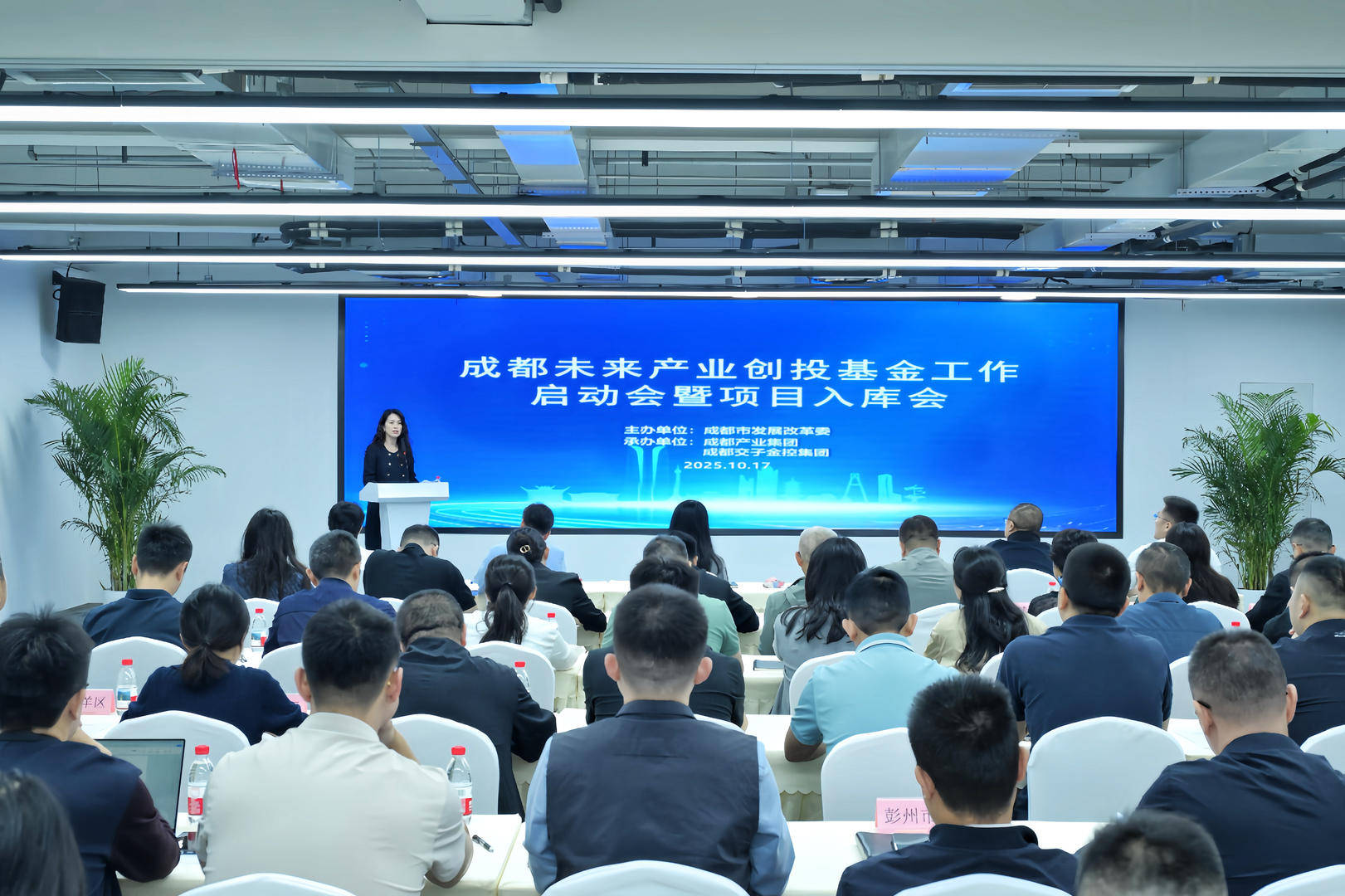
首期规模超百亿元 成都未来产业创投基金正式启动
Sou Hu Cai Jing· 2025-10-17 08:55
Core Insights - The Future Industry Venture Capital Fund has officially launched with an initial scale exceeding 10 billion yuan, marking a significant step in Chengdu's strategic investment in future industries [1][3]. Group 1: Fund Overview - The Future Industry Venture Capital Fund is part of a larger 100 billion yuan future industry fund announced in July, aimed at fostering technological innovation and strategic industry development in Chengdu [3]. - The fund's initial phase has a scale of over 10 billion yuan, with Chengdu Industrial Group and Chengdu Jiaozi Financial Holding Group each establishing funds of 6.5 billion yuan and 6.9 billion yuan respectively [3][5]. - The fund aims to create a "billion-level" venture capital parent-child fund cluster, enhancing Chengdu's reputation in the venture capital space [3]. Group 2: Investment Focus - The fund will focus on a modern industrial system categorized as "9+9+10," targeting sectors such as humanoid robots, flying cars, quantum technology, brain-machine interfaces, advanced nuclear energy, and frontier materials [5]. - It will also invest in strategic emerging industries like integrated circuits, aerospace, artificial intelligence, biomedicine, green hydrogen, and rail transportation, aligning with Chengdu's pillar industries [5]. Group 3: Project Evaluation and Ecosystem Development - During the launch event, five technology companies presented their projects, highlighting the fund's focus on "hard" technology sectors, particularly artificial intelligence [7]. - The event facilitated a platform for efficient connections between quality projects and capital, marking a substantial phase in the fund's operational activities [7]. - Chengdu plans to continue optimizing its venture capital ecosystem to support the successful implementation of innovative projects [7].
外资基金经理看“中国新消费”:女性情感消费推高估值,持续创新力是未来
Di Yi Cai Jing· 2025-06-11 10:59
Group 1 - The next decade is considered the "golden decade" for Chinese IP, driven by the rise of "new consumption" themes in the Hong Kong stock market, particularly favored by younger generations and women [1][4] - The emotional consumption preferences of women are identified as a primary driver of the new consumption trend, with a focus on products that resonate emotionally rather than just functionally [2][3] - Companies like Pop Mart and others are experiencing significant stock price increases, indicating a growing interest from long-term foreign investors in high-margin themes related to Chinese innovation [3][4] Group 2 - The emotional connection to IP products is seen as a key factor in their global appeal, with the loneliness experienced by the only-child generation enhancing their emotional reliance on these products [4][7] - The growth of new consumption is expected to continue, with projections indicating that sectors like trendy toys and new beverage brands will benefit from changing consumer behaviors and the increasing popularity of domestic brands [4][6] - The valuation of new consumption companies is becoming challenging, with some companies reaching high static PE ratios, necessitating a focus on growth metrics like PEG [5][6] Group 3 - The importance of international expansion is emphasized, with companies like Pop Mart planning significant store openings in Southeast Asia and Australia, and experiencing substantial revenue growth in these regions [7] - Sustained innovation is crucial for maintaining high profit margins, with a shift from traditional low-margin manufacturing to high-margin businesses driven by proprietary IP and technological advancements [8][9] - Companies in various sectors, including toys, gold retail, pharmaceuticals, and semiconductors, are achieving high gross margins, indicating a broader trend of improving profitability through innovation and R&D investment [9]

通信行业周报:AI上游业绩高兑现,美团AI需求渐起
KAIYUAN SECURITIES· 2025-04-27 03:23
Investment Rating - The industry investment rating is "Positive" (maintained) [1] Core Views - The AI computing industry chain continues to show strong performance, with significant year-on-year growth in Q1 2025 across various segments, including AI chips, servers, and optical modules [5][14][15] - The demand for data centers remains robust, with companies like Vertiv and Google Cloud reporting increased orders and revenue growth, indicating a strong market outlook [16][17] - The report emphasizes the importance of domestic AI computing, satellite internet, and 6G as key investment directions, recommending specific companies within these sectors [7][25] Summary by Sections 1. Weekly Investment Insights - The AI computing industry chain has shown impressive performance in Q1 2025, with companies like Haiguang Information and Huqin Technology reporting substantial revenue and profit growth [13][14] - Vertiv's Q1 2025 report indicates a 24% increase in net sales, with strong demand for data centers driving growth [16] - Google's Q1 2025 revenue reached $90.2 billion, with Google Cloud growing by 28%, reflecting a strong demand for AI infrastructure [17][19] - ByteDance and Meituan are actively developing AI applications, indicating a growing trend in AI recruitment and development [20][22] 2. Communication Data Tracking - As of February 2025, China has 4.325 million 5G base stations, with 1.051 billion 5G mobile users, marking a 23.5% year-on-year increase [35] - The report highlights the growth in 5G infrastructure and user adoption, with a notable increase in the number of 5G mobile devices shipped [35][42] 3. Investment Recommendations - The report suggests focusing on seven key industry directions, including AIDC data center construction, IT equipment, network devices, cloud computing, AI applications, satellite internet, and 6G [25][26][27][31][32]


华工科技百亿研发创70余项“中国第一” AI光模块订单激增月产能100万只增3倍
Chang Jiang Shang Bao· 2025-04-21 00:11
Core Viewpoint - Huagong Technology has rapidly advanced to become a leading player in the global laser industry, focusing on R&D innovation to solve critical technology challenges and achieve high-quality growth [1][7]. Group 1: Business Performance - In 2024, Huagong Technology achieved a net profit of 1.22 billion yuan, marking six consecutive years of rapid growth [2][3]. - The company expects a net profit of 390 to 440 million yuan for Q1 2025, representing a year-on-year increase of 34.54% to 51.79% [3]. - The company reported a revenue of 11.709 billion yuan in 2024, a year-on-year increase of 13.57% [3][4]. Group 2: Core Business Segments - Huagong Technology's three core business segments—perception, connection, and intelligent manufacturing—have all shown significant growth in 2024 [4]. - The revenue from the perception business reached 4.095 billion yuan, growing by 26.08% year-on-year [4]. - The connection business generated 3.975 billion yuan, with a year-on-year increase of 23.75% [4]. Group 3: R&D Investment - The company has invested over 10 billion yuan in R&D, creating more than 70 "China first" achievements in the industry [2][7]. - R&D expenditures from 2021 to 2024 were 451 million yuan, 608 million yuan, 783 million yuan, and 993 million yuan, respectively, with growth rates exceeding revenue growth [7]. - By the end of 2024, the number of R&D personnel reached 2,483, accounting for 28.14% of the total workforce [7]. Group 4: Global Expansion - Huagong Technology has established a global production footprint, with manufacturing bases in countries like Vietnam and Thailand [2]. - The company exports to over 80 countries and regions, with significant growth in markets such as Europe, North America, and the Middle East [5]. - The company reported a product growth rate of 35% annually, reshaping the global laser equipment industry landscape [5].