
AI Agent(智能体)

Search documents
黄仁勋罕见发长文
创业家· 2026-03-16 10:34
Core Viewpoint - AI is not merely a single model or application but an evolving infrastructure system, akin to electricity and the internet, requiring significant investment for development [3][22]. Group 1: AI as Infrastructure - AI is described as a "five-layer cake" infrastructure consisting of energy, chips, infrastructure, models, and applications, with a need for trillions of dollars in future investment [3][10][12]. - The current global investment in AI infrastructure is in the hundreds of billions, indicating that the overall construction is still in its early stages [3][15]. Group 2: Employment and Labor Market Impact - Contrary to fears of job loss, AI is expected to create numerous new job opportunities, particularly in skilled labor sectors necessary for AI infrastructure development [5][16]. - The demand for skilled workers such as electricians, plumbers, and network technicians is high, with these roles offering competitive salaries [5][16]. Group 3: Transition from Software to Real-Time Intelligence - AI is transitioning from traditional software, which relies on pre-written programs, to real-time generated intelligence that can understand unstructured data [7][8]. - This shift necessitates a complete redesign of the underlying computational architecture to support real-time intelligence generation [8]. Group 4: The Five-Layer Structure of AI - The five layers of AI infrastructure are: 1. **Energy**: The foundational layer requiring real-time power generation [12][24]. 2. **Chips**: Efficient processors that convert energy into computational power [12][24]. 3. **Infrastructure**: Systems that enable multiple processors to work together, termed "AI factories" [12][24]. 4. **Models**: AI models that can interpret various types of information across multiple fields [12][24]. 5. **Applications**: The top layer where economic value is created through various AI applications [12][24]. Group 5: Open Source Models and Industry Expansion - Open-source models play a crucial role in the AI ecosystem, driving demand across the entire industry when they reach advanced levels [18][27]. - The example of the DeepSeek-R1 model illustrates how a breakthrough in one model can stimulate demand for training, infrastructure, chips, and energy [19][27]. Group 6: Broader Economic Implications - AI is poised to transform not only the software industry but also energy production, manufacturing, labor structures, and economic growth models [21][22]. - The ongoing development of AI infrastructure and workforce training is still in its infancy, with significant opportunities yet to be realized [21][22].



黄仁勋罕见发长文:未来几年传统的软件和APP形态或将消失
新华网财经· 2026-03-11 04:46
Core Viewpoint - The AI industry is still in its early development stage, requiring trillions of dollars in ongoing investment to fully realize its potential, despite current investments in the industry amounting to hundreds of billions of dollars [3]. Group 1: AI Five-Layer Architecture - The AI "Five-Layer Architecture" is defined as a "five-layer cake," consisting of energy, chips, infrastructure, models, and applications, with each layer supporting and driving the others [4]. - The energy layer is identified as the fundamental principle of AI infrastructure, emphasizing that real-time generated intelligence requires real-time generated power, making energy supply a critical bottleneck for AI's scalable development [4]. - The chip layer serves as the physical foundation for computing power, with advancements in chip technology directly influencing the speed of AI expansion and the reduction of intelligence costs, although current chip technology is struggling to keep pace with the explosive growth in AI computing demands [4]. Group 2: Infrastructure and Model Layers - The infrastructure layer, referred to as the "AI factory," includes essential components such as land, power delivery, cooling systems, and network coordination, with a significant global push to build chip manufacturing plants, supercomputer factories, and AI factories, marking one of the largest infrastructure developments in human history [5]. - The model layer encompasses various types of information processing, with the potential of AI models still largely untapped; open-source models play a crucial role in accelerating the demand for underlying infrastructure, chips, and energy [7]. Group 3: Application Layer and Employment Impact - The application layer is where AI generates economic value, with a wide range of applications such as drug discovery platforms and autonomous vehicles; the innovation space in this layer remains vast, with predictions that traditional software forms may evolve into a new paradigm of AI Agents [7]. - Contrary to fears of job loss due to AI, it is believed that AI will create numerous new job opportunities, particularly in skilled labor sectors needed for infrastructure development, filling significant labor gaps in various industries [8].

用AI重构中国智造新引擎
Di Yi Cai Jing Zi Xun· 2026-02-03 13:26
Core Viewpoint - The article emphasizes the transformation of the manufacturing industry through AI, highlighting the importance of smart manufacturing as a key direction for technological change and optimization in China [2]. Group 1: AI and Manufacturing Transformation - The Chinese government is focusing on utilizing AI technology to reshape the entire production and manufacturing cycle, aiming for technological innovation and product upgrades while maintaining scale advantages [2]. - The ongoing discussions at the Shanghai meetings center around building a modern industrial system during the "14th Five-Year Plan" period, which includes promoting the digital and green transformation of traditional industries and developing new emerging industrial clusters [2][3]. - By 2026, China aims to leverage AI to become a leader in future industries and economies, which is crucial for securing a position in the AI-driven physical world [2][3]. Group 2: Opportunities and Challenges - China possesses extensive manufacturing experience and data, which are strategic resources for competing in the AI-driven physical world, but it also faces challenges in balancing existing manufacturing capacity with the need for AI-driven transformation [3]. - The transformation requires a willingness to embrace trial and error, as well as the courage to fundamentally restructure traditional manufacturing logic [3][4]. - The shift driven by AI will not only test operational and technological capabilities but also necessitate a reformation of the economic and social systems to create a more flexible environment for innovation [3][4]. Group 3: Successful Practices and Economic Environment - Learning from successful industrial layouts in various regions is essential, as exemplified by Shanghai's introduction of Tesla, which has helped establish an international supply chain for the new energy vehicle industry [4]. - The core experience from successful practices includes creating a free and open economic environment, which has been crucial for the international competitiveness of China's new energy vehicle sector [4][5]. - The future of manufacturing will increasingly depend on the openness of markets, the openness of technology, and the inclusiveness of systems, making these factors essential for survival and development in the AI era [5].

用AI重构中国智造新引擎
第一财经· 2026-02-03 13:23
Core Viewpoint - The article emphasizes that AI is reshaping the manufacturing ecosystem, transitioning from traditional manufacturing to intelligent manufacturing, which is seen as a key direction for industrial technological transformation and optimization [2]. Group 1: AI and Manufacturing Transformation - The Chinese government is focusing on smart manufacturing as a primary strategy to leverage AI technology across the entire production chain and lifecycle, aiming for technological innovation and product upgrades while maintaining scale advantages [2]. - The ongoing discussions at the Shanghai meetings highlight the importance of building a modern industrial system during the "14th Five-Year Plan" period, which includes promoting the digital and green transformation of traditional industries and developing new emerging industrial clusters [2]. Group 2: Opportunities and Challenges - China has a significant opportunity in the AI-driven transformation of the physical world due to its extensive manufacturing experience and data resources, which are crucial for competing in the AI landscape [3]. - However, challenges arise from the need to balance maintaining existing manufacturing capacity with the integration of AI technologies, requiring a willingness to restructure traditional manufacturing logic and supply chains [3]. Group 3: Institutional and Economic Reforms - The transformation driven by AI necessitates not only operational and technological upgrades but also a fundamental restructuring of the economic and social systems, emphasizing the need for institutional reforms to create a more flexible environment for innovation [3]. - Recent adjustments in VAT input tax by the Ministry of Finance are seen as a positive step towards fostering a more conducive environment for market participants [3]. Group 4: Learning from Successful Practices - Learning from successful industrial layouts in various regions is crucial, as exemplified by Shanghai's introduction of Tesla, which has helped establish a competitive international supply chain for electric vehicles [4]. - The experience gained from these practices is valuable for advancing China's manufacturing into intelligent manufacturing and leveraging AI technologies [4]. Group 5: Open Economic Environment - The success of China's electric vehicle industry is attributed to the establishment of a free and open economic environment, which has facilitated the integration of global technologies and standards [6]. - In the era of physical AI, the competition will increasingly depend on market openness, technological openness, and institutional inclusiveness, making these factors essential for survival and development [6]. Group 6: Future of AI in Manufacturing - The article suggests that the future of manufacturing will involve AI agents as a service, which presents new challenges regarding product safety, technical standards, and compliance with local laws [6]. - The transition to a physical AI era will require a shift in thinking from merely using AI as a tool to creating a robust institutional framework that supports decision-making, tolerance for failure, and innovation [7].

一财社论:用AI重构中国智造新引擎
Di Yi Cai Jing· 2026-02-03 11:40
Core Viewpoint - China is entering the AI era in the physical world, necessitating a reconstruction of institutional frameworks, a reset of business strategies, and a transformation of consumer behaviors [1][5]. Group 1: AI in Manufacturing - The Chinese government emphasizes that smart manufacturing is the main direction for driving technological transformation and optimization in the industry, focusing on leveraging AI across the entire production chain [2]. - The ongoing discussions at the Shanghai meetings highlight the need to build a modern industrial system during the 14th Five-Year Plan, aiming for the digital and green transformation of traditional industries and the development of new pillar industries [2][4]. - By 2026, China aims to leverage AI to become a leader in future industries, which is crucial for securing a position in the AI-driven economy [2][3]. Group 2: Opportunities and Challenges - China possesses extensive manufacturing experience and data, which are strategic resources for competing in the AI landscape, but faces challenges in balancing existing production capacity with the need for AI-driven transformation [3]. - The transformation requires a willingness to embrace trial and error, as well as a decisive approach to restructuring traditional supply chains [3]. Group 3: Institutional and Economic Reforms - The shift towards AI in the physical world demands a reformation of the economic system, particularly in incentive mechanisms, to foster a more flexible environment for innovation [3]. - Recent adjustments in tax policies, such as changes to VAT input tax credits, are seen as positive steps towards creating a conducive environment for innovation [3]. Group 4: Learning from Successful Practices - Learning from successful industrial layouts in various regions is crucial, as exemplified by Shanghai's introduction of Tesla, which has helped develop an international supply chain for the new energy vehicle industry [4]. - The competitive advantage of China's new energy vehicle sector has been built on an open market environment, which is essential for the future of AI in manufacturing [4]. Group 5: Market Dynamics in the AI Era - The future of manufacturing will increasingly rely on AI agents, which present new challenges in terms of product safety, technical standards, and compliance with varying legal frameworks [4]. - The competitive landscape in the AI era will depend heavily on market openness, technological accessibility, and inclusive institutional frameworks, making openness a fundamental requirement for survival and growth [4].
吉宏股份发布业绩预告 2025年净利润同比预增79.4%至89.26%
Zheng Quan Shi Bao Wang· 2026-01-19 12:44
Group 1 - The company expects a net profit of approximately 330.9 million to 349.1 million yuan for the year 2025, representing a year-on-year growth of about 79.4% to 89.3% [1] - Significant revenue and profit growth is attributed to two main factors: the recovery of the consumer market driving steady demand for packaging from downstream clients, and the company's strategic partnerships with leading enterprises in the fast-moving consumer goods sector [1] - The company has improved operational efficiency and profitability through group management and resource utilization [1] Group 2 - The company has been applying AI technology at scale across various operational management aspects, achieving both cost reduction and efficiency enhancement [2] - The implementation of AI Agents has transitioned from "point tools" to "full-domain intelligence," significantly improving operational efficiency in core business areas such as product selection, advertising, customer service, and design [2] - Continued investment in AI research and development is expected to strengthen the company's competitive position in the cross-border e-commerce sector, leading to higher quality growth [2]

“估值一轮轮下调后,创始人基本上没股份了”
投中网· 2026-01-16 06:40
Core Viewpoint - The Chinese private equity investment industry is at a historical crossroads, facing challenges such as fundraising difficulties, investment challenges, and exit difficulties, prompting a search for new logic and consensus to navigate through these cycles [3]. Group 1: Changes in Funding Structure - The funding structure in China's venture capital market has fundamentally reversed, with market-oriented LPs retreating and state-owned capital, represented by government-guided funds and local industrial funds, becoming the dominant force [6][8]. - The shift is driven by macroeconomic cycles, financial deleveraging, and a decrease in market risk appetite, leading to a necessity for GPs to embrace state-owned capital for survival [8][9]. Group 2: GP Survival Strategies - GPs are rethinking their positioning and strategies to balance the multiple demands of state-owned LPs while maintaining investment professionalism [11]. - The balance between adherence to investment principles and the need for compromise is crucial, as GPs must selectively collaborate with local government-guided funds to avoid deviating from their investment goals [11][12]. - GPs are encouraged to demonstrate their unique value to LPs, with some positioning themselves as investment institutions with industrial foundations to meet LPs' demand for stable returns [11][12]. Group 3: New Investment Opportunities - The investment logic is shifting from "import substitution" and "model innovation" to seeking new incremental markets and "non-consensus" opportunities, particularly in AI, globalization, and "national fortune" investments [15][26]. - AI is identified as a key investment area, with strategies focusing on infrastructure, vertical applications, and the development of new consumer hardware driven by AI technology [19][20]. - The healthcare sector is highlighted for its potential for globalization, with significant growth in overseas licensing of Chinese innovative drugs projected to reach $1029.96 billion by 2025 [22]. Group 4: M&A as an Exit Strategy - M&A is viewed as a critical exit strategy, offering a more controllable path to liquidity compared to public markets, despite the complexities and challenges involved [28][30]. - The ideal of M&A as a win-win solution is often hindered by valuation conflicts and internal disputes over profit distribution, leading to difficulties in achieving successful transactions [31][33]. - The future of M&A will likely involve deeper integration with state-owned capital and innovative strategies leveraging differences in capital market rules [37][38].

多重利好!这一板块异动!
Zheng Quan Ri Bao Zhi Sheng· 2026-01-12 07:51
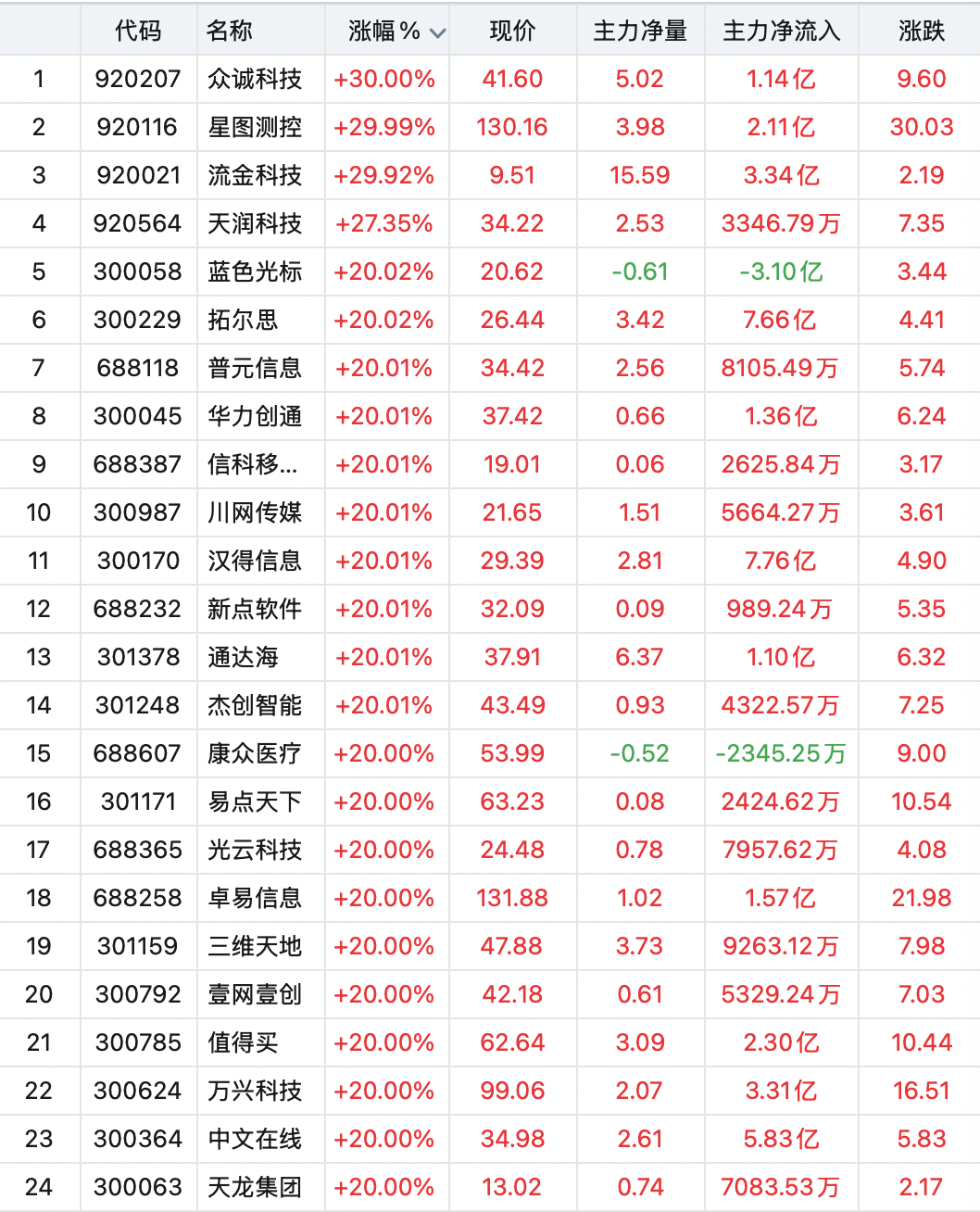
Core Viewpoint - The AI application sector experienced a significant surge on January 12, with various AI-related stocks hitting their daily price limits, indicating strong market enthusiasm for AI technologies and applications [1][2]. Group 1: Stock Performance - Over 80 stocks, including Zhongcheng Technology, Xingtum Control, and Zhidema, reached their daily limit, showcasing a robust interest in AI-related investments [1]. - In the Hong Kong market, AI concept stocks also saw substantial gains, with Zhipu rising over 40% and MINIMAX-WP increasing by more than 29% [1]. Group 2: Policy and Industry Developments - The Ministry of Industry and Information Technology, along with seven other departments, issued the "Implementation Opinions on 'Artificial Intelligence + Manufacturing'," providing guidelines for the intelligent upgrade of industries such as chemicals [2][3]. - By 2027, China aims to achieve reliable supply of key AI technologies, with plans to apply 3 to 5 general large models in manufacturing and develop 1,000 high-level industrial intelligent agents [3][4]. Group 3: Market Trends and Future Outlook - The AI industry in China is showing strong competitive advantages, with breakthroughs in large model capabilities and a thriving open-source ecosystem [4]. - Investment logic in AI applications is shifting from hardware competition to focusing on commercial viability and localized breakthroughs, emphasizing the importance of application scenarios [5][6]. - The AI application sector is expected to evolve from being merely usable to highly effective by 2026, with diverse business models becoming mainstream [6].





智能体是新宠,但非万能药——专访麦肯锡全球资深董事合伙人周宁人
麦肯锡· 2025-12-24 08:07
Core Viewpoint - The article discusses the current state and future potential of AI deployment in various industries, particularly in finance, highlighting the challenges and opportunities associated with scaling AI applications effectively [5][14]. Group 1: AI Deployment Status - Despite 88% of global enterprises using AI in at least one business function, only 39% report profitability from these applications, indicating a significant gap between adoption and effective implementation [5][16]. - In China, 83% of enterprises regularly use generative AI in at least one function, surpassing the global average, with 45% achieving large-scale or comprehensive deployment, higher than the global average of 38% [8][9]. - The financial sector is seen as a leading area for AI application, yet many institutions report that the effectiveness of AI does not meet expectations, primarily due to the exploratory phase of AI integration [14][16]. Group 2: AI Agent and Agentic AI - AI Agents, which enable machines to take action, are becoming popular, with 62% of organizations experimenting with them, but less than 10% have fully integrated them into business processes [10][11]. - The emergence of Agentic AI, which allows AI to autonomously complete tasks, is identified as a key trend, driven by reduced inference costs and the rise of smaller models that can operate on local devices [12][14]. - Successful AI organizations tend to have clear AI roadmaps and actively integrate AI into their core processes, moving beyond mere experimentation [14][15]. Group 3: Challenges and Recommendations - Organizations must redesign workflows to effectively leverage AI, focusing on identifying core pain points to enhance collaboration between AI and human workers [16][17]. - It is crucial to avoid a one-size-fits-all approach to AI deployment; instead, organizations should tailor AI applications to specific business needs and ensure proper governance and monitoring [18][20]. - The financial sector must balance innovation with risk management, employing a mixed strategy of rule-based AI for predictable tasks and AI-assisted processes for more complex scenarios [18].

当黑灰产用“智能体”养号,如何以AI识别?
Xin Jing Bao· 2025-12-12 13:43
Core Viewpoint - The rise of AI technology brings convenience but also poses challenges, particularly in the realm of black and gray market activities, as AI makes it difficult for apps to determine whether the user is the legitimate owner of the device [1] Group 1: AI and Black Market Operations - AI technology is being exploited by black market entities to enhance efficiency in operations such as account farming and mimicking user behavior, making it harder for traditional risk control measures to be effective [3] - The use of large models by black market actors allows for the automatic generation of realistic responses, significantly reducing the cost of account farming and increasing profit potential [3] - Traditional methods of automated scripts are being replaced by intelligent agents that can execute complex operations with human-like behavior, making detection more challenging [3] Group 2: Risk Control Strategies - The identification of good versus bad users is becoming increasingly complex as the majority of online operations shift from human to intelligent agent interactions [2] - A new paradigm for risk control, termed "AI risk control new paradigm," has been proposed, focusing on distinguishing between normal user behavior and black market operations through behavioral analysis [2] - The approach includes the "three laws of anti-fraud," which involve diversity, consistency, and correlation to effectively identify black market activities [2] Group 3: Future Implications - In the next 5-10 years, it is anticipated that over 50% of information encountered by humans will be generated by AI, necessitating an evolution in content risk control from merely identifying objects to understanding intent [5] - The introduction of AI-based review agents is suggested as a potential solution to address the new challenges posed by the increasing sophistication of black market operations [5]