Atlas 950

Search documents
阿里自研高端AI芯片正式上线,科创芯片设计ETF易方达(589030)最新单日净流入近8300万元
Xin Lang Cai Jing· 2026-01-29 03:10
Group 1 - The core viewpoint of the news highlights the active trading and significant inflow of funds into the E Fund Sci-Tech Chip Design ETF (589030), with a turnover of 10.97% and a transaction volume of 46.7362 million yuan as of January 29, 2026 [1] - As of January 28, the latest scale and share of the E Fund Sci-Tech Chip Design ETF reached a new high since its establishment, with a net inflow of 82.7062 million yuan [1] - Over the past five trading days, there have been net inflows on four days, totaling 141 million yuan, indicating strong investor interest [1] Group 2 - Alibaba has launched its self-developed high-end AI chip "Zhenwu 810E," marking a significant step in its vertical integration strategy, with the chip featuring 96G HBM2e memory and already deployed in multiple clusters for over 400 clients, including State Grid and the Chinese Academy of Sciences [1] - The emergence of super node server clusters is accelerating the penetration of domestic AI infrastructure, with the Huawei Atlas 900 A3 SuperPoD cluster achieving 1.7 times the total performance of NVL72 and a memory capacity 3.6 times greater, with over 300 sets deployed by September 2025 [2] - The newly released Atlas 950 and 960 SuperCluster have achieved scales of over 500,000 and 1 million cards respectively, indicating a systemic leap in domestic AI computing capabilities [2]
国产AI芯片:推理赛道起飞,谁能再破寒武纪神话?
Nan Fang Du Shi Bao· 2026-01-07 23:14
Core Insights - The domestic AI chip industry is experiencing a significant transformation in 2025, driven by the launch of DeepSeek, which has accelerated the demand for AI computing power and domestic alternatives [2][3] - Major domestic companies like Cambrian, Moore Threads, and Muxi are making headlines with their stock performances and upcoming IPOs, indicating a capital market boom for domestic AI chips [2][5] - The market is witnessing a shift in focus from training to inference, with a projected market size for AI inference chips in China expected to grow from 162.6 billion yuan in 2024 to 310.6 billion yuan in 2025 [3][4] Trend 1: Domestic AI Chip Opportunities - The launch of DeepSeek has ignited enthusiasm for domestic AI chips, particularly in the inference sector, as companies like Huawei and Cambrian quickly adapt to support this new model [2][3] - The inference chip market is expected to see explosive growth, with significant contributions from companies focusing on inference applications, such as Huawei, Cambrian, and Muxi [3][4] Trend 2: IPO Surge of Domestic AI Chip Manufacturers - 2025 marks a pivotal year for domestic AI chip manufacturers, with several companies successfully listing on the stock market, including Moore Threads and Muxi, which saw substantial initial stock price increases [5][6] - Despite the IPO successes, the market share of domestic chip manufacturers remains low, with major players like Nvidia and AMD dominating the market [6][7] Trend 3: Nvidia's Market Dynamics - Nvidia has faced challenges in the Chinese market, including export restrictions and security concerns, which have opened opportunities for domestic chip manufacturers [9][10] - The approval of Nvidia's H200 chip for sale in China could impact the domestic market, as it offers competitive performance, although concerns about dependency on foreign technology persist [10][11] Trend 4: Advanced Process Limitations - Domestic AI chip manufacturers are constrained by limitations in advanced process technologies, with most using 7nm or 14nm processes compared to Nvidia's 4nm technology [12][13] - Companies are exploring alternative solutions, such as switching to domestic supply chains and developing "super nodes" to enhance performance despite process limitations [13][14] Outlook: Future Opportunities for Domestic AI Chips - The domestic AI chip market is expected to exceed 300 billion yuan by 2026, driven by the rapid development of intelligent computing centers and increasing AI demands from internet companies [15][16] - The industry is anticipated to split into two main directions: self-developed ASICs by CSPs and local suppliers, with a focus on lower-spec AI inference chips presenting significant growth opportunities [16]



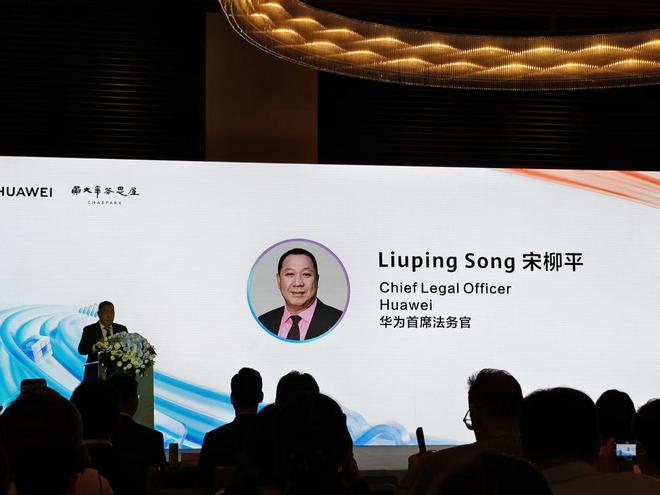
华为知识产权部长:研发捷报频传,尽最大努力对外开放
Guan Cha Zhe Wang· 2025-11-12 01:26
Core Insights - Huawei emphasizes the importance of open innovation and knowledge protection in driving technological advancement and societal development [1][3][10] R&D Investment - Huawei has invested over 20% of its annual sales revenue in R&D for the past five years, with R&D expenses exceeding RMB 170 billion in 2024, accounting for 20.8% of total sales [1][4] - Cumulatively, Huawei has invested over RMB 1.2 trillion in R&D over the past decade, ranking 6th globally in R&D spending according to the 2024 EU Industry R&D Scoreboard [1][4] Open Source and Collaboration - Huawei's open-source initiatives include the HarmonyOS and Euler operating systems, aimed at enhancing technology efficiency and reducing costs for developers and partners [3][4] - The OpenHarmony community has seen over 8,100 contributors and more than 10 million lines of new open-source code submitted in the past year [4] Patent and Licensing Strategy - In 2024, Huawei publicly disclosed a record 37,000 new patents, with over 150,000 valid patents globally, making it the largest patent holder in China [6][10] - Huawei's patent licensing revenue reached a historical high of $630 million in 2024, with cumulative licensing revenue over the past decade potentially exceeding $4 billion [6][7] Industry Contributions - Huawei has signed 233 patent licensing agreements, with 95% achieved through negotiation, and has contributed significantly to standards in cellular communication and multimedia technologies [10] - The company has paid significantly more in licensing fees than it has received, with cumulative payments exceeding $12 billion [8] Public Engagement and Tools - Huawei launched the "Chasi Patent" tool to provide free access to patent data for researchers, which has received over 2 million visits since its launch [11] - The tool has been upgraded to include features like semantic search and AI summaries, enhancing its utility for the research community [11] Future Outlook - Huawei aims to foster an environment of open collaboration and innovation, emphasizing the importance of protecting intellectual property while driving industry growth [11]
格林大华期货早盘提示-20250923
Ge Lin Qi Huo· 2025-09-22 23:31
Report Industry Investment Rating - The macro and financial sector of the global economy is rated as "Bullish" [1] Core View - The global economy maintains an upward trend, with China implementing the "Artificial Intelligence +" initiative, international capital actively increasing positions in China's technology sector, the US retail and manufacturing showing positive trends, the euro - zone manufacturing PMI breaking above the boom - bust line, and the global AI infrastructure accelerating [1] Summary by Related Catalogs Important Information - From a global perspective, Luobomei is more optimistic about non - US equity markets, especially China, Japan, and Europe. The weakening of the US dollar is expected to promote global capital re - balancing, and the demand for foreign capital to flow back to A - shares and Hong Kong stocks is expected to significantly increase [1] - A Goldman Sachs trader believes that the market is entering a liquidity - driven speculative stage, similar to the situation in 1999 in the US stock market, with the investment logic shifting from fundamentals to liquidity, market positions, and price trends [1] - Hong Kong - related ETFs have become the core carriers of capital inflows, with many products showing high scale and high net capital inflows. As of September 19, the latest scale of E Fund Hang Seng Tech ETF exceeded 20 billion yuan, reaching 20.45 billion yuan [1] - Huaxi Securities believes that Huawei has achieved TB - level ultra - large bandwidth through multi - port aggregation and high - sealing technology. The inter - connection bandwidth of Atlas 950 reaches 16.3PB/s, 62 times that of NVIDIA NVL144, and has achieved a 24% improvement in latency [1] - Samsung has significantly raised the prices of memory and flash products, with DRAM products increasing by up to 30% and NAND flash prices rising by 5 - 10%. Micron and SanDisk have also announced similar price increases [1] - Morgan Stanley says the humanoid robot industry is at a critical turning point, with the global market expected to reach $5 trillion by 2050. China leads the world in commercial orders, with a cumulative order amount of 975 million yuan, and Tesla Optimus V3 has become a global focus [1] Global Economic Logic - China implements the "Artificial Intelligence +" initiative, and international capital actively increases positions in China's technology sector. The US retail in August increased by 0.6% month - on - month, exceeding expectations. The US capital goods imports in July reached $95.8 billion, a new record. The euro - zone manufacturing PMI in August broke above the boom - bust line for the first time since June 2022. Huawei announced the evolution and goals of Ascend chips, and the global AI infrastructure is accelerating [1]
科技行业周报:推理应用驱动算力投资,国产算力景气升级-20250922
First Shanghai Securities· 2025-09-22 11:05
Investment Rating - The report maintains a strong positive outlook on the AI application-driven demand for computing power, indicating a significant growth trajectory for both domestic and international markets [2]. Core Insights - The report emphasizes that the domestic computing power supply chain is expected to overcome bottlenecks in advanced process capacity and packaging, with a notable increase in production anticipated by 2026 [3]. - It highlights the real demand for computing power from major Chinese internet companies, driven by the need for intelligent computing to support business operations and the proliferation of generative AI applications [3]. - The report suggests investors focus on companies with strong performance consistency and warns of potential short-term volatility due to changes in shipment rhythms, market share fluctuations, and capital expenditure variations [2]. Summary by Sections Domestic Computing Power Supply Chain - The domestic computing power market is in a tight balance, with key bottlenecks being gradually addressed, leading to a favorable investment outlook for the second half of the year and into next year [3]. - Huawei's recent announcements regarding its computing chip roadmap and the launch of the Atlas 950 and Atlas 960 SuperCluster are seen as significant advancements in the domestic computing power landscape [3]. Key Companies to Watch - The report recommends focusing on core computing hardware companies such as Cambricon (688256), SMIC (0981.HK), and Hua Hong Semiconductor (1347.HK) [4]. - It also highlights opportunities in the optical module sector, suggesting investments in leading companies like Zhongji Xuchuang (300308) and NewEase (300502) [5]. Next-Generation Training Clusters - The trend towards customized PCIe switches for interconnecting chips within cabinets is noted, with significant developments from major players like AWS and Meta [6]. - The report suggests monitoring companies like Astera Labs (ALAB) and Lattice Semiconductor (688008) for potential investment opportunities [6]. Edge AI Opportunities - The report mentions Meta's launch of AI smart glasses and OpenAI's plans to enter the AI hardware market, indicating a growing demand for high-performance, low-power edge AI hardware [8]. NAND Storage Price Increase - SanDisk's announcement of a 10% price increase for NAND Flash modules is expected to be followed by domestic leader Yangtze Memory Technologies [9]. - The report suggests monitoring companies like Demingli (001309) and Zhaoyi Innovation (603986) for potential benefits from this price increase [9]. Analog Chip Market - The report notes a recent anti-dumping investigation into U.S. analog chips, which could benefit domestic manufacturers and lead to price increases in the analog chip market [9]. - Companies such as Hua Hong Semiconductor (1347.HK) and Naxin Micro (688052) are highlighted as potential investment opportunities [9].
新力量New Force总第4864期
First Shanghai Securities· 2025-09-22 08:47
Group 1: Company Overview - NetDragon's revenue for the first half of 2025 was RMB 2.38 billion, a year-on-year decline of 28%[5] - The gross profit was RMB 1.7 billion, down 24.7% year-on-year, but the gross margin improved by 2.9 percentage points to 69.5%[5] - The company has a net cash position of approximately RMB 2.3 billion and holds 12,000 Ethereum as digital asset reserves[5] Group 2: Business Segments - The gaming and other businesses generated RMB 1.74 billion in revenue, a decrease of 18% year-on-year, but only a 4% decline compared to the second half of 2024, indicating stabilization[6] - The education segment, Mynd.ai, reported revenue of RMB 640 million, impacted by tightened customer budgets, with ongoing cost optimization efforts[7] Group 3: Financial Projections - The target price for NetDragon is set at HKD 20.24, representing a 71% upside from the last closing price[8] - The adjusted EPS for 2025 is projected at HKD 1.004, a decrease of 25% from previous estimates, while 2026 EPS is expected to be HKD 1.175, down 22%[2] Group 4: Market Strategy - The company plans to return at least HKD 600 million to shareholders through dividends and share buybacks over the next year[5] - New game titles and expansion into overseas markets are expected to drive future growth, with several products in the pipeline for release[6]

华为徐直军,罕见公开华为AI算力版图,新超节点已超越英伟达
2 1 Shi Ji Jing Ji Bao Dao· 2025-09-18 10:48
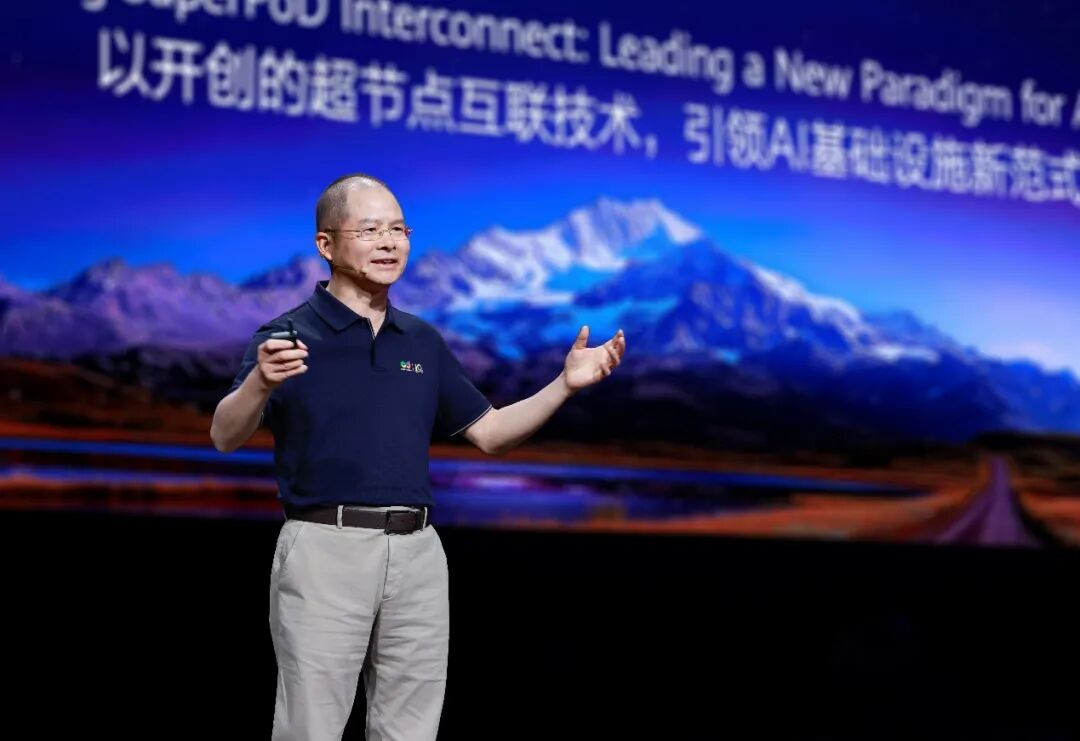
Core Insights - Huawei's Vice Chairman Xu Zhijun unveiled the company's AI computing power roadmap at the HC 2025 conference, detailing the evolution of the Ascend chip series over the next three years, with a focus on doubling computing power annually [3][4] Group 1: AI Computing Power Development - The Ascend 950 series will launch in Q1 2026, followed by the Ascend 960 in 2027 and the Ascend 970 in 2028, with significant advancements in low-precision data formats, vector computing power, interconnect bandwidth, and self-developed HBM [3][4] - The Atlas 950 and Atlas 960 supernode products were introduced, with the Atlas 950 featuring 8192 cards and an FP8 computing power of 8E FLOPS, set to launch in Q4 2026, significantly surpassing NVIDIA's concurrent offerings [3][4] Group 2: Expansion into General Computing - Huawei is extending its supernode concept to general computing with the TaiShan 950 supernode, which aims to outperform traditional databases and high-end servers by achieving a 2.9x performance boost without requiring database modifications [4] - The self-developed "UnifiedBus" interconnect protocol will be open-sourced from version 2.0, promoting a truly open supernode ecosystem [4] Group 3: Market Reaction and Collaborations - Following the announcements, Huawei's computing power concept stocks surged, with companies like Fenghuo Communication hitting the daily limit, and others like Xingtuxinke and Xinghuan Technology seeing significant gains [6][9] - Companies in the Huawei ecosystem, such as Fenghuo Communication and Xingtuxinke, are actively collaborating with Huawei on various AI solutions and have received certifications for their compatibility with Huawei's Ascend platform [9] Group 4: Industry Outlook - Analysts from Zhongyin Securities noted a rising industry sentiment, with domestic computing power expected to see significant growth, driven by high utilization rates in wafer manufacturing and semiconductor equipment orders [10]

华为披露芯片路线图,详情披露
半导体芯闻· 2025-09-18 10:40
Core Viewpoint - Huawei is leading a new paradigm in AI infrastructure with its innovative supernode interconnection technology, emphasizing the importance of computing power in artificial intelligence development [2][8]. Summary by Sections Ascend Chip Development - Huawei has committed to the monetization of Ascend hardware and plans to open-source its CANN compiler and virtual instruction set interface by December 31, 2025 [2]. - The Ascend 950 series, including Ascend 950PR and Ascend 950DT, is set to significantly enhance computing power and efficiency compared to previous models [3][4]. - The Ascend 950 chip will support new data formats and achieve a computing power of 1 PFLOPS for FP8 and 2 PFLOPS for FP4, with interconnect bandwidth increased to 2 TB/s [5][6]. Upcoming Chip Releases - The Ascend 950PR chip is targeted for Q1 2026, focusing on inference prefill and recommendation scenarios, while the Ascend 950DT will be released in Q4 2026, emphasizing inference decode and training [6][7]. - The Ascend 960 chip, expected in Q4 2027, will double the specifications of the Ascend 950, enhancing performance for training and inference [7]. - The Ascend 970, planned for Q4 2028, aims to further upgrade performance metrics across various specifications [7]. Supernode Products - The Atlas 950 supernode, based on the Ascend 950DT, will support 8192 Ascend 950DT chips, achieving FP8 computing power of 8 EFLOPS and interconnect bandwidth of 16 PB/s, set to launch in Q4 2026 [9][10]. - The Atlas 960 supernode, launching in Q4 2027, will support 15488 cards, with FP8 computing power reaching 30 EFLOPS and interconnect bandwidth of 34 PB/s [11]. Interconnection Technology - Huawei has developed a new interconnection protocol, "Lingqu," to support large-scale supernodes, enhancing reliability and bandwidth while reducing latency [18][19]. - The Atlas 950 SuperCluster, consisting of 64 Atlas 950 supernodes, will achieve a total FP8 computing power of 524 EFLOPS, launching alongside the Atlas 950 supernode in Q4 2026 [20]. Future Directions - Huawei aims to continue evolving its supernode and cluster products to meet the growing demands for AI computing power, with a focus on both AI and general computing applications [12][21].
华为徐直军,罕见公开华为AI算力版图,新超节点已超越英伟达
21世纪经济报道· 2025-09-18 10:12
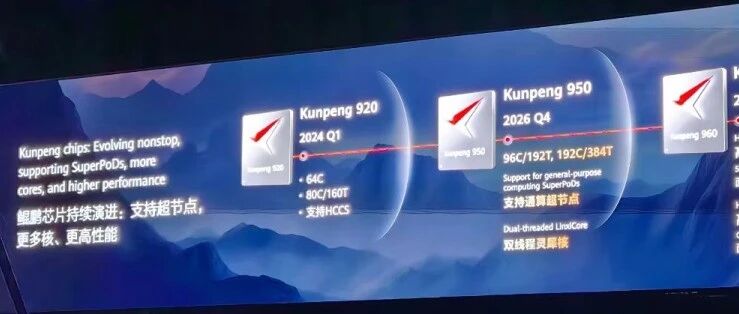
Core Viewpoint - Huawei unveiled its AI computing roadmap at the HC 2025 conference, emphasizing a commitment to doubling computing power annually through the development of its Ascend chip series and a comprehensive AI infrastructure strategy [3][4]. Group 1: AI Computing Strategy - Huawei's Vice Chairman Xu Zhijun detailed the three-year iteration plan for the Ascend chips, with the Ascend 950 series launching in Q1 2026, followed by the Ascend 960 in 2027, and the Ascend 970 in 2028, aiming for a doubling of computing power each year [3]. - The Atlas 950 and Atlas 960 supernode products were introduced, with the Atlas 950 featuring 8192 cards and achieving FP8 computing power of 8E FLOPS, and the Atlas 960 set to support 15488 cards, further enhancing performance [3][4]. Group 2: Infrastructure and Ecosystem - Huawei's TaiShan 950 supernode, based on the new Kunpeng 950 processor, aims to outperform traditional databases and high-end servers with a 2.9x performance improvement without requiring database modifications [4]. - The self-developed "UnifiedBus" interconnect protocol facilitates high-reliability computing collaboration across large-scale systems and will be open-sourced from version 2.0 to foster an open supernode ecosystem [4]. Group 3: Market Reaction and Collaborations - Following the announcements, Huawei's computing concept stocks surged, with Fenghuo Communication hitting the daily limit, and other companies like Xingtuxinke and Xinghuan Technology also seeing significant gains [5][6]. - Companies such as Fenghuo Communication and Xingtuxinke are actively collaborating with Huawei's Ascend ecosystem, enhancing their capabilities in AI and computing solutions [6][7]. Group 4: Industry Outlook - Analysts from Zhongyin Securities noted that Huawei's dual breakthroughs in computing and software are paving the way for a new era in domestic AI, with significant growth potential in the domestic computing chain [7]. - The semiconductor sector is experiencing increased utilization rates and strong orders, indicating a favorable environment for domestic computing chip growth driven by AI demand [7].