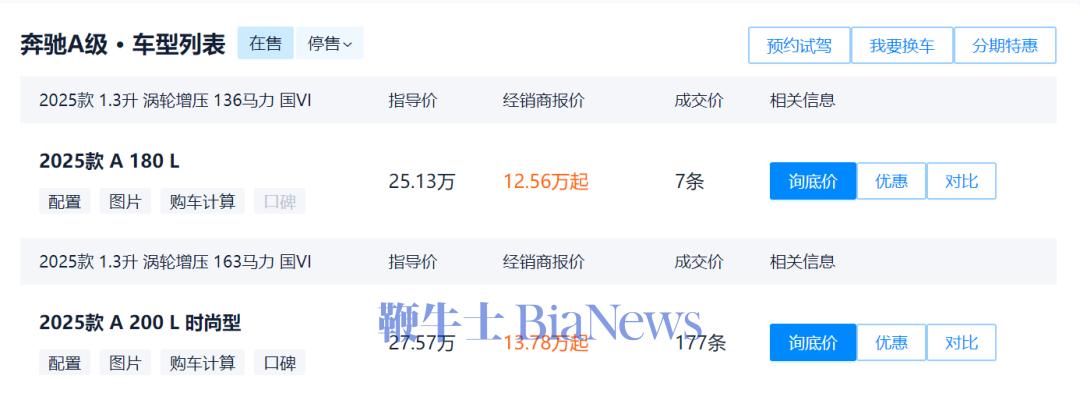
奔驰A级

Search documents
奔驰C级:门店全款优惠53000,白色以外的颜色很少卖
车fans· 2026-03-10 00:29
Core Viewpoint - The Mercedes-Benz C-Class is positioned as an accessible luxury vehicle, appealing to younger buyers who aspire to own a prestigious brand without the high costs associated with higher-end models like the E-Class or S-Class [1]. Sales Performance - In a local four-tier city, the dealership experiences a daily foot traffic of 6-8 groups, with over 50% of visitors interested in the C-Class, making it the primary sales model [2]. - Last month, the dealership sold 17 units of the C-Class, with a commission range of 1500-2500 for the sales staff. The current inventory includes around 20 units, predominantly in white, with the C200 and special editions being less popular [3][10]. Customer Demographics - The typical C-Class buyer is younger, aged between 20-35, often comprising white-collar workers who view the purchase as a reward for their hard work [5]. - A notable customer example includes a 30-year-old woman who specifically sought the C260 model, demonstrating a clear preference for the vehicle despite being offered alternatives [5]. Competitive Landscape - The C-Class is often compared with competitors like the Audi A4L and BMW 3 Series, with customers typically having a budget of around 300,000 yuan and being flexible regarding body styles [7]. - Key selling points for the C-Class include its interior quality, brand prestige, and competitive features, particularly the 2.0T engine shared with the E-Class, enhancing its appeal [7]. Customer Preferences - The most popular configuration is the white exterior with a black interior in the sport version, accounting for 70-80% of sales. Other colors, particularly blue, have struggled to sell [10]. - Customers express dissatisfaction with the complexity of the vehicle's technology and the rear space, which is seen as a disadvantage [15]. Pricing and Discounts - Current discounts on the C-Class are around 50,000 yuan, with the dealership able to offer up to 53,000 yuan in incentives [16]. - Financing options include a 4% interest subsidy on loans, which is reflected in the final pricing [14]. Maintenance and After-Sales - Maintenance costs are structured with A service at 2,000 yuan for every 10,000 kilometers and B service at 5,000 yuan for every 20,000 kilometers, adhering strictly to the service schedule [18]. - Customers are advised to avoid external maintenance services during the warranty period to ensure quality and reliability [19].


“中年人的一代神车”正在消失
汽车商业评论· 2026-02-26 23:05
Core Viewpoint - The article discusses the decline of classic fuel vehicles, highlighting the transition to electric vehicles and the reasons behind the discontinuation of iconic models like Honda Fit, Mazda 6, Ford Focus, and Mercedes A-Class [3][4][12][19][24]. Group 1: Reasons for Discontinuation of Fuel Vehicles - Strict emissions regulations and laws are forcing the elimination of fuel vehicles, with companies unwilling to invest heavily in R&D for a shrinking market [3][4]. - Market demand has shifted towards electric vehicles, which offer lower operating costs and better performance, leading to the phasing out of traditional fuel cars [4][9]. - Automakers are strategically pivoting towards electric and hybrid technologies, ceasing the development of new fuel platforms and engines [4][12]. Group 2: Specific Model Discontinuations - Honda Fit officially exited the Chinese fuel vehicle market in February 2026, with a limited edition model selling out quickly before the discontinuation [6][9]. - Mazda has ceased production of three classic models: Mazda 6, CX-3, and Mazda 2, with the Mazda 6's global production ending in March 2025 after a 23-year lifecycle [10][12][16]. - Ford Focus will be globally discontinued by November 2025, despite still having decent sales in Europe, due to stringent regulations and market shifts [18][19][22]. - Mercedes A-Class will not have a successor, with production extended until 2027 due to stable demand in Europe, while other compact models are being phased out [24][27].




目标裁撤3万人!奔驰大裁员,赔付额被曝最高达50万欧元
新浪财经· 2025-10-23 08:33
Core Viewpoint - Mercedes-Benz is implementing its largest layoff plan in history, aiming to encourage around 30,000 employees to voluntarily leave by offering substantial severance packages, with the goal of saving approximately €5 billion annually by 2027 [3][5]. Group 1: Layoff Plan and Compensation - Approximately 4,000 employees have accepted the voluntary severance package, with senior management potentially receiving up to €500,000 (over 4 million RMB) in compensation [3][5]. - The severance package is designed with a gradient structure based on job level and years of service, including an "accelerated bonus" to incentivize early decision-making [5][7]. - The layoff plan primarily targets employees in engineering, administration, and IT sectors, with applications open until March 2026 [7]. Group 2: Market Performance and Sales Decline - Mercedes-Benz reported a significant decline in global sales, with a 12% year-on-year drop in Q3, totaling 525,300 vehicles sold [12]. - In China, the largest single market for Mercedes-Benz, sales fell by 27% year-on-year in Q3, worsening from a 19% decline in Q2 [12][13]. - The U.S. market also faced challenges, with a 17% decrease in sales to 70,800 vehicles [12]. Group 3: Competitive Landscape and Pricing Strategy - The automotive industry in Germany is experiencing overall performance declines, with competitors like BMW and Volkswagen also reporting reduced sales and profits [7][8]. - Mercedes-Benz has seen drastic price reductions for several models, with discounts reaching up to 50% in some cases, driven by increased market competition [9][10]. - The company is adjusting its marketing strategies to cope with the competitive environment, as luxury brands are becoming more common and price-sensitive [10]. Group 4: Future Outlook and Product Strategy - Despite challenges in major markets, Mercedes-Benz is focusing on long-term customer value and high-end product experiences in China [13]. - The company is accelerating product updates, with plans for new electric models and high-end vehicles set to launch in the near future [13].

目标裁撤3万人!奔驰大裁员,赔付额被曝最高达50万欧元
Xin Lang Cai Jing· 2025-10-23 07:48
Group 1: Company Restructuring - Mercedes-Benz is implementing its largest-ever layoff plan, with approximately 4,000 employees having accepted severance packages so far [3][4] - The CEO aims to encourage around 30,000 employees to voluntarily leave by offering generous severance packages, with senior management receiving up to €500,000 (over 4 million RMB) [3][4] - The company plans to save about €5 billion annually by 2027 through outsourcing decisions and other measures [3] Group 2: Market Performance - In the third quarter of 2025, Mercedes-Benz reported a global sales decline of 12% year-on-year, with total sales of 525,300 vehicles [10] - The company's sales in China, its largest single market, fell by 27% year-on-year, worsening from a 19% decline in the previous quarter [10][11] - In contrast, the European market saw a slight increase in sales, with Germany growing by 3% and Spain by 5% [10] Group 3: Pricing and Competition - Multiple models from Mercedes-Benz have experienced significant price drops, with discounts reaching up to 50% on certain models [7][8] - The competitive landscape has intensified, prompting the company to adjust its marketing strategies and pricing to maintain sales [9] - The decline in prices has led to the closure of several dealerships across various cities, attributed to business adjustments and authorization terminations [8] Group 4: Future Outlook - Mercedes-Benz is accelerating product updates, with plans for new electric models and high-end vehicles set to launch in early 2026 [12] - The company is focusing on enhancing customer value and high-end product experiences in response to market challenges [11]
创近5年新低!奔驰7月国内销量暴跌超40%
Xi Niu Cai Jing· 2025-08-20 05:20
Core Viewpoint - Mercedes-Benz is facing significant challenges in the Chinese market, with a notable decline in sales and increasing competition from domestic brands, highlighting the need for accelerated transformation in electric and intelligent vehicle offerings [2][4][5] Group 1: Sales Performance - In July, Mercedes-Benz's retail sales in China were only 26,653 units, a month-on-month decline of over 40%, marking a five-year low and falling below the 27,000-unit threshold for the first time [2] - Compared to the worst sales figures in the past three years of 36,000 units, July's sales were down by over 9,000 units, with competitors BMW and Audi significantly outperforming Mercedes-Benz, selling 40,190 and 37,600 units respectively [2] Group 2: Market Challenges - The decline in sales is attributed to both internal and external factors, including the rise of domestic brands like Wuling, Li Auto, and Zeekr, which have captured market share in the 300,000 yuan and above segment [4] - Mercedes-Benz's slow progress in electric and intelligent vehicle technology has further exacerbated the situation, as competitors like Audi have partnered with Huawei to enhance their offerings [4] Group 3: Financial Performance - For the first half of the year, Mercedes-Benz reported a revenue of 66.377 billion euros, a year-on-year decline of 8.6%, and a net profit of 2.688 billion euros, down 55.8% year-on-year [4] - In the Chinese market, total sales for the first half were 293,200 units, reflecting a year-on-year decrease of 14%, with a 19% decline in the second quarter [4] Group 4: Strategic Implications - The current predicament of Mercedes-Benz serves as a microcosm of the challenges faced by traditional luxury car manufacturers amid the automotive industry's transformation [5] - Without accelerating the transition to electric and intelligent vehicles and improving product and service quality, Mercedes-Benz risks relying solely on brand prestige, which could lead to significant challenges in both the Chinese and global markets [5]
老豪华如何进化为新豪华
Zhong Guo Qi Che Bao Wang· 2025-08-12 06:33
Core Insights - Traditional luxury brands like BBA (Benz, BMW, Audi) are facing strong competition from new luxury brands represented by companies like Wenjie and Li Auto in the Chinese market [2][3] - Significant price reductions have been observed for multiple Benz models, with discounts reaching up to 50%, leading to the closure of several dealerships in cities like Tangshan, Dongying, and Luoyang [2] - Mercedes-Benz's net profit after tax dropped by 55.8% year-on-year in the first half of the year, with total sales in China declining by 14% to 293,200 units [2] - Audi and BMW also reported declines in sales, with Audi's sales down 10.2% and BMW's net profit decreasing by over 29% [2] Market Dynamics - The definition of luxury is evolving as the automotive industry accelerates towards electrification and intelligence, with younger consumers prioritizing technology and practicality over brand prestige [2][3] - Mercedes-Benz is adjusting its electrification strategy to allow for a coexistence of fuel and electric vehicles, catering to different market conditions, particularly in China [3][10] - The acceptance of intelligent technology varies globally, with Chinese consumers showing the highest willingness to adopt smart features, while North American and European consumers express concerns about privacy and data security [3][9] Technological Focus - Mercedes-Benz identifies five key future technology anchors: electronic and electrical architecture, powertrains, autonomous driving, smart cockpits, and data security [8][9] - The company emphasizes the importance of self-research in electronic architecture and powertrains to maintain competitive advantage, while opting for collaboration in areas like data security and chip development [10][12] - The strategy includes a focus on user-centered technology that enhances safety, comfort, and convenience, avoiding mere technological accumulation [6][7] Localization and Global Strategy - The unique dynamics of the Chinese market are seen as a testing ground for innovation, with Mercedes-Benz aiming to adapt its product development processes to align with local market demands [13][14] - The company plans to leverage its experiences in China to enhance its global operations, potentially developing next-generation platforms locally [13] - The shift from traditional luxury to new luxury is characterized by a blend of brand heritage with modern consumer needs, with China acting as a catalyst for this transformation [14]

最低只要12万,奔驰价格“崩”了?
Hu Xiu· 2025-08-07 07:01
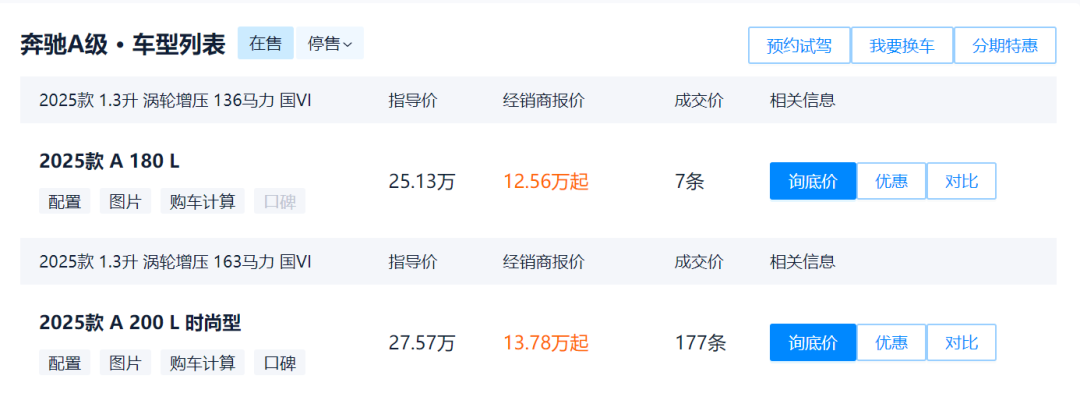
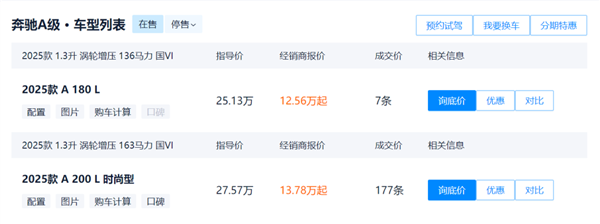
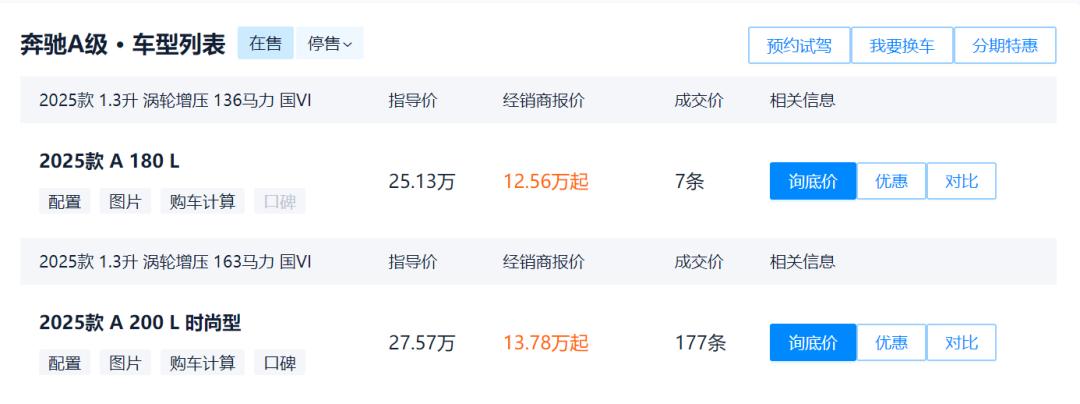
Core Viewpoint - Mercedes-Benz is experiencing significant price reductions on multiple models, leading to store closures and a sharp decline in sales and profits, particularly in the Chinese market [1][3][23]. Pricing and Sales - Recent price cuts for models like the A-Class and C-Class have reached up to 50%, with the A-Class being offered at a low of 125,600 yuan compared to its original price of 251,300 to 275,700 yuan [5][24]. - The overall sales revenue for Mercedes-Benz in the first half of 2025 was 66.377 billion euros, a year-on-year decline of 8.6% [24]. Store Closures - Several Mercedes-Benz dealerships, including those in Tangshan, Dongying, and Luoyang, have closed, attributed to business adjustments [2][9]. - The closures have caused customer dissatisfaction, as many are left without support for services purchased at the now-closed dealerships [10][12]. Financial Performance - The net profit after tax for the second quarter dropped by 68.7% year-on-year, with a total net profit of 2.688 billion euros for the first half, down 55.8% [24][25]. - In China, the sales volume fell by 14% in the first half of the year, making it the market with the largest decline for Mercedes-Benz globally [27][28]. Market Position and Challenges - The company is struggling to adapt to the growing demand for electric vehicles, with its electric models not gaining significant traction in the market [28][29]. - Mercedes-Benz's reliance on traditional fuel vehicles is becoming a liability as the industry shifts towards electrification and smart technology [16][29].
奔驰价格崩了!最低只要12万:多地门店人去楼空
Xin Lang Ke Ji· 2025-08-07 04:04
Core Viewpoint - Mercedes-Benz is facing significant challenges in the Chinese market, with drastic price cuts on multiple models and a notable decline in sales and profits, leading to the closure of several dealerships [1][10][11]. Pricing and Sales - Recent price reductions for models such as the A-Class, C-Class, EQA, and EQB have reached up to 50%, with the A-Class being offered at a low of 125,600 yuan [1][2]. - The sales revenue for Mercedes-Benz in the first half of 2025 was 66.377 billion euros, a year-on-year decline of 8.6%, with a net profit drop of 55.8% [10]. - In the Chinese market, sales fell by 14% to 293,200 units in the first half of the year, marking the largest decline globally for Mercedes-Benz [10][11]. Dealership Closures - Multiple dealerships in cities like Tangshan, Dongying, and Luoyang have closed, attributed to business adjustments and authorization terminations [1][3][5]. - Customers are facing difficulties in accessing services and warranties due to the closures, leading to concerns about their rights and the continuity of service [3][5]. Technological Lag and Customer Dissatisfaction - Mercedes-Benz is perceived to be lagging in technology, particularly in electric and smart vehicle features, with customers expressing dissatisfaction over additional charges for services that are often free with competitors [6][9]. - The company is reportedly expanding its R&D team in China to improve its software and smart cockpit capabilities, indicating a response to competitive pressures [6][11]. Market Position and Future Outlook - The shift towards electric vehicles in China is significant, with new energy vehicles accounting for over 44% of total sales, while Mercedes-Benz remains heavily reliant on traditional fuel vehicles [11]. - The decline in sales and profitability, coupled with the aggressive pricing strategies, raises concerns about the long-term viability of Mercedes-Benz in the competitive automotive landscape [10][11].
奔驰价格崩了,最低只要12万,多地门店「人去楼空」
3 6 Ke· 2025-08-07 02:47
Core Viewpoint - Mercedes-Benz is facing significant challenges in the Chinese market, with drastic price reductions on multiple models and a notable decline in sales and profits, leading to the closure of several dealerships [1][13][14]. Pricing and Sales Performance - Recent price cuts for models such as the A-Class and C-Class have seen discounts of up to 50%, with the A-Class being offered at a low of 125,600 yuan compared to its original price of 251,300-275,700 yuan [2][3]. - The company's revenue for the first half of 2025 was reported at 66.377 billion euros, a year-on-year decline of 8.6%, with a staggering 55.8% drop in net profit [13][14]. - In the Chinese market, sales fell by 14% to 293,200 units in the first half of 2025, marking it as the largest decline globally for Mercedes-Benz [13][14]. Dealership Closures - Multiple dealerships in cities such as Tangshan, Dongying, and Luoyang have closed, attributed to business adjustments and authorization terminations [5][6][8]. - The closures have led to customer concerns regarding service continuity and rights, as many customers find themselves unable to access previously purchased services [6][9]. Customer Experience and Technology Issues - Customers have expressed dissatisfaction with the company's lag in smart technology and the introduction of fees for features that were previously included, such as remote control and navigation services [8][12]. - The company is reportedly expanding its R&D team in China to address the technological gap, particularly in software and smart cockpit development [8]. Market Position and Future Outlook - The decline in sales is partly due to the company's heavy reliance on traditional fuel vehicles, while the market is shifting towards electric vehicles, which have seen a significant increase in sales [14]. - The overall market environment shows that new energy vehicles accounted for over 44% of total vehicle sales in China, highlighting the urgency for Mercedes-Benz to adapt [14].
奔驰价格崩了!最低只要12万,多地门店「人去楼空」
Xin Lang Ke Ji· 2025-08-07 01:55
Core Viewpoint - Mercedes-Benz is experiencing significant price reductions on multiple models, leading to store closures and a sharp decline in sales and profits, particularly in the Chinese market [1][16][20] Pricing and Sales - Recent price drops for models like the A-Class and C-Class have seen discounts of up to 50%, with the A-Class being offered at a low of 125,600 yuan compared to its original price of 251,300-275,700 yuan [1][3] - The EQA and EQB electric models also saw similar price cuts, with the EQA's price dropping to 161,000 yuan from a manufacturer suggested price of 322,000 yuan [4] Store Closures - Several Mercedes-Benz dealerships in cities such as Tangshan, Dongying, and Luoyang have closed, attributed to business adjustments and authorization terminations [5][6][10] - Customers are facing difficulties in accessing services and warranties due to these closures, leading to concerns about their rights and service continuity [6][8] Financial Performance - Mercedes-Benz reported a revenue decline of 8.6% year-on-year for the first half of 2025, with net profit dropping by 55.8%, and a staggering 68.7% decline in the second quarter [17] - Global sales fell to 1.0763 million vehicles, a decrease of 8%, with electric vehicle sales down 14% [17][19] Regional Performance - In the Chinese market, which is the largest single market for Mercedes-Benz, sales fell by 14% to 293,200 vehicles, with a 19% drop in the second quarter [19] - The overall trend shows a significant decline in sales across various regions, including Europe and North America, with the Asian market experiencing a 16% drop [18] Market Challenges - The decline in sales is attributed to Mercedes-Benz's slow transition to electric vehicles and a lack of competitiveness in smart technology compared to domestic brands [20] - The company is reportedly expanding its R&D team in China to enhance its software and smart cockpit capabilities, indicating a response to the competitive pressure [12]