DeepSeekR1模型

Search documents
AI技术突破与法律困局,2026年五大趋势背后的机遇与挑战
Sou Hu Cai Jing· 2026-01-11 14:46
Group 1 - The core viewpoint of the article highlights five major trends in AI development by 2026, emphasizing the rise of Chinese open-source models, global regulatory battles, transformations in shopping ecosystems, accelerated scientific discoveries, and increasing legal challenges [4][33]. - Chinese open-source models are reshaping the global competitive landscape, with significant adoption rates, such as Alibaba's Qwen series reaching 8.85 million downloads, indicating that one in three AI developers globally is using these models [6][8]. - The gap between Chinese and American AI models is narrowing, particularly in specific niches, with the open-source strategy providing a trust advantage that is more valuable than mere technical specifications [12]. Group 2 - AI regulation in the U.S. is characterized by political conflicts, with the federal government delaying state-level AI laws, leading to confusion and challenges for companies trying to navigate the regulatory landscape [14][19]. - The AI-driven consumer market is projected to reach $263 billion during the holiday shopping season, with estimates suggesting it could grow to $3-5 trillion by 2030, showcasing the transformative impact of AI on retail [21][23]. - Legal issues surrounding AI are becoming increasingly complex, with cases like the OpenAI lawsuit raising questions about responsibility and accountability in AI-generated content and autonomous systems [31][39].


中信证券徐广鸿:估值修复与结构重塑共振 2026年港股锚定四大核心赛道
Zhong Guo Zheng Quan Bao· 2025-12-09 22:44
Core Viewpoint - The Hong Kong stock market is entering a phase of valuation repair and structural reshaping, characterized by undervaluation, capital misalignment, and performance differentiation, with significant net inflows from southbound funds and a shift in foreign capital [1][2]. Valuation and Market Trends - The Hang Seng Index has experienced a cumulative decline of over 50% from early 2021 to January 2024, leading to a significant valuation gap [2]. - As of December 9, 2023, the Hang Seng Index, Hang Seng China Enterprises Index, and Hang Seng Technology Index have recorded cumulative gains of 49.20%, 22.59%, and 24.32%, respectively [2]. - By the end of 2025, the expected EPS growth for the Hang Seng Index in 2026 is projected to be 8%, with a dynamic P/E ratio of only 12 times, indicating a notable valuation gap compared to major global markets [2]. Capital Flow Dynamics - Southbound funds have seen a record net inflow of nearly 1.4 trillion HKD by the end of November 2023, marking a new high since the launch of the mutual market access mechanism [3]. - The inflow of ETFs surged to 51.3% from June to October, with August reaching 88%, indicating strong enthusiasm among domestic individual investors [3]. - Institutional investors favor sectors like non-bank themes and precious metals, while individual investors focus on growth sectors such as automotive, pharmaceuticals, and consumer goods [3]. Sector Performance and Investment Opportunities - The technology sector is expected to see significant profit growth in 2025, contrasting with traditional sectors like finance and real estate [4]. - The AI industry chain in Hong Kong is strengthening, with a positive correlation between the Hang Seng Technology Index and the USD/JPY exchange rate [4]. - For 2026, investment opportunities should focus on sectors with performance certainty and valuation elasticity, particularly technology, pharmaceuticals, resource products, and essential consumer goods [8]. Long-term Market Outlook - The market is anticipated to experience a second round of valuation repair driven by internal and external factors, including the implementation of the "14th Five-Year Plan" and easing monetary policies globally [6][5]. - The potential for external capital inflow is expected to increase as the risk premium decreases due to improved Sino-U.S. relations [6]. Specific Sector Insights - The technology sector, especially the AI industry, is expected to benefit from a virtuous cycle of investment and revenue growth, with a focus on leading companies and quality players in the computing power supply chain [8]. - The pharmaceutical sector is entering a growth phase supported by policy and industry developments, with a focus on innovative companies and those benefiting from domestic market reforms [8]. - The resource sector is supported by supply-demand mismatches and liquidity drivers, with companies in precious metals and rare earths likely to benefit from rising commodity prices [9]. - The essential consumer goods sector is poised for valuation recovery as domestic policies stimulate consumption and improve income expectations [9].

中信证券徐广鸿: 估值修复与结构重塑共振 2026年港股锚定四大核心赛道
Zhong Guo Zheng Quan Bao· 2025-12-09 20:46
Core Viewpoint - The Hong Kong stock market is entering a phase of valuation repair and structural reshaping, characterized by undervaluation, capital misalignment, and performance differentiation, with a significant influx of southbound capital and a shift in foreign investment reshaping the funding landscape [1][2]. Valuation and Market Dynamics - The Hang Seng Index has experienced a cumulative decline of over 50% from the post-Lunar New Year of 2021 to January 2024, leading to a significant valuation gap [2]. - As of December 9, 2023, the Hang Seng Index, Hang Seng China Enterprises Index, and Hang Seng Technology Index have recorded cumulative gains of 49.20%, 22.59%, and 24.32%, respectively [2]. - By the end of 2025, the expected EPS growth rate for the Hang Seng Index in 2026 is projected to be 8%, with a dynamic P/E ratio of only 12 times, indicating a notable valuation gap compared to major global markets [2]. Capital Flow and Investment Preferences - Southbound capital has seen a record net inflow of nearly 1.4 trillion HKD by the end of November, marking a new high since the launch of the mutual market access mechanism [3]. - The capital structure shows a clear differentiation, with institutional investors favoring themes like non-bank ETFs and personal investors focusing on growth sectors such as automotive, pharmaceuticals, and consumer goods [3]. - Foreign capital, while still experiencing outflows, has shown signs of recovery since August, with long-term foreign capital seeing its first phase of inflow since September 2022, particularly favoring the information technology sector [3]. Sector Performance and Outlook - The technology sector is expected to see significant profit growth in 2025, contrasting sharply with traditional sectors like finance and real estate [4]. - The Hang Seng Technology Index has shown volatility but continues to strengthen its core competitiveness, with the sector benefiting from advancements in AI and related technologies [4]. - The long-term trend of recovery in the Hong Kong stock market is expected to continue, driven by policy dividends and external risk dynamics [5][6]. Investment Directions - Key investment opportunities for 2026 are identified in four main sectors: technology, pharmaceuticals, resource products, and essential consumer goods, focusing on "earnings certainty + valuation elasticity" [8][9]. - The technology sector, particularly the AI industry chain, is anticipated to benefit from a virtuous cycle of investment and revenue growth, with a focus on leading companies and quality players in the computing power supply chain [8]. - The pharmaceuticals sector is entering a phase of certain growth, supported by policy and industry developments, with a focus on innovative companies and those benefiting from domestic market reforms [8]. - The resource products sector is supported by supply-demand mismatches and liquidity drivers, with expectations of rising commodity prices benefiting related stocks [9]. - The essential consumer goods sector is poised for valuation recovery, supported by domestic policies aimed at boosting consumption and improving income expectations [9].
估值修复与结构重塑共振 2026年港股锚定四大核心赛道
Zhong Guo Zheng Quan Bao· 2025-12-09 20:22
● 本报记者 谭丁豪 2025年港股步入估值修复与结构重塑并行阶段,估值低估、资金错位与业绩分化成为核心特征。历经此 前三年调整,恒生指数形成显著的估值洼地,南向资金创纪录净流入与外资转向共同重塑资金格局。 日前,中信证券海外策略首席分析师徐广鸿在接受中国证券报记者专访时表示,2026年港股将在政策红 利与外部风险博弈中开启第二轮估值修复,内外因素共振有望进一步打开上行空间。在此背景下,投资 需紧扣"业绩确定性+估值弹性"主线,科技、医药、资源品与必选消费四大赛道,凭借政策支撑、产业 景气或供需优势,成为把握港股修复行情的核心方向。 估值洼地凸显 今年以来,港股三大指数震荡上行。Wind数据显示,截至12月9日,恒生指数、恒生中国企业指数、恒 生科技指数分别累计涨幅为49.20%、22.59%、24.32%。 "今年港股市场整体呈现估值修复的态势,有业绩支撑的行业估值扩张更为显著,例如原材料板块。在 此背景下,具有进一步基本面支撑的行业有望获得更大的估值上行空间。"徐广鸿说。 "当前港股正处于估值修复与结构重塑的关键阶段,估值低估、资金错位与业绩分化构成市场核心特 征。"徐广鸿表示,从估值维度看,2021年春 ...
科技行业催化不断!双创50ETF增强(588320)、科创100ETF增强指数基金(588680)午后集体拉升,涨超1%
Xin Lang Cai Jing· 2025-06-05 06:52
Group 1: ETF Performance - The Double Innovation 50 Enhanced ETF (588320) has increased by over 1% as of June 5, 2025, with a cumulative increase of 15.08% over the past year, ranking first among comparable funds [1] - The Science and Technology Innovation 100 Enhanced ETF (588680) also rose by over 1%, with a cumulative increase of 8.21% over the past six months, ranking first among comparable funds [1] - The Double Innovation 50 Enhanced ETF has outperformed its benchmark with an annualized return of 3.95% over the past six months, ranking first among comparable funds [1] Group 2: Policy and Industry Development - The Ministry of Industry and Information Technology is promoting the development of the artificial intelligence industry, emphasizing systematic planning and collaborative advancement to create a favorable ecosystem for innovation [2] - The focus is on strengthening the industrial foundation, enhancing computing power supply, and promoting the deployment of large models in key manufacturing sectors [2] - The global humanoid robot market is projected to reach approximately 1.1665 trillion yuan in 2024, with China's market expected to reach about 2.76 billion yuan, accounting for approximately 2.36% of the global market [2] Group 3: Corporate Developments - On May 25, 2025, Haiguang Information, a component of the Double Innovation 50 ETF, announced a suspension of trading as it plans to merge with Zhongke Shuguang through a share exchange, optimizing the industrial layout from chips to software and systems [3] - The integration of Zhongke Shuguang and Haiguang Information aims to enhance the information industry chain by consolidating high-quality resources [3] Group 4: AI Industry Trends - The AI industry is experiencing upward trends, with significant improvements in reasoning capabilities and the introduction of advanced models such as Claude4 and DeepSeekR1 [4] - The computing power industry is identified as a high-growth sector benefiting from policy and industrial changes, with domestic leaders like Haiguang and Shuguang expected to enhance competition [4] - The focus on core computing power leaders and their ecosystems is recommended for future investment opportunities [4] Group 5: Investment Opportunities - The Double Innovation 50 ETF and Science and Technology Innovation 100 ETF are positioned as a "Science and Technology Asset Upgrade Package," allowing investors to capture excess returns in the technology sector [5]
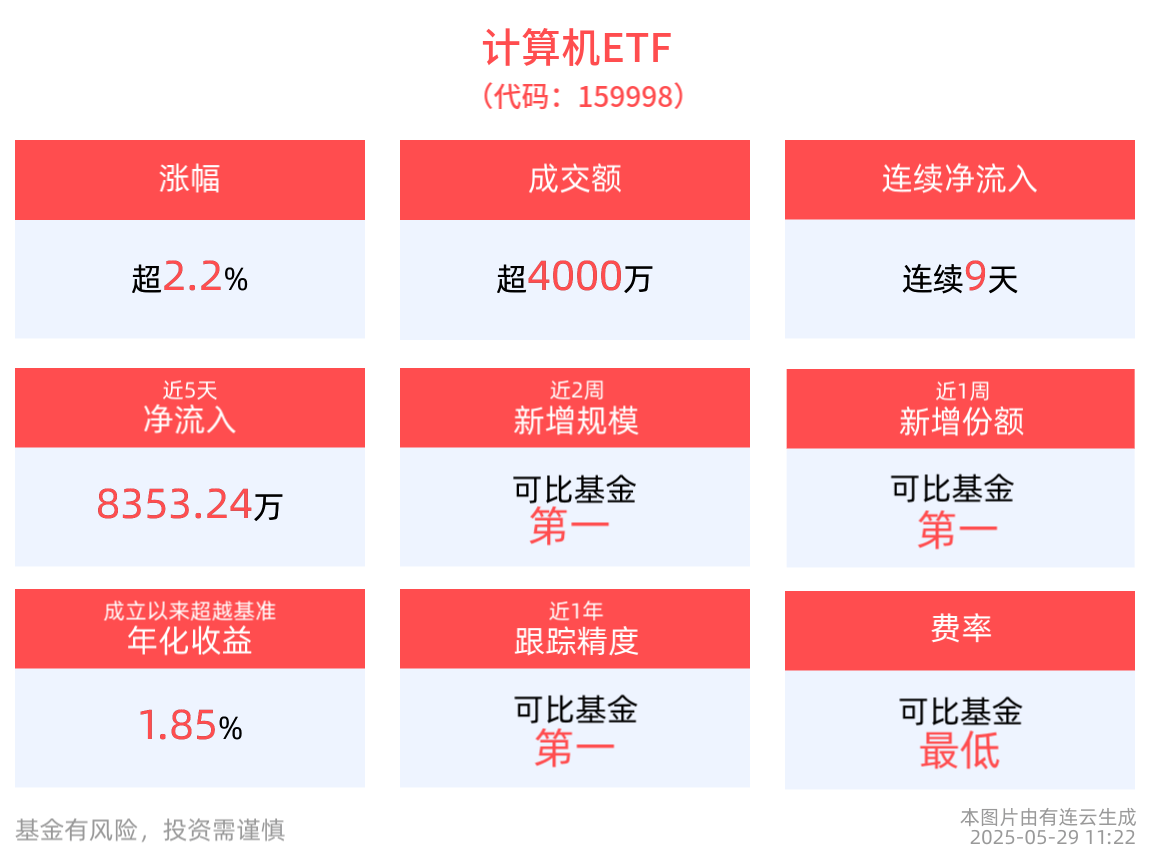
DeepSeekR1模型升级上线,计算机ETF(159998)上涨2.25%,连续9天净流入
Sou Hu Cai Jing· 2025-05-29 04:18
Core Viewpoint - The computer industry is experiencing a strong upward trend, driven by AI demand and policy support, with significant movements in stock prices and ETFs related to cloud computing and chips [3][4][5]. Group 1: Market Performance - The CSI Computer Theme Index rose by 1.93%, with notable gains in stocks such as Langxin Group (up 19.97%) and CloudWalk Technology (up 6.66%) [3]. - The Computer ETF (159998) increased by 2.25%, with a trading volume of 49.08 million yuan and a turnover rate of 1.73% [3]. - The CSI Hong Kong-Shenzhen Cloud Computing Industry Index saw a 1.49% rise, with Longbright Technology and Tianyuan Dike gaining 7.44% and 4.18%, respectively [3]. Group 2: Corporate Developments - On May 25, Zhongke Shuguang and Haiguang Information announced a merger plan to enhance business synergy and focus on AI full-stack solution development [3]. - The merger coincides with the revision of the "Major Asset Restructuring Management Measures for Listed Companies," indicating a new phase in optimizing industrial resource allocation [3]. Group 3: Investment Opportunities - The AI industry is expected to boost downstream demand in the computer sector, with a focus on AI computing power and domestic substitution trends [4]. - Investment strategies should consider the vertical integration capabilities of merged entities in cloud computing, which may enhance gross margins [4]. - The computer ETF has seen a significant increase in scale, growing by 23.02 million yuan over two weeks, and a notable inflow of 1.25 billion yuan over nine days [5].