
NVIDIA Alpamayo系列开源AI模型

Search documents
索菱股份涨幅10.00%封板!智能驾驶业务成炒作核心,英伟达开源AI模型催化智驾赛道升温
Jin Rong Jie· 2026-01-15 02:13
Group 1 - The core viewpoint of the news highlights the significant market interest in intelligent driving technologies, particularly focusing on companies like索菱股份, which has shown a 10% increase in stock price due to its advancements in the field [1][3] -索菱股份 has accumulated substantial experience in research and delivery in the field of assisted driving, with successful mass production cases and driving data in L2 and L2++ products, and feasible technical solutions for L3 autonomous driving [1] - The company serves a diverse customer base that includes both passenger and commercial vehicles, covering various models such as sedans, SUVs, MPVs, and light trucks [1] Group 2 - NVIDIA has launched the Alpamayo series of open-source AI models, simulation tools, and datasets aimed at enhancing the development of safe and reliable inference-based assisted driving vehicles [2] - The Alpamayo initiative introduces a complete open-source closed loop that incorporates "causal reasoning" capabilities into the autonomous driving research paradigm, significantly lowering the barriers to industry implementation [2] - The open-source framework includes a high-fidelity end-to-end simulation environment and a diverse large-scale dataset with over 1,700 hours of driving data, which supports rapid validation and strategy optimization for autonomous driving [2]


2026年第2周计算机行业周报:智谱及MiniMax上市带动国产AI应用行情-20260113
Changjiang Securities· 2026-01-13 15:23
Investment Rating - The industry investment rating is "Positive" and is maintained [7] Core Insights - The computer sector experienced a significant increase of 9.12%, ranking 4th among primary industries in the Yangtze River region, with a trading volume accounting for 7.72% of the total market [2][4][15] - The recent listings of Zhiyu and MiniMax are expected to drive investment opportunities in domestic AI applications, with MiniMax's stock surging nearly 110% on its debut, reaching a market capitalization of over HKD 105 billion [6][49] - The report suggests focusing on domestic large model manufacturers, major cloud service providers, vertical scenario agent manufacturers, and the domestic computing power industry chain [6][49] Summary by Sections Market Performance - The computer sector saw a substantial rise, with the Shanghai Composite Index achieving a sixteen-day winning streak, closing at 4120.43 points, reflecting an overall increase of 3.82% [4][15] - AI-related stocks were particularly active, with notable gains in companies such as Starry Technology (+49.74%) and Zhuoyi Information (+43.33%) [17] Key Developments - NVIDIA launched the Alpamayo series of open-source AI models aimed at enhancing autonomous driving capabilities [20][22] - OpenAI introduced ChatGPT Health, a specialized version of ChatGPT designed for health and wellness applications [31][38] - China submitted a proposal to the ITU for multiple satellite constellations, totaling 203,000 satellites, indicating a strategic acceleration in the commercial space sector [41][42] Investment Recommendations - The report emphasizes the importance of the recent IPOs of Zhiyu and MiniMax, which may reshape the industry landscape and capital market pricing logic, shifting the focus from parameter competition to profitability and implementation efficiency [49][60] - Investors are encouraged to monitor developments in the AI application sector, particularly in relation to large model manufacturers and cloud service providers [6][49]
四大芯片巨头掌门人罕见同台发声
2 1 Shi Ji Jing Ji Bao Dao· 2026-01-08 05:57
Core Insights - The CES 2026 highlighted the significant advancements in AI technology, particularly in the context of increasing computational power and the emergence of new applications across various sectors [1][2][8] - Chinese companies are playing an increasingly vital role in the global tech landscape, showcasing innovative AI hardware and solutions that attract considerable attention at international events [1][4][9] Group 1: AI and Computational Power - NVIDIA's CEO Jensen Huang emphasized the arrival of the "ChatGPT moment," indicating that machines are beginning to understand and act in the real world, with autonomous taxis being one of the first applications to benefit [2] - Huang introduced the new Rubin architecture, which includes a comprehensive stack solution with six core components, addressing the exponential growth in AI computational demands, projected to increase tenfold annually [2] - AMD's CEO Lisa Su noted that the computational power is transitioning from Zetta to Yotta Scale, with AI model training floating-point computation power increasing fourfold each year and inference token consumption rising by 100 times over the past two years [2] Group 2: Emerging AI Applications - Qualcomm's CEO Cristiano Amon highlighted the potential of next-generation personal AI devices, predicting a market size of 100 million units in the coming years, driven by edge AI and situational awareness capabilities [3] - The CES showcased a variety of AI-native products, with a notable increase in the capabilities of robots, moving beyond simple demonstrations to more complex functionalities [4][6] - The development of humanoid robots is progressing towards commercialization, with companies achieving significant advancements in motion control and operational precision, indicating a clear path for deployment in sectors like manufacturing and logistics [6][7] Group 3: Chinese Companies and Global Impact - Chinese firms are increasingly recognized as key players in the global tech ecosystem, leveraging their supply chain and R&D capabilities to drive innovation and efficiency [1][8][9] - The ability of Chinese companies to rapidly iterate on products, with a typical development cycle of about one year compared to two to three years for European counterparts, is enhancing their competitive edge [8][9] - The CES 2026 served as a platform for showcasing how AI technologies are set to permeate everyday life, with a focus on transforming concepts into tangible value through collaborative global efforts [9]


四大芯片巨头掌门人罕见同台发声
21世纪经济报道· 2026-01-08 05:49
Core Insights - The CES 2026 highlighted the significant role of chip giants like NVIDIA, Intel, AMD, and Qualcomm in the AI era, emphasizing the need for hundreds of times more computing power and the expansion of AI applications from cloud to edge [2] - Chinese manufacturers showcased their advancements in AI hardware, gaining international attention and marking China's evolution into a key player in global tech innovation [2][9] - The rapid evolution of foundational computing infrastructure is crucial for the development of AI large models, with chip leaders stressing the accelerating demand for computing power and new application opportunities [2][4] Group 1: AI and Computing Power - NVIDIA's CEO Jensen Huang announced the arrival of the "ChatGPT moment" in AI, highlighting the capabilities of machines to understand and act in the real world, with autonomous taxis being a primary application [3] - Huang introduced the new Rubin architecture, which includes a comprehensive stack solution with multiple core components to address the exponential growth in AI computing demands [4] - AMD's CEO Lisa Su noted that AI model training requires floating-point computing power to grow fourfold annually, with inference token consumption increasing by 100 times over the past two years [4] Group 2: Emerging AI Applications - Qualcomm's CEO Cristiano Amon emphasized the potential of next-generation personal AI devices, predicting a market size of 100 million units in the coming years, driven by edge AI and situational awareness capabilities [5] - The integration of edge data is seen as critical for providing personalized services, with Amon predicting that those who can leverage edge data will lead in the AI competition [5] Group 3: Robotics and Automation - Chinese companies showcased advanced robots at CES 2026, demonstrating improved capabilities compared to previous years, indicating a shift from simple demonstrations to more complex functionalities [6][7] - The development of humanoid robots is progressing towards commercialization, with companies achieving significant advancements in motion control and operational precision [7][9] - The demand for robotics is increasing due to global aging populations and rising labor costs, with exoskeleton robots gaining traction in various markets [7][9] Group 4: Supply Chain and Innovation - Chinese manufacturers are leveraging their supply chain advantages to accelerate product iterations, achieving faster development cycles compared to European counterparts [9][10] - The efficiency of China's industrial chain is enabling rapid technological breakthroughs and cost optimizations, distinguishing "Chinese manufacturing" from "Chinese innovation" [10] - The CES 2026 served as a platform for showcasing how AI is set to permeate everyday life, with a focus on transforming concepts into tangible value through collaborative efforts across the industry [10]

CES 2026见证AI生态变局 中国厂商跻身全球核心阵营
2 1 Shi Ji Jing Ji Bao Dao· 2026-01-07 23:14
Core Insights - The competition among major chip manufacturers is intensifying around the foundational computing power for AI, with native AI hardware accelerating its large-scale implementation, transitioning from laboratory settings to consumer and industrial applications [1][2] - Chinese manufacturers are playing an increasingly significant role at global tech events, showcasing their advancements in AI hardware and capabilities, which are supported by their supply chain and R&D strengths [2][11] Group 1: Computing Power and AI Development - The rapid evolution of underlying computing infrastructure is crucial for the accelerated development of AI large models, with chip leaders emphasizing the exponential growth of computing power and the new application opportunities it creates [3][4] - NVIDIA's CEO highlighted the arrival of the "ChatGPT moment" for physical AI, indicating that machines are beginning to understand and act in the real world, with autonomous taxis being one of the first applications to benefit [3] - AMD's CEO noted that the floating-point computing power for training AI models is growing fourfold annually, with inference token consumption increasing by 100 times over the past two years, necessitating new product offerings to meet Yotta-scale infrastructure demands [4] Group 2: Emerging AI Applications - The potential of edge AI is significant, with advancements in smart wearable devices being highlighted as a new category of mobile terminals that will coexist with smartphones [5][6] - Qualcomm's CEO projected that the market for personal AI devices could reach 100 million units in the coming years, emphasizing the importance of edge data for providing highly relevant user services [6] Group 3: Robotics and Physical AI - The maturity of physical AI was showcased at CES, with Chinese manufacturers presenting advanced robots that demonstrate improved capabilities compared to previous years [7][8] - The introduction of humanoid robots and their increasing commercial viability was noted, with companies achieving substantial progress in motion control and operational precision [9][10] - The integration of hardware, sensors, and environmental perception into scalable systems is seen as essential for advancing physical AI applications across various industries [10] Group 4: Chinese Manufacturers' Competitive Edge - Chinese companies are leveraging their supply chain efficiencies and R&D capabilities to drive rapid iterations and cost optimization in the robotics sector, significantly outpacing European competitors in product development cycles [11][12] - The shift from simple manufacturing to innovative solutions reflects a broader transformation in the perception of "Made in China" to "Created in China," highlighting the technological advancements and better solutions being offered [12]
CES 2026见证AI生态变局,中国厂商跻身全球核心阵营
2 1 Shi Ji Jing Ji Bao Dao· 2026-01-07 13:35
Core Insights - The article highlights the acceleration of native AI hardware development, emphasizing the growing demand for computing power and the expansion of AI applications from cloud to edge [1][2][12] - Chinese manufacturers are increasingly becoming significant players at CES 2026, showcasing a variety of AI hardware, including AI glasses and robots, which have garnered substantial attention [1][12] Group 1: AI Hardware and Computing Power - The rapid evolution of underlying computing infrastructure is supporting the accelerated development of AI large models, with a noted annual increase in floating-point operations for training by four times and a 100-fold increase in inference token consumption over the past two years [2][3] - NVIDIA's CEO highlighted the arrival of the "ChatGPT moment" for physical AI, with autonomous taxis being one of the first applications to benefit from this technology [2] - AMD's CEO discussed the transition to Yotta Scale compute, indicating that AI potential will be fully unleashed across data centers, personal computing devices, and edge AI [2][3] Group 2: Robotics and Physical AI - The maturity of physical AI was emphasized at CES, with a notable improvement in the capabilities of showcased robots compared to previous years, indicating a shift from simple demonstrations to more complex functionalities [7][8] - Companies like UTree Technology and Zongqiong Robotics are showcasing advanced robots capable of performing intricate movements, signaling a move towards mass production and real-world applications [8][9] - The integration of edge AI and real-time situational awareness in wearable devices is expected to create significant market opportunities, with projections of reaching 100 million units in the coming years [5][6] Group 3: Chinese Manufacturers and Global Role - Chinese firms are transitioning from being merely the "world's factory" to becoming key players in global technological innovation, supported by strong supply chain and R&D capabilities [1][12] - The efficiency of China's supply chain allows for rapid product iteration, with a production cycle of about one year compared to three to five years for European companies [12][13] - The article underscores that the advancements in AI technology are not just about manufacturing but also about creating better solutions and technologies, marking a shift from "Chinese manufacturing" to "Chinese innovation" [13]
今年CES,芯片厂商又开始“神仙打架”
3 6 Ke· 2026-01-07 00:42
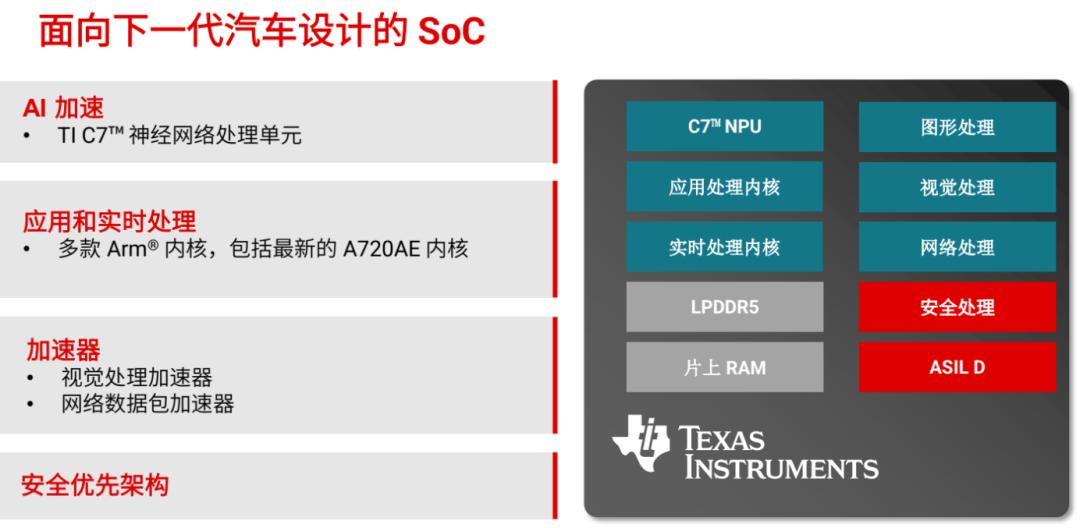
Group 1: TI's Automotive Innovations - TI launched three powerful automotive products at CES: the TDA5 series SoC, AWR2188 radar transmitter, and DP83TD555J-Q1 Ethernet PHY [1][4][7] - The TDA5 SoC features a maximum performance of 1200 TOPS and an energy efficiency of over 24 TOPS/W, with a 12-fold increase in AI computing power compared to previous generations [1] - AWR2188 is the industry's first single-chip 8x8 radar solution, enhancing performance by 30% and achieving high-precision detection for targets over 350m [4] - The DP83TD555J-Q1 Ethernet PHY supports nanosecond-level time synchronization and can transmit power and data over the same line, reducing cable design complexity and costs [7] Group 2: ADI's Diverse Solutions - ADI showcased various solutions in automotive, consumer, and robotics sectors, highlighting the A²B 2.0 solution with four times the bandwidth of its predecessor [10] - The automotive solutions include advanced lighting control and ADAS systems utilizing machine vision inputs [10][11] Group 3: NXP's High-Integration Processor - NXP introduced the S32N7 processor series, which integrates multiple vehicle functions on a single chip, potentially reducing total cost of ownership (TCO) by up to 20% [12][15] Group 4: Microchip's Demonstrations - Microchip presented demos including the ASA Motion Link for Qualcomm's Ride platform and a software-free intelligent headlight system using 10BASE-T1S technology [17][18] Group 5: Silicon Labs' New SDK - Silicon Labs launched a new Simplicity SDK for Zephyr, enhancing support for embedded systems and showcasing advancements in Bluetooth wireless technology [19] Group 6: Infineon's Development Kit - Infineon and Flex unveiled a modular development kit for regional control units, aimed at accelerating the development of software-defined vehicle architectures [20] Group 7: ST's Automotive Gateway - ST displayed the Osdyne Automotive Gateway, which enhances vehicle communication and security while reducing wiring complexity [22] Group 8: Ambarella's AI Vision Chip - Ambarella released the CV7 AI vision SoC, built on a 4nm process, achieving over 20% power reduction and more than 2.5 times the AI performance of its predecessor [25] Group 9: NVIDIA's Revolutionary Products - NVIDIA introduced the Rubin platform with six new chips and launched the Alpamayo series for AI-assisted driving development [26][28] Group 10: AMD's AI Innovations - AMD announced several new products, including the MI455X GPU and Ryzen AI 400 series processors, emphasizing its comprehensive AI capabilities [29][30] Group 11: Arm's Technology Trends - Arm focused on five key technology trends at CES, including advancements in autonomous driving, robotics, and smart home devices [31][32] Group 12: Industry Trends - The CES highlighted three major trends: the penetration of AI across all technology layers, the shift towards centralized and software-defined automotive electronics, and the importance of ecosystem collaboration over isolated technology competition [33]



英伟达发布开源模型Alpamayo,首搭车型一季度上路;蔚来第100万辆量产车下线 | 汽车早参
Mei Ri Jing Ji Xin Wen· 2026-01-06 22:36
Group 1: Automotive Industry Trends - The Ministry of Commerce announced that from 2024 to 2025, the national second-hand car transactions will reach 39.686 million units, with scrapped car recoveries at 17.673 million units, reflecting a significant annual growth rate of 45.8% [1] - The push for car recycling and second-hand car transactions indicates a major transformation demand in the automotive industry, with nearly 60% of the 18.3 million cars to be replaced being new energy vehicles [1] Group 2: NVIDIA's Advancements in Autonomous Driving - NVIDIA unveiled the Alpamayo series of open-source AI models and simulation tools at the 2026 CES, aimed at enhancing the development of safe and reliable autonomous driving vehicles [2] - The first vehicle equipped with NVIDIA's autonomous driving technology is set to hit the roads in the U.S. in the first quarter of 2026, marking a significant milestone in the company's eight-year research into autonomous vehicles [2][3] Group 3: NIO's Production Milestone and Future Plans - NIO celebrated the production of its one-millionth vehicle, with CEO Li Bin expressing confidence in achieving profitability by the fourth quarter of 2025 [4] - NIO's strategic focus includes enhancing operational efficiency, expanding charging infrastructure to over 10,000 stations by 2030, and maintaining a growth rate of 40% to 50% annually while deepening its presence in the Chinese market [4] Group 4: GAC Honda's Production Delays - GAC Honda announced a two-week extension of its production halt, affecting its manufacturing schedule due to adjustments made by Honda [5][6] - The delay raises concerns about supply chain issues within the automotive industry, potentially impacting GAC Honda's short-term financial performance and market competitiveness during peak sales seasons [6]


芯片巨头齐聚CES发新品;豆包否认AI眼镜出货丨新鲜早科技
2 1 Shi Ji Jing Ji Bao Dao· 2026-01-06 02:42
Group 1: Technology Developments - NVIDIA launched a new generation of AI platform Rubin, featuring six new chips, including Rubin GPU with a reasoning power of 50 PFLOPS, five times that of Blackwell [2] - Qualcomm and Google announced an expansion of their decade-long partnership to create end-to-end automotive technology solutions, integrating Qualcomm's Snapdragon digital chassis with Google's automotive software [4] - NVIDIA introduced the Alpamayo series of open-source AI models and tools aimed at enhancing the development of safe and reliable autonomous driving systems [11] Group 2: Corporate Collaborations - Zhiyuan Robotics partnered with MiniMax to enhance voice interaction experiences through customized AI technology [5] - GAC Group signed a comprehensive cooperation framework agreement with Huawei to deepen collaboration on smart vehicle technologies [5] Group 3: Market Movements - Chinese aerospace company China Aerospace Science and Technology Corporation increased its registered capital from 1 billion to 1.396 billion yuan, a 77.6% increase [10] - Defu Technology announced a cooperation agreement with a leading domestic CCL company to supply high-end copper foil products, expected to positively impact its 2026 performance [9] Group 4: Product Launches and Innovations - Raybird Innovation completed over 1 billion yuan in financing and plans to showcase the world's first AR smart glasses with eSIM technology at CES 2026 [15] - ByteDance's Doubao denied rumors regarding the imminent shipment of AI glasses, clarifying that there are currently no sales plans [8]
直击CES丨NVIDIA开源Alpamayo系列AI模型及工具,黄仁勋:物理AI的ChatGPT时刻已然到来
Xin Lang Cai Jing· 2026-01-06 01:28
Core Insights - NVIDIA has launched the Alpamayo series of open-source AI models, simulation tools, and datasets at CES 2026, aimed at advancing the development of safe and reliable reasoning-based autonomous driving vehicles [1][2][3] Group 1: Challenges in Autonomous Driving - Autonomous vehicles must operate safely under complex and variable driving conditions, with "long-tail" rare and complex scenarios being a significant challenge for driver assistance systems [1][3] - Traditional driver assistance architectures separate perception from planning, which limits system scalability in unexpected or abnormal situations [3] Group 2: Technological Innovations - The Alpamayo series introduces a VLA reasoning model based on chain-of-thought reasoning, designed to tackle the challenges posed by long-tail scenarios in autonomous driving [1][3] - These systems can progressively simulate rare or novel scenarios, enhancing driving capabilities and interpretability, which is crucial for building a safety trust framework for smart vehicles [3] Group 3: Supporting Tools and Collaborations - The Alpamayo series includes simulation tools and datasets such as Alpamayo 1, AlpaSim, and the Physical AI open dataset, which support the development of vehicles with perception, reasoning, and human-like decision-making capabilities [2][3] - Leading companies in the mobility sector, including Jaguar Land Rover, Lucid, and Uber, along with the autonomous driving research community like Berkeley DeepDrive, will leverage Alpamayo to accelerate the deployment of safe reasoning-based Level 4 systems [4] Group 4: Industry Impact - NVIDIA's CEO Jensen Huang stated that the era of physical AI akin to ChatGPT has arrived, enabling machines to understand the real world, reason, and take action, with autonomous taxis being one of the earliest beneficiaries [4]