OPPO Reno系列

Search documents
手机厂商,集体涨价
财联社· 2026-03-18 11:44
Core Viewpoint - The smartphone industry is facing significant challenges due to insufficient demand and soaring raw material costs, leading to price increases by various brands as a necessary response to cover rising costs [1][2][9]. Price Increase Overview - Brands like OPPO and vivo have officially announced price adjustments due to rising costs of key components, with OPPO increasing prices on certain models by 500 yuan and vivo planning similar adjustments [3][5]. - The price increase for low-end models ranges from 200 to 500 yuan, while new high-end models may see increases around 1000 yuan [1][6]. Impact on Low-End Models - The price hikes for low-end models are unlikely to fully cover the increased costs, with many manufacturers facing potential short-term losses [2][9]. - According to Counterpoint, the BOM cost for low-end smartphones is expected to rise significantly, making it difficult for manufacturers to maintain profitability [9][10]. Manufacturer Strategies - Manufacturers are diversifying their procurement strategies in response to rising costs, with larger brands securing direct supply agreements while smaller brands rely on ODMs [13][14]. - There is a shift in focus towards high-end products, with brands reducing their low-end offerings to mitigate losses [12][15]. Market Trends and Production Adjustments - The overall smartphone production is projected to decline due to increased costs, with estimates suggesting a drop of about 10% in global smartphone production by 2026 [16][17]. - Companies like Xiaomi and OPPO have already begun adjusting their production volumes in anticipation of rising storage prices [17].



OPPO、vivo宣布涨价
WitsView睿智显示· 2026-03-16 08:43
Price Adjustments - OPPO has announced price adjustments for certain released products, indicating a trend of rising prices in the smartphone industry due to the memory price surge [2] - Following OPPO and OnePlus, vivo and iQOO have also announced adjustments to the suggested retail prices of some products, effective March 18, 2026, due to the significant increase in global semiconductor and storage costs [3] Market Impact - According to TrendForce's latest survey, the shortage and rising prices of memory, which constitute a significant portion of smartphone costs, are impacting brand shipment plans for 2026 and weakening panel shipment momentum [5] - Global smartphone panel shipments are projected to decline to approximately 2.14 billion units in 2026, a decrease of about 7.3% from 2.31 billion units in 2025, marking the end of a growth cycle that began in 2023 [6] - The share of AMOLED smartphone panels is expected to increase from 41.2% in 2025 to 43.2% in 2026, while the share of LTPS LCD is projected to shrink from 4.4% to 2.5%, with a-Si LCD maintaining around 54.4% market share [6] Cost Management Strategies - In response to rising costs driven by memory prices, smartphone brands may pass some costs onto consumers while also engaging in aggressive supply chain cost management, including negotiating for lower prices with key component suppliers such as panel manufacturers [6]

千元机快要消失了
21世纪经济报道· 2026-03-10 06:55
Core Viewpoint - The article discusses the rising prices of smartphones due to increasing costs of key components, particularly storage chips, and how this trend is affecting various manufacturers in the industry [1][4][10]. Group 1: Price Adjustments by Manufacturers - OPPO announced a price adjustment for certain models, specifically the A and K series, starting from March 16, 2026, due to rising costs of key components [1][4]. - Other manufacturers, including Samsung, have also raised prices, with the Galaxy S26 series seeing an increase of 1000 yuan compared to its predecessor [6][10]. - The price hikes are primarily affecting lower-priced models, indicating that the cost pressures are most significant in the budget segment of the market [4][10]. Group 2: Impact of Storage Chip Prices - The continuous rise in storage chip prices is expected to lead to a contraction in the smartphone market, with predictions of a significant drop in shipments for budget models [4][9]. - The price of storage chips has reportedly increased to nearly four times the price from the previous year, creating substantial pressure on manufacturers [7][10]. - Analysts predict that the storage market is entering a "super bull market," with prices expected to rise by 40% to 50% in the coming years, further straining the smartphone industry [8][15]. Group 3: Strategic Responses from Manufacturers - Manufacturers are likely to respond to rising costs by reducing product specifications or delaying new releases, particularly in the budget segment [9][13]. - Companies like Xiaomi and Meizu are exploring partnerships and adjusting their product strategies to cope with the increased costs of components [7][13]. - The trend of rising prices and reduced specifications may lead to a "survival of the fittest" scenario in the smartphone market, with weaker brands facing significant challenges [11][15].

“广货群侠”多强大?广东这五大品牌征服了全球
21世纪经济报道· 2026-01-20 10:29
Core Viewpoint - The article emphasizes the competitive landscape of the smartphone industry, highlighting Guangdong's dominance as a major manufacturing hub and innovation center, with significant contributions from local brands like Huawei, OPPO, vivo, and Honor [1][13]. Industry Overview - Guangdong is recognized as the most important smartphone industry cluster in China, leading in scale, production, and export, with one in three smartphones sold globally originating from this region [13]. - The smartphone market is characterized by rapid technological advancements and intense competition, with major players continuously innovating to maintain their market positions [1]. Company Highlights - **Huawei**: Utilizes its advanced Kirin chips and Kunlun glass, with the HarmonyOS enabling seamless connectivity. In 2025, Huawei's smartphone shipments reached 4.67 million units, capturing 16% of the market share in China [3]. - **OPPO**: Focuses on imaging, AI, communication, and fast charging technologies. By November 2025, the global activation of the OPPO Reno series surpassed 10 million, and the Find X9 series sold over 1 million units within 10 days of its domestic launch [5]. - **vivo**: Specializes in professional imaging technology, launching the X300 series with a focus on high-quality mobile photography. Currently, vivo serves over 100 million users globally [7]. - **Honor**: Launched the Honor Power2 in January 2026, featuring a 10,080mAh battery to address battery life concerns. In 2025, Honor's smartphone shipments exceeded 71 million units, with over 30% of sales coming from international markets [9]. Technological Evolution - Over the past 30 years, Guangdong's smartphone technology has evolved from self-developed feature phones to the emergence of autonomous brands in the smartphone era, achieving breakthroughs in fast charging, imaging, full-screen displays, and 5G technology [16].

全球每三台手机就有一台广东造 广货“粤来粤强”驶入快车道
Nan Fang Du Shi Bao· 2026-01-19 13:52
Core Viewpoint - The Guangdong smartphone industry is experiencing significant growth and transformation, establishing itself as a global leader in smartphone manufacturing and innovation, with local brands gaining substantial market share both domestically and internationally [1][2][11]. Group 1: Industry Overview - Guangdong is the most important cluster for the smartphone industry in China, leading in scale, production, and export, with a projected revenue of 1.9618 trillion yuan in 2024, accounting for 38.7% of the province's new generation electronic information industry revenue [2]. - In 2024, Guangdong's smartphone production reached 683 million units, representing 40.9% of the national total, while exports amounted to 205 million units, also leading the country [2]. - The smartphone industry in Guangdong has evolved from a manufacturing hub to a global innovation leader, with local brands capturing 38% of the global market share by 2025 [2][12]. Group 2: Brand Performance - Major Guangdong brands like Huawei, OPPO, and vivo dominate both domestic and international markets, with Huawei's global shipment reaching 48.4 million units in 2024, capturing one-third of the high-end market [3]. - OPPO's global shipments reached 104.8 million units in 2024, with its Reno series leading in the $400-$600 price segment [3]. - By 2025, six Guangdong brands are expected to be among the top ten in the global smartphone market, with market shares of 9% for vivo, 8% for Transsion, and 7% for OPPO [2]. Group 3: Global Expansion Strategies - Guangdong smartphone brands are increasingly focusing on international markets, particularly in Southeast Asia and Latin America, leveraging cultural similarities and existing market experiences for efficient penetration [4][5]. - OPPO's gradual global expansion strategy began in Thailand and has since included Indonesia and Vietnam, with plans to enter European markets [5]. - vivo's strategy emphasizes deep localization, establishing a significant retail network in Indonesia and expanding into various regions since 2014 [5]. Group 4: Technological Innovation - Guangdong smartphone companies are at the forefront of technological innovation, with significant investments in R&D, particularly in chip technology and fast charging [11]. - Huawei's self-developed Kirin 9000S chip achieved a 65% self-sufficiency rate in 2024, while OPPO's 125W fast charging technology leads globally in patent numbers [11]. - The rise of AI smartphones, with brands like Huawei and vivo integrating advanced AI capabilities, marks a new era in the industry [12]. Group 5: Manufacturing and Supply Chain - Guangdong's smartphone manufacturing ecosystem is robust, with a high concentration of electronic component manufacturers, accounting for 28% of China's total [7]. - The region's strong supply chain allows for rapid assembly and production, with average production cycles as short as 48 hours in Dongguan [9]. - Major manufacturers like Foxconn and local firms have adopted advanced manufacturing techniques, enhancing efficiency and production capabilities [8][9].
苹果手机单季在华销量大增28%,份额突破20%
Guan Cha Zhe Wang· 2026-01-19 08:34
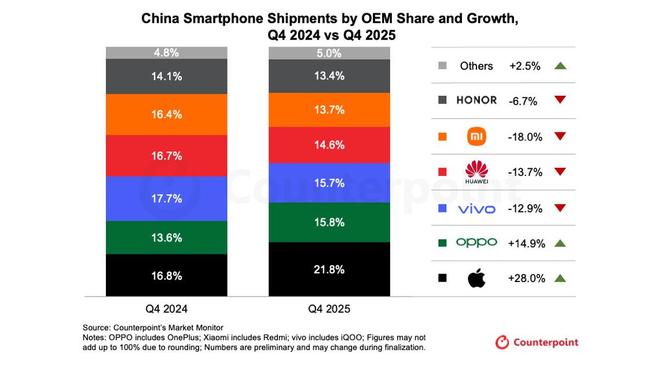
Core Insights - Counterpoint Research reports a 1.6% year-on-year decline in China's smartphone shipments for Q4 2025, with an overall annual decrease of 0.6% [1] - Apple leads the domestic market with a 21.8% market share in Q4, followed by OPPO at 15.8% and vivo at 15.7% [1] - Huawei maintains the top position for the entire year with a 16.9% market share, closely followed by Apple (16.7%) and vivo (16.4%) [1] Group 1: Market Performance - Apple's Q4 shipments surged by 28% year-on-year, driven by strong demand for the iPhone 17 series and increased supply [4] - OPPO achieved a 15% year-on-year growth in Q4, supported by strong demand for the Reno series and contributions from the newly launched Find X9 and OnePlus 15 series [5] - Huawei's mid-to-high-end models performed well after price promotions, despite a decline in the second half of the year [5] Group 2: Product Insights - The iPhone Air's late launch and design compromises have led to a slow start, but it is expected to have a long-term impact on the eSIM smartphone market [5] - Vivo's iQOO 15 offers strong value among devices with Qualcomm's latest flagship chip, while Xiaomi's 17 series has gained attention for its Pro model's unique back screen [6] - Honor's X70 and 400 series maintained steady demand, with the new WIN series noted for its cooling performance [6] Group 3: Industry Outlook - Counterpoint Research anticipates a 40%-50% increase in storage prices in Q1 2026, followed by an additional 20% rise in Q2 [6] - The low-end market (under $200) has been significantly impacted, with a 20%-30% increase in Bill of Materials (BoM) costs since the beginning of the year [7] - Global smartphone shipments are projected to decline by 2.1% in 2026, with an expected average selling price increase of 6.9% due to cost adjustments [7]

IDC 2025: OPPO第四季度国内双位数增长,安卓唯一
Xin Lang Cai Jing· 2026-01-14 06:23
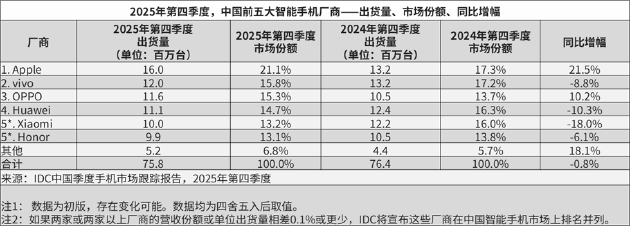
Core Insights - The global smartphone market is expected to reach a total shipment of 1.26 billion units in 2025, reflecting a year-over-year growth of 1.9%, indicating a continued recovery trend in the market [1] - In the fourth quarter of 2025, global smartphone shipments reached 336.3 million units, marking a 2.3% increase compared to the previous year [3][8] Group 1: Global Market Performance - The fourth quarter of 2025 saw a total shipment of 336.3 million smartphones, with Apple leading the market with a share of 24.2% and shipments of 81.3 million units, up 4.9% year-over-year [3][8] - Samsung followed with a market share of 18.2%, achieving a significant year-over-year growth of 18.3% with shipments of 61.2 million units [3][8] - The overall smartphone market in China experienced a slight decline of 0.8% in shipments, totaling approximately 75.8 million units in the fourth quarter [7] Group 2: Company-Specific Insights - OPPO was the only major Android brand in China to achieve double-digit growth in the fourth quarter of 2025, with a year-over-year increase of 10.2%, resulting in shipments of 11.6 million units [2][7] - OPPO's strong performance is attributed to the successful launch of competitive new products, particularly the OPPO Find X9 series, which sold 1 million units within 10 days of its domestic launch [5][9] - The OPPO Reno series has seen significant activation numbers, nearing 100 million units in China and over 130 million globally, maintaining a leading position in the competitive $400–$600 price segment [6][9]
智能手机惊变2025:固化的高端、流动的中场,与闯入门口的AI革命
3 6 Ke· 2025-12-29 13:44
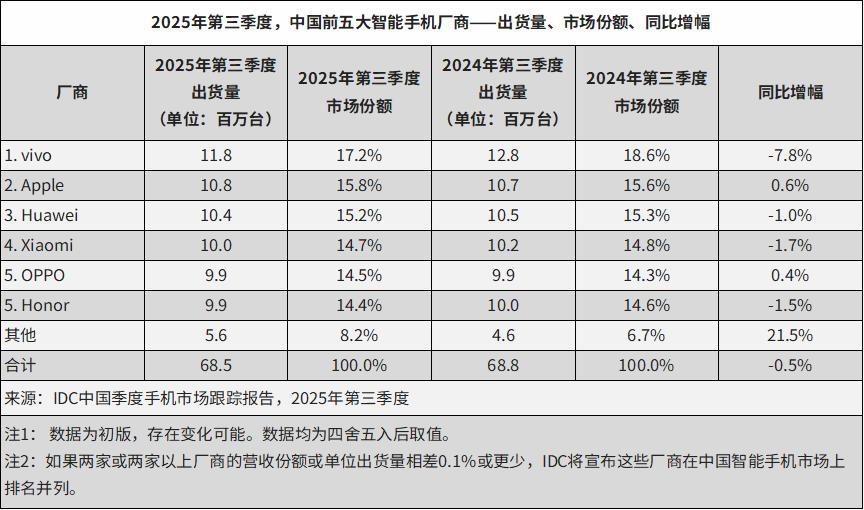
Core Insights - The Chinese smartphone industry is experiencing a silent "three-line war," characterized by fierce competition in the mid-range market, a duopoly in the high-end segment, and a push towards AI integration [1][2] Group 1: Market Dynamics - By 2025, the smartphone market is showing signs of a split narrative, with significant reshuffling among mainstream manufacturers in the mid-range segment while Apple and Huawei dominate the high-end market [2] - IDC data for Q3 2025 indicates that vivo leads the market with a 17.2% share, followed by Apple at 15.8%, Huawei at 15.2%, Xiaomi at 14.7%, and OPPO at 14.5% [3][4] - The total shipment volume for the top five manufacturers in Q3 2025 was 68.5 million units, a slight decline of 0.5% year-on-year [4] Group 2: Competitive Landscape - The mid-range market is marked by intense competition and strategic adjustments, with brands like Honor and Xiaomi struggling to maintain their positions [5][6] - Huawei faces challenges with its HarmonyOS ecosystem, particularly in app compatibility, which affects user experience [6] - The high-end market remains stable, with Apple and Huawei holding over 80% of the market share for devices priced above 6000 yuan [7][8] Group 3: AI Integration - The smartphone industry is transitioning to an AI 3.0 phase, where AI capabilities are becoming integral to the user experience rather than just additional features [10][11] - The introduction of advanced AI models is expected to redefine user interaction with smartphones, moving from hardware specifications to intelligent integration [12] - Companies are increasingly focusing on AI as a differentiator, with significant investments from major players like ByteDance in collaboration with hardware manufacturers [13] Group 4: New Entrants and Market Evolution - The entry of cross-industry players and the resurgence of previously overlooked brands are reshaping the competitive landscape [14][15] - The smartphone industry is evolving from hardware competition to ecosystem competition, emphasizing service differentiation [16] - The market is anticipated to undergo another round of reshuffling in 2026, with smaller manufacturers needing to leverage AI to avoid being sidelined [16]
OPPO成三季度唯一增长的国产手机品牌 品牌忠诚度仅次于苹果
Di Yi Cai Jing Zi Xun· 2025-11-07 07:39
Group 1 - OPPO is the only leading brand in China to achieve growth in Q3, demonstrating strong resilience and growth capability [1] - The OPPO Reno series continues to be favored by young consumers, leading to OPPO's top position in shipment volume within the $400–$600 price range during the first three quarters of the year [1] - OPPO has a broad user base in the mid-to-high-end market, with global device activation exceeding 130 million [1] Group 2 - OPPO's brand loyalty is reflected in its nearly 50% same-brand replacement user ratio, the highest among Android brands [1] - The global memory chip market is experiencing significant price increases, with DRAM prices rising and cost pressures being passed on to end products [1] - Upcoming mid-range models are expected to face price hikes as new flagship models have already seen price increases of several hundred yuan [1]
OPPO成三季度唯一增长的国产手机品牌 品牌忠诚度仅次于苹果
第一财经· 2025-11-07 07:34
Group 1 - OPPO is the only brand among top manufacturers in China to achieve growth in Q3, demonstrating strong resilience and growth capability [1] - The OPPO Reno series continues to be favored by young consumers, leading the shipment volume in the competitive $400-$600 price range during the first three quarters of the year [1] - OPPO's global device activation has surpassed 130 million, indicating a broad user base for the Reno series [2] Group 2 - OPPO has a high brand loyalty with nearly 50% of its users being repeat customers, the highest among Android brands [2] - The global memory chip market is experiencing significant price increases, with DRAM prices rising, which is expected to impact the pricing of end products [2] - Upcoming mid-range models are anticipated to also see price hikes as new flagship models have already been launched with price increases [2]