
RTX 3060

Search documents
老黄鸽了游戏卡!30年来首次咕咕,内存优先让路AI
量子位· 2026-02-06 12:00
Core Viewpoint - Nvidia has indefinitely postponed the release of the RTX 50 Super and the next-generation RTX 60 series due to a global shortage of memory chips, prioritizing AI GPU production instead [2][15][18]. Group 1: Nvidia's Product Delays - Nvidia has historically released new gaming GPUs every other year, but this year, it has broken tradition by not launching the RTX 50 Super as expected [8][10]. - The RTX 50 Super was reportedly already designed under the codename "Kicker," but the release was delayed as of December last year [12][13]. - The delay will also affect the planned production of the RTX 60 series, originally set for late 2027 [14]. Group 2: Market Impact and Pricing - The price of the RTX 5090 has surged from an initial MSRP of $1999 to between $3500 and $4000, with projections suggesting it could reach $5000 by the end of the year [27][28]. - The ongoing chip shortage is causing price increases across all PC gaming components, leading to a potential shift in consumer behavior towards cloud services or delaying hardware upgrades [26][35]. - Companies like Valve and Nintendo are also reevaluating their product pricing and release schedules due to the memory shortage, with Nintendo having already increased the prices of its Switch models [29][33].


旧技术回潮?显存经济学或迫使英伟达重启老款GPU生产以填补市场空白
Hua Er Jie Jian Wen· 2026-01-16 12:53
Core Insights - Nvidia is adjusting its product strategy based on a "revenue per GB of memory" model, prioritizing high-margin products due to ongoing GPU memory supply constraints [1][2] - The company may reactivate older GPU production lines to fill market supply gaps, particularly for mid-range products that are being marginalized [1][3] Group 1: Product Strategy Adjustments - Nvidia is focusing on ensuring supply for high-profit models like the RTX 5060 Ti (8GB) while potentially reducing production for mid-range models like the RTX 5060 Ti (16GB) [1][2] - The company aims to optimize revenue by adjusting supply across five product tiers, prioritizing the first, third, and fifth tiers while compressing the second and fourth tiers due to lower revenue contributions per GB of memory [2] Group 2: Market Dynamics and Supply Chain - Nvidia may restart production of older models like the RTX 3060 to fill supply gaps in the mid-to-low-end market, allowing new generation resources to focus on higher-margin products [3][4] - The demand for general-purpose DRAM in data center construction is driving the current memory shortage, causing Nvidia's consumer GPU business to become strategically less important [4]
黄仁勋CES回应全场!内存卡了GPU脖子,游戏玩家可能只能用旧显卡了
猿大侠· 2026-01-08 04:11
Core Viewpoint - Huang Renxun emphasizes that robots are the "AI immigrants" capable of taking on jobs that humans are unwilling to do, highlighting the need for AI to support economic growth and job creation [10][11]. Group 1: AI and Robotics - Huang predicts that a significant number of jobs will not be replaced by AI in the near future, but blue-collar jobs in manufacturing may disappear [12]. - He expects to see robots with human-level mobility and dexterity by the end of this year [12]. - The development of robots requires not only visual perception but also tactile capabilities, which poses significant technical challenges [13]. Group 2: Autonomous Driving - Huang introduced the world's first open-source, large-scale autonomous driving visual-language-action (VLA) reasoning model, Alpamayo 1, and highlighted its differences from Tesla's Full Self-Driving (FSD) technology [15][16]. - NVIDIA positions itself as a technology platform provider for companies developing autonomous vehicles, rather than a manufacturer of autonomous cars [16][20]. - The company has a high industry penetration rate, with over 1 billion vehicles on the road, and anticipates that millions will have strong autonomous driving capabilities in the next decade [20]. Group 3: AI Infrastructure and Memory Supply - Huang describes AI infrastructure as "AI factories," emphasizing the need for unprecedented infrastructure to convert power, chips, and data into intelligent outputs [35]. - He addresses the tight supply of high-bandwidth memory (HBM) and proposes a new storage memory platform concept, asserting that NVIDIA is a key demand engine across various memory types [36]. - NVIDIA is the first and nearly the only major user of HBM4, collaborating closely with memory suppliers to ensure synchronized production and platform release [36]. Group 4: Gaming and Graphics Technology - NVIDIA upgraded its super-resolution model with the new DLSS 4.5 version, enhancing multi-frame generation capabilities [31]. - Huang speculates that future rendering methods will likely involve executing more AI computations on fewer but higher-quality pixels, leading to significant advancements in gaming realism [32]. - He believes that future video games will be filled with AI-driven characters, greatly enhancing the immersive experience [32][33]. Group 5: Market Dynamics and Product Strategy - NVIDIA is considering restarting the production of older graphics cards due to rising memory costs and supply constraints, indicating that this option is not off the table [25][26]. - The company is exploring the possibility of integrating the latest AI technologies into previous generations of GPU products, although this would require substantial R&D resources [26][27].

黄仁勋CES回应全场!内存卡了GPU脖子,游戏玩家可能只能用旧显卡了
量子位· 2026-01-07 09:11
Core Viewpoint - Huang Renxun emphasizes that robots are the "AI immigrants" capable of taking on jobs that humans are unwilling to do, highlighting the need for AI to support economic growth and job creation [10][11]. Group 1: AI and Robotics - Huang states that the "robot revolution" will drive economic progress and create more job opportunities while maintaining low inflation levels [11]. - He predicts that by the end of this year, robots will achieve human-level capabilities in mobility, joint movement, and fine motor skills [12]. - The development of robots requires not only visual perception but also tactile capabilities, which poses significant technical challenges [13]. Group 2: Autonomous Driving - Huang introduced the world's first open-source, large-scale autonomous driving visual-language-action (VLA) reasoning model, Alpamayo 1, and praised Tesla's FSD technology as world-class [15][16]. - NVIDIA's role is to provide a complete technology stack for companies developing autonomous vehicles, rather than manufacturing the vehicles themselves [16][20]. - The company has a high industry penetration rate, with over 1 billion vehicles on the road, and expects that millions will have strong autonomous driving capabilities in the next decade [20]. Group 3: AI Infrastructure and Memory Supply - Huang introduced NVIDIA's next-generation AI supercomputing platform, Vera Rubin, and discussed the challenges posed by rising memory prices and supply constraints [24][25]. - The company is positioned as a key player in the memory market, addressing the growing demand for high-bandwidth memory (HBM) and collaborating closely with suppliers to ensure production capacity aligns with product launches [36]. Group 4: Gaming and AI - NVIDIA upgraded its super-resolution model with the new DLSS 4.5 version, indicating a shift towards AI-driven gaming experiences [31]. - Huang predicts that future video games will be filled with AI characters, significantly enhancing realism and interactivity [32][33].

RTX 50 Super系列或将亮相CES:显存升级、成本飙升、定价压力增大
Xin Lang Cai Jing· 2026-01-07 01:45
Core Viewpoint - NVIDIA's RTX 50 Super series is expected to be announced at the upcoming CES event, despite previous concerns about supply chain issues and rising memory costs [1][5]. Product Updates - The RTX 50 Super series will upgrade memory capacity from 2GB to 3GB, representing a 50% increase, while most models will maintain the same number of CUDA cores [3][5]. - The RTX 5070 Super will be the exception, increasing its CUDA cores from 6144 to 6400, a rise of approximately 4.2%, and its memory from 12GB to 18GB, with a slight power increase from 250W to 275W, a 10% rise [3][6]. - Performance improvements for the RTX 50 Super series are estimated to be around 10% compared to existing products [6]. Pricing and Cost Implications - Initial predictions suggested a price increase of 5% to 10%, but due to skyrocketing memory costs, this estimate is no longer applicable [6]. - Current estimates indicate that memory costs have nearly doubled, potentially adding $100 to $150 to the total cost of the graphics cards, leading to retail prices that may exceed initial expectations [3][6]. Market Strategy - NVIDIA plans to resume production of the RTX 3060 model, indicating a reliance on the RTX 30 and RTX 40 series for the mid-range market, while transitioning the high-end market to the RTX 50 Super series [4][6]. - Some models in the RTX 50 series are experiencing supply shortages, suggesting a gradual exit from the mainstream market to make way for the new generation of products [4][6].
心智观察所:摩尔线程无法回避的尴尬
Guan Cha Zhe Wang· 2025-12-18 02:00
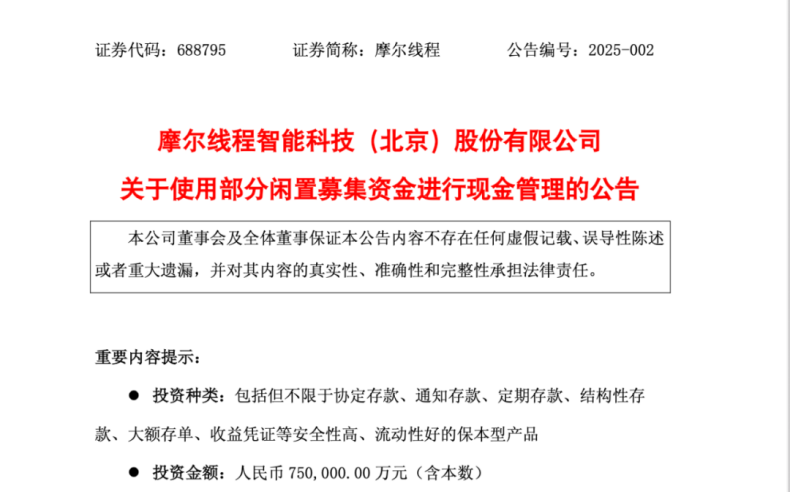
Core Viewpoint - The capital market in December 2025 is dominated by domestic GPUs, with companies like Moer Thread and Muxi experiencing significant stock price surges, but underlying issues reveal the challenges faced by the domestic GPU industry [1][2]. Fundraising and Financial Management - Moer Thread's decision to invest approximately 7.5 billion yuan of its raised funds into financial products instead of immediate R&D has sparked controversy, raising questions about the company's commitment to innovation [2][3]. - The company plans to allocate 2.5 billion yuan for AI training chip development, 2.5 billion yuan for graphics chip development, and 2 billion yuan for AI SoC chip development, but its current revenue is significantly low, indicating a potential misalignment in resource allocation [3][4]. Market Performance and Competition - Moer Thread's revenue for 2024 is projected to be less than 500 million yuan, with only slight improvements expected in 2025, highlighting the company's struggle to compete in a mature and highly competitive graphics card market [3][5]. - The company's main consumer-grade product, the S80, is underperforming compared to its competitors, with actual gaming performance lagging behind older models, which raises concerns about its market viability [8][9]. Industry Challenges and Comparisons - The domestic GPU sector is facing significant challenges, as evidenced by the failures of companies like Xiangdixian and Lishuan Technology, which highlight the harsh realities of the industry [10][11]. - The reliance on foreign technology and the complexities of GPU design contribute to the difficulties faced by domestic companies, as they struggle to establish a competitive edge against established players like NVIDIA [12][17]. Financial Health and Future Outlook - Moer Thread has accumulated losses exceeding 5 billion yuan from 2022 to 2024, with expectations of continued losses, indicating a prolonged "burn rate" before achieving profitability [14][15]. - The company’s revenue concentration risk is high, with 56% of its income derived from a single major client, which poses significant operational risks if market conditions change [15][16]. Strategic Insights - The industry is witnessing a shift towards AI computing, with Moer Thread's revenue from AI computing accounting for 77.63%, indicating a strategic pivot away from consumer-grade graphics [9][10]. - The need for a robust ecosystem and technological advancements is critical for the survival of domestic GPU companies, as they face increasing pressure from both domestic and international competitors [17][19].
一签赚27万!摩尔线程上市首日疯涨468%,狂欢下的三大隐忧,你必须知道
Sou Hu Cai Jing· 2025-12-06 16:35
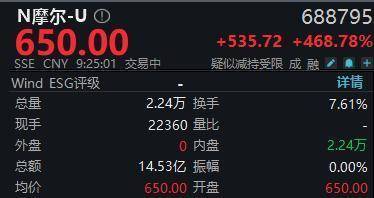
Core Viewpoint - The listing of the GPU chip company Moore Threads, dubbed the "Chinese version of Nvidia," on the STAR Market has generated significant market excitement, with its stock price soaring dramatically on its debut [1][4]. Group 1: Company Overview - Moore Threads was founded in 2020 and is led by Zhang Jianzhong, a former global vice president at Nvidia, which provides the company with a strong industry background and connections [11]. - The company focuses on developing full-function GPUs capable of handling various tasks, including graphics rendering and scientific computing, distinguishing itself from competitors that specialize only in AI computing [11]. Group 2: Market Performance - The initial public offering (IPO) price was set at 114.28 CNY per share, the highest for any new stock in the A-share market in the past year [2][6]. - On its first trading day, the stock opened at 650 CNY, representing a staggering increase of 468.78%, with a peak price of 688 CNY, reflecting a rise of over 500% at one point [3][9]. - The total market capitalization of Moore Threads exceeded 300 billion CNY, making it the fourth-largest chip company on the STAR Market [4]. Group 3: Financial Performance - Moore Threads raised approximately 7.576 billion CNY through the issuance of 70 million shares, marking it as the largest fundraising in the STAR Market for 2025 [6]. - The company reported a revenue of 46.088 million CNY in 2022, which surged to 2.15 billion CNY in 2023, and is projected to reach between 1.5 billion CNY and 1.98 billion CNY in 2025 [17][20]. - The compound annual growth rate (CAGR) of revenue from 2022 to 2024 is an impressive 208.44% [18]. Group 4: Losses and Valuation - Despite rapid revenue growth, Moore Threads has incurred significant losses, with a cumulative net loss of 5.939 billion CNY over four years [21][22]. - The company's price-to-sales ratio at the IPO was 122.51 times, significantly higher than the average for comparable chip design companies, indicating high investor expectations for future growth [24]. Group 5: Market Dynamics - The IPO attracted intense interest, with institutional investors bidding 1,572 times the available shares, resulting in a low winning rate of approximately 0.036% [7]. - The stock's trading volume reached 12.59 billion CNY on its first day, the highest in the A-share market [9]. - The listing has caused a capital flow effect, with some stocks considered "Moore Threads concept stocks" experiencing declines as funds shifted towards the new listing [26]. Group 6: Industry Context - The demand for AI computing power has surged, with some sectors experiencing a 300% increase, creating a significant supply gap in the Chinese market due to export restrictions on high-end GPUs from companies like Nvidia [13][14]. - If domestic GPU products can fully replace imports, the market size in China could potentially reach 50 billion CNY annually [16].
摩尔线程首日大涨425.46%!中一签赚24万,投资者赢麻了
Sou Hu Cai Jing· 2025-12-05 11:41
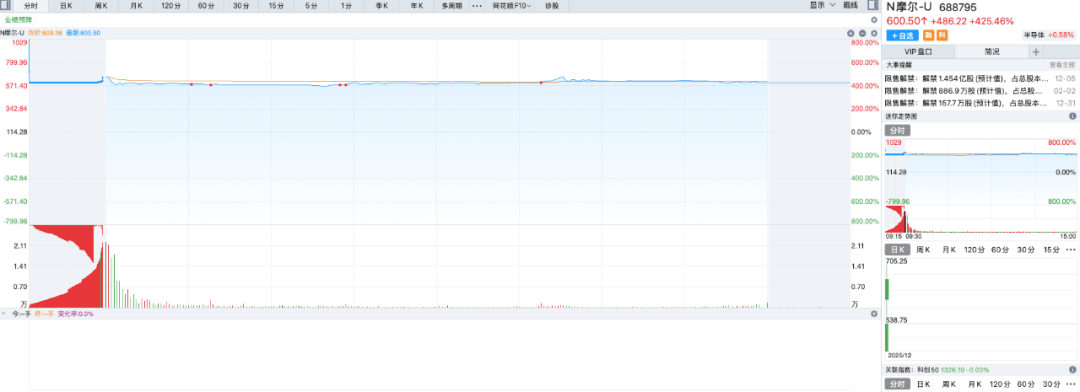
Core Viewpoint - The investment in Moer Thread has yielded significant returns for early investors, with some seeing their investments increase over eightfold within a year, driven by the growing demand for GPUs in the AI industry and the company's unique positioning in the market [3][4][11]. Industry Overview - The global AI industry is experiencing rapid growth, leading to an explosive demand for computing power, particularly for GPUs, which is expected to exceed $100 billion this year and grow to over a trillion dollars by 2030, with a compound annual growth rate of around 30% [5][6]. - The Chinese GPU market is projected to grow from 163.8 billion yuan last year to 1.36 trillion yuan by 2029, supported by national policies favoring domestic chip development [8]. Company Insights - Moer Thread's appeal to investors is partly due to its scarcity and the strong background of its core team, many of whom have experience at NVIDIA, including the CEO who worked there for 14 years [10][11]. - The company focuses on developing domestic full-function GPUs and related products, which is a niche area with limited competition in China [10]. Financial Performance - Despite the high market enthusiasm, Moer Thread is currently operating at a loss, with a projected net loss of 1.618 billion yuan in 2024, and its price-to-sales ratio is significantly higher than that of established competitors like NVIDIA [12]. Competitive Landscape - Moer Thread faces substantial challenges in overcoming the technological barriers established by NVIDIA over the past two decades, particularly in chip architecture and software ecosystem development [13][14]. - The company is still in the early stages of building its software ecosystem and developer support, which are critical for competing effectively in the GPU market [13].
一签预计赚23万的摩尔线程,被一群人喷成“电子垃圾”
3 6 Ke· 2025-11-28 07:47
Core Viewpoint - Moore Threads is set to officially launch on the Sci-Tech Innovation Board on November 24, with an issue price of 114.28 yuan per share and a total market value of approximately 53.715 billion yuan after the issuance [1][2]. Company Overview - Moore Threads is a domestic GPU manufacturer that gained attention with its MTT S80 graphics card, which was claimed to rival NVIDIA's RTX 3060 [4][6]. - The company has faced criticism for not updating its MTT S80 graphics card over the past three years, leading to negative sentiments among gamers [4][5][18]. Market Performance and Expectations - The expected return for investors is significant, with a low subscription rate of 0.036% but potential profits of up to 228,600 yuan per share if the stock price rises by 400% [2][19]. - The company has been struggling financially, with cumulative losses of nearly 6 billion yuan over three years, prompting a shift in focus from consumer graphics cards to AI computing products [22][23]. Product Development and Strategy - The MTT S80 was launched in 2022 and was the first domestic graphics card to support Windows and DirectX, but it has not seen significant updates since its release [8][11]. - Moore Threads has shifted its business focus from consumer products to B2B solutions, particularly in AI computing, which has led to improved profit margins [19][22]. Competitive Landscape - The competitive environment for consumer graphics cards is dominated by NVIDIA and AMD, with Moore Threads struggling to keep pace [15][24]. - The company’s transition to AI computing aligns with industry trends, but it risks alienating its original gaming customer base [23][25]. Future Outlook - Moore Threads aims to achieve profitability by 2027, but its pivot away from the consumer market may limit its future in gaming graphics [23][26].

“国产GPU第一股”摩尔线程,超300万元新股遭弃购
Sou Hu Cai Jing· 2025-11-27 23:17
Core Viewpoint - The company, Moer Technology, known as the "first domestic GPU stock," has completed its initial public offering (IPO) on the Sci-Tech Innovation Board, raising a total of 8 billion yuan, despite some online investors abandoning shares during the subscription process [1][3]. Subscription Results - The total number of shares issued by the company was 70 million, with an issue price of 114.28 yuan per share, aiming to raise approximately 8 billion yuan, with a net amount expected to be 7.576 billion yuan after deducting issuance costs [1]. - Offline investors fully subscribed, purchasing 39.2 million shares for 4.48 billion yuan, while online investors subscribed for 16.77 million shares, totaling 1.917 billion yuan, with 29,302 shares abandoned, amounting to 334,860 yuan [1][3]. Company Background - Moer Technology was established on June 11, 2020, with a registered capital of approximately 400 million yuan, focusing on the research, design, and sales of GPUs and related products [3]. - The company's legal representative, Zhang Jianzhong, has nearly 20 years of experience in the GPU industry, having previously served as NVIDIA's global vice president and general manager for China [3]. Financial Performance - As of the first half of 2025, the company had not yet achieved profitability, with cumulative losses exceeding 1.4 billion yuan [5]. - Revenue figures from 2022 to 2024 were approximately 46 million yuan, 124 million yuan, and 438 million yuan, respectively, with corresponding net losses of approximately -1.84 billion yuan, -1.673 billion yuan, and -1.492 billion yuan [5]. - In the first half of 2025, the company reported revenue of 702 million yuan, surpassing the total revenue from 2022 to 2024, but still incurred a net loss of -271 million yuan [5]. Industry Competition - The GPU industry is characterized by an oligopolistic market structure, dominated by international giants like NVIDIA and AMD, which pose significant competitive pressure on domestic GPU manufacturers [6]. - Moer Technology's consumer-grade graphics card, MTT S80, has performance metrics approaching NVIDIA's RTX 3060, but still faces challenges due to limitations in graphics API and driver ecosystem [6]. - The company acknowledges the risk of intensified domestic competition as the GPU chip sector attracts substantial capital and talent, emphasizing the need to accurately gauge market demand and close the performance gap with leading international firms [6].
