
Xin Hua Cai Jing

Search documents
韩国央行上调全年GDP预测至2.0% 非IT领域复苏乏力
Xin Hua Cai Jing· 2026-02-26 06:33
Group 1 - The Bank of Korea has raised its GDP growth forecast for 2026 from 1.8% to 2.0%, driven primarily by the semiconductor industry's continued strength and better-than-expected global economic trends [1] - The first quarter of 2026 is expected to see a 0.9% quarter-on-quarter growth, significantly higher than the previous forecast of 0.3%, mainly due to strong export performance in semiconductors and a low base effect from negative growth in the previous quarter [1] - Private consumption is projected to grow by 1.8%, equipment investment by 2.4%, and goods exports by 2.1%, while construction investment is expected to turn positive at 1.0%, albeit down 1.6 percentage points from the previous forecast [1] Group 2 - The current account surplus for 2026 is expected to reach $170 billion, significantly higher than the previous estimate of $130 billion, driven by a substantial increase in semiconductor prices [2] - The job market is expected to see a moderate improvement, with an estimated 170,000 new jobs in 2026, slightly lower than the 190,000 in 2025, but the decline in private employment is expected to ease due to better performance in the service sector and reduced drag from the construction industry [2] - The future economic outlook is highly dependent on three variables: the global semiconductor market, the evolution of trade conditions, and geopolitical risks [2] Group 3 - The domestic economy is exhibiting a "K-shaped recovery," characterized by high performance in the IT sector while the non-IT sector remains sluggish, which may hinder a full recovery in domestic demand [3] - International oil prices are projected to average $64 per barrel in 2026, and exchange rate fluctuations remain significant risks to inflation [3]
2月25日中国汽、柴油批发价格分别为7525、6092元/吨
Xin Hua Cai Jing· 2026-02-26 06:22
Core Viewpoint - The wholesale prices of gasoline and diesel in China have increased as of February 25, with gasoline averaging 7525 yuan per ton and diesel averaging 6092 yuan per ton, reflecting a rise of 10 yuan and 8 yuan per ton respectively from the previous day [1]. Market Overview - Despite a decline in international crude oil futures prices on February 24, the new pricing cycle for crude oil has initiated a positive change rate, leading to an upward trend in domestic gasoline and diesel prices [1]. - The market sentiment post-holiday is cautious, resulting in a generally subdued purchasing atmosphere [1]. Regional Price Changes - Gasoline prices have risen in regions including Qinghai, Ningxia, Xinjiang, Heilongjiang, Gansu, Inner Mongolia, Jilin, Shaanxi, Henan, and Tianjin, while prices have decreased in Shandong, Jiangsu, Jiangxi, Guangdong, Beijing, Hebei, and Hubei [1]. - Diesel prices have increased in Heilongjiang, Gansu, Qinghai, Xinjiang, Ningxia, Shanghai, Hainan, Tianjin, and Shanxi, whereas they have decreased in Liaoning, Shaanxi, Chongqing, Shandong, Jiangsu, Guangdong, Beijing, Hebei, and Hubei [1]. - In Shandong's local refineries, gasoline prices have decreased while diesel prices have seen a slight increase [1]. Data Source - The price data is published by the China Economic Information Agency and the China Petroleum Economic and Technological Research Institute's "Energy Big Data Laboratory," in collaboration with the Shanghai Petroleum and Natural Gas Trading Center, reflecting the overall situation of China's gasoline and diesel wholesale market [1].
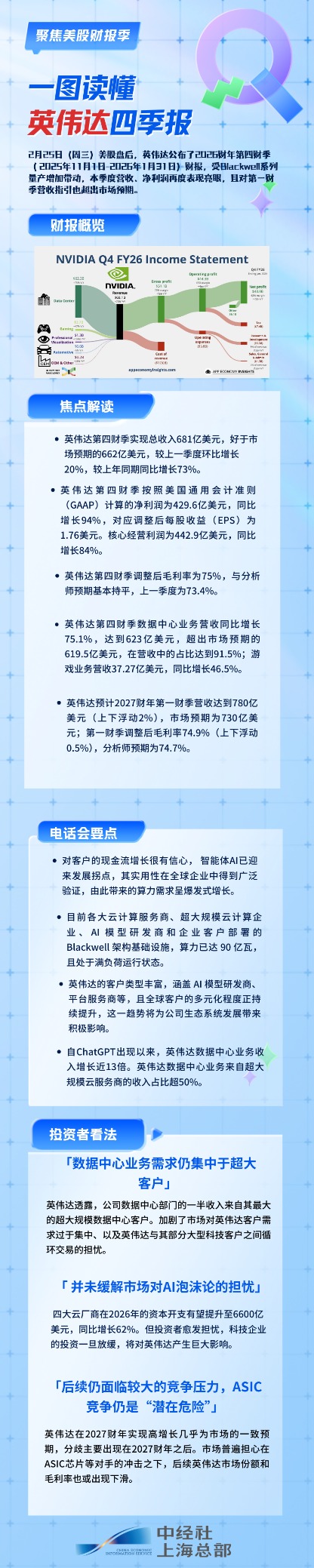
一图读懂英伟达季报:营收、利润再超预期,数据中心需求集中引市场担忧
Xin Hua Cai Jing· 2026-02-26 05:54
Core Insights - NVIDIA reported strong financial results for Q4 FY26, with total revenue of $68.1 billion, exceeding market expectations of $66.2 billion, and showing a 20% quarter-over-quarter increase and a 73% year-over-year increase [1] - The net profit for Q4 FY26 was $42.96 billion, a 94% year-over-year increase, with adjusted EPS at $1.76 and core operating profit at $44.29 billion, up 84% year-over-year [1] - NVIDIA's data center business revenue grew by 75.1% year-over-year to $62.3 billion, accounting for 91.5% of total revenue, while gaming revenue reached $3.727 billion, up 46.5% year-over-year [1] Financial Overview - NVIDIA's adjusted gross margin for Q4 FY26 was 75%, in line with analyst expectations, compared to 73.4% in the previous quarter [1] - For Q1 FY27, NVIDIA expects revenue to reach $78 billion (with a 2% fluctuation), surpassing market expectations of $73 billion, and an adjusted gross margin of 74.9% (with a 0.5% fluctuation), slightly above analyst expectations of 74.7% [1] Market Dynamics - Demand in the data center business is heavily concentrated among large-scale customers, raising concerns about customer dependency and potential circular transactions with major tech clients [3] - Despite a projected 62% year-over-year increase in capital expenditures among the four major cloud providers to $660 billion in 2026, there are growing investor concerns that a slowdown in tech investments could significantly impact NVIDIA [4] - Competition pressure remains significant, particularly from ASIC chip competitors, leading to concerns about potential declines in NVIDIA's market share and gross margins beyond FY27 [5] Customer and Industry Trends - The company expresses confidence in cash flow growth from customers, citing a turning point in AI development with widespread validation of its utility across global enterprises, resulting in explosive demand for computing power [6] - The infrastructure based on the Blackwell architecture deployed by major cloud service providers and large-scale cloud enterprises has reached 90 billion watts and is operating at full capacity [6] - Since the emergence of ChatGPT, NVIDIA's data center business revenue has increased nearly 13 times, with over 50% of revenue coming from large-scale cloud service providers [6]


股市面面观丨节后A股市场稳步回暖,钢铁、有色领涨有何动力?
Xin Hua Cai Jing· 2026-02-26 05:52
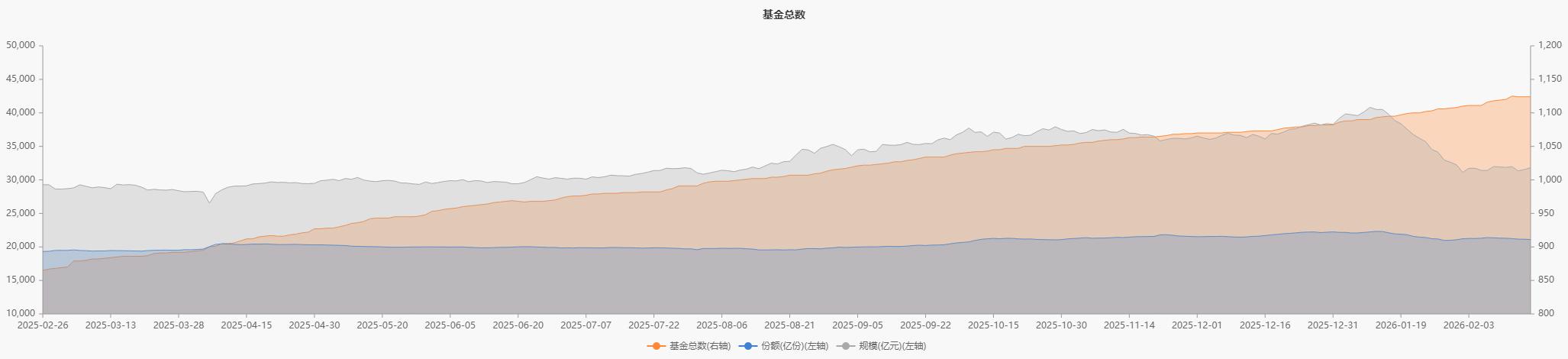
Market Overview - The A-share market has shown a significant recovery since the holiday, with the Shanghai Composite Index rising by 1.6%, the Shenzhen Component Index by 2.66%, and the ChiNext Index by 2.41% as of February 25 [1] - The average stock price in the A-share market increased by 1.62%, reaching 30.07 yuan per share, surpassing the 30 yuan mark [1] - Trading volume has also rebounded, with the first trading day post-holiday seeing a turnover of 2.2 trillion yuan, which further increased to 2.46 trillion yuan on the following day, exceeding the average daily turnover of approximately 2.09 trillion yuan before the holiday [1] Leverage and Fund Inflow - Leveraged funds have actively entered the market post-holiday, with net financing purchases reaching 338.9 billion yuan on the first trading day, marking the second-highest level of the year [2] - On February 25, net financing purchases amounted to 236.4 billion yuan, bringing the total for the two trading days to 575.3 billion yuan, surpassing the net selling scale before the holiday [2] - Prior to the holiday, the A-share market experienced a decline in financing balance from 2.722 trillion yuan to 2.572 trillion yuan, a drop of 150 billion yuan due to risk aversion among investors [2] ETF Market Stability - The A-share stock ETF market saw a rapid decline in late January, dropping from over 4 trillion yuan to around 3.1 trillion yuan, but has stabilized since February [2] - As of February 25, the asset scale of stock ETFs was reported at 3.18 trillion yuan, maintaining a steady state [2] Sector Performance - Among the 31 first-level industries, the steel, non-ferrous metals, building materials, oil and petrochemicals, and basic chemicals sectors showed the highest growth rates post-holiday, with the steel sector leading at a 7.19% increase [4][5] - Other notable sectors included non-ferrous metals at 6.90%, building materials at 6.56%, oil and petrochemicals at 5.73%, and basic chemicals at 5.68% [5] Economic Outlook and Policy Impact - Market participants have noted an increased expectation for macroeconomic recovery, particularly with the anticipation of stable growth policies being reflected in the A-share market [6] - Analysts predict that a series of investment-promoting policies will be implemented, leading to accelerated infrastructure investment in the first half of 2026 [6] - The market is expected to shift from "policy expectations" to "earnings realization" as companies begin to disclose their annual reports for 2025 and subsequent quarterly reports for 2026, which will serve as key market indicators [7]
英国1月公共财政盈余超预期,乐观状态能否持续尚未可知
Xin Hua Cai Jing· 2026-02-26 05:42
Group 1 - The UK public finances achieved a record surplus of £30.4 billion in January, exceeding the market expectation of £23.8 billion and nearly doubling the surplus from the same period last year, marking the highest level since 1993 [1] - The primary driver of this record surplus was government revenue exceeding expectations, with total public revenue reaching £143.1 billion, an increase of £16.8 billion compared to the previous year [1] - Tax revenue was the main contributor to the revenue growth, with capital gains tax rising to £17 billion, a 69% increase year-on-year, and national insurance contributions increasing by £2.9 billion due to a rise in employer rates [1] Group 2 - Government spending in January was £112.7 billion, only increasing by £0.9 billion compared to the previous year, indicating that spending growth was below expectations [2] - The slower growth in government spending was attributed to a decrease in interest payments on government debt, as the Bank of England has lowered interest rates, resulting in a £2.3 billion expenditure on debt interest, which was £4 billion lower than previous forecasts [2] - The UK government plans to achieve a budget surplus by the fiscal year 2028-29, relying on significant reductions in borrowing, with strong tax revenue growth making this target more attainable [3] Group 3 - Despite the positive fiscal surplus in January, concerns remain about the sustainability of this surplus due to low economic growth and potential future tax increases [4] - Employee wage growth in the UK has slowed, with a year-on-year increase of 4.2% in the last quarter of 2025, down from 4.5% in the previous quarter, which may impact future government revenue [4] - The shadow chancellor highlighted that the UK economy is growing below its potential, attributing this to high tax rates imposed by the government, which may hinder economic growth despite efforts to stabilize the fiscal situation [4]
逐梦煤海的“北疆工匠”
Xin Hua Cai Jing· 2026-02-26 05:42
丁明磊告诉记者,煤机司机是采煤工作的核心成员,决定了工作面回采效率、质量、设备安全等多个方 面,是重点岗位、关键少数,操作上既要胆大心细,也要有前瞻眼光,还要有组织能力,要用过硬的技 术为采煤工业保驾护航。 从郑州煤炭技工学校毕业后,他先后在河南当地煤炭企业、神东煤炭集团上湾煤矿工作,于2018年进入 乌兰木伦煤矿。他爱岗敬业、勤于钻研,凭借扎实的理论功底和丰富的实践经验,快速成长为采煤企业 的业务骨干和技术标兵。 据不完全统计,28年来,丁明磊累计安全采煤2000多万吨。他曾经带领班组成员创造了在采高6.3米、 长250米的工作面8小时割煤11.5刀、产煤2.3万吨的佳绩,并连续7个月在月度产量汇总中稳居第一。 数九寒天,位于内蒙古伊金霍洛旗的国能神东煤炭集团乌兰木伦煤矿外北风凛冽、滴水成冰,矿井下却 是一派机器轰鸣、采煤繁忙的热火朝天景象。 晚上11时,乌兰木伦煤矿采煤技术员、综采煤机司机丁明磊与同事们乘坐无轨胶轮车,抵达井下埋深 180米左右的工作面,开始8个小时的夜班采煤工作。 在综采工作面,丁明磊手持遥控器,巨大的采煤机缓缓移动,伴随着滚筒的旋转,一块块煤炭从乌黑坚 硬的煤层纷纷剥落,随着刮板输送机 ...
午评:深成指探底回升涨0.28% 算力硬件股集体走强
Xin Hua Cai Jing· 2026-02-26 04:18
Market Overview - A-shares showed mixed performance on February 26, with the Shanghai Composite Index slightly down, the Shenzhen Component Index rebounding, and the ChiNext Index showing weaker performance. The Shanghai and Shenzhen markets had a half-day trading volume of 1.64 trillion yuan, an increase of 117.3 billion yuan compared to the previous trading day [1] Sector Performance - Strong performance was noted in sectors such as computing hardware, power generation, and small metals, with stocks like Shenzhen South Circuit, Dazhu Laser, and Yunnan Zhenye hitting the daily limit. The power sector also saw gains, with Ganneng Co. achieving two consecutive limit-ups [1][2] - Conversely, the lithium battery sector experienced a decline, with Penghui Energy dropping over 9%, and the film and cinema sector faced significant losses, with Bona Film Group experiencing a sharp drop [1][2] Institutional Insights - Citic Securities highlighted a recent export ban on lithium from Zimbabwe, which aims to strengthen mineral regulation and promote deep processing. This ban could lead to a significant increase in lithium prices, as Zimbabwe is projected to account for 19% of China's lithium ore imports by 2025 and 12% of global lithium resource output by 2026. Investors are advised to focus on stocks not affected by this export policy [3] - Citic Jiantou noted a recent surge in Hong Kong-listed surgical robot companies, driven by positive bidding outcomes. The firm remains optimistic about the surgical robot sector and related investment opportunities. Additionally, the A-share brain-computer interface sector saw significant gains before the Spring Festival, suggesting continued interest in AI healthcare and brain-computer interface themes [3]
【环球财经】巴西联邦公共债务在1月份继续增长至1.68万亿美元
Xin Hua Cai Jing· 2026-02-26 03:50
巴西联邦公共债务包括内债与外债,是衡量其财政状况的重要指标,对宏观经济稳健性具有重要参考价 值。 (文章来源:新华财经) 新华财经圣保罗2月26日电(记者杨家和)巴西财政部最新数据显示,2026年1月巴西的联邦公共债务比 2025年12月增长0.07%,达到 8.641万亿雷亚尔(约合1.68万亿美元)。 财政部公告同时指出,外国投资者持有的国内公共债务比例从2025年12月的10.35%提高至2026年1月的 10.69%。在此期间,这些投资者持有的债券规模增加306.3亿雷亚尔(约59.54亿美元)。 数据显示,这一增长主要受债务利息计入总量的影响——2025年12月末为8.635万亿雷亚尔(约1.678万 亿美元),2026年1月末增至8.641万亿雷亚尔(约1.68万亿美元)。 机构持仓结构方面,金融机构仍是国内债务证券的最大持有群体,其次是投资基金和社会保障实体。 联邦债务构成显示,内债部分以名义值计算增长0.26%,至8.33万亿雷亚尔(约1.62万亿美元);外债 部分则下降4.75%,降至3105.9亿雷亚尔(约603.79亿美元)。 ...
新疆边境小额贸易额连续四年位居全国首位
Xin Hua Cai Jing· 2026-02-26 03:20
Core Insights - In 2025, Xinjiang's border small-scale trade import and export volume is expected to reach 209.9 billion yuan, maintaining the top position in the country for four consecutive years [1] - Xinjiang's total foreign trade import and export volume is projected to exceed 500 billion yuan for the first time, with a year-on-year growth of 19.9%, ranking first in the nation [1] - The region has established trade cooperation mechanisms with 228 countries and regions, enhancing its role as a key player in China's westward opening strategy [1] Trade and Economic Development - Xinjiang has leveraged its geographical advantages to deepen border trade cooperation with neighboring countries [1] - The region's border small-scale trade has played a crucial supporting role in the overall foreign trade growth [1] - The local government is focused on improving the convenience of border trade through infrastructure development and innovative customs clearance models [1] Infrastructure and Logistics - Significant progress has been made in the construction of smart ports, with the first cargo channel between China and Kyrgyzstan operating 24/7, greatly enhancing customs efficiency [1] - In 2026, Xinjiang plans to accelerate the modernization of ports, extend customs clearance times at key road ports, and improve border trade storage and logistics conditions [1]
日本央行委员:日本不再处于通缩状态 政策正常化必须审慎
Xin Hua Cai Jing· 2026-02-26 03:16
Core Viewpoint - The Bank of Japan's committee member Soichiro Takata indicates that the economy is no longer in deflation, emphasizing that concerns about returning to deflation have been eliminated [1][2]. Group 1: Economic Conditions - Takata states that the path to overcoming deflation is finally taking shape, driven by domestic structural factors rather than solely relying on external cost transmission [1]. - He expresses hope for a "true dawn" for Japan's economy, suggesting that the current situation is fundamentally different from past experiences [1]. Group 2: Monetary Policy - Takata advocates for a gradual increase in interest rates, noting that Japan's real short-term interest rates remain significantly negative, even after a potential rate hike in December 2025 [1]. - He warns of the risk that the Bank of Japan may fall behind the global recovery and rate hike cycle starting in 2026 [1]. Group 3: Debt and Market Stability - The need for cautious normalization of policies is emphasized, particularly regarding the pace of reducing government bond purchases [1]. - Takata highlights the risk of weak demand for ultra-long Japanese government bonds and warns of potential market volatility that could lead to dysfunction in the bond market [1]. Group 4: External Risks - He raises concerns about external risks, particularly the evolving U.S. trade policies that could heighten global risk sentiment and exacerbate currency market volatility due to diverging monetary policies between Japan and the U.S. [2]. - Takata acknowledges the moderate growth of the overseas economy but believes Japan has the foundation for endogenous inflation, suggesting that the central bank should focus more on rising prices [2].