Guan Cha Zhe Wang

Search documents
被判侵犯摄影师作品权益后,视觉中国道歉
Guan Cha Zhe Wang· 2025-11-23 08:26
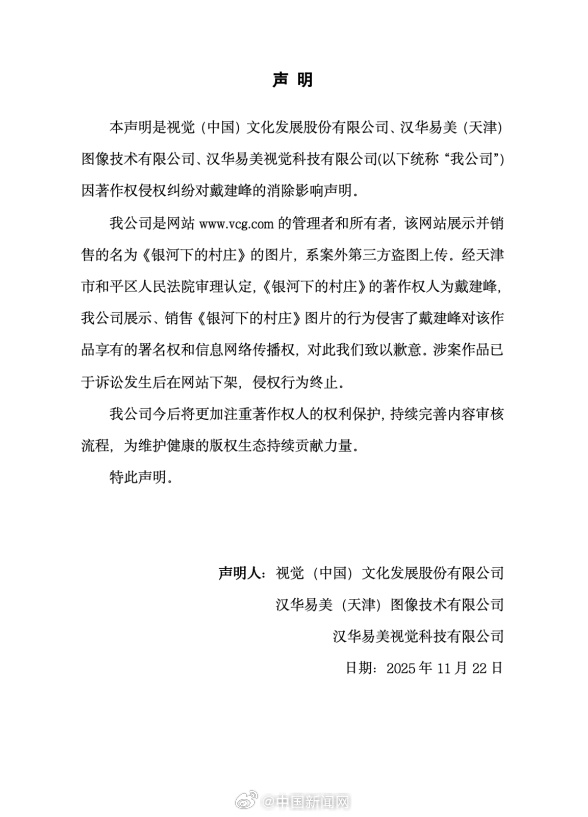
Core Viewpoint - The court ruled that Visual China infringed on photographer Dai Jianfeng's copyright by selling his photo "Village Under the Galaxy" without authorization, leading to a compensation order and a public apology requirement [4][5]. Group 1: Legal Proceedings - The Tianjin Peace District People's Court confirmed Visual China's infringement and ordered them to compensate Dai Jianfeng for economic losses and reasonable expenses totaling 15,000 yuan [5]. - The court found that Visual China had illegally sold the photo through a third party, claiming ownership without proper rights [4]. - Visual China was required to publish a statement on their website for 48 hours to mitigate the impact of the infringement [5]. Group 2: Company Actions - Visual China acknowledged the infringement and stated that they would enhance copyright protection measures and improve content review processes in the future [1]. - The company had previously demanded over 80,000 yuan from Dai Jianfeng for alleged infringement, which the court deemed inappropriate due to a lack of due diligence [4][5]. - The court ruled that the sale of 148 other photos by Visual China did not constitute infringement [5].

国产DDR5重磅亮相,已达国际领先水平
Guan Cha Zhe Wang· 2025-11-23 07:50
随着处理器核心数量与AI模型规模持续增长,算力系统对内存速率的需求大幅提升。观察者网了解到,长鑫存储最新发布的8000 Mbps DDR5 芯片,较 6400Mbps产品速率提升25%。当前市场基准中,6400 Mbps代表服务器与高端PC的主流性能层级,而8000 Mbps则已迈入国际顶级性能梯队。 在内存容量上,长鑫存储在标准16Gb 颗粒以外,重点推出24Gb大容量颗粒,对于大规模数据中心具有显著优势,能在不占用额外物理插槽的前提下,显著 提升系统的模型加载能力与多任务处理效率,满足数据中心快速扩容的刚需。 11月23日,观察者网获悉,国产存储芯片厂商长鑫存储在IC China 2025(中国国际半导体博览会)上正式发布其最新DDR5产品系列:最高速率达 8000Mbps,最高颗粒容量24Gb,均达到国际领先水平,并同步推出覆盖服务器、工作站及个人电脑全领域的七大模组产品。 在展台上,长鑫存储展示了最新DDR5系列产品,以及最高速率10667Mbps、最高颗粒容量16Gb的最新LPDDR5X移动端内存。其两大产品系列速率、容量 双维度均位居业界第一梯队,标志其产品性能与布局已全面达到全球主流高端水准,国 ...

网传小米汽车工厂内电池产线起火,小米回应
Guan Cha Zhe Wang· 2025-11-23 03:25
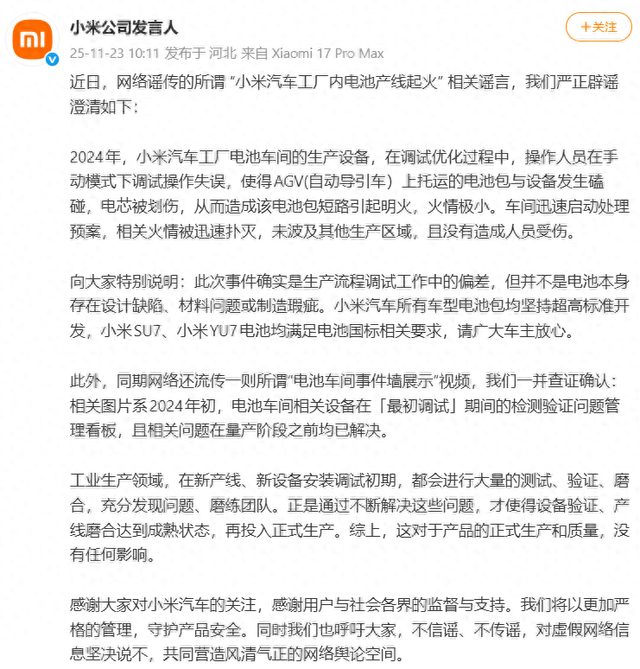
Core Viewpoint - Xiaomi Technology has officially clarified rumors regarding a fire incident in its battery production line, stating that the event was a minor issue during equipment debugging and did not result from any design or manufacturing defects in the batteries [1][2]. Group 1: Incident Details - The fire incident occurred during the debugging of production equipment, caused by an operational error that led to a battery pack being damaged and short-circuiting, resulting in a small flame [1]. - The fire was quickly extinguished, did not affect other production areas, and there were no injuries reported [1]. Group 2: Product Assurance - Xiaomi emphasizes that all battery packs for its automotive models, including the Xiaomi SU7 and Xiaomi YU7, meet national standards and are developed under high safety standards [1]. - The company reassures customers that the incident does not impact the quality or safety of the products, as the issues were resolved before mass production [2]. Group 3: Response to Misinformation - Xiaomi calls for the public to refrain from believing or spreading rumors, urging a collective effort to maintain a positive online discourse [2].

连续第二年,韩国单独举办“佐渡金山”劳工追悼仪式
Guan Cha Zhe Wang· 2025-11-23 01:39
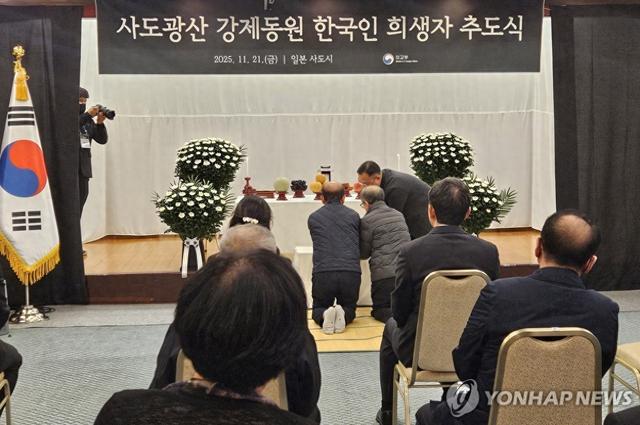
当地时间11月21日,韩国政府在日本佐渡岛举办悼念仪式。 韩联社 报道指出,这是韩国政府去年和今年连续两年缺席日方主办的悼念活动,原因是日方坚持不承认朝鲜半 岛劳工被日方强征的史实。在日方今年9月13日举办的"佐渡金山"追悼仪式上,日本政府代表对强征朝 鲜半岛劳工一事只字未提。 日本外务省国际文化交流审议官冈野结城子当时在活动上,将被日本强征的朝鲜半岛劳工称为"来自朝 鲜半岛的劳动者",并仅称"他们在严酷的环境中从事苦力,我缅怀曾在佐渡金山辛勤工作的所有劳动 者,并对逝者表示深切哀悼"。 据韩联社报道,当地时间11月21日,韩国政府在日本佐渡岛举办悼念仪式,纪念二战期间在"佐渡金 山"矿中强迫劳动的朝鲜半岛劳工。这是韩方连续第二年缺席日方主办的活动,选择单独举办悼念活 动。 当日上午,韩方在日本新潟县佐渡岛的一家酒店举办悼念仪式,7名受害者的11名家属以及韩国驻日大 使李赫出席活动。 李赫向受害者家属表达慰问,并表示:"80多年前,在朝鲜总督府的参与下,通过招募和征用等手段, 许多朝鲜半岛劳工违背自身意愿来到佐渡岛从事强迫劳动。工人们当时的恐惧和孤独至今仍在受害者家 属的心中留下痛苦和悲伤。" 仪式结束后,李 ...
马斯克不是在开玩笑,而是当成了此生最大使命在执行
Guan Cha Zhe Wang· 2025-11-23 00:50
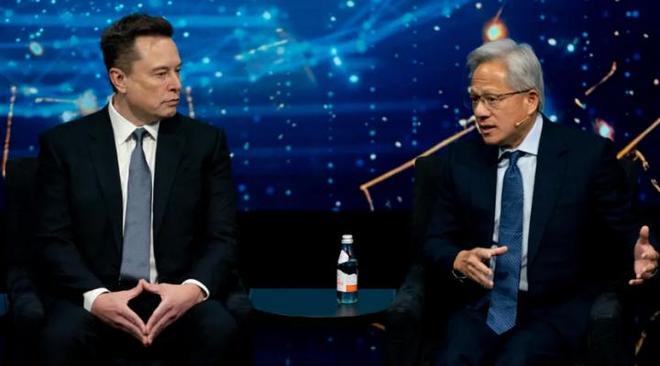
Core Viewpoint - The discussion between Elon Musk and Jensen Huang at the US-China Investment Forum highlights the transformative potential of AI and robotics, predicting a future where work becomes optional and money loses its significance due to extreme material abundance brought about by technological advancements [1][4][8]. Group 1: Future of Work - Musk predicts that in 10 to 20 years, work will become optional, akin to hobbies like gardening or gaming, as AI and robotics will eliminate poverty and create wealth for everyone [1][8]. - Huang agrees that AI will change job content in the short term, enhancing productivity by simplifying previously difficult tasks, as seen in the case of radiologists who now have more time for patient care due to AI [3][4]. Group 2: AI as Infrastructure - Both Musk and Huang view AI as a foundational infrastructure that will permeate every company, industry, and country, transitioning from retrieval-based computing to generative AI that requires real-time content generation [3][4]. - Huang emphasizes the need for "AI factories" to meet the demand for real-time content generation, indicating a shift in computational paradigms [3]. Group 3: AI in Space - Musk proposes that the most cost-effective way to conduct AI computations in the next four to five years will be through solar-powered AI satellites, overcoming the limitations of power generation and cooling on Earth [4]. - He estimates an annual AI computation demand of 300 gigawatts, which is two-thirds of the annual electricity consumption of the US, suggesting that space offers a viable solution to these challenges [4]. Group 4: Concerns and Philosophical Views - Huang dismisses concerns about an "AI bubble," asserting that the shift from general to accelerated computing justifies investments in revolutionary AI technologies [5]. - Musk concludes with a philosophical reminder that civilization's progress is not guaranteed, urging the need for effort to ensure a positive trajectory towards a better future [5].
汽车行业将携“价值竞争”迈入2026
Guan Cha Zhe Wang· 2025-11-22 12:33
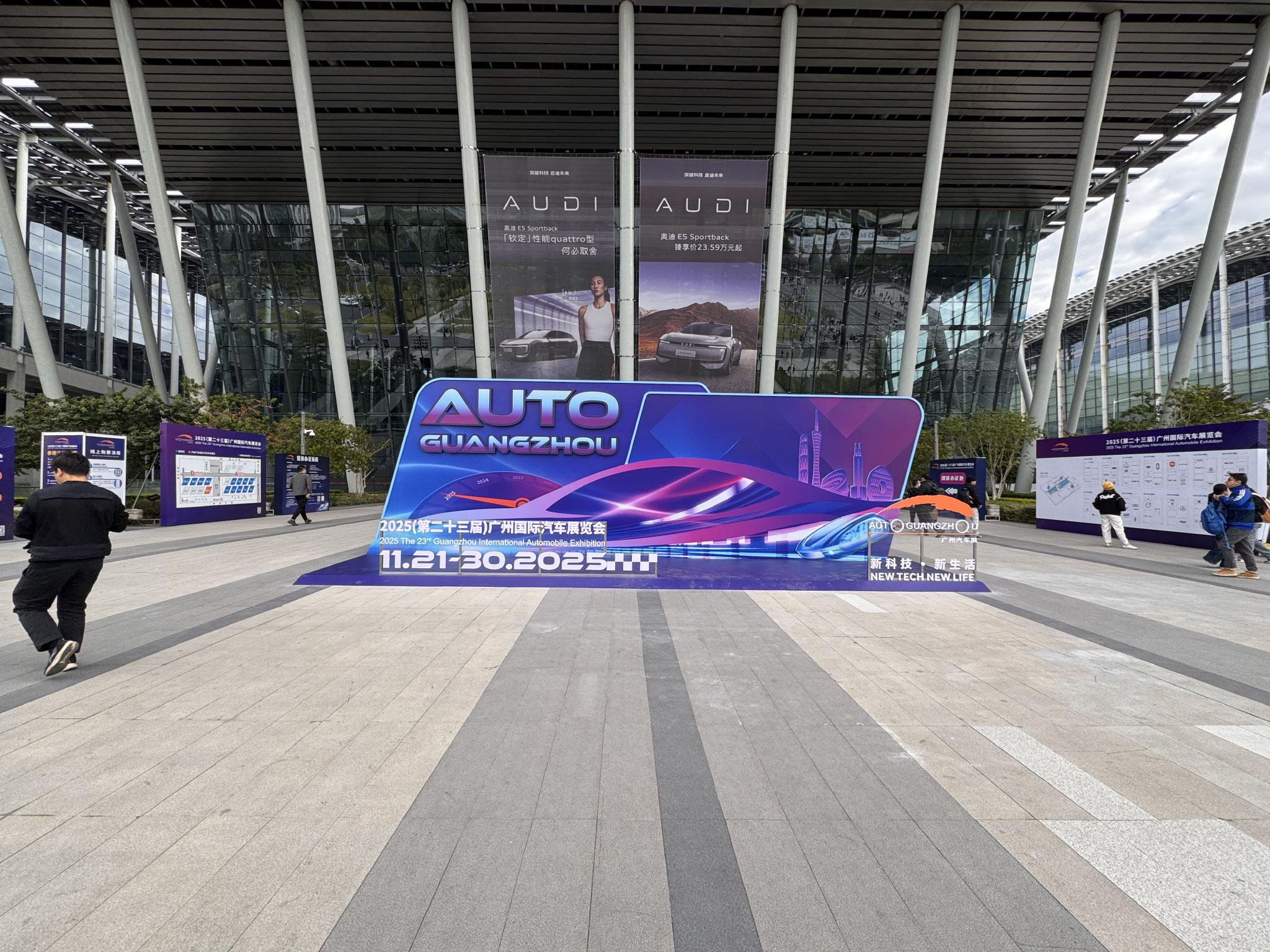
Core Insights - The 23rd Guangzhou International Auto Show marks a significant shift in the Chinese automotive industry from policy-driven growth to market-driven dynamics, emphasizing a transition from "price wars" to "value wars" [1][4][16] Industry Trends - A total of 1,085 vehicles were showcased at the auto show, with 629 being new energy vehicles (NEVs), representing 58% of the total, an increase of 14.3 percentage points from the previous year [4] - In the first ten months of this year, cumulative sales of NEVs in China exceeded 10 million units, achieving a market penetration rate of over 52.9% [4] - The shift in policy from direct subsidies to market-oriented growth is evident, with the Ministry of Industry and Information Technology announcing a reduction in NEV purchase tax starting in 2026 [4][16] Market Dynamics - The auto show highlighted a significant reshuffling in the market, with over 20 brands absent, including well-known names like Beijing Hyundai and Peugeot Citroën, indicating a trend of declining market performance for certain brands [6] - Brands are increasingly focusing on hybrid technology to meet consumer demand, with companies like Xpeng and GAC Aion expanding their product lines to include hybrid models [7] Technological Advancements - The concept of "smart driving equality" has gained traction, with advanced driving features becoming more accessible in mainstream models, as seen with the introduction of products like Leapmotor A10 and GAC Toyota's smart version [9] - Huawei has emerged as a key player in the auto show, showcasing its capabilities in smart driving and intelligent cockpit technologies, with its ADS having partnered with 33 vehicle models and accumulated over 5 billion kilometers of assisted driving mileage [13] Competitive Landscape - The automotive industry is transitioning from a focus on single product competition to ecosystem competition, with traditional automakers leveraging partnerships with technology suppliers to enhance their electric and intelligent capabilities [12] - A report indicates that only 15 out of 129 automotive brands in China are expected to achieve financial sustainability by 2030, suggesting an impending wave of consolidation and competition in the industry [16] Future Outlook - The auto show serves as a reflection of the past five years of transformation in the Chinese automotive sector while also pointing towards future trends, emphasizing the importance of value competition and long-term strategies for high-quality development [16]
用AI改变课堂,中国00后创业者Simon获硅谷顶级风投a16z投资
Guan Cha Zhe Wang· 2025-11-22 11:54
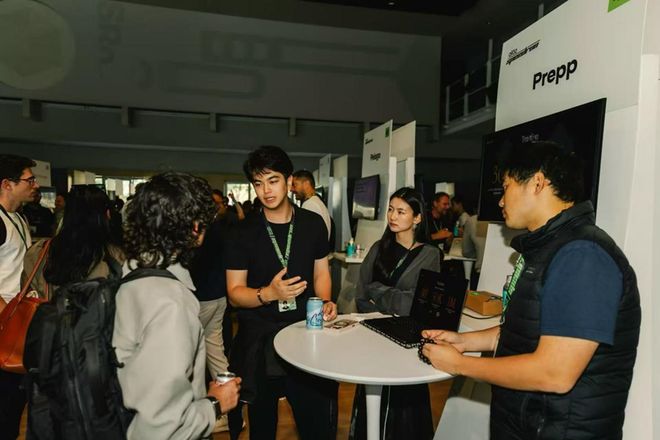
Core Insights - The article highlights the innovative approach of Prepp, an AI education platform founded by a young entrepreneur named Simon, who aims to transform traditional classrooms by personalizing learning experiences for each student through AI technology [1][9]. Group 1: Company Overview - Prepp has recently secured seed investment from a16z, a prominent venture capital firm known for its focus on hard tech, marking a rare venture into the education technology sector [1][9]. - The platform is designed to assist teachers by providing them with AI tools that can generate lesson plans and teaching materials quickly, thus acting as a personal assistant [6][7]. Group 2: Educational Philosophy - Simon's educational philosophy is influenced by his experiences in both Chinese and American educational systems, recognizing the strengths and weaknesses of each [4]. - The platform aims to address global educational disparities, emphasizing that both American and developing countries face significant challenges in education quality [4][9]. Group 3: Product Features - Prepp allows teachers to create engaging lesson materials in minutes, while students receive personalized tutoring based on their individual learning needs [6][7]. - The system utilizes a modular learning approach, breaking down knowledge into small, manageable units, which has shown to improve student performance significantly [7]. Group 4: Market Positioning - Simon's bold statements during pitch presentations have resonated with investors, positioning Prepp as a solution to global educational inequality rather than just a tool for improving American classrooms [9][10]. - The platform's innovative features, such as AI-driven personalized learning and real-time data analysis, have attracted interest from multiple investment firms [10]. Group 5: Future Aspirations - The company plans to expand its reach into Asia and Africa over the next three years, aiming to create a global educational community that fosters collaboration among teachers and students [11]. - Simon envisions making learning as engaging as gaming, incorporating elements of fun and reward systems to enhance student motivation and participation [11].

用AI改变课堂,中国00后创业者获硅谷顶级风投投资
Guan Cha Zhe Wang· 2025-11-22 11:54
"教,是为了更好地学。"说这话的Simon,是一位00后创业者。他创立的AI教育平台Prepp,最近拿到了 硅谷顶级风投a16z(Andreessen Horowitz)的种子投资,成为这家以硬核科技闻名的投资机构少有的教 育科技项目。而Simon的野心,远不止做一个"聪明"的学习工具——他想用AI改变课堂,让每个孩子都 能找到适合自己的学习方式。 从"刷题少年"到教育革新者 Simon的办公室里,总放着一杯奶茶。他说,学习就像定制奶茶,有人喜欢少糖多珍珠,有人偏爱去冰 加布丁,而传统课堂却像"一锅水煮茶叶",所有人都是同一个味道。这种想法,源于他自己的成长经 历。 作为土生土长的中国00后,Simon高中时也曾为考试刷题到深夜。后来,他考入芝加哥大学,攻读经济 学与数据科学双学位,体验了美国互动自由的课堂。两种截然不同的教育模式,让他成了"有留学背景 的本土教师粉丝"——既欣赏西方启发式教育的魅力,也理解中国应试环境的现实。 AI会取代老师吗? "AI再聪明,它也当不了真正的老师,"Simon说,"就像无人机飞得再高,也得有人在地上操控。"在他 眼中,AI和老师的关系定位非常清晰:AI是老师的工具和助手,而 ...
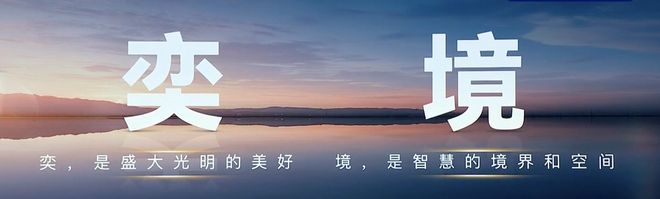
“五界”之后又多“两境”:车企需要何种身份的华为?
Guan Cha Zhe Wang· 2025-11-22 10:00
Core Insights - The future survival of automotive brands may hinge less on technology itself and more on the unique value that car manufacturers can offer as smart technology becomes standardized [12] Group 1: New Brand Launch - Huawei introduced two new high-end smart electric vehicle brands, "Yijing" and "Qijing," in collaboration with Dongfeng Motor and GAC Group, respectively [1] - These brands are the first results of a new cooperation model between Huawei and car manufacturers, alongside the existing "Five Realms" brands under the "Hongmeng Intelligent Driving" ecosystem [3] Group 2: Cooperation Models - There are three cooperation models between Huawei and car manufacturers: "Component Supply Model," "Smart Selection Car Model," and "HI Model" [3][5] - The "Component Supply Model" involves Huawei providing standardized components and technical solutions, while the "Smart Selection Car Model" allows for deeper collaboration, including product definition and marketing [5] - The "HI Model" offers a middle ground where Huawei provides comprehensive intelligent vehicle solutions without participating in product definition and marketing [5] Group 3: Brand Positioning and Challenges - The "Yijing" and "Qijing" brands will see Huawei participating more deeply in product definition and design compared to the HI Model, but car manufacturers will retain more autonomy in branding and production [6][10] - Concerns arise regarding the balance of power in collaborations, as some manufacturers fear losing brand identity when partnering with Huawei [6][8] - The "HI Model" has not achieved ideal market feedback, leading to questions about whether the new "境" brands can address these challenges [9][10] Group 4: Market Dynamics - As consumer attitudes shift towards advanced driving assistance and smart cockpit technologies, traditional manufacturers face pressure to enhance their smart capabilities [6] - The increasing complexity of collaboration models raises the challenge of maintaining brand differentiation and avoiding homogenization in the market [11] - The evolution of these partnerships reflects ongoing experimentation in the integration of automotive and technology sectors, necessitating a redefinition of boundaries as collaborations deepen [11]