
Shen Zhen Shang Bao

Search documents
10月深圳CPI上涨0.4%
Shen Zhen Shang Bao· 2025-11-12 07:02
Group 1 - The Consumer Price Index (CPI) in Shenzhen increased by 0.4% year-on-year in October 2025, with the core CPI rising by 0.9%, marking a 0.1 percentage point increase from the previous month [1] - Average CPI from January to October 2025 rose by 0.1% compared to the same period last year [1] - Food prices decreased by 1.5%, with rice, pork, and dairy prices falling by 10.0%, 6.3%, and 4.4% respectively, contributing to a 0.17 percentage point decline in CPI [1] Group 2 - Non-food prices increased by 0.7%, with medical services and utilities rising by 6.3% and 1.4%, respectively, contributing to a 0.29 percentage point increase in CPI [1] - Jewelry and platinum prices surged by 51.1% and 56.4%, respectively, adding approximately 0.21 percentage points to the CPI [1] - The CPI remained stable month-on-month, following a 0.2% decline in the previous month [1] Group 3 - The pork market is currently characterized by strong supply and weak demand, leading to a 2.1% decrease in pork prices [2] - The arrival of seasonal fruits has increased supply, resulting in a 2.8% drop in fresh fruit prices [2] - Non-food prices remained stable, with hotel accommodation and travel agency fees rising by 7.6% and 4.1% during the National Day holiday, contributing to a 0.06 percentage point increase in CPI [2]
10月深圳PPI上涨0.7%
Shen Zhen Shang Bao· 2025-11-12 06:58
Core Insights - The Producer Price Index (PPI) in Shenzhen increased by 0.7% year-on-year and 0.5% month-on-month in October 2025, while the purchasing prices for industrial producers decreased by 0.5% year-on-year and increased by 0.5% month-on-month [1][2] - For the period from January to October, the average PPI rose by 0.1% year-on-year, while the purchasing prices fell by 0.3% year-on-year [1] Price Trends - Year-on-year, the prices of production materials decreased by 0.4%, with mining industry prices dropping by 10.5% and processing industry prices down by 0.4%. Raw materials prices increased by 1.2%. In contrast, living materials prices rose by 2.8%, with durable consumer goods prices down by 2.2% and clothing prices down by 1.7% [1] - Year-on-year, food prices increased by 2.2%, and general daily necessities saw a significant rise of 21.3% [1] - In terms of purchasing prices, fuel and power prices decreased by 8.1%, while prices for building materials and non-metallic products fell by 5.3% and wood and pulp prices dropped by 5.0%. Agricultural products prices decreased by 4.1% [1] Month-on-Month Changes - Month-on-month, production material prices increased by 0.1%, with mining prices down by 1.3% and both raw materials and processing prices up by 0.1%. Living materials prices rose by 1.2%, with food prices down by 1.3% [2] - Durable consumer goods prices increased by 0.3%, clothing prices rose by 0.6%, and general daily necessities prices surged by 4.8% [2] - For purchasing prices, building materials and non-metallic prices decreased by 0.8%, while fuel and power prices increased by 0.5% and chemical raw materials prices rose by 0.6% [2]
三年拉锯战落幕:天马新材与金力股份握手言和
Shen Zhen Shang Bao· 2025-11-12 06:42
Core Viewpoint - The long-standing legal dispute between Tianma New Materials Co., Ltd. and Hebei Jinli New Energy Technology Co., Ltd. has been resolved through a settlement agreement, concluding a three-year contract dispute over the sale of aluminum oxide powder materials [1][5]. Summary by Sections Background of the Dispute - In March 2022, Tianma New Materials signed a sales contract with Jinli New Energy and its subsidiaries for aluminum oxide powder materials worth approximately 4 million yuan, but Jinli refused to pay, citing product quality issues [2][3]. - Tianma filed a counterclaim seeking payment of 1.56 million yuan and interest, while also pursuing claims against Jinli's subsidiaries for additional amounts [2][3]. Legal Proceedings - The case went through multiple court hearings, with the first instance court ruling against Tianma, which led to an appeal [3][4]. - The second instance court found procedural errors in the first ruling and sent the case back for retrial [4]. Settlement Agreement - On November 10, 2025, both parties reached a settlement where Tianma agreed to pay 1.5 million yuan in cash, and Jinli would return unused goods, with both parties withdrawing their lawsuits [5][6]. Financial Impact - The litigation led Tianma to make provisions in its 2023 financial report, impacting net profit by approximately 18.52 million yuan [7]. - The company reported a revenue of 207 million yuan for the first three quarters of 2025, a year-on-year increase of 14.29%, but a significant decline in net profit [7].
突发!知名上市公司,被自然人告上法庭
Shen Zhen Shang Bao· 2025-11-12 04:35
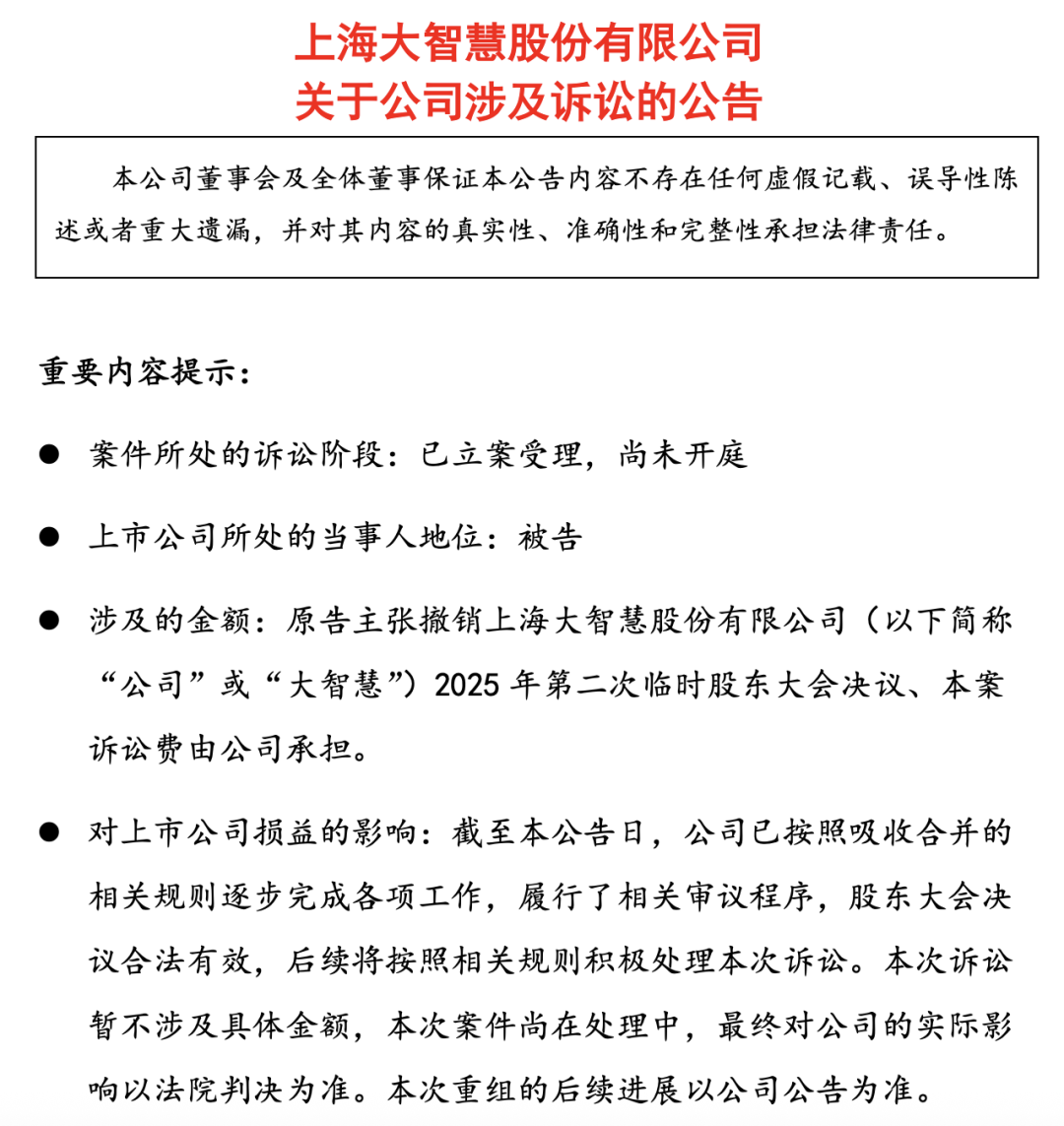
Core Viewpoint - Dazhihui is undergoing a share swap merger with Xiangcai Co., aiming to raise funds through the issuance of A-shares to all A-share shareholders of Dazhihui [3][6] Group 1: Merger and Acquisition Details - The merger involves a share swap ratio of 1:1.27, meaning each share of Dazhihui can be exchanged for 1.27 newly issued shares of Xiangcai [7] - Following the merger, Xiangcai's total share capital will increase to 5.141 billion shares, while Dazhihui will be delisted and its legal entity will be dissolved, with all assets, liabilities, and operations transferred to Xiangcai [7] - Xiangcai plans to raise up to 8 billion yuan for financial model development, big data projects, integrated wealth management platform construction, and to supplement working capital and repay debts [7] Group 2: Legal Proceedings and Shareholder Concerns - A lawsuit was filed by Wang Gongwei to annul the resolutions from Dazhihui's second extraordinary general meeting, claiming that the merger constitutes a significant related party transaction that should have undergone proper evaluation and approval [4][6] - Dazhihui asserts that it has complied with all necessary procedures and that the resolutions are valid, supported by opinions from its financial and legal advisors [6] - The Shanghai Stock Exchange has accepted Xiangcai's application for the merger, indicating that the application documents are complete and in legal form [6] Group 3: Financial Performance - For the first three quarters of the year, Dazhihui reported total revenue of 564 million yuan, an increase of 8.78% year-on-year, but incurred a net loss attributable to shareholders of 29.56 million yuan, compared to a loss of 201 million yuan in the same period last year [7] - The net cash flow from operating activities was -88.73 million yuan, an improvement from -261 million yuan in the previous year [7] Group 4: Market Reaction - As of November 11, Dazhihui's stock price fell by 3.04%, closing at 13.71 yuan per share, with a total market capitalization of 27.271 billion yuan [8]


汇源通信今起停牌,控制权飘摇
Shen Zhen Shang Bao· 2025-11-12 04:35
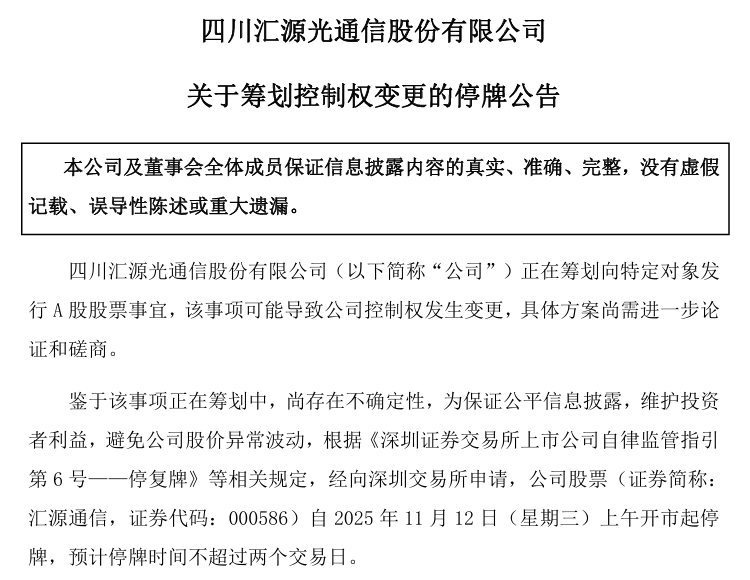
Group 1 - The company Huayuan Communication (000586) announced on November 11 that it is planning to issue A-shares to specific investors, which may lead to a change in control of the company. The specific plan is still under further verification and negotiation [1] - Due to the ongoing planning, there is uncertainty surrounding this matter, and the company has applied for a trading suspension starting from November 12, 2025, expected to last no more than two trading days [1] Group 2 - As of the end of Q3 2025, the largest shareholder of the company is Beijing Dingyun Technology Development Co., Ltd., holding a 14.10% stake with 27,273,330 shares [4] - On November 10, the company announced that shareholder Quanzhou Shenghui Investment Co., Ltd. pledged 6 million shares, accounting for 62.03% of its holdings and 3.10% of the total share capital. As of the announcement date, Quanzhou Shenghui had a total of 6 million pledged shares [4] - For the first three quarters of 2025, the company achieved operating revenue of 361 million yuan, a year-on-year increase of 30.4%. The net profit attributable to shareholders turned from a loss of 2.61 million yuan in the same period last year to a profit of 14.76 million yuan [4] - The net profit after deducting non-recurring gains and losses also turned from a loss of 3.32 million yuan to a profit of 11.74 million yuan. The net cash flow from operating activities was 13.64 million yuan, a year-on-year increase of 470.6%. The EPS (fully diluted) was 0.0763 yuan [4] - In Q3, the company reported operating revenue of 125 million yuan, a year-on-year increase of 9.0%. The net profit attributable to shareholders was 6.19 million yuan, up 86.7% year-on-year, and the net profit after deducting non-recurring gains and losses was 4.27 million yuan, an increase of 40.8% year-on-year. The EPS for Q3 was 0.032 yuan [4] Group 3 - As of the end of Q3, the company's total assets were 613 million yuan, an increase of 8.5% compared to the end of the previous year. The net assets attributable to shareholders were 339 million yuan, an increase of 4.6% compared to the end of the previous year [5]

“公司可能永远无法盈利”!东方妍美IPO招股书失效
Shen Zhen Shang Bao· 2025-11-12 04:32
Core Viewpoint - Oriental Yanmei (Chengdu) Biotechnology Co., Ltd. has seen its IPO application expire after six months, indicating potential challenges in its market entry and financial performance [1][2]. Company Overview - Established in 2016, Oriental Yanmei focuses on the research, production, and commercialization of regenerative medical devices and specialized medical foods [2]. - The company’s product portfolio includes two main lines: regenerative medical material injectables and medical dressings and patches [2]. Financial Performance - In 2023, Oriental Yanmei reported revenues of 12.882 million yuan, with a projected increase to 14.52 million yuan in 2024, indicating modest growth [2]. - Revenue sources are heavily reliant on non-core businesses, with medical dressings and patches generating 3.616 million yuan and peripheral products like pharmaceutical intermediates and masks contributing 7.551 million yuan in 2024 [2]. Product Development - The company has 13 candidate products for regenerative medical material injectables, with two currently in the registration review stage [2]. - The core product, XH301, is a regenerative injectable that stimulates collagen regeneration but has not yet been commercialized, resulting in no revenue for 2023 and 2024 [2]. Losses and Expenditures - Oriental Yanmei reported significant losses, with a net loss attributable to shareholders of 63.501 million yuan in 2023 and an increase to 69.383 million yuan in 2024, totaling over 130 million yuan in two years [3]. - High expenses are attributed to R&D investments of 45.726 million yuan and 44.95 million yuan for 2023 and 2024, respectively, which account for over 300% of revenue [3]. - Administrative expenses surged by 113% in 2024, and sales costs increased by 23% from 114 million yuan in 2023 to 141 million yuan in 2024 [3]. Future Outlook - The company anticipates continued losses in the short term, potentially exacerbated by increased R&D spending and efforts to advance product approvals and commercial partnerships [3]. - Oriental Yanmei acknowledges the uncertainty of achieving profitability, stating that it may never become profitable or maintain profitability if it does [3]. Funding and Valuation - The company has completed three rounds of financing, with notable investors including Shenzhen Capital Group and Shenzhen High-tech Investment [4]. - The latest funding round in April raised 90 million yuan at a per-share cost of 9.76 yuan, resulting in a post-money valuation of 1.5 billion yuan [4].

永辉超市,又出利空
Shen Zhen Shang Bao· 2025-11-12 04:29
Core Viewpoint - Yonghui Supermarket announced a share reduction plan by major shareholder Zhang Xuansong and his associates, intending to sell up to 90,750,000 shares, representing no more than 1% of the company's total share capital due to personal funding needs [1][2]. Group 1: Share Reduction Details - The share reduction will occur through centralized bidding, with a planned reduction period from December 4, 2025, to March 3, 2026 [2]. - The total shares held by Zhang Xuansong and his associates amount to 1,274,987,806 shares, accounting for 14.05% of the company's total share capital [2][3]. - The Shanghai Xishirun Investment Management Co., Ltd. - Xishirun He Run 6 Private Securities Investment Fund holds 169,638,486 shares, which is 1.87% of the total share capital [3]. Group 2: Company Performance - Yonghui Supermarket reported a revenue of 42.434 billion CNY for the first three quarters, a year-on-year decline of 22.21%, with a net loss of 710 million CNY, significantly widening from a loss of 78 million CNY in the previous year [3]. - In Q3, the revenue was 12.486 billion CNY, down 25.55% year-on-year, with a net loss of 469 million CNY, compared to a loss of 353 million CNY in the same period last year [3]. - The company has experienced a continuous decline in revenue for four consecutive years in Q3 and three consecutive years in the first three quarters [3]. Group 3: Store Closures - Yonghui Supermarket plans to close two stores in Shenzhen, located in key commercial areas, as part of its strategy to shut down long-term loss-making stores [4]. - As of September 30, the total number of operating stores was reduced to 450 from 775 at the end of 2024, with 325 stores closed in the current year, including 102 in Q3 alone [4]. - The company is actively pursuing a "close old and renew" strategy, with only two new stores opened during the same period [4]. Group 4: Market Performance - As of November 12, Yonghui Supermarket's stock price fell by 1.9% to 4.65 CNY per share, with a total market capitalization of 42.199 billion CNY [4].


三季报数据填错!“西北啤酒王”紧急更正
Shen Zhen Shang Bao· 2025-11-12 04:27
Core Viewpoint - *ST Lanhuang has disclosed a correction announcement for its Q3 2025 report, revealing errors in the securities investment section due to staff mistakes [1] Group 1: Financial Performance - For the first three quarters of 2025, the company achieved total operating revenue of 219 million yuan, a year-on-year increase of 23.35% [5] - The net profit attributable to the parent company was 10.93 million yuan, marking a turnaround from losses [5] - The net cash flow from operating activities was -134 million yuan, compared to -220.59 million yuan in the same period last year [5] Group 2: Business Challenges - The company faces significant challenges in maintaining its listing status, as it was flagged for delisting risk due to negative profits and low revenue [3][4] - 2025 is identified as a critical year for the company to avoid delisting, as it must not repeat the negative financial performance of the previous year [5] Group 3: Operational Insights - The beer production volume for the first half of 2025 was 18,800 kiloliters, a decrease of 39.95% compared to the first half of 2024 [5] - Beer sales volume also declined by 37.66% to 19,600 kiloliters in the same period [5] - The company is investing 65 million yuan in a new juice beverage project in Chongqing to diversify its product offerings and improve financial performance [5] Group 4: Market Performance - As of November 12, the stock price of *ST Lanhuang increased by 1.49%, closing at 8.85 yuan per share, with a total market capitalization of 1.644 billion yuan [5]

违规交易近4000万元,光大证券一员工被罚
Shen Zhen Shang Bao· 2025-11-12 02:11
Core Viewpoint - An employee of Everbright Securities, Liu Zefang, has been penalized for illegal trading activities involving securities, resulting in a fine of 45,000 yuan [1] Summary by Relevant Sections Regulatory Action - The Xiamen Regulatory Bureau of the China Securities Regulatory Commission issued an administrative penalty against Liu Zefang for violating the Securities Law of the People's Republic of China [1] - Liu Zefang's actions were found to be in violation of the relevant regulations, leading to the imposition of a fine [1] Financial Impact - From January 10, 2020, to November 22, 2024, Liu Zefang conducted transactions totaling 39,141,591.80 yuan, incurring a total loss of 139,803.64 yuan [1] - The transactions involved trading stocks and convertible bonds using accounts controlled by Liu Zefang at Everbright Securities [1] Legal Framework - The actions of Liu Zefang were assessed under the Convertible Corporate Bonds Management Measures, which classify convertible bonds as securities with equity characteristics [1] - The penalty reflects the enforcement of compliance with the Securities Law and related regulations [1]

家电企业与车企的合作及相关收购事件动作频频
Shen Zhen Shang Bao· 2025-11-12 01:37
Group 1 - Changan Automobile's Avita Technology and Haier Group's Katai Chi Holdings have formed a partnership to innovate in product customization, home-vehicle integration, and in-car functionality design for a new high-end flagship product [1] - Tengshi New Energy Vehicles has also partnered with Midea Group's high-end appliance brand COLMO, while Sharp announced its first electric vehicle, LDK+, set to launch in 2027 [1] - The trend of collaboration and acquisitions between home appliance companies and automotive firms is increasingly evident, indicating a clear "automotive+" trend in the home appliance industry [1] Group 2 - Haier Group signed a strategic cooperation agreement with Changan Automobile to develop a home-vehicle ecosystem, including interconnected systems and personalized vehicle modifications [2] - Haier's Katai Chi Holdings acquired a 43% stake in Autohome from Ping An's Yunchen Capital for approximately $1.8 billion, becoming the controlling shareholder [2] - Haier aims to leverage platforms like Autohome and Katai Chi to transition from selling products to selling scenarios, focusing on after-market services rather than manufacturing vehicles [3] Group 3 - The home appliance industry's foray into the automotive sector can be categorized into three models: direct vehicle manufacturing, key component supply, and automotive distribution [4] - Companies like Hisense and TCL are transitioning to provide essential components and solutions for electric vehicles, with significant growth in their respective orders and shipments [4] - Gome's automotive market initiative aims to establish a network of smart experience centers across China, enhancing collaboration with manufacturers and dealers [4] Group 4 - The push by home appliance companies into the automotive sector is driven by growth limitations in their own industry and the desire to control both home and mobile entry points for users [5] - The automotive industry presents significant challenges due to its capital intensity, rapid technological changes, and complex supply chains, as evidenced by the struggles of brands like WM Motor and Hozon [6]

