
Shen Zhen Shang Bao

Search documents
光正眼科,利空不断
Shen Zhen Shang Bao· 2026-02-07 01:15
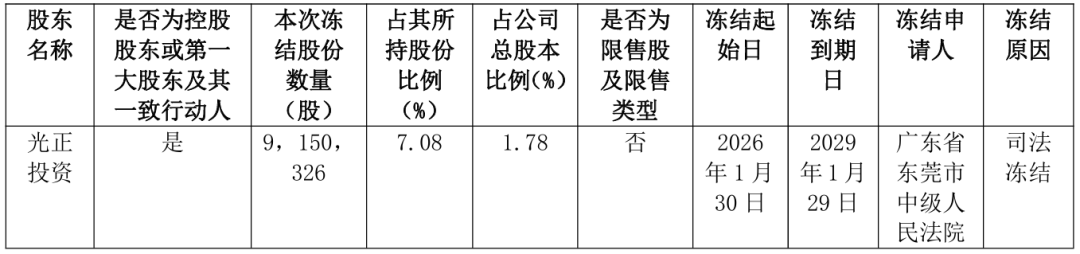
2月6日晚间,光正眼科(002524)发布公告,公司控股股东光正投资915万股被司法冻结,占其所持股份比例为7.08%,占公司总股本比例为1.78%。冻结 起始日为2026年1月30日,冻结到期日为2029年1月29日,冻结申请人为广东省东莞市中级人民法院。 截至公告披露日,光正投资及其一致行动人累计被冻结股份情况与本次冻结情况一致,即累计被冻结股份数量为915.03万股,占其持股总数的7.08%,占 公司总股本的1.78%。 | 股东 | 是否为控股 | 本次冻 | 占其所 | 占公司 | 是否为 | 冻结起 | 冻结 | 冻结申 | 冻结 | | --- | --- | --- | --- | --- | --- | --- | --- | --- | --- | | 名称 | 股东或第一 | 结股份 | 持股份 | 总股本 | 限售股 | 始日 | 到期 | 请人 | 原因 | | | 大股东及其 | 数量 | 比例 | 比例(%) | 及限售 | | H | | | | | 一致行动人 | (股) | (%) | | 类型 | | | | | | 光正 | 是 | 9, 150, | 7.08 | 1 ...


3.92亿元应付账款逾期,金浦钛业连亏四年转型梦碎!
Shen Zhen Shang Bao· 2026-02-07 00:39
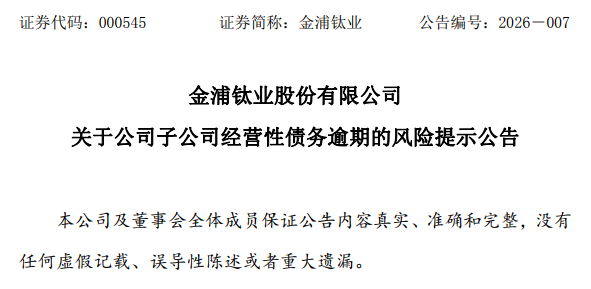
2月6日晚,金浦钛业(000545)发布风险提示公告称,子公司南京钛白化工有限责任公司、徐州钛白化工有限责任公司、安徽金浦新能源科技有限公司累 计到期未付的应付账款总额约为3.92亿元,占2024年度经审计净资产28.08%,占2024年度经审计总资产13.25%。公司暂无金融债务逾期。 为应对子公司经营性债务逾期的情况,公司将持续与债权人进行积极协商,争取尽快与债权人就债务解决方案达成一致意见,同时,公司也将通过加强成 本控制、加快应收账款回收工作等方式全力筹措偿债资金,以尽快解决经营性债务逾期问题。 金浦钛业表示,如公司不能妥善解决逾期债务问题,公司或将面临诉讼、仲裁等风险,以及支付由此产生的相关违约金、滞纳金等情况导致公司财务费用 增加,影响公司正常生产经营。 读创财经记者注意到,在3.92亿元逾期应付账款中,全资子公司徐州钛白化工有限责任公司(以下简称"徐州钛白")是"重灾区"。 1月16日,金浦钛业公告,徐州钛白因与供应商存在合同纠纷,涉及部分房产被轮候查封。涉诉总金额为1285.37万元,被查封房产账面净值1.46亿元,占 公司2024年度经审计净资产的10.45%。 更为严峻的是,金浦钛业同日宣 ...

天士力“两连降”
Shen Zhen Shang Bao· 2026-02-06 15:54
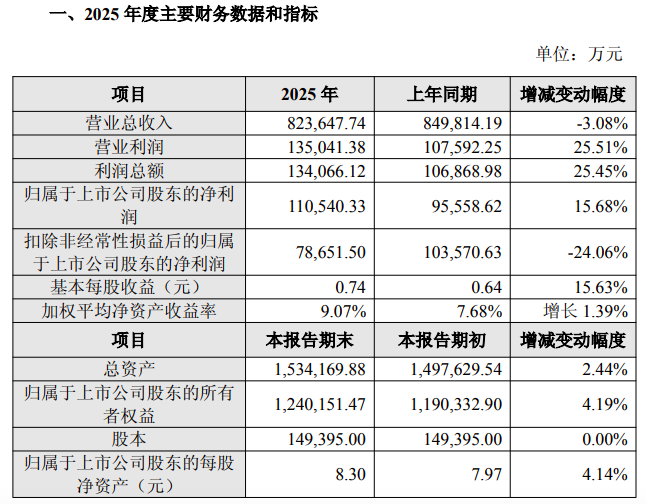
Core Viewpoint - Tianjin Tasly Pharmaceutical Group Co., Ltd. reported a mixed performance for the year 2025, with a decline in total revenue but an increase in net profit, highlighting the impact of industry policies on its business operations [1][3]. Financial Performance Summary - Total revenue for 2025 was 8.236 billion yuan, a decrease of 3.08% compared to the previous year [2]. - Net profit attributable to shareholders was 1.105 billion yuan, an increase of 15.68% year-on-year [2]. - Non-recurring net profit attributable to shareholders was 787 million yuan, down 24.06% year-on-year [2]. - Basic earnings per share increased to 0.74 yuan, up 15.63% from 0.64 yuan [2]. - The weighted average return on equity rose to 9.07%, an increase of 1.39 percentage points [2]. Asset and Equity Summary - Total assets at the end of 2025 were 153.42 billion yuan, a 2.44% increase from the beginning of the year [2]. - Shareholders' equity attributable to the listed company was 124.02 billion yuan, up 4.19% [2]. - The net asset per share attributable to shareholders increased to 8.30 yuan, a rise of 4.14% [2]. Business Segment Insights - The decline in revenue was primarily attributed to a 14.24% decrease in pharmaceutical commercial income, particularly from chain pharmacy operations, due to industry policies such as "outpatient overall planning" [3]. - The pharmaceutical commercial segment reported a significant revenue drop of 16.70% in the first three quarters of 2025 compared to the same period in 2024 [4]. Control Change and Market Performance - In 2025, the control of the company changed significantly, with China Resources Sanjiu directly holding 28% of the shares, marking a shift in the controlling shareholder from Tasly Group to China Resources Limited [5]. - As of February 6, 2025, the company's stock price was 15.09 yuan per share, with a total market capitalization of 22.544 billion yuan [5].

连续两日狂跌,乐摩科技股价较上市“腰斩”
Shen Zhen Shang Bao· 2026-02-06 15:28
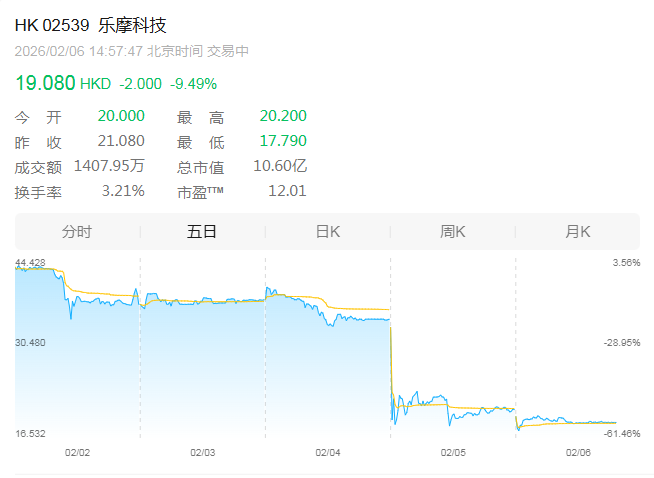
Group 1 - The stock price of LeMo Technology plummeted by 39.77% on February 5, reaching a low of 18 HKD, with a closing price of 21.08 HKD, resulting in a market capitalization of 1.171 billion HKD [1] - LeMo Technology was listed on the Hong Kong Stock Exchange on December 3, 2025, with an initial offering price of 40 HKD per share, raising a net amount of 182 million HKD [1] - The first trading day saw the stock open at 64.8 HKD, a 62% increase from the offering price, and close at 54.5 HKD, a 36.25% increase, giving it a market capitalization of 3.028 billion HKD [1] Group 2 - LeMo Technology is recognized as the "first stock of shared massage chairs," providing intelligent massage services in various consumer locations such as commercial complexes and transportation hubs [3] - Revenue projections for LeMo Technology are 330 million CNY, 587 million CNY, and 800 million CNY for the years 2022, 2023, and 2024 respectively, with gross profits of 85.34 million CNY, 245 million CNY, and 288 million CNY [3] - For the first eight months of 2025, LeMo Technology reported revenue of 631 million CNY, a 13.9% increase from 554 million CNY in the same period last year, with a gross profit of 231 million CNY [3]
移远通信遭飞利浦起诉,索赔4800万欧元!
Shen Zhen Shang Bao· 2026-02-06 13:23
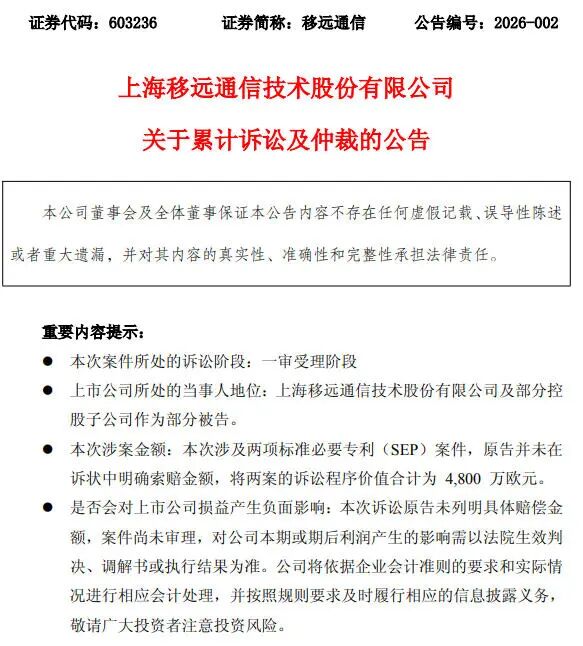
Core Viewpoint - The company, Quectel, is facing a patent infringement lawsuit filed by Koninklijke Philips N.V. in the European Unified Patent Court, which claims that the company and some of its subsidiaries have infringed on two standard essential patents related to cellular IoT modules [1][4]. Group 1: Lawsuit Details - The lawsuit has been officially accepted by the court but has not yet gone to trial [2]. - Philips alleges that the company and its subsidiaries manufactured, sold, promised to sell, imported, and used products implementing the two patents without permission in certain European countries [4]. - Philips is seeking a permanent injunction, product recall and destruction, compensation for damages or profits gained from the infringement, provision of necessary information, and coverage of legal costs, with the total value of the lawsuit estimated at €48 million [4]. Group 2: Company Response and Impact - The company has stated it will actively respond to the lawsuit to protect its and its shareholders' legal rights, asserting that its operations remain normal and are not significantly impacted by the lawsuit [4]. - The specific amount of compensation sought by Philips has not been disclosed, and the potential impact on the company's profits remains uncertain pending the court's decision [4]. Group 3: Financial Performance - For the first three quarters of 2025, the company reported total revenue of ¥17.877 billion, a year-on-year increase of 34.96%, and a net profit attributable to shareholders of ¥733 million, up 105.65% [7]. - The company also reported a net cash flow from operating activities of -¥800 million, compared to ¥307 million in the same period last year [7]. Group 4: Recent Developments - The company completed a private placement plan, raising ¥2.2 billion, with the funds allocated for expansion projects in automotive and 5G modules, AI computing modules, and upgrading its headquarters and R&D center [8]. - As of February 6, the company's stock closed at ¥86.18, with a total market capitalization of ¥24.805 billion [8].

10倍牛股巨亏,中信给出上千元目标价?
Shen Zhen Shang Bao· 2026-02-06 12:02
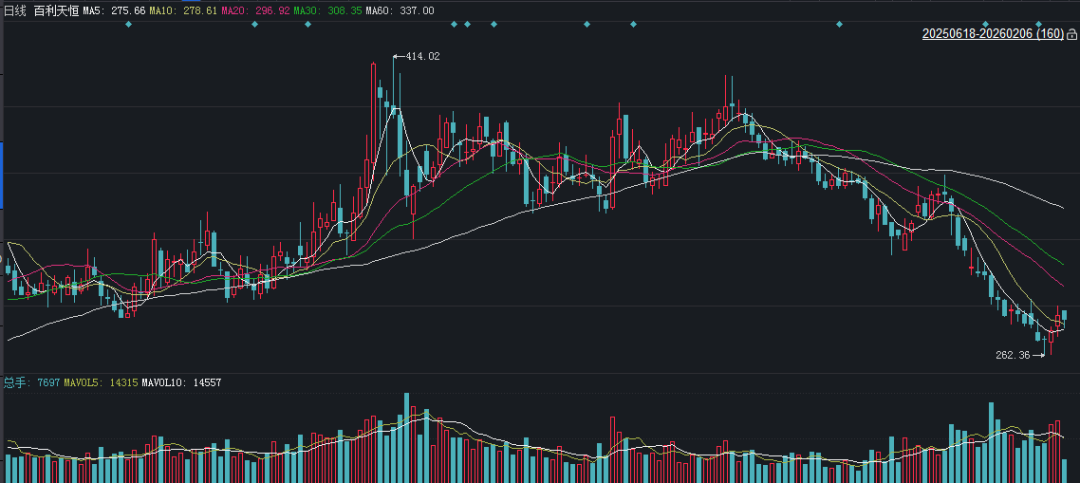
Core Viewpoint - CITIC Securities has issued a "buy" rating for Baile Tianheng, setting a target price of no more than 1322 yuan, predicting a net profit of -760 million yuan for 2025 [1] Group 1: Financial Performance - As of the report's release, Baile Tianheng's A-share price was 282.30 yuan per share, having increased over tenfold since its listing two years ago [1] - The predicted price implies a potential increase of over 468%, with a market capitalization exceeding 546 billion yuan if the target price is reached [1] - However, four days later, Baile Tianheng announced an earnings forecast indicating a net profit of approximately -1.1 billion yuan for 2025, a year-on-year decline of about 129.67%, significantly worse than CITIC Securities' forecast [3] - The expected revenue for 2025 is around 2.5 billion yuan, reflecting a year-on-year decrease of approximately 57.06% [3] - Historical performance shows Baile Tianheng's net profit fluctuating dramatically, with figures of -100 million yuan, -282 million yuan, -781 million yuan, and 3.708 billion yuan from 2021 to 2024 [5] Group 2: Research and Development - Baile Tianheng has increased its R&D investment to accelerate product pipeline development, which has led to a significant rise in R&D expenses [3] - The company has 17 innovative drugs in clinical trials, with 6 in global trials, and is conducting over 100 clinical trials worldwide [7] - The core product Iza-bren has received priority review status from the National Medical Products Administration (NMPA) for new indications, which is a key reason for CITIC Securities' positive outlook [4] Group 3: Strategic Partnerships - Baile Tianheng's collaboration with Bristol-Myers Squibb (BMS) on Iza-bren is progressing well, achieving a milestone in the global II/III phase key registration clinical trial, resulting in a milestone payment of 250 million USD [3] - The previous year, the company received an irrevocable and non-deductible upfront payment of 800 million USD from BMS, which contributed to higher income recognition in the prior period compared to the current period [3]
国投瑞银突发公告!回应“白银基金”估值调整
Shen Zhen Shang Bao· 2026-02-06 11:27
Group 1 - The company, Guotou Ruijin, has announced its commitment to address investor concerns following significant losses due to a sharp decline in net asset value [1] - A working group has been established to develop plans for facilitating resolutions for investors through mediation, arbitration, and other legal channels [1] - The company emphasizes its ability to protect investors' legal rights and will ensure fair pricing in fund operations and valuations [1] Group 2 - On February 6, Guotou Ruijin's silver LOF fund experienced its fifth consecutive trading halt, closing at 3.099 yuan, reflecting a weekly decline of 41% [1] - The fund's net asset value dropped by 31.5% on February 2, triggered by adjustments based on international silver price fluctuations [1] - The fund had a premium rate of 28.73% as of February 5, prior to the valuation adjustment announcement [1]

刚刚,深圳上市公司达600家!
Shen Zhen Shang Bao· 2026-02-06 01:42
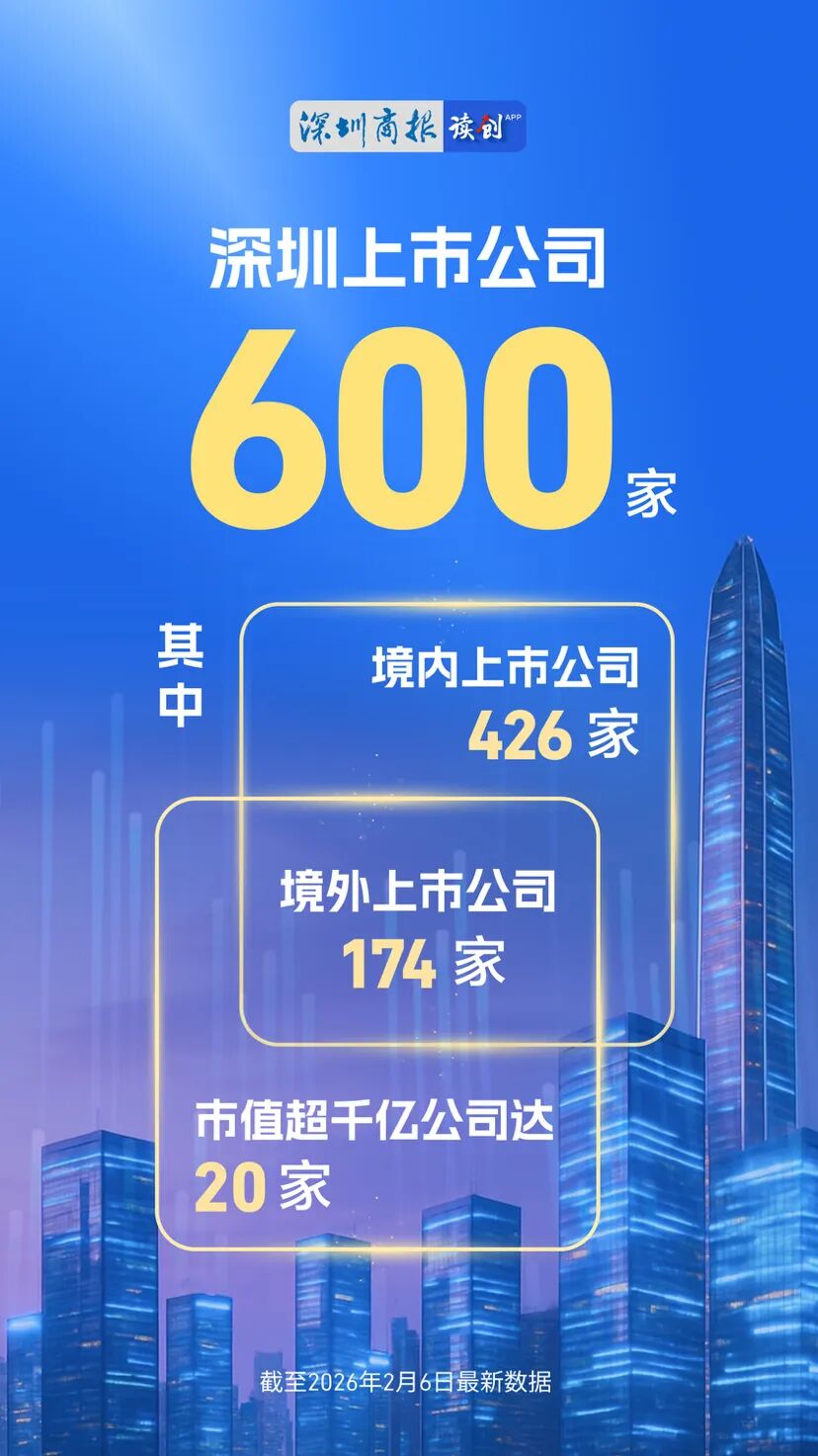
2月6日上午,随着卓正医疗,大族数控(301200)在港股敲钟上市,宣告深圳迎来了里程碑时刻:全市上市公司总量突破600家大关,其中,境内上市公 司426家,境外上市公司174家。 这不仅是一个数字的跨越,更是一座城市实体经济活力、创新动能与金融生态深度融合的生动映照,同时也是深圳在全球产业链中地位提升、新质生产力 加速形成、以及"科技-产业-金融"高效循环生态日臻成熟的集中体现。 600家上市公司,构成了一座城市经济无比生动的"基本盘"和"晴雨表"。截至2025年1月末,深圳上市公司总市值超19万亿元,稳居全国大中城市第二位。 600家上市公司的构成,清晰地映照出深圳经济结构的韧性与高度。境内上市公司在"十四五"期间增长超35%,龙头企业的牵引力与辐射力日益增强。 更为引人注目的是"新面孔"所蕴含的产业风向标意义。其中,北芯生命作为科创板医疗器械第五套上市标准重启后的"首例",大普微以未盈利之身闯关创 业板成功,惠科股份率先试水深市主板第二套上市标准……这些"首单""首家"不仅是企业的荣光,更是深圳积极拥抱资本市场改革、精准对接前沿科技创 新脉搏的缩影。从市值突破千亿的"智能影像第一股"的影石创新,到重新定 ...

围剿“仅退款”,电商告别草莽时代
Shen Zhen Shang Bao· 2026-02-05 23:01
Core Viewpoint - The recent implementation of the "Network Transaction Platform Rules Supervision Management Measures" marks a significant shift in the e-commerce landscape, aiming to combat the malicious "only refund" practices that have plagued the industry, thus signaling the end of a chaotic era in e-commerce [1][8]. Group 1: Background and Evolution of "Only Refund" Mechanism - The "only refund" mechanism was introduced in 2021 to address the high logistics costs associated with returning perishable goods, allowing consumers to receive refunds without returning items, which initially reduced costs for both consumers and merchants [2][3]. - As the e-commerce industry shifted towards a focus on user retention, platforms began to excessively promote the "only refund" policy across all categories, leading to widespread misuse and a competitive race to offer the most lenient return policies [2][3]. Group 2: Impact on Merchants - Merchants have faced significant challenges due to the lack of oversight in the "only refund" process, with some consumers exploiting the system to obtain refunds without returning products, leading to substantial financial losses for businesses [3][4]. - The misuse of the "only refund" policy has created a detrimental ecosystem where dishonest consumers profit at the expense of honest merchants, forcing the latter to either cut costs or raise prices to compensate for losses [4][6]. Group 3: Regulatory Response and Platform Adjustments - In response to the escalating issues, major e-commerce platforms began to refine their "only refund" policies in late 2024, with initiatives aimed at enhancing merchant autonomy and reducing the incidence of malicious refund requests [6][8]. - The introduction of the "Network Transaction Platform Rules Supervision Management Measures" on February 1, 2026, explicitly prohibits platforms from forcing merchants to accept "only refund" requests, marking a pivotal regulatory intervention [8]. Group 4: Future Outlook - The ongoing regulatory efforts and platform reforms are expected to restore balance in the e-commerce ecosystem, fostering a healthier environment for both consumers and merchants, as evidenced by improved merchant sentiments regarding platform policies [8]. - The application of AI technology to detect fraudulent refund claims is also being implemented, further supporting merchants in combating abuse of the refund system [7][8].

“太空游”启航,首航票价300万元
Shen Zhen Shang Bao· 2026-02-05 23:01
Core Viewpoint - The commercial space tourism market is rapidly developing, with companies like Beijing Chuan Yue Zhe and others planning to launch suborbital flights by 2028, targeting high-net-worth individuals with ticket prices around 3 million yuan [1][5]. Group 1: Company Developments - Beijing Chuan Yue Zhe has unveiled its commercial manned spacecraft "Chuan Yue Zhe No. 1" and announced its first batch of 11 space tourists, including notable figures [1]. - The company has pre-sold nearly 20 tickets for its planned suborbital flights, which are set to begin in 2028 [1]. - Other domestic companies such as Ziwei Technology and Zhongke Aerospace are also focusing on the suborbital travel market, aiming for the same 2028 target [3]. Group 2: Market Structure - The global space tourism market has established three main product forms: suborbital tourism, orbital tourism, and deep space tourism, each with distinct technical requirements and pricing [2]. - Suborbital tourism is currently the most commercially viable option, allowing passengers to experience a few minutes of weightlessness without entering orbit [2]. - Orbital tourism, which involves longer stays in space, is currently only offered by SpaceX, with ticket prices reaching approximately 55 million yuan [3]. Group 3: Competitive Landscape - Chinese commercial space companies are engaged in a comprehensive competition involving technology, capital, and supply chains, with 2028 as a critical milestone [4]. - Different technological approaches are being pursued, with Zhongke Aerospace focusing on integrated rocket and spacecraft systems, while Chuan Yue Zhe is adopting a model that separates spacecraft and rocket functions [4]. - Companies are also exploring various commercialization strategies, such as ticket pre-sales and technology reuse to lower costs [5]. Group 4: Consumer Considerations - Space tourism remains a high-end consumer product, with significant physiological and economic barriers for the average person [6]. - The physical requirements for suborbital flights are less stringent than for professional astronauts, but participants still need to undergo training [6]. - The current pricing structure is primarily aimed at wealthy individuals, but advancements in technology may eventually lead to lower costs and broader accessibility [6].
