
Zhong Guo Hua Gong Bao

Search documents
印欧自贸协定面临绿色壁垒
Zhong Guo Hua Gong Bao· 2026-02-03 03:15
Core Insights - The India-EU Free Trade Agreement (FTA), described as the largest in history, aims to reshape trade relations and has significant implications for the global energy and chemical industries [1][2] - The agreement covers 2 billion people and accounts for 25% of the global economy, addressing US tariff threats while creating new opportunities through tariff adjustments and market access rules [1] Group 1: Tariff Adjustments - India will gradually eliminate or reduce tariffs on 22% of EU chemical products, enhancing the competitiveness of EU high-end chemical materials in the Indian market [1] - The reduction in tariffs is expected to meet the demand for high-end chemical materials in India's manufacturing sector and accelerate technological innovation among local chemical companies [1] Group 2: Market Opportunities - The EU will progressively eliminate or reduce tariffs on 99.5% of Indian goods over seven years, providing a pathway for Indian traditional chemical products to enter the EU market [2] - India's capacity advantages in basic chemical raw materials and pesticide intermediates will allow its products to gain price advantages in the EU, leading to significant growth in exports and boosting domestic industry capacity and employment [2] Group 3: Green Trade Barriers - The EU's Carbon Border Adjustment Mechanism (CBAM), effective from January 1, imposes carbon costs on high-emission products, impacting India's energy and chemical sectors [2] - Indian fertilizer and chemical industries, heavily reliant on fossil fuels, face additional costs of approximately $290 per ton for exports to the EU, which may weaken their competitiveness [2] - The existence of carbon border taxes compels Indian energy and chemical companies to invest more in green technology and pursue energy-saving and clean energy alternatives [2] Group 4: Overall Implications - The implementation of the India-EU FTA presents new development opportunities for the global energy and chemical industries while raising the bar for green development standards [2]
钠电池商业化应用迎关键节点
Zhong Guo Hua Gong Bao· 2026-02-03 03:13
Core Insights - The sodium battery industry has seen significant breakthroughs since 2026, with leading companies actively launching new products and expanding production capabilities [1][2]. Group 1: Company Developments - CATL launched its first mass-produced sodium battery for light commercial vehicles, which retains over 92% usable capacity at -20°C and supports plug-and-charge even at -30°C [1]. - Zhongna Energy has officially started production at the world's largest sodium iron sulfate cathode material base in Meishan, Sichuan, marking a shift from kiloton to megaton scale production [1]. - Zhongwei New Materials announced it secured a kiloton-level order for sodium batteries, with expected significant shipment increases in 2026 due to rising lithium carbonate prices [1]. - Tianna Technology plans to establish a sodium battery anode material production base with an annual output of 10,000 tons, projected to generate approximately 400 million yuan in annual revenue [1]. Group 2: Market Trends and Projections - Sodium batteries are expected to penetrate various applications, including energy storage, two-wheeled vehicles, and start-stop power sources, potentially replacing or supplementing lead-acid and some lithium batteries [2][3]. - The average price of sodium battery cells is projected to decrease from 0.52 yuan/Wh in 2025 to 0.25 yuan/Wh by 2030, with the global energy storage sodium battery market expected to reach 580 GWh by 2030 [2]. - The sodium battery market for low-speed electric vehicles is anticipated to reach a scale of 100 billion yuan, driven by cost sensitivity in these segments [3]. Group 3: Performance and Advantages - Sodium batteries exhibit excellent low-temperature performance, safety, and cost potential, making them ideal for extreme cold environments and various applications [2][3]. - In the energy storage market, sodium batteries are expected to exceed 50 GWh in shipments by 2030, providing a complementary alternative to lithium-ion batteries [3]. - In the start-stop market, sodium batteries are projected to achieve a 30% penetration rate by 2030, with an expected shipment volume of 20 GWh [4].

小镜头守护大平安
Zhong Guo Hua Gong Bao· 2026-02-03 03:12
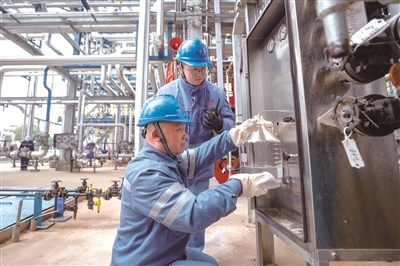
"这个机器有异响,得立刻处理!"近日,宝石机械热工分公司铸钢车间造型班班长杜晓辉巡检时,用手 机拍下隐患上传至"隐患随手拍"平台,2小时内便完成闭环整改,成功规避了生产风险。这一案例正是 宝石机械以"随手拍"安全管理活动为抓手,叠加科技赋能强化安全管理的生动写照。 不止于全员参与,智慧监控也让安全监管再无死角。公司升级生产监控系统为"全天候安全哨兵",以直 观警示推动现场违章行为大幅减少,从源头降低事故率。 AI技术的应用更是实现了监管模式革新。试点建成的AI安全监管平台可自动识别危险并预警,目前已 在西安宝美和宝石特车公司推广,实现从"人治"到"技治"的跨越。 从"随手拍"用一个个镜头筑牢员工安全生产防线,到智慧监控与AI赋能的精准管控,宝石机械多维度筑 牢安全防护网,员工安全意识与隐患识别能力显著提升,为企业高质量发展保驾护航。 为激活全员安全动能,宝石机械推行隐患排查激励机制,依托"隐患随手拍"平台形成"发现—上报—整 改—验证"全链条闭环管理。如今,在宝石机械各生产车间,员工主动拿起手机排查隐患已成常态。从 车间角落的器材摆放不当,到设备运行中的细微异常,再到违章行为,都被一一记录、整改。 "随手拍" ...
太化新材料余热发电二期项目并网发电
Zhong Guo Hua Gong Bao· 2026-02-03 03:08
Core Viewpoint - The project by Lu'an Chemical's Taiyuan Chemical New Materials Company has successfully achieved grid-connected power generation, with an average output of 4000 kWh per hour, enhancing energy efficiency and utilization in the industrial park [1] Group 1: Project Details - The second phase of the waste heat power generation project has passed assessment and is now operational [1] - The project utilizes high-temperature and high-pressure steam at 8.83 MPa and 535°C, generated by a 10 MW back-pressure steam turbine generator set [1] - The generated electricity is directly integrated into the 10 kV substation of the boiler, prioritizing supply for the park's boilers and auxiliary production equipment [1] Group 2: Energy Efficiency - The project features a scientific design of "stepwise progression and closed-loop circulation" throughout the energy utilization process [1] - This design addresses the inefficiencies of traditional steam utilization, converting previously idle thermal resources into stable electricity output [1] - The project significantly enhances the overall energy utilization efficiency within the industrial park [1]
科技创新提质效 竞逐国际新赛道
Zhong Guo Hua Gong Bao· 2026-02-03 03:08
Core Viewpoint - The fluorochemical industry is undergoing significant transformation due to the global phase-out of hydrofluorocarbons (HFCs) and increasing regulations on perfluoroalkyl and polyfluoroalkyl substances (PFAS), presenting both challenges and opportunities for companies like Quanzhou Yujie [1] Group 1: Development Strategy - Quanzhou Yujie has outlined a three-year development plan focusing on innovation-driven growth, foundational industrial strength, market-led direction, and management capability as key components of its strategy [1] - The company aims to accelerate technological innovation to enhance productivity and advance high-end fluorinated materials to the forefront of international competition [1] Group 2: Technological Innovation - By 2025, Quanzhou Yujie plans to increase R&D investment to tackle key technologies in high-end fluorinated materials, achieving breakthroughs such as 99.999% purity in hexafluorobutylene for semiconductor applications [2] - The company’s environmentally friendly electrical insulation gas, perfluoroisobutylene, has been selected for a provincial technology project and is being used in China's first 500 kV environmentally friendly gas-insulated power plant [2] Group 3: Market Integration - Quanzhou Yujie is shifting its competitive strategy from a single product focus to a comprehensive system of "technology + quality + service" by 2025, successfully entering the global high-end semiconductor supply chain [3] - The company plans to actively engage in both domestic and international markets, enhancing product structure and application solutions while participating in industry exhibitions and collaborations [3] Group 4: Green Development - The company emphasizes green development throughout its R&D, production, and application processes, aiming to promote the large-scale application of environmentally friendly products by 2026 [4] - Quanzhou Yujie will focus on building smart green factories to optimize production, storage, and logistics, improving energy efficiency and clean production levels [4] Group 5: Organizational Strength - To support its strategic goals, Quanzhou Yujie will enhance its organizational structure and talent management, focusing on attracting, nurturing, retaining, and utilizing high-end talent [5] - The company will implement a three-year plan with annual themes to improve management capabilities, lean management, and risk control, ensuring a robust governance framework for sustainable development [5]
以“特”塑优势 以“强”固根基 | 大家谈 如何破除“内卷式”竞争
Zhong Guo Hua Gong Bao· 2026-02-03 03:01
Core Insights - The refining industry is facing intensified homogenization competition, leading to profit shrinkage and many companies hovering near losses. To break this "involution" dilemma, companies must create unique advantages and strengthen their foundations to enhance core profitability and achieve high-quality development [1] Group 1: Differentiation Strategy - The core of differentiation is to identify unique market segments and develop irreplaceable specialty advantages. Jingmen Petrochemical has actively planned to transform towards high-end petrochemical products and specialty oils, developing over 60 types of specialty oils, including white oil and transformer oil, with a domestic market share of 50% for high-grade white oil [1] - The company is set to complete a 600,000 tons/year naphthenic specialty oil hydrogenation unit, which will increase its annual production capacity of specialty oils to 1.36 million tons, further enhancing market competitiveness [1] Group 2: Strengthening Core Competitiveness - Strengthening core competitiveness involves comprehensive improvements in innovation, green practices, safety, and intelligence. Innovation is the primary driver, requiring companies to enhance their R&D capabilities and achieve breakthroughs in high-end product preparation and green production processes [2] - By 2025, Jingmen Petrochemical's R&D team aims to optimize process parameters and successfully develop new products like naphthenic industrial white oil, while also pushing annual aviation fuel sales to exceed 600,000 tons, marking a historical high since inception [2] Group 3: Green and Intelligent Development - Green and low-carbon initiatives are essential, with a focus on developing low-VOCs products, promoting energy-saving and carbon-reduction transformations, and enhancing solid waste resource utilization to convert green development into cost and brand advantages [3] - Safety and intelligence are critical for strengthening operations. The company has implemented essential safety requirements and enhanced management practices, while also accelerating digital transformation through smart control systems and digital twin technologies to improve production efficiency and management precision [3] - By the end of 2025, a new material management app will integrate with the enterprise resource planning (ERP) system, utilizing IoT and big data technologies to enhance data collection and operational decision-making efficiency [3]
中韩石化百万吨级航煤装置投产
Zhong Guo Hua Gong Bao· 2026-02-03 03:01
Core Viewpoint - The successful commissioning of the 1.2 million tons per year liquid-phase aviation kerosene hydrogenation unit by Sino-Korean Petrochemical marks a significant advancement in domestic aviation fuel production technology and capacity [1] Group 1: Project Details - The hydrogenation unit is located in Wuhan and was built using a renovation model that achieves zero land expansion [1] - The technology used is the upward continuous liquid-phase bed hydrogenation technology, independently developed by Sinopec Research Institute, with 100% localization of core equipment and control systems [1] - This project represents the first application of this technology in a million-ton-level aviation kerosene unit in China [1] Group 2: Production Capacity and Environmental Impact - Following the commissioning of this unit, Sino-Korean Petrochemical's total aviation kerosene production capacity has increased to 1.6 million tons per year [1] - The unit has achieved a 50% reduction in energy consumption and is expected to reduce carbon dioxide emissions by 55,000 tons annually [1] - The projected annual output value of the unit is expected to exceed 8 billion yuan [1]

小镜头守护大平安
Zhong Guo Hua Gong Bao· 2026-02-03 03:01
"随手拍"让安全管理从"专人巡查"转向"全员监督",从"被动整改"变为"主动防范",2025年累计2463名 员工参与其中,公司发放奖金46950元、奖励875人次,营造出全员参与安全管理的氛围。 不止于全员参与,智慧监控也让安全监管再无死角。公司升级生产监控系统为"全天候安全哨兵",以直 观警示推动现场违章行为大幅减少,从源头降低事故率。 AI技术的应用更是实现了监管模式革新。试点建成的AI安全监管平台可自动识别危险并预警,目前已 在西安宝美和宝石特车公司推广,实现从"人治"到"技治"的跨越。 从"随手拍"用一个个镜头筑牢员工安全生产防线,到智慧监控与AI赋能的精准管控,宝石机械多维度筑 牢安全防护网,员工安全意识与隐患识别能力显著提升,为企业高质量发展保驾护航。 "这个机器有异响,得立刻处理!"近日,宝石机械热工分公司铸钢车间造型班班长杜晓辉巡检时,用手 机拍下隐患上传至"隐患随手拍"平台,2小时内便完成闭环整改,成功规避了生产风险。这一案例正是 宝石机械以"随手拍"安全管理活动为抓手,叠加科技赋能强化安全管理的生动写照。 为激活全员安全动能,宝石机械推行隐患排查激励机制,依托"隐患随手拍"平台形成"发现 ...
中石化经纬最深测井纪录刷新
Zhong Guo Hua Gong Bao· 2026-02-03 03:00
Core Viewpoint - The company successfully completed a cable measurement task at a depth of 10,700 meters in the Tarim Basin, setting a new record for the deepest well logging in the external market of Sinopec [1] Group 1: Project Details - The Xinjiang project team of the company achieved the logging task at the Xinyuan 22 well, which is located in the western low uplift of the Manjar depression in the Tarim Basin [1] - The designed depth of the well is 10,700 meters, with the measured section being from 9,956 to 10,700 meters [1] - The bottom temperature and pressure of the well exceeded conventional limits, presenting significant challenges for the logging instruments and operational precision [1] Group 2: Technical Challenges and Solutions - To address the construction challenges, the company quickly established a "Deep Well Logging Construction Special Team" led by experts [1] - The team conducted comprehensive research on well conditions and drilling information, optimizing the logging construction plan and performing extensive testing on the hoisting system and logging cable [1] - The GILEE-92 instrument, capable of withstanding temperatures of 230°C and pressures of 200 MPa, underwent repeated adjustments to ensure it met the requirements for deep well construction [1] Group 3: Operational Execution - During the construction process, the team employed a "dual-person monitoring" mode to precisely control the instrument's descent and logging operations [1] - The team quickly addressed an abnormal downhole tension issue with a 35-minute adjustment, successfully mitigating construction risks [1] - Ultimately, the team completed the deployment, logging, and recovery of a 32.23-meter-long logging instrument, fulfilling all tasks for the Xinyuan 22 well [1]
1月制造业景气水平有所回落
Zhong Guo Hua Gong Bao· 2026-02-03 02:55
Core Viewpoint - In January, China's manufacturing Purchasing Managers' Index (PMI) decreased to 49.3%, reflecting a decline in manufacturing activity and indicating a contraction in the sector [1] Group 1: Manufacturing Activity - The manufacturing sector is experiencing a seasonal downturn, with some industries entering a traditional off-peak period and insufficient market demand contributing to the decline in PMI [1] - Production continues to expand in certain sectors, but industries such as petroleum, coal, and automotive are showing reduced market demand, leading to a decrease in production [1] Group 2: Price Indices - The price indices for major raw materials and factory output have both increased, with the purchasing price index at 56.1% and the factory price index at 50.6%, marking rises of 3 percentage points and 1.7 percentage points respectively from the previous month [1] Group 3: Enterprise Size and Performance - Large enterprises maintain a PMI above the critical point at 50.3%, indicating ongoing support for the manufacturing sector [1] - High-tech manufacturing continues to lead with a PMI of 52.0%, suggesting a positive development trend in related industries [1] Group 4: Business Expectations - Enterprises remain optimistic about future production and operational activities, with the production and business activity expectation index at 52.6%, continuing to exceed the critical point [1]