Zhong Guo Hua Gong Bao

Search documents
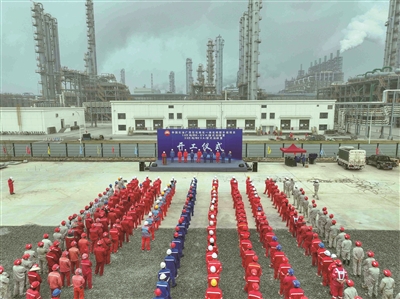
广西石化炼化一体化项目EVA装置开建
Zhong Guo Hua Gong Bao· 2026-01-21 02:43
Core Viewpoint - China Petroleum Guangxi Petrochemical Company has officially commenced the construction of a 300,000 tons/year EVA plant (tubular method) and a 100,000 tons/year H-EVA plant (kettle method), targeting high-end market demands and applications in various industries [1]. Group 1 - The 300,000 tons/year tubular method plant focuses on large-scale production of photovoltaic-grade EVA, with a planned completion date of December 2027 [1]. - The 100,000 tons/year kettle method plant specializes in high-end specialty H-EVA products, expected to be completed by the end of February 2028 [1]. - The products from both plants will serve multiple sectors, including photovoltaic film, high-end cables, foamed products, and medical devices [1]. Group 2 - The photovoltaic-grade EVA products will effectively fill the domestic supply gap for high-grade EVA used in photovoltaic films [1]. - The high-end cable EVA is designed to meet the needs of new energy vehicles and smart grid applications [1]. - The foamed products will replace traditional materials in high-end packaging and automotive interiors [1].

首个海上膜脱碳工程回收伴生气超2000万方
Zhong Guo Hua Gong Bao· 2026-01-21 02:43
Core Viewpoint - China National Offshore Oil Corporation (CNOOC) has successfully implemented the country's first offshore membrane decarbonization demonstration project, achieving the recovery of over 20 million cubic meters of associated gas and efficient decarbonization, recovery, and resource utilization [1] Group 1: Project Overview - The Huizhou 32-5 platform is one of the high-yield oil platforms in the eastern South China Sea oil field, serving as a pilot for advancing green and low-carbon transformation [1] - The project has innovatively established a technical system for efficient carbon dioxide capture, reinjection, and storage [1] Group 2: Technical Process - The project process includes three main stages: raw gas pretreatment, membrane separation decarbonization, and post-membrane treatment and recovery [1] - The membrane separation decarbonization stage utilizes a self-developed membrane decarbonization device by CNOOC, which occupies less space and consumes less energy, making it highly suitable for offshore platform environments [1] Group 3: Innovation and Impact - In the post-membrane treatment and recovery phase, the project innovatively employs the same well injection and production technology, allowing for the compression and safe reinjection of carbon dioxide without affecting oil extraction [1] - This approach addresses the challenge of resource constraints in offshore platform well slots and provides a replicable and scalable new pathway for carbon storage in offshore oil fields [1]

一批石化项目入围多省重点工程项目清单
Zhong Guo Hua Gong Bao· 2026-01-21 02:43
Group 1 - Major project construction is seen as a "ballast" and "strong engine" for accelerating high-quality development, with various provinces releasing key project lists for 2026, particularly in the oil and chemical sectors [1] - Sichuan Province has announced a total of 830 key projects for 2026, with an expected investment of 762.48 billion yuan, including several significant oil and chemical projects [1] - Jiangsu Province's key project list includes 670 projects, with a focus on strategic emerging industries, advanced manufacturing, and several petrochemical projects [2] Group 2 - Hebei Province plans to arrange 747 key construction projects for 2026, with a total investment of 1.56 trillion yuan, focusing on strategic emerging industries and traditional industry upgrades [2] - Shanxi Province has included 629 projects in its 2026 key project list, with 63.4% focused on energy transition and industrial upgrades, highlighting the importance of these sectors [3] - The energy transition projects in Shanxi involve hydrogen energy, new materials, and green electricity, along with various petrochemical projects aimed at enhancing sustainability [3]



辽宁石化职院宣讲四中全会精神
Zhong Guo Hua Gong Bao· 2026-01-21 02:43
Core Viewpoint - The report emphasizes the importance of studying and implementing the spirit of the 20th Central Committee of the Communist Party of China as a significant political task for the current and future periods [1][2] Group 1 - The institution aims to align its educational direction with the socialist values and the important speeches of Xi Jinping, particularly regarding vocational education [1] - There is a focus on integrating education, technology, and talent development to meet national strategic layouts and innovation needs [1] - The school plans to scientifically outline its development positioning and implementation path for the "14th Five-Year Plan" period [1] Group 2 - The institution recognizes the new opportunities and challenges faced by high-level educational units at the national and provincial levels in achieving high-quality vocational education [2] - There is a commitment to deepen the collaborative innovation mechanism among government, industry, and educational institutions [2] - The institution aims to enhance the quality of talent cultivation and improve its ability to serve local development through various key projects [2]
包头稀土高新区国家级零碳园区启建
Zhong Guo Hua Gong Bao· 2026-01-21 02:43
Core Viewpoint - The Baotou Rare Earth High-tech Zone has initiated the construction of China's first batch of zero-carbon parks, aiming to systematically address carbon reduction challenges in heavy industrial clusters and provide a replicable "Baotou solution" [1] Group 1: Project Overview - The zero-carbon park construction adopts a "park within a park" model, including rare earth industry parks and high-end equipment manufacturing parks, with established leading industries in rare earths, photovoltaics, and energy storage [1] - The park has a clear "two-step" strategic path: from 2025 to 2027, the focus will be on green electricity replacement and energy-saving renovations; from 2028 to 2035, the emphasis will shift to system integration and smart fusion to enhance zero-carbon outcomes [1] Group 2: Goals and Initiatives - The park aims to complete the national-level zero-carbon park creation task by the end of 2027 through initiatives such as green electricity direct connection construction, new energy project development, hydrogen energy demonstration utilization, and multi-industry collaborative energy-saving and carbon reduction efforts [1]
华鲁恒升:锻长补短 固基强优
Zhong Guo Hua Gong Bao· 2026-01-21 02:43
Core Viewpoint - The "Work Plan for Steady Growth in the Petrochemical Industry (2025-2026)" emphasizes the integration of qualitative improvement and reasonable quantitative growth to achieve high-quality development, enhancing the resilience and safety of the industrial supply chain in response to external uncertainties [1] Group 1: Investment Strategy - The plan advocates for expanding effective investment and promoting transformation and upgrading, aligning with the company's strong main business and high-end development strategy [2] - The company aims to integrate technological and industrial innovation, focusing on cost reduction through technology, product high-end development, and collaborative industrial chain growth [2] - The four major sectors will focus on "specialized, refined, unique, and new" advancements, with specific strategies for each sector to enhance competitiveness and operational scale [2] Group 2: Market Coordination - The plan encourages expanding market demand and stimulating market potential, which aligns with the company's cost leadership and lean operation strategy [3] - The company will optimize its market structure and deepen market collaboration to increase revenue and profitability while enhancing operational capabilities [3] - Emphasis will be placed on flexible adjustments based on market changes and maintaining effective communication with industry peers to avoid excessive competition [3] Group 3: Digital and Green Transformation - The plan calls for accelerating digital and green transformation, which aligns with the company's vision of innovation, safety, and sustainable development [4] - The company will enhance safety production and environmental protection through advanced monitoring and control systems, ensuring stable operation of key equipment [4] - Focus will be on digital applications using new technologies like 5G and AI to improve operational efficiency and resource utilization while adhering to energy efficiency and environmental standards [4]

六国化工通过DCMM二级贯标认证
Zhong Guo Hua Gong Bao· 2026-01-21 02:37
贯标过程中,该公司围绕数据全生命周期开展了系列专项建设:通过建立数据权责体系与标准规范,落 实"谁产生、谁负责、谁使用、谁监督"原则;构建覆盖采集、存储到应用的全流程数据质量校验机制, 保障数据准确性与完整性;完善分级分类的数据安全防护体系,实现数据资产可控可管;同时,积极推 进数据与业务融合,为产品创新、运营优化与决策支持提供支撑。 中化新网讯 近日,湖北六国化工公司通过国家数据管理能力成熟度(DCMM)二级贯标认证。 ...

福建石化业探讨“十五五”发展路径
Zhong Guo Hua Gong Bao· 2026-01-21 02:36
Group 1 - The core viewpoint of the articles emphasizes the importance of the "14th Five-Year Plan" for the petrochemical industry in Fujian Province, focusing on high-quality development, green transformation, and technological innovation [1][2] - The Fujian petrochemical industry aims to align with national top-level design while prioritizing green and low-carbon directions, technological innovation, and high-value sectors such as new chemical materials [1] - Key industry representatives discussed strategies for the next five years, including a shift from broad expansion to deep-rooted development and from scale leadership to value leadership [2] Group 2 - The Fujian Energy and Chemical Group's overall planning for the "14th Five-Year Plan" includes maintaining strategic focus, cautious strategic expansion, and prioritizing high-end downstream industries [2] - The discussions highlighted the need for optimizing the industrial chain to enhance competitiveness and actively exploring green development pathways to promote low-carbon growth [2]
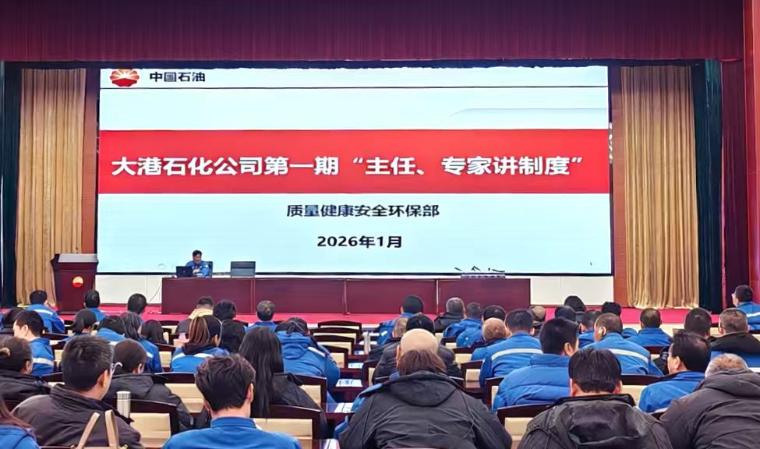
深化改革筑根基 精雕细琢强队伍——中国石油大港石化打造过硬职工队伍支撑高质量发展
Zhong Guo Hua Gong Bao· 2026-01-20 13:43
Core Viewpoint - Daqing Petrochemical Company is focusing on high-quality development through organizational reform, human resource optimization, and innovative compensation mechanisms to drive transformation and growth [1][5]. Group 1: Organizational Structure - The company is implementing a "lean and efficient" organizational structure by optimizing its framework, which includes the abolition of one secondary institution and the adjustment of another's affiliation, promoting a flatter management hierarchy [3]. - The restructuring also involves repositioning functions across various departments, including technology planning and production operations, to enhance efficiency and collaboration [3]. Group 2: Cadre Team Development - Daqing Petrochemical is enhancing its cadre team by optimizing leadership structures, with 16 leadership teams adjusted and 30 personnel changes made throughout the year, while 24.6% of middle management are now under 42 years old [3]. - A comprehensive training system combining theory and practice has been established, with 80 middle management and 87 key personnel participating in training, alongside a multi-dimensional evaluation of over 740 employees [3][4]. Group 3: Human Resource Management - The company emphasizes precise human resource allocation, with regular assessments for operational staff and the introduction of a "cross-position" training system that has led to skill improvements for 651 operational personnel [4]. - A new training mechanism has been introduced, involving 206 part-time trainers and the implementation of a points-based incentive system for employees, promoting continuous learning and skill enhancement [4]. Group 4: Compensation and Incentives - Daqing Petrochemical is optimizing its compensation structure to enhance basic salary security and increase rewards for high performers, including new awards for technological innovation and efficiency improvements [4]. - The company aims to create a clear incentive for high performers, thereby boosting motivation among employees and encouraging a proactive work environment [4]. Group 5: Future Outlook - The company plans to continue deepening human resource reforms with better mechanisms and practical measures to build a strong workforce, contributing to its goal of becoming a world-class enterprise [5].

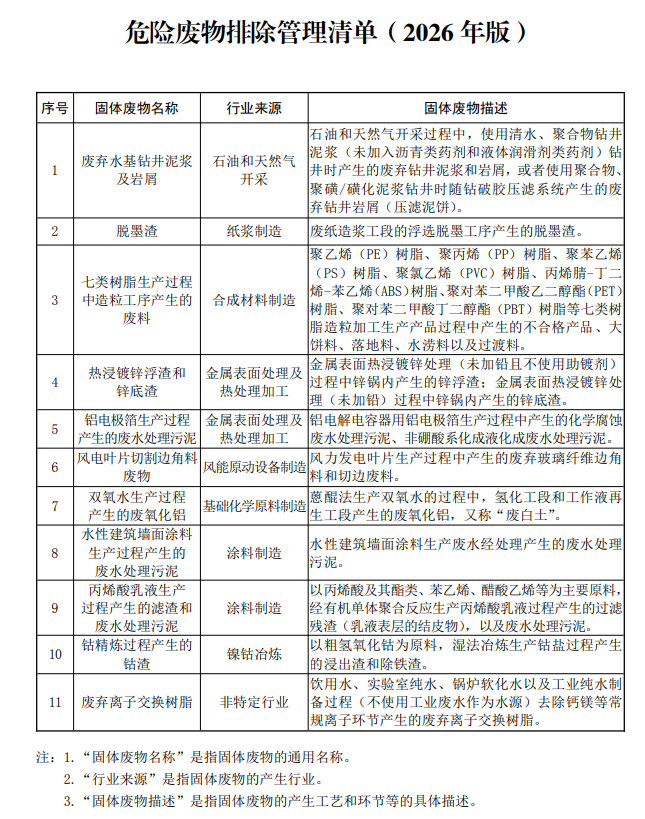
生态环境部明确:11类固废不属于危险废物(附清单)
Zhong Guo Hua Gong Bao· 2026-01-20 09:31
Core Viewpoint - The Ministry of Ecology and Environment has released the "Hazardous Waste Exclusion Management List (2026 Edition)", which clarifies that the solid waste listed does not fall under hazardous waste classification. The new list will take effect immediately, replacing the 2021 version [1]. Group 1: Key Changes in the Exclusion List - The 2026 edition includes 11 categories of solid waste, with five new additions compared to the 2021 version. These include waste aluminum oxide from hydrogen peroxide production, wastewater treatment sludge from water-based architectural wall paint production, filter residue and wastewater treatment sludge from acrylic emulsion production, cobalt slag from cobalt refining, and discarded ion exchange resins [1]. Group 2: Purpose and Impact - The "Hazardous Waste Exclusion Management List" is part of the hazardous waste identification system. Solid waste included in the exclusion list is not classified as hazardous waste. This initiative aims to clarify the attributes of solid waste that are currently ambiguous and of public concern, thereby standardizing management practices, enhancing environmental management levels, and reducing solid waste management costs for enterprises [1].