
Zhong Guo Chan Ye Jing Ji Xin Xi Wang

Search documents
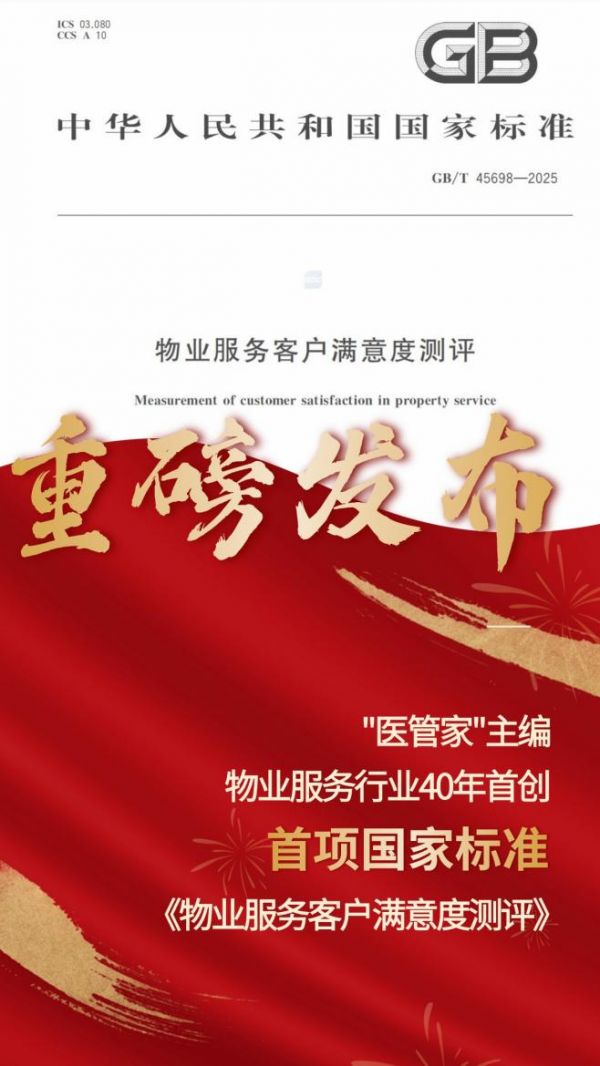
行业首发,“医管家”主编《物业服务客户满意度测评》国家标准落地!
Zhong Guo Chan Ye Jing Ji Xin Xi Wang· 2025-08-21 02:46
Core Viewpoint - The release of the national standard "Property Service Customer Satisfaction Evaluation" (GB/T45698—2025) marks a significant milestone in the property service industry in China, establishing a standardized measure for customer experience after 40 years of industry development [1][6]. Group 1: Standard Development - The national standard fills a gap in the property service industry by providing a scientific and standardized evaluation system for customer satisfaction, addressing issues such as varying evaluation systems and weightings among different companies [5]. - The standard was developed by a professional drafting team led by Shanghai Yizhong Gengtai (Group) Co., Ltd. ("Yijianjia"), which has over 20 years of experience in the medical logistics sector, and involved extensive research, discussions, and public consultations [5]. Group 2: Impact on the Industry - The implementation of this national standard is expected to have a profound impact on the property service industry, allowing companies to objectively measure service effectiveness and enhance service quality [6]. - The standard provides a scientific and fair evaluation benchmark for industry regulation and market competition, promoting healthy and orderly development in the property service market [6]. Group 3: Leadership and Future Directions - "Yijianjia" is positioned as a leader in the standardization efforts within the industry, having established a pathway for standardization from enterprise standards to local and national standards [6]. - The introduction of the national standard signifies a shift towards a more measurable, comparable, and improvable approach in property services, laying a solid foundation for a harmonious and high-quality service environment [7].

北京打造辐射全球的跨境电商创新高地
Zhong Guo Chan Ye Jing Ji Xin Xi Wang· 2025-08-21 00:24
Core Viewpoint - Beijing aims to establish itself as a global hub for cross-border e-commerce through the "Beijing Action Plan for Promoting High-Quality Development of Cross-Border E-Commerce (2025-2027)" focusing on innovation, cooperation, and ecological optimization [1][2] Group 1: Development Strategy - The plan emphasizes leveraging five advantages, including technological innovation, policy innovation, headquarters economy, logistics efficiency, and quality business services to enhance cross-border e-commerce [2] - By 2027, the goal is to establish around three cross-border e-commerce service centers, attract numerous billion-level platforms and ten-million-level brands, and cultivate a thousand cross-border e-commerce talents [2] Group 2: Business Growth - The initiative aims to nurture cross-border e-commerce enterprises by supporting those with core technologies and quality products to grow into high-tech, specialized, and unicorn companies [3] - It encourages the development of cross-border e-commerce service enterprises and the establishment of specialized industrial parks in various districts [3] Group 3: Innovation Focus - The plan supports the application of advanced technologies such as cloud computing, big data, and AI in cross-border e-commerce [4] - New marketing models like "live streaming + short videos" and "bonded warehouses + live streaming" are to be explored to enhance retail imports [4] Group 4: Service Optimization - The initiative aims to improve customs efficiency with a "green channel" for cross-border e-commerce exports and enhance logistics support through the construction of a national logistics hub [4] Group 5: Ecosystem Development - A platform for cross-border e-commerce exchanges will be established to foster collaboration and compliance, including knowledge protection and legal training [5] - The plan also focuses on building a high-quality talent pool by integrating educational resources and encouraging institutions to offer cross-border e-commerce programs [5]
上半年石化行业经济运行基本平稳
Zhong Guo Chan Ye Jing Ji Xin Xi Wang· 2025-08-21 00:23
Core Insights - The petrochemical industry in China experienced a stable economic performance in the first half of the year, with a total revenue of 7.77 trillion yuan, a year-on-year decrease of 2.6% [1] Group 1: Economic Performance - Crude oil production, import, processing, and consumption all saw year-on-year growth, marking a turnaround from last year's declines [1] - Major chemical products' production and consumption both achieved "double growth," indicating stable market demand for petrochemical products and chemical materials [1] - The chemical sector outperformed the oil and gas extraction and refining sectors, with revenue and import-export values increasing, while profits decreased [1] Group 2: Trade Dynamics - The import and export dynamics showed a "volume increase, price decrease" trend, with total import-export value, import value, and trade deficit all declining year-on-year, while export value slightly increased by 0.4% [1] Group 3: Product Trends - Both production and consumption of refined oil experienced a "double decline," attributed to the impact of new energy vehicles on gasoline markets and liquefied natural gas heavy trucks on diesel consumption [2] - The production rate of refined oil dropped to 55.3%, down from 59.7% in the previous year, reflecting the industry's structural adjustments and transition towards "reducing oil and increasing chemicals" [2] Group 4: Price Trends - Prices for crude oil and major petrochemical products continued to decline, influenced by ongoing geopolitical conflicts and economic uncertainties [2] Group 5: Future Outlook - The industry aims to prioritize quality improvement and efficiency enhancement, focusing on cost reduction, potential exploration, and optimization [2] - There is a push for accelerating the high-end and green transformation of the petrochemical industry, alongside efforts to manage "involutionary" competition and ensure the orderly exit of outdated capacities [2]
四川成都邛崃市:加快打造世界级新能源高地
Zhong Guo Chan Ye Jing Ji Xin Xi Wang· 2025-08-21 00:19
Core Viewpoint - The city of Qionglai is rapidly developing into a world-class production base for new energy battery materials, supported by robust industrial data and a complete supply chain in lithium battery materials [1][3]. Group 1: Industrial Growth and Data - In 2024, the industrial output value of new energy materials in Qionglai is projected to reach 19.51 billion yuan, with a growth rate of 17.9% [1]. - Qionglai has established a complete supply chain covering lithium battery anodes, cathodes, separators, and equipment manufacturing, with over 320 enterprises in the industry chain by July 2025 [1][3]. Group 2: Leading Enterprises - Puxin Technology is a leading enterprise in Qionglai's new energy materials industry, with significant production capabilities and a projected annual output value of 12 billion yuan from its lithium battery anode materials [3][4]. - Chengdu Rongjie Lithium Industry is focusing on digital transformation to enhance production efficiency and management, aiming to establish a significant battery-grade lithium salt production base [4]. Group 3: Collaborative Development - The integration of upstream and downstream enterprises is crucial for the collaborative development of the industry chain, with companies like Aiminte and Hongli New Energy contributing to local production and reducing logistics costs [5][6]. - Hongli New Energy has achieved rapid production timelines, with its manganese lithium battery production line operational within 86 days, showcasing the efficiency of local government support [6]. Group 4: Strategic Expansion - Qionglai is actively pursuing cross-regional and cross-industry collaborations to enhance its new energy materials sector, including partnerships with the Tianfu New Area for research and production integration [7][8]. - The city is also focusing on emerging sectors such as new energy storage and low-altitude economy, aiming to attract projects related to high-performance lithium batteries and composite materials [8]. Group 5: Future Outlook - Qionglai is implementing policies to strengthen and expand its industrial chain, with infrastructure developments like the 500 kV power transmission project and the G108 expressway enhancing connectivity [9]. - The city aims to build a "trillion-level" industrial cluster centered on battery materials, quality liquor, and pharmaceuticals, contributing to the development of Chengdu's sub-center [9].

上海税务11项措施加力浦东稳外资稳外贸
Zhong Guo Chan Ye Jing Ji Xin Xi Wang· 2025-08-21 00:19
Group 1 - The Shanghai tax authority has implemented tax collection service measures to enhance the level of openness in the Pudong New Area, effectively stimulating foreign trade and investment vitality [1] - In the first half of the year, Pudong New Area processed export tax refunds exceeding 40 billion yuan, a year-on-year increase of 14.2%, and offshore trade stamp duty exemptions exceeded 200 million yuan, benefiting 1,300 enterprises [1] - The foreign reinvestment deferred tax amount increased by 208.5% year-on-year, indicating a significant boost in foreign investment activities [1] Group 2 - In the biopharmaceutical sector, Pudong New Area has pioneered the implementation of a tax policy for small enterprises seeking FDA certification, aiding small and medium-sized pharmaceutical companies in enjoying overseas certification fee exemptions [2] - The FDA certification tax policy has already benefited eight pharmaceutical companies, accelerating the internationalization of the biopharmaceutical industry in Pudong New Area [2] - The Shanghai tax authority aims to continue leveraging its tax functions to support stable foreign investment and trade through the implementation of 11 measures [2]
河南新一轮稳楼市政策有望开启
Zhong Guo Chan Ye Jing Ji Xin Xi Wang· 2025-08-21 00:18
"河南房地产市场最新数据表明,当前市场仍处于深度调整阶段。这种调整有助于风险出清,并为市场 企稳奠定更扎实的基础。"上海易居房地产研究院副院长严跃进接受大河财立方记者采访时表示,横向 对比来看,河南多项数据表现优于全国平均水平,体现出较强韧性。这与当地市场更加趋稳、潜在购房 需求规模较大,以及政策红利持续释放等因素密切相关。 值得关注的是,1—7月份,全省房地产开发企业到位资金同比增长0.3%。其中,国内贷款下降15.2%; 自筹资金增长1.7%;定金及预收款增长7.1%;个人按揭贷款下降7.1%。 8月19日,河南省统计局发布1—7月份全省房地产市场基本情况。从销售端来看,1—7月份,全省新建 商品房销售面积同比下降1.0%,降幅低于全国平均水平3个百分点,比去年同期收窄17.3个百分点;销 售额同比下降0.2%,降幅低于全国平均水平6.3个百分点,比去年同期收窄21.5个百分点。 从投资端来看,1—7月份,全省房地产开发投资同比下降8.0%,降幅低于全国平均水平4个百分点,比 去年同期收窄1.4个百分点。 "定金及预收款为正增长,反映购房者积极性较高,市场预期趋稳。这既有利于开发商资金回笼,也体 现出市场 ...
山西临汾25个农产品地理标志成功通过转化认定
Zhong Guo Chan Ye Jing Ji Xin Xi Wang· 2025-08-21 00:15
Group 1 - The core viewpoint of the news is that the successful recognition of 25 agricultural geographical indications in Linfen City, Shanxi Province, marks a significant breakthrough in the city's geographical indication protection efforts [1] - The recognized products include Gu County walnut, Gu County millet, and various other local agricultural products, enhancing the region's agricultural identity and marketability [1] - Prior to this announcement, Linfen City already had several geographical indication products, indicating a growing trend in the region's agricultural branding [1] Group 2 - The protection of geographical indication products is crucial for promoting rural economic development and plays a significant role in achieving rural revitalization and strengthening enterprises [2] - The local authority plans to focus on high-quality creation, efficient utilization, and high-standard protection of intellectual property rights, aiming to enhance the development level of geographical indications [2] - There is an emphasis on encouraging counties to explore integration paths between geographical indications and local industries, which will help in discovering more quality resources [2]

哈尔滨自贸片区:科创变量催生新质动能
Zhong Guo Chan Ye Jing Ji Xin Xi Wang· 2025-08-21 00:15
Core Insights - The Harbin Free Trade Zone is leveraging "dual self-driven" initiatives, technology transfer, and specialized industrial clusters to accelerate new productivity growth in Heilongjiang province [1][2][5] Group 1: Dual Self-Driven Initiatives - Since the approval of the Harbin-Daqing-Qiqihar National Independent Innovation Demonstration Zone in May 2022, a 2.0 version of the "dual self-driven" work plan has been implemented, establishing an international innovation corridor [2] - The zone has set up offshore incubators in Moscow and encourages local enterprises to collaborate with global advanced countries to establish innovation and entrepreneurship incubation stations [2] - As of now, there are 1,323 high-tech enterprises in the Harbin Free Trade Zone, accounting for 26.3% of the province's total [2] Group 2: Technology Transfer and Innovation - The establishment of a full-chain service system for technology transfer has led to the formation of over 1,000 convertible research outcomes, with a conversion rate of 87.5% for 28 projects from Harbin Institute of Technology [3] - The zone has created a national-level aerospace high-end equipment future industry technology park, recognized as one of the "Top Ten Future Industry Technology Parks" in the country [3] - The area has set up 10 industry-education joint bodies to attract high-end talent, with 367 technology innovation outcomes converted in 2024, representing 34% of the city's total [3] Group 3: Specialized Industrial Clusters - The Harbin Free Trade Zone is developing 15 specialized parks, including those for "smart robots" and "high-end satellites," with the industrial output of emerging industries growing over 30% annually [4] - The zone has invested 1.47 billion yuan in 47 technological transformation projects, facilitating the digital transformation of leading enterprises [4] - More than 30 related industrial projects have been established in specialized industrial parks, with ongoing projects totaling over 1.3 billion yuan in investment [4] Group 4: Future Development Goals - The Harbin Free Trade Zone aims to deepen institutional reforms and create a collaborative innovation ecosystem, targeting over 2,000 high-tech enterprises and 1,500 technology transfers by 2027 [5] - The goal is to scale the commercial aerospace, smart robotics, and new materials industries to exceed 10 billion yuan in output [5]
山东明确新能源上网电价市场化改革方案
Zhong Guo Chan Ye Jing Ji Xin Xi Wang· 2025-08-21 00:14
8月7日,山东省发改委、国家能源局山东监管办公室、山东省能源局联合印发《山东省新能源上网电价 市场化改革实施方案》(以下简称《方案》),标志着《关于深化新能源上网电价市场化改革促进新能源 高质量发展的通知》在山东正式落地。 《方案》按要求分类施策。对存量项目,以每千瓦时0.3949元(含税)燃煤基准价兜底,确保改革对存量 项目收益不造成较大影响。对增量新能源项目,通过价格竞争方式确定机制电价与单个项目机制电量, 引导新能源企业充分竞争,降低全社会用能成本。 山东是改革前全国仅有的两个允许现货市场出现负价的省份之一。2025年"五一"假期期间,省内负荷低 迷叠加日间新能源大发,实时与日前市场分别出现46小时与50小时的负电价。面对愈演愈烈的负电价争 议以及可能因负电价增加机制差价结算费用的压力,山东敢于正视负电价背后供过于求的真正问题,坚 持通过市场化方式提高系统消纳率。改革保留了负电价,激励用户主动改变用电习惯削峰填谷,从"按 需用电"转为"按价用电"。同时,负的价格下限,足以抵消省内新能源电量送至全国任一省份的输配电 价与网损费用,甚至从山东返送至西北地区,仍具备经济性。 山东是东部沿海地区新能源装机规模率 ...
前7个月福建省平板显示模组出口货值突破百亿元
Zhong Guo Chan Ye Jing Ji Xin Xi Wang· 2025-08-21 00:11
Core Insights - The flat panel display technology is experiencing a surge in market demand, driven by the growth of the global technology industry [1] - Fujian Province's export of flat panel display modules reached 12.872 billion yuan in the first seven months of this year, marking a year-on-year increase of 15.72% [1] - The Belt and Road Initiative countries have provided significant opportunities for Fujian's flat panel display module exports, with a total export value of 7.942 billion yuan, up 16.56% year-on-year, accounting for 61.7% of the province's total exports in this category [1] Industry Support - Xiamen Customs is actively supporting the development of the flat panel display industry by innovating regulatory services to align with enterprise export plans and customs needs [1] - The customs authority has facilitated the approval of cross-cycle import and export applications for six companies and 43 batches of goods, saving enterprises over 8 million yuan in taxes during the first seven months of the year [1]