
Jin Rong Shi Bao

Search documents
继中行、建行之后,又一家国有大行宣布!
Jin Rong Shi Bao· 2025-12-17 09:39
Core Viewpoint - The announcement of capital changes by state-owned banks, including the recent increase in registered capital by Bank of Communications, reflects a broader trend of capital replenishment among major state-owned banks in China, driven by regulatory support and market conditions [1][2][3] Group 1: Capital Changes - Bank of Communications has increased its registered capital by 14.101 billion RMB, changing from 74.263 billion RMB to 88.364 billion RMB following a specific issuance of A-shares [1] - This capital increase follows similar actions by other state-owned banks, including Bank of China and China Construction Bank, which also raised capital through targeted A-share issuances [1] Group 2: Capital Replenishment Trends - In 2023, major state-owned banks are actively replenishing capital, with a total planned fundraising of 520 billion RMB through targeted A-share issuances, as outlined in the government work report proposing the issuance of special government bonds [1][2] - The capital replenishment strategies of state-owned banks are characterized by a diversified approach, utilizing both internal profit retention and external financing methods such as targeted issuance and IPOs [2] Group 3: Importance of Capital Adequacy - The capital adequacy of systemically important banks (D-SIBs) is crucial for maintaining financial stability, with sufficient capital serving as a core defense against risks associated with being "too big to fail" [3] - The proactive capital replenishment by state-owned banks sends a positive signal to the market regarding prudent management and risk control, which helps stabilize market expectations and boost investor confidence [3]

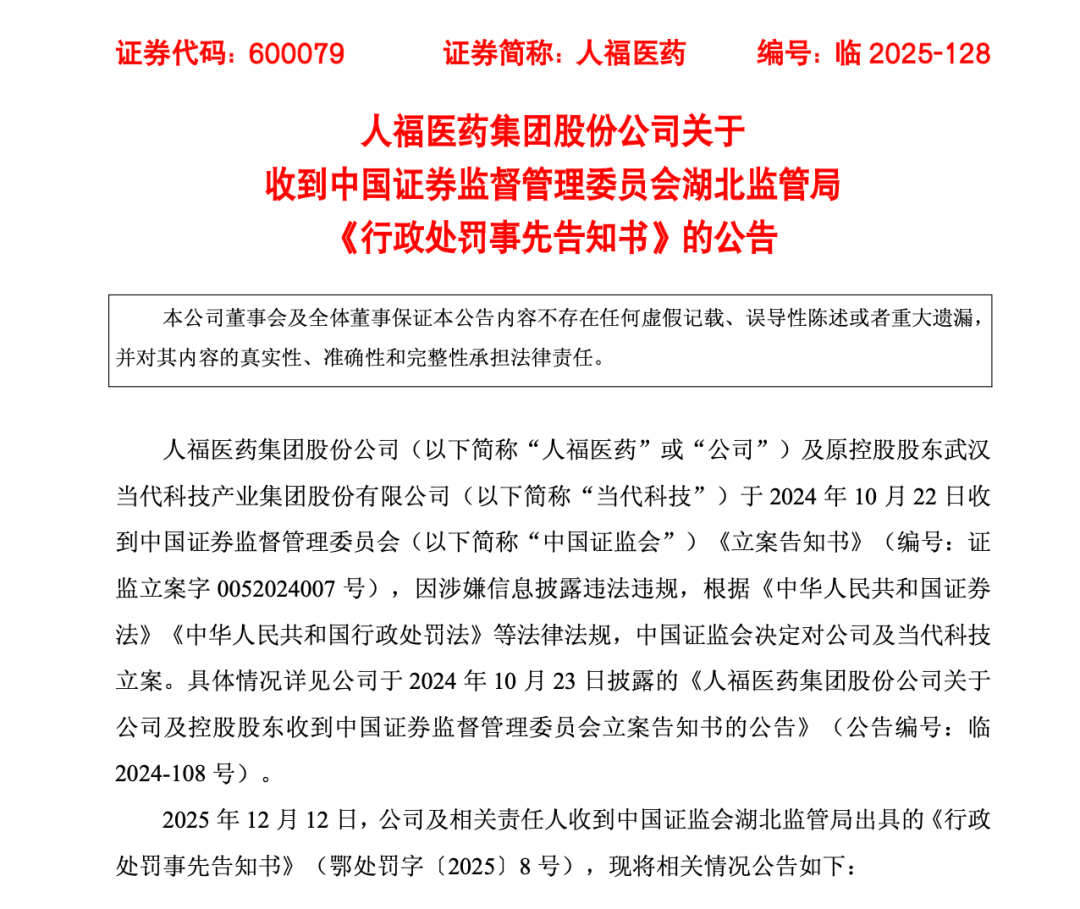
重罚落地,ST人福为何首日涨停?
Jin Rong Shi Bao· 2025-12-17 08:24
Core Viewpoint - The article discusses the regulatory actions against Renfu Pharmaceutical and its former controlling shareholder, Dongdai Group, highlighting significant financial misconduct and the subsequent restructuring of the company under new control. Group 1: Regulatory Actions and Violations - Renfu Pharmaceutical was officially designated as ST (Special Treatment) on December 16 due to multiple violations, including significant fund occupation and false financial reporting [1][3] - The Hubei Securities Regulatory Bureau issued a notice detailing four main violations from 2020 to 2022, including a total fund occupation of 12.785 billion yuan, which represented a significant percentage of the company's net assets during those years [5][6] - The total fines imposed on Renfu Pharmaceutical and Dongdai Group amounted to 36.7 million yuan, with individual penalties for responsible parties ranging from 500,000 to 3.9 million yuan [8] Group 2: Financial Misconduct Details - The first violation involved non-operational fund occupation, with Dongdai Group occupying 2.502 billion yuan, 8.179 billion yuan, and 2.104 billion yuan in 2020, 2021, and early 2022, respectively [5] - The second violation related to undisclosed related-party transactions, where Renfu Pharmaceutical purchased assets from a company closely related to Dongdai Group without proper disclosure, totaling 1.645 billion yuan [6] - The third violation included false financial records, where Renfu Pharmaceutical inflated its net profit by 143 million yuan, 72 million yuan, and 91 million yuan in 2020, 2021, and the first half of 2022, respectively [6] - The fourth violation involved the concealment of related-party relationships during a transaction, leading to a lack of timely disclosure [7] Group 3: Corporate Restructuring and New Control - Following the financial misconduct, Renfu Pharmaceutical's control was transferred to China Merchants Group, which invested 11.8 billion yuan to acquire a 23.70% voting stake in the company [9][10] - The restructuring process was initiated due to Dongdai Group's severe debt crisis, which included bankruptcy proceedings initiated by creditors [9] - Significant changes in the board and management of Renfu Pharmaceutical occurred post-restructuring, with new appointments from China Merchants Group [10] Group 4: Financial Performance - For the first three quarters of 2025, Renfu Pharmaceutical reported revenues of 17.883 billion yuan, a decrease of 6.58% year-on-year, while net profit attributable to shareholders increased by 6.22% to 1.689 billion yuan [11]


这家银行获批开业 茅台集团成第三大股东→
Jin Rong Shi Bao· 2025-12-17 07:51
Core Points - The Guizhou Rural Commercial Union Bank has officially been approved to commence operations with a registered capital of 10.458 billion yuan [1] - The bank's primary business scope includes handling or acting as an agent for fund clearing and settlement within the Guizhou banking system, participating in the money market, and other approved financial activities [1] - The major shareholders include Guizhou Financial Holding Group with a 65.844% stake, Guizhou Provincial Finance Department with 15.032%, and both Moutai Group and Guizhou Qiansheng State-owned Assets Management Co., Ltd. holding 9.562% each [1] Industry Context - Moutai Group has been involved in equity investments in local financial institutions and is a significant shareholder in Guizhou Bank and Guiyang Bank [2] - The Guizhou provincial government has emphasized the need for rural credit cooperative reforms, leading to the establishment of the Guizhou Rural Commercial Union Bank [2] - The reform process has accelerated, with multiple announcements regarding the establishment of unified legal entity rural commercial banks in various cities within Guizhou [2]

这一会计师事务所被罚没超6500万元!禁止从事证券服务业务!
Jin Rong Shi Bao· 2025-12-17 07:14
Core Viewpoint - Yongtuo Accounting Firm has been severely punished by the Jiangsu Securities Regulatory Bureau for failing to perform due diligence and issuing false audit reports, leading to a ban on engaging in securities services and a total fine exceeding 65 million yuan [1][4][5]. Group 1: Administrative Penalties - The Jiangsu Securities Regulatory Bureau's administrative penalty decision revealed that Yongtuo failed to exercise due diligence, resulting in false records in annual audit reports and verification reports for fund usage [1][2]. - Yongtuo was ordered to rectify its practices and was banned from engaging in securities services, with a total penalty of approximately 65.28 million yuan, which includes confiscated business income and fines [4][5]. - This is the first instance of a regulatory body imposing a ban on an audit firm from conducting securities services since the revision of the Securities Law in 2019 [1]. Group 2: Role in Financial Fraud - Yongtuo acted as an accomplice in financial fraud, knowingly issuing unqualified audit reports despite being aware of significant issues and deficiencies in audit practices [2][3]. - The firm was responsible for auditing several companies, including Hongda Xingye and Hengjiu Technology, where it failed to maintain objectivity and independence, leading to the issuance of false audit reports [2][3]. - Specific instances of misconduct included fabricating audit adjustments and altering financial statements, as well as failing to assess fraud risks adequately [3]. Group 3: Regulatory Environment - The regulatory environment emphasizes the critical role of intermediary institutions, such as accounting firms, in maintaining market integrity and preventing financial misconduct [6]. - The China Securities Regulatory Commission has intensified enforcement actions against violations, with a notable increase in cases involving intermediary institutions failing to perform due diligence [7]. - Recent measures have been introduced to enhance oversight of intermediary institutions, including increased inspections and a focus on improving audit quality and professional competence [7].
银保通系统接口规范行业标准发布
Jin Rong Shi Bao· 2025-12-17 05:30
(责任编辑:马欣) 记者从中国保险行业协会获悉,近日,国家金融监管总局正式发布《银保通系统接口规范》行业标准。 该标准由中国保险行业协会牵头,联合中国人寿、平安产险、建信金科和中科标准等单位组成起草组, 多家代表性银行保险机构共同参与制定。银保通系统支撑银行柜面、手机银行等多渠道代理保险业务, 承担投保、财务处理、风险控制等核心功能,涵盖基础要求、车险、非车险及人身险业务四大板块,为 银行保险机构系统对接提供统一流程与数据字典。(记者 孙榕) ...
滑雪季来了 如何购买一份合适的保险
Jin Rong Shi Bao· 2025-12-17 04:41
"本以为自己买了普通意外险就万事大吉了,结果没想到前几天滑雪意外骨折后,保险公司说这属 于高风险运动,一分钱都没赔。"来自北京的滑雪爱好者庞女士对《金融时报》记者说:"原来,滑雪保 险还有这么多门道呢!" 随着雪季来临,越来越多的像庞女士这样的滑雪爱好者参与其中,但不少人都和她一样,对与滑雪 有关的保险存在认知盲区。滑雪保险到底该不该买?怎么买?怎么做才能既不花冤枉钱,又能做好保 障?记者日前就相关话题采访了业内人士。 不少消费者疑惑,雪场门票中已经包含了一份"保险",还有必要再单独买吗?据悉,滑雪场门票中 包含的保险为基础保险,通常为公众责任险,主要规避因景区管理的过失,导致消费者在游玩过程中受 伤或者产生财产损失。换言之,该保险仅针对滑雪场责任导致的事故,而不覆盖游客自身因滑雪活动造 成的摔伤、碰撞等意外。因此,一份针对消费者个人的滑雪保障是必要的,特别是对滑雪新手而言。 另外,庞女士的疑惑也困扰着不少雪友——为何普通的意外险"防不住"滑雪风险呢? 记者了解到,有四个关键点。一是相关保险产品必须明确承保高风险运动,条款里要写清楚包含滑 雪相关风险。二是意外保障要充足。简单来说,保额越高,兜底效果越好。业内 ...
从保险销售到人生规划师 和我的客户一起慢慢变老
Jin Rong Shi Bao· 2025-12-17 04:41
Core Insights - The article discusses the emergence of Health Wealth Planners (HWP) in response to the aging population in China, highlighting the need for dignified aging planning as the elderly population is projected to reach 310 million by the end of 2024 [1][5] - The traditional insurance model is evolving into a new business model that integrates insurance with health and wellness services, creating a more comprehensive approach to client needs [2][3] Group 1: Industry Transformation - The insurance industry is transitioning from a "quantity-driven" model to a "quality-driven" model, with the HWP role emerging as a new profession that addresses the uncertainties of aging through professional planning [5] - The new model combines insurance, health care, and wealth management, allowing agents to provide a more holistic service to clients [3][5] Group 2: HWP Development and Support - There are over 30,000 HWPs at Taikang Life, who are reshaping the insurance sales model and driving the overall upgrade of the insurance agent workforce [3] - Taikang Life offers comprehensive support for HWP development, including recruitment, training, and incentives, focusing on ten core dimensions for deep empowerment [3] Group 3: Client-Centric Services - HWPs provide clients with not just insurance policies but also access to health and wellness facilities, enhancing the client experience and creating long-term relationships [3][4] - The innovative "1+N" multidisciplinary care model at Taikang's retirement communities addresses the dual challenges of healthcare and aging, ensuring that elderly clients receive both medical care and quality of life improvements [4]

瑞士再保险发布Sigma最新报告: 全球保险市场承压分化 中国韧性增长开辟新赛道
Jin Rong Shi Bao· 2025-12-17 04:41
Global Insurance Market Overview - The global insurance premium growth is expected to slow down over the next two years, with total premium growth rate projected to decline from approximately 3.1% in 2025 to 2.3% in 2026-2027 [1][2] - Life insurance is anticipated to accelerate, with premium income growth expected to rise to about 2.5% during the same period, driven by high interest rates and increasing demand for retirement and health coverage due to aging populations [2] - Non-life insurance growth is projected to slow to around 2.1%, impacted by intensified competition in developed markets and declining rate cycles, although long-term demand for risk coverage in emerging sectors like AI will support this segment [2] Risk and Challenges - The complexity and cost of risks are increasing, with annual insurance losses from natural disasters exceeding $100 billion and approaching $150 billion, while about half of economic losses globally remain uninsured, particularly in emerging markets [3] - The interconnected nature of risks and underestimation of certain risks are highlighted, with new risks emerging from sectors like AI and energy transition, challenging traditional pricing models and underwriting capabilities in the insurance industry [3] Opportunities in the Chinese Insurance Market - The Chinese insurance market, particularly the property insurance sector, is viewed as a significant growth area, with average annual premium growth expected to remain between 5% and 6% from 2025 to 2030, significantly higher than the global average [4] - Five key thematic opportunities are identified: disaster prevention and reduction, green development, rural revitalization and agricultural modernization, overseas investment by Chinese enterprises, and industrial modernization in emerging technologies [4][5] - The profitability foundation of the Chinese insurance market is strengthening, with reforms in auto insurance and the application of AI in underwriting and claims management expected to optimize costs and lead to sustainable underwriting profits by 2027 [5]

四问首版商保创新药目录
Jin Rong Shi Bao· 2025-12-17 04:41
Core Viewpoint - The release of the first commercial health insurance innovative drug directory in China, which includes 19 innovative drugs, marks a significant step in building a multi-tiered medical security system, set to be implemented on January 1, 2026 [1] Group 1: Purpose of the Innovative Drug Directory - The establishment of the commercial health insurance innovative drug directory aims to alleviate the financial burden on patients by allowing high-value innovative drugs, which are not included in basic medical insurance, to be compensated through commercial health insurance [2] - This directory provides a clear policy interface and guidance on the range of drugs for commercial health insurance to participate in innovative drug coverage [2] Group 2: Focus Areas of the First Batch of Drugs - The first batch of 19 drugs comes from 18 companies, primarily focusing on new mechanisms and targets, including 9 first-class new drugs, which complement the basic medical insurance directory [3] - The drugs cover treatments for rare diseases such as CAR-T cell therapy, Gaucher disease, short bowel syndrome, and neuroblastoma, filling gaps in the current basic medical insurance coverage [3] Group 3: Understanding the "Three Exclusions" Principle - The "Three Exclusions" principle allows related drugs to be exempt from basic medical insurance self-payment rate assessments, excluded from monitoring for alternative products in centralized procurement, and their usage cases are not included in disease-based payment statistics [4] - This policy alleviates concerns for medical institutions regarding the use of innovative drugs, enabling patients to obtain these drugs directly in hospitals and settle through commercial insurance, thus enhancing drug accessibility [4] Group 4: Direct Benefits to Consumers - The release of the commercial health insurance innovative drug directory is expected to promote existing products like inclusive commercial health insurance, million medical insurance, and special drug insurance, making it easier for patients to access high-value drugs and receive compensation through commercial insurance [5] - Insurance companies benefit from a negotiated discount mechanism on the prices of drugs in the directory, which helps reduce their claims costs, and the directory provides a vetted list of drugs, lowering the selection and risk management costs in product design [5] - Cities like Beijing, Shanghai, and Guangzhou are exploring one-stop settlement services combining medical insurance and commercial insurance, which is expected to further enhance claims efficiency and user experience [5]
超293亿元上市险企中期分红“已到账”
Jin Rong Shi Bao· 2025-12-17 04:41
Core Viewpoint - The listed insurance companies in China are actively implementing mid-term dividends in response to the government's policy encouraging multiple dividends within a year, showcasing strong capital strength and operational confidence [1][5]. Group 1: Mid-term Dividend Distribution - The total cash dividends distributed by four major A-share listed insurance companies, excluding China Pacific Insurance, reached approximately 29.336 billion yuan, an increase of 2.372 billion yuan or 8.8% compared to the previous year [2][5]. - China Ping An had the largest dividend distribution, amounting to 17.202 billion yuan [1]. Group 2: Individual Company Dividend Announcements - China Life announced a cash dividend of 0.238 yuan per share, totaling approximately 6.727 billion yuan, with the cash dividend distribution date set for October 17 [4]. - China Ping An's cash dividend was set at 0.95 yuan per share, totaling 17.202 billion yuan, with the distribution date on October 24 [4]. - China Re announced a cash dividend of 0.075 yuan per share, totaling approximately 3.317 billion yuan, with the distribution date on December 12 [3]. Group 3: Policy Impact and Industry Trends - The implementation of mid-term dividends reflects the government's encouragement for listed companies to enhance dividend frequency and shareholder returns, as outlined in the "New National Guidelines" [5]. - Prior to the new guidelines, only China Ping An maintained a consistent mid-term dividend policy, while other companies have adopted this practice in the last two years [5]. - The average dividend payout ratio among five major insurance companies is 45.63%, with all maintaining a payout ratio above 30% [6]. Group 4: Future Outlook - Insurance companies are committed to maintaining the continuity and stability of their dividend policies, aiming for long-term stable growth in per-share dividends [7]. - As operational quality improves, future dividend distributions are expected to continue increasing [7].



