
Jin Rong Shi Bao

Search documents
绿色金融,“挂钩贷”助推六盘水向绿而行
Jin Rong Shi Bao· 2025-11-25 07:03
Core Viewpoint - The People's Bank of China, Liupanshui Branch, is actively promoting financial support for the local economy's green and low-carbon transition through innovative financial products like "linked loans" [1] Group 1: Financial Initiatives - The Liupanshui Branch has introduced "linked loans" specifically aimed at supporting green and low-carbon transitions in the local economy [1] - As of the end of October this year, financial institutions in Liupanshui have issued a total of 7.028 billion yuan in green low-carbon transition "linked loans" [1] Group 2: Collaboration and Development - The branch collaborates with local banks, such as Guiyang Bank, to understand and support the green low-carbon transition of enterprises like Meijin Huayu New Energy Co., Ltd. [1]
黑土地上“蔬”写致富经
Jin Rong Shi Bao· 2025-11-25 05:18
Core Insights - The vegetable industry in Suhua City, Heilongjiang Province, is thriving, with a planting area of 870,000 acres and a production capacity of 1.036 million tons, significantly contributing to local farmers' income and industrial revitalization [1][3] Group 1: Industry Overview - Suhua City has established a strong reputation for its vegetable brands, including "Black Land" chili and "Zhongnuo Feng" soybean, which are gaining recognition in various markets [1] - The city has developed a new supply chain for vegetable distribution, facilitating the transportation of fresh produce to regions like the Yangtze River Delta and Pearl River Delta [1] Group 2: Financial Support and Initiatives - The People's Bank of China Suhua Branch has issued guidelines to enhance financial support for the vegetable industry, proposing 12 specific measures to increase credit availability and reduce financing costs [3] - As of September, a total of 298 million yuan in loans has been issued to 1,026 vegetable industry entities, marking a year-on-year increase of 13.1% [3] Group 3: Banking Products and Services - Local banks are optimizing their credit products to support the vegetable industry, with offerings like "Farmer Credit Quick Loan" and "Personal Business Loan" to meet diverse financing needs [4] - The "Scale Grower Loan" product introduced by Suhua Rural Commercial Bank aims to enhance the loan approval rate for agricultural entities through a scientific scoring system [4]
事关黄金业务,工行再布局!
Jin Rong Shi Bao· 2025-11-25 04:43
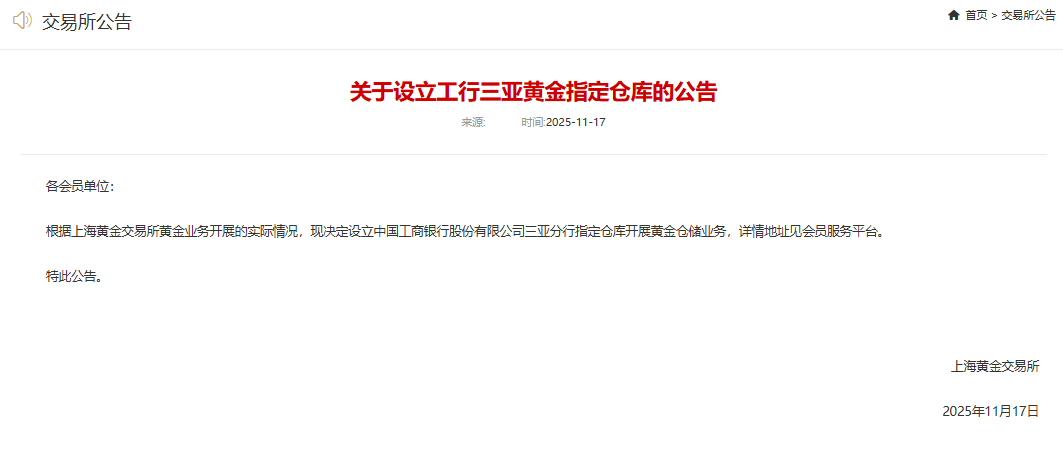
Core Insights - Industrial and Commercial Bank of China (ICBC) has been actively establishing gold storage facilities across various regions in China this year, with a recent announcement of a designated warehouse in Sanya by the Shanghai Gold Exchange [1][4] - The establishment of the gold warehouse in Hezhou, which was approved on May 16 and officially opened on October 21, is aimed at addressing local businesses' challenges related to gold delivery efficiency and costs [3][4] Summary by Sections Gold Storage Business Expansion - ICBC's recent establishment of a gold storage facility in Sanya follows closely after the opening of the Hezhou warehouse, indicating a strategic push in the gold storage sector [3][4] - The Hezhou warehouse is built to national first-class warehouse standards, allowing for efficient operations with same-day storage and delivery capabilities [4] Industry Impact and Strategic Positioning - The new warehouses are expected to facilitate the growth of the local gold industry by resolving issues related to high costs and risks associated with off-site deliveries [4][5] - The Hezhou warehouse is positioned to serve the local gold and jewelry industry cluster, while the Sanya facility aims to leverage Hainan's free trade port policies and tourism to explore new retail models for gold consumption [5] Shift in Banking Strategy - The move by ICBC signifies a shift in the banking sector's approach to precious metals, transitioning from a focus on retail products to a comprehensive ecosystem that includes storage and logistics [5] - Leading banks are expected to follow ICBC's lead in integrating storage capabilities into their service offerings, enhancing their competitive edge in the industrial finance sector [5]


市镇直联 产融共振
Jin Rong Shi Bao· 2025-11-25 04:12
Core Viewpoint - Shishan Town in Nanhai, Foshan, is experiencing a financial transformation aimed at enhancing its economic development through innovative financial models and direct connections between municipal and town-level financial resources [1][2]. Group 1: Financial Innovation and Mechanisms - The People's Bank of China (PBOC) in Foshan has signed a cooperation memorandum with Shishan Town to implement a financial empowerment model that includes three key lists: a financial demand list, a customized financial product list, and an effect tracking list [2][3]. - A financial service advisory group has been established to provide consulting and customized financing solutions to local enterprises, addressing their financing challenges effectively [2][3]. Group 2: Achievements and Impact - The new "city-town direct connection" model has successfully served over 1,900 enterprises, with 31 park enterprises receiving tailored financial solutions [3][4]. - Regular communication mechanisms have been established between the PBOC and Shishan Town leadership to ensure timely financial service delivery and responsiveness to local enterprise needs [4]. Group 3: Resource Coordination and Support - The PBOC has facilitated the issuance of a 500 million yuan bond by Shishan Investment Holdings, marking a significant step in utilizing capital markets for rural revitalization [4]. - A 10 billion yuan credit agreement has been signed with Agricultural Bank of China, and a specialized technology branch has been established to enhance financial services in Shishan [4][6]. Group 4: Focus on Key Industries - Shishan Town is home to influential industrial clusters, including automotive manufacturing, high-end equipment, new materials, and biomedicine, with financial services increasingly tailored to meet the specific needs of these sectors [5][6]. - Financial institutions have developed specialized products such as "Aluminum Industry Preferred Loan" to support the local aluminum industry and "Industrial Park Renovation Loans" for comprehensive project financing [6].
从穷沟沟到“桃花源”
Jin Rong Shi Bao· 2025-11-25 04:12
Core Insights - The transformation of the Bashan Grand Canyon into a thriving tourist destination is attributed to significant financial support and innovative credit products, resulting in over 11.92 million annual visitors and a tourism revenue exceeding 7.8 billion yuan [1] Financial Support and Infrastructure Development - The financial system in Dazhou has played a crucial role, providing a total of 2.339 billion yuan in loans for infrastructure development, cultural promotion, and poverty alleviation [1] - In 2016, the Bashan Grand Canyon was designated as a key tourism poverty alleviation project, leading to the issuance of 660 million yuan in poverty alleviation loans to improve transportation and connect scattered villages [2] - Additional loans of 250 million yuan for infrastructure and 16.55 million yuan in small credit loans were provided to support local development projects [2] Cultural Integration and Employment Generation - The integration of local culture with tourism has been emphasized, with performances like "Dreaming Back to the Ba State" and traditional Tujia drum performances enhancing visitor experiences [2] - A credit loan of 8 million yuan was provided to support the "Bashan Welcomes Guests" cultural show, which has increased local farmers' average annual income by 40,000 yuan [3] - The establishment of 243 guesthouses in Dukuo Township has created 8,670 jobs, with average annual income increasing fivefold since 2018 [3] Ecological and Economic Development - The Bashan Grand Canyon is leveraging its ecological advantages to develop a top-tier ski resort and wellness retreat, promoting a "scenic area leads to village" model for regional development [4] - The village of Chaoyang has been recognized as a provincial model for rural revitalization, with local guesthouses generating over 3.13 million yuan in annual revenue and providing employment for over 30 villagers [4] - The goal for 2025 is to achieve the status of the first 5A-level scenic area in the city, further enhancing the integration of cultural and tourism resources [4]
加快推进新型工业化
Jin Rong Shi Bao· 2025-11-25 03:39
Core Insights - The development of Xuzhou's industry is foundational, with new industrialization being the core engine for urban advancement [1] - Financial support from the People's Bank of China in Xuzhou is crucial for the city's new industrialization efforts, with significant increases in manufacturing loans and green credit [2][3] Group 1: Financial Support and Growth - As of September, the total manufacturing loans in Xuzhou exceeded 126 billion yuan, with green credit growing nearly 30% year-on-year [1] - Manufacturing loans increased by 18.8 billion yuan year-to-date, representing a year-on-year growth of 16.65%, surpassing the average growth rate of all loans by 4.55 percentage points [2] - The local banking sector has provided 97 billion yuan in central bank funds, effectively mobilizing bank credit towards technology and green sectors [3] Group 2: Support for High-Tech and Small Enterprises - The "Xuchuang Tong" policy was introduced to facilitate financing for technology-driven enterprises, resulting in a 300 million yuan low-interest loan for a local new energy equipment company [3] - A financing initiative named "Silver Enterprise Together, Industry and Finance Progress" aims to allocate 110 billion yuan in special credit funds to support small and medium-sized manufacturing enterprises [4] - Local banks have provided 246 billion yuan in credit for major industrial projects, with 98 billion yuan in loans specifically for industrial projects [5][6] Group 3: Case Studies of Financial Impact - A mechanical technology company received a 5 million yuan loan in just three days, enabling the development of four new products and enhancing market competitiveness [1] - Jiangsu Ningyi Electric Equipment Co., Ltd. has benefited from various financial supports, including a 300 million yuan working capital loan and a 1.6 million yuan pre-approval for factory expansion [5]
科技金融助力重点产业“链式”崛起
Jin Rong Shi Bao· 2025-11-25 03:39
Core Insights - The rapid response and professional support from the Hunan branch of the People's Bank of China have enabled companies in the aerospace and Beidou industries to secure critical financing, addressing their funding challenges due to external factors [1] - The Hunan branch has established a comprehensive financial support system for technology-driven small and medium-sized enterprises (SMEs), significantly increasing the loan balance for key industrial chains [2][7] Financial Support Mechanisms - The Hunan branch has developed a multi-faceted financing system that includes specialized bank branches, intellectual property pledges, customized insurance products, and dedicated capital market platforms to support technology SMEs [2] - As of August, the loan balance for technology-related financing in Hunan has increased by 11.5% year-on-year, reflecting the effectiveness of these initiatives [2] Internal Management and Team Development - The introduction of the "Four Specialties and Four Optimizations" credit management model aims to enhance the efficiency of technology financing for key industrial chains [3] - Over 90% of banks in the province have allocated special quotas for technology financing, with more than 70% establishing due diligence exemption lists [3] Bank Initiatives - Several banks, including ICBC and CCB, have established technology finance centers and specialized teams to support key industries, with ICBC raising the credit limit for specific industries to 150 million yuan [4][6] - Hunan banks have actively engaged in supply chain financing, with significant amounts allocated to various industrial chains, such as 57 billion yuan for the new energy vehicle industry [6] Product and Service Optimization - Financial institutions in Hunan have innovated financing solutions tailored to the needs of 13 major industrial chains, facilitating direct engagement between banks and enterprises [5] - The "Bankers Go to Counties" initiative has resulted in over 11,200 visits and 223 financing matchmaking events, leading to a total signed amount of 2,745.3 billion yuan [5] Collaborative Financial Policies - The Hunan government has implemented policies to enhance the synergy between financial and fiscal support, including interest subsidies for digital transformation projects [7] - A total of 146.8 billion yuan in knowledge value credit loans has been issued this year, benefiting 5,825 technology enterprises [7] Risk Mitigation and Investment Facilitation - The establishment of the Hunan Technology Financing Guarantee Company aims to strengthen risk-sharing mechanisms for technology enterprises [8] - Collaborative efforts among various financial institutions have led to significant investments in key sectors, such as 13.7 billion yuan for the smart computing industry [8]
绿色金融助力全球治沙典范
Jin Rong Shi Bao· 2025-11-25 03:39
Core Viewpoint - The integration of ecological governance and green finance in the Kubuqi Desert has transformed it from an ecological threat to a model of sustainable development, significantly reducing sediment flow into the Yellow River and creating employment opportunities for local communities [1][2][3]. Group 1: Ecological Governance and Financial Support - The Kubuqi Desert, covering an area of 2,116 million mu, has seen a reduction in sediment flow from 27 million tons to 4 million tons due to comprehensive management efforts [1]. - The innovative governance model in Ordos City emphasizes government leadership, financial support, enterprise involvement, and community participation, leading to a successful ecological revolution [1][2]. - In the first half of the year, the People's Bank of China in Ordos issued low-cost loans totaling 1.01 billion yuan for integrated photovoltaic projects aimed at desertification control, resulting in a carbon reduction of 41,580 tons [2]. Group 2: Project Implementation and Impact - The successful integration of photovoltaic projects in the Kubuqi Desert has led to a projected annual power generation of over 1.8 billion kWh, replacing approximately 600,000 tons of standard coal and reducing CO2 emissions by about 570,000 tons [2][3]. - The first completed project in the region, a 500,000 kW photovoltaic initiative, has effectively reduced wind speed by 40% and sand dust migration by 65% through various ecological measures [3]. - Financial institutions have provided comprehensive support, with total credit exceeding 5 billion yuan for photovoltaic desertification control projects, including 130 million yuan in low-cost funds [3]. Group 3: Innovative Financial Products - The People's Bank of China in Ordos has promoted innovative financial products such as "desertification loans" and "rural revitalization loans" to support long-term desertification projects [4]. - A loan of 2 million yuan was issued to a local agricultural company under favorable interest rates and government subsidies, enabling the company to manage 4,000 mu of desert land and create over 50 jobs [4][5]. - The Industrial and Commercial Bank of China has developed a "desertification loan" product to address funding challenges faced by cooperatives and collective economic organizations involved in ecological projects [5][6].
沂蒙孝善承家远 养老金融护长安
Jin Rong Shi Bao· 2025-11-25 03:39
Group 1 - The elderly population in Linyi, Shandong Province exceeds 2.6 million, making it the city with the largest elderly population in the province [1] - The People's Bank of China in Linyi is promoting financial services integrated into the "Filial Piety Linyi" elderly care brand, focusing on creating a comprehensive financial product system for the elderly [1] - Agricultural Bank of China Linyi Branch has issued a loan of 60 million yuan to Aishule Health Products, a leading company in adult incontinence care, highlighting the growth potential of the elderly care industry [2][3] Group 2 - The Agricultural Bank of China Linyi Branch has established a regular tracking mechanism for elderly care projects, optimizing financial support strategies and offering various tailored loan products [3] - As of August, the loan balance for the elderly care industry in Linyi reached 329 million yuan, a 67.9% increase from the beginning of the year [3] - The People's Bank of China in Linyi is building a multi-level elderly care service system that combines home, community, and institutional care, supported by local ecological resources [4] Group 3 - The total amount of elderly deposits in Linyi reached 413 million yuan, a 116.2% increase from the beginning of the year, indicating a growing financial product system for the elderly [5] - Financial institutions in Linyi have established over 1,300 bank branches with green channels for the elderly, providing various facilities to enhance accessibility [5] - The city is advancing several key health and elderly care projects, with 50 major projects underway, including the Yunmeng Sun City International Health and Wellness Town [4]

日本经济:打击一波接着一波
Jin Rong Shi Bao· 2025-11-25 02:59
Group 1 - The economic performance of Japan's new Prime Minister, Sanae Takaichi, is described as "bleak," with concerns over her comments regarding Taiwan and a massive stimulus plan of 21.3 trillion yen, which has drawn comparisons to the UK's "Truss storm" and raised fears of increasing debt undermining Japan's fiscal foundation [1] - The Japanese financial market experienced a rare "triple kill" with significant declines in stocks, bonds, and currency, as the 30-year government bond yield reached a historical high, the yen approached the critical level of 160 against the dollar, and the Nikkei 225 index erased all gains since Takaichi took office, indicating growing investor distrust and concerns about Japan's economic outlook [1] - Experts warn that Takaichi's comments on Taiwan could further complicate Japan's economy, as China is Japan's largest trading partner, and disruptions in supply chains could severely impact Japanese industries [1] Group 2 - Inflation remains a significant issue for Japanese citizens, with the core Consumer Price Index (CPI) rising by 3.0% year-on-year in October, marking the 50th consecutive month of increases, while real wages for workers have been declining, with a 1.4% drop in August, the largest decline in three months [2] - The U.S. tariff policy continues to weigh on Japan's economy, as a trade agreement reached in July resulted in a reduction of tariffs on Japanese imports to 15%, which, while lower than previously threatened rates, is still significantly higher than earlier levels this year [2] - Takaichi's poor performance is dragging down Japan's economy and financial markets, with potential further erosion of investor confidence leading to increased selling of yen-denominated assets [2]