Jin Rong Shi Bao

Search documents
上海票据交易所 召开2026年工作会议
Jin Rong Shi Bao· 2026-01-23 02:02
会议认为,2025年,票交所着力加强党的建设,扎实推动巡视整改,管党治企水平再上台阶;坚持聚焦 主责主业,拓展延伸服务触角,服务实体经济质效实现提升;持续筑牢底线思维,不断深化监测预警, 风险防控能力切实增强;高效做好信创工作,全面保障生产安全,各项科技任务稳妥推进;深入优化内 部管理,建好建强干部队伍,公司发展根基不断夯实。 本报讯记者李珮报道上海票据交易所(以下简称"票交所")1月15日召开2026年工作会议。会议以习近平 新时代中国特色社会主义思想为指导,深入学习贯彻党的二十大精神和二十届历次全会、中央经济工作 会议精神,传达学习2026年中国人民银行工作会议精神,回顾总结2025年票交所工作,结合当前形势, 安排部署2026年工作任务。 会议要求,2026年着重做好以下几个方面的任务:一是要以更大的力度强化党建引领,切实提高政治站 位,把牢高质量发展的正确方向。二是要以更主动的姿态深入一线调研,全力支持市场发展,推动服务 实体经济质效跃升。三是要以更高的标准统筹发展和安全,持续强化风险防控,维护高质量发展的底线 红线。四是要以更实的举措做好科技管理,平稳落实关键任务,实现研发运维高质量转型。五是要以更 ...
信用卡分期贴息“免申即享” 精准激活消费动能
Jin Rong Shi Bao· 2026-01-23 01:58
Core Viewpoint - The recent optimization of the personal consumption loan interest subsidy policy, which includes credit card installment payments, aims to stimulate consumer spending and respond to public demand [1][2]. Group 1: Policy Changes - The new policy allows credit card installment payments to benefit from a 1% interest subsidy, addressing consumer needs and enhancing market consumption [1]. - The removal of restrictions on consumption areas means that any personal consumption loan or credit card installment from designated institutions can qualify for the subsidy, potentially boosting demand in durable goods and service sectors [1]. Group 2: Economic Impact - The interest subsidy policy is expected to alleviate immediate payment pressures for consumers, particularly in large purchases like home appliances and education, transforming "want to consume" into "able to consume" [2]. - Increased consumer demand will directly promote the circulation of goods and services, fostering a virtuous cycle of "consumption growth—production expansion—consumption upgrade" [2]. Group 3: Implementation Strategies for Banks - Banks must optimize processes to ensure consumers can easily access the benefits of the policy, adhering to principles like "no application required" and "direct subsidy" [2]. - Collaboration with merchants to create diverse consumption scenarios is essential, focusing on retail and service sectors to launch special installment products [3]. - Risk management is crucial, as the expanded range of institutions requires banks to enhance their risk control capabilities, ensuring compliance and monitoring fund flows to prevent misuse [3].
信用卡分期贴息“免申即享”
Jin Rong Shi Bao· 2026-01-23 01:32
Core Viewpoint - The recent optimization of the personal consumption loan interest subsidy policy, which includes credit card installment payments, aims to stimulate consumer spending and respond to public demand [1][2]. Group 1: Policy Changes - The new policy allows credit card installment payments to benefit from a 1% interest subsidy, addressing consumer needs and enhancing market consumption [1]. - The policy eliminates restrictions on consumption areas, enabling various personal consumption loans and credit card installments to qualify for subsidies, thereby stimulating demand in durable goods and service sectors [1]. Group 2: Economic Impact - The interest subsidy policy is designed to alleviate immediate payment pressures for consumers, particularly in large purchase scenarios such as home appliances and education, transforming "wanting to consume" into "being able to consume" [2]. - Increased consumer demand will directly promote the circulation of goods and services, fostering a positive cycle of "consumption growth - production expansion - consumption upgrade" [2]. Group 3: Implementation Strategies - Banks are required to optimize processes to ensure consumers can easily access policy benefits, adhering to principles like "no application required" and "direct subsidy" [2]. - Financial institutions should enhance collaboration with merchants to create diverse consumption scenarios, offering combined discount activities in retail and service sectors [3]. Group 4: Risk Management - The expansion of eligible institutions for the subsidy necessitates improved risk management capabilities among financial institutions, emphasizing compliance and regulatory adherence [3]. - Banks must utilize technologies like big data and AI for accurate credit assessments and ensure that installment funds are used appropriately for consumption, preventing misuse [3].
央行对两家拒收人民币现金单位作出处罚
Jin Rong Shi Bao· 2026-01-23 01:32
Core Viewpoint - The People's Bank of China has imposed economic penalties on two entities for refusing to accept cash payments, emphasizing the importance of cash as a legal tender and its role in supporting the real economy and financial stability [1][3]. Group 1: Penalties Imposed - Jiangsu Urban Space Operation Management Co., Ltd. received a warning and a fine of 20,000 yuan for refusing cash payments for parking fees, with the responsible manager fined 2,000 yuan [1]. - China Pacific Insurance Co., Ltd.'s Ningbo Beilun branch was fined 30,000 yuan for refusing cash payments for insurance services, with the responsible manager fined 8,000 yuan [1]. Group 2: Regulations on Cash Payments - The newly established "Regulations on Cash Payment and Service" will be implemented to ensure cash payment acceptance in various scenarios, including face-to-face services and online transactions completed offline [2]. - Entities using self-service models must clearly indicate payment methods and cash acceptance policies, while fully respecting the public's right to know and choose payment options [2]. Group 3: Banking Sector Requirements - Financial institutions are required to provide cash deposit and withdrawal services at their branches and ensure that the layout of ATMs meets the needs of different customer groups [3]. - Banks must also manage cash circulation properly to prevent the distribution of unfit currency and support cash acceptance when acting as payment agents [3].
银行业被罚超26亿元 上百人被“终身禁业”
Jin Rong Shi Bao· 2026-01-23 01:32
Core Insights - In 2025, financial regulatory authorities issued a total of 2,588 fines to banking institutions, amounting to 2.641 billion yuan, marking a significant increase from 2024 [1][2] - The regulatory approach has shifted from punishing institutions to holding individual employees accountable, with over 3,000 banking personnel penalized [1][9] - The trend of "strict regulation, strong accountability, and zero tolerance" has become normalized, focusing on quality and effectiveness rather than broad coverage [1][2] Regulatory Trends - The number of large fines (over 1 million yuan) issued to banking institutions increased significantly, with 455 such fines in 2025, including 31 fines exceeding 10 million yuan [2][3] - The majority of penalties were concentrated in the second half of 2025, with a notable spike in fines towards the end of the year [3][4] - The largest single fine in 2025 reached 97.9 million yuan, attributed to poor management practices across various banking operations [3] Types of Violations - Major areas of violations included credit business, anti-money laundering, and internal control systems, with nearly half of the large fines related to credit business infractions [6][8] - Internet loan business violations emerged as a significant concern, with several banks penalized for inadequate risk management during rapid business expansion [7][8] - Anti-money laundering fines surged to 1,381 in 2025, a 185.92% increase from 2024, reflecting heightened regulatory scrutiny [8] Individual Accountability - The "double penalty" system has led to a substantial increase in fines against individual banking personnel, with 3,933 personal fines issued in 2025 [9][10] - Over 100 banking employees received lifetime bans from the industry, a notable rise compared to previous years [10][11] - The regulatory focus on individual accountability aims to enhance compliance awareness and risk management within financial institutions [11] Future Outlook - The trend of stringent regulation and risk prevention is expected to continue into 2026, with a shift towards behavior-based assessments rather than merely financial metrics [12] - Compliance capabilities are anticipated to become essential for the survival of banks, with a focus on proactive governance and integration into business processes [12] - Regulatory attention will likely center on corporate governance, data security, consumer rights protection, and compliance with green and inclusive finance policies [12]
开创“保险+精准医疗+健康管理”新范式
Jin Rong Shi Bao· 2026-01-23 01:30
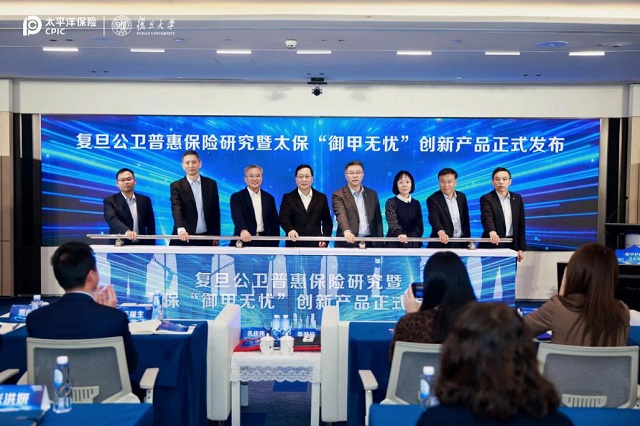
复旦大学公共卫生学院院长何纳分享专项研究报告 中国太保寿险总经理李劲松阐述"御甲无忧"精准破解甲癌患者三大痛点 复旦大学公共卫生学院院长何纳带来《中国人群甲状腺癌术后复发与生存研究报告》。他指出,甲状腺 癌近年来发病率呈上升趋势。尽管患者术后总体生存率较高,但术后复发仍是需要关注的重要风险。研 究团队基于大量临床数据分析,明确了影响复发风险的关键因素,这些研究成果为"御甲无忧"产品的精 准风险定价与保障设计提供了关键的医学依据。 1月9日,中国太保旗下中国太保寿险与复旦大学保险应用创新研究院、复旦大学公共卫生学院联合研发 的创新产品"太保御甲无忧疾病保险"(以下简称"御甲无忧")正式发布。作为面向甲状腺癌术后患者的专 属解决方案,"御甲无忧"精准回应患者对于健康风险保障及持续健康管理的迫切需求,是破解带病体人 群保障难题的一次创新实践。 发布会上,复旦大学保险应用创新研究院执行理事长孔庆伟表示,这款由复旦大学与中国太保寿险联合 研发的带病体保险产品的推出,标志着精准医学与保险精算的深度融合,是金融创新服务民生的重要实 践。他回望复旦大学保险应用创新研究院创立的初心"复旦平台、上海力量、行业先声",表示"御甲无 ...


锋龙股份“公告前涨停”引内幕交易质疑
Jin Rong Shi Bao· 2026-01-23 01:25
Core Viewpoint - Fenglong Co., Ltd. has experienced a significant stock price surge, reaching 90.48 CNY per share, with a 17-day consecutive trading limit increase, raising concerns about potential trading risks and market speculation [1] Group 1: Stock Performance and Trading Risks - The stock price of Fenglong Co., Ltd. has increased dramatically since mid-December 2025, attributed to the anticipated acquisition by UBTECH Robotics, despite no major changes in operational conditions or disclosures [2] - The company has issued multiple risk warnings regarding its stock price volatility, indicating a significant deviation from its fundamental performance and cautioning against irrational market behavior [1][3] - The company reported a net loss of 7.04 million CNY in 2023, with a projected profit of 4.59 million CNY in 2024, highlighting a stark contrast to its current high static price-to-earnings ratio of nearly 3000 times [3] Group 2: Acquisition Details - UBTECH Robotics plans to acquire a 29.99% stake in Fenglong Co., Ltd. at a price of 17.72 CNY per share, with a total transaction value of approximately 1.665 billion CNY [3][4] - Following the acquisition, UBTECH will hold a 43.01% stake in Fenglong, becoming the controlling shareholder, which is seen as a strategic move to enhance its industry chain and competitive edge [4] - UBTECH has already paid about 101 million CNY as a performance guarantee for the acquisition, with the transaction pending approval from relevant regulatory bodies [5] Group 3: Industry Context - UBTECH Robotics, established in 2012, is recognized as a leading player in the humanoid robotics sector and aims to leverage its technological advantages in collaboration with Fenglong's manufacturing capabilities [4] - The recent partnership with Airbus for humanoid robot services indicates UBTECH's commitment to expanding the application of humanoid robots in various industries, including aerospace [5]

首家日资独资券商落地北京
Jin Rong Shi Bao· 2026-01-23 01:25
Group 1 - Mizuho Securities (China) Co., Ltd. has officially established its presence in Beijing with a registered capital of 2.3 billion RMB, becoming the second newly established wholly foreign-owned securities company in Beijing [1] - Mizuho Securities (China) is fully owned by Mizuho Securities Co., Ltd., a core institution of Japan's Mizuho Financial Group, marking it as the first wholly Japanese-owned securities firm in China and the sixth wholly foreign-owned securities firm in the country [1][3] - The company’s business scope includes securities underwriting, proprietary trading, and asset management limited to asset securitization [1] Group 2 - The management team of Mizuho Securities (China) includes experienced local executives, with Geng Xin serving as Vice Chairman and General Manager, who has a strong background in investment banking [2] - Mizuho Securities has a long history dating back to 1891 and has over 7,000 employees, with operations across Europe, America, and Asia [2] - Prior to Mizuho Securities (China), there were two other Japanese securities firms in China, Nomura Orient International Securities and Daiwa Securities (China), both of which are joint ventures [3] Group 3 - The establishment of Mizuho Securities (China) reflects the increasing openness of China's capital markets, which currently has six wholly foreign-owned securities firms and eight foreign-controlled joint venture firms [4] - The entry of foreign institutions into the Chinese capital market is seen as a direct expression of confidence in the market, promising a wider range of financial products and more professional service models [4] - The China Securities Regulatory Commission emphasizes the importance of integrating foreign expertise and practices to enhance the development of the Chinese capital market [4]
保险业协会 召开健康保险高质量发展工作座谈会
Jin Rong Shi Bao· 2026-01-23 01:24
Group 1 - The meeting held by the China Insurance Industry Association on January 22 aims to promote the development of the health insurance sector in alignment with national strategies and policies [1] - The commercial health insurance sector has experienced a compound annual growth rate (CAGR) of over 20% in the past decade, with more than 11,000 medical insurance products currently available [1] - The meeting highlighted the importance of policy support and market demand in driving the sustainable development of the health insurance industry [1] Group 2 - Commercial health insurance has expanded its coverage to include high-value treatments and technologies, such as CAR-T therapy and proton therapy, which were added to the responsibility list over the past decade [2] - It is estimated that by 2025, the total compensation amount for innovative drugs and devices by commercial health insurance will reach approximately 14.7 billion yuan, with a CAGR of 70% over the past four years [2] - The insurance industry is encouraged to enhance service quality and product offerings to better meet the high-quality health protection needs of the population, especially in response to aging demographics and the support of key national industries [2]
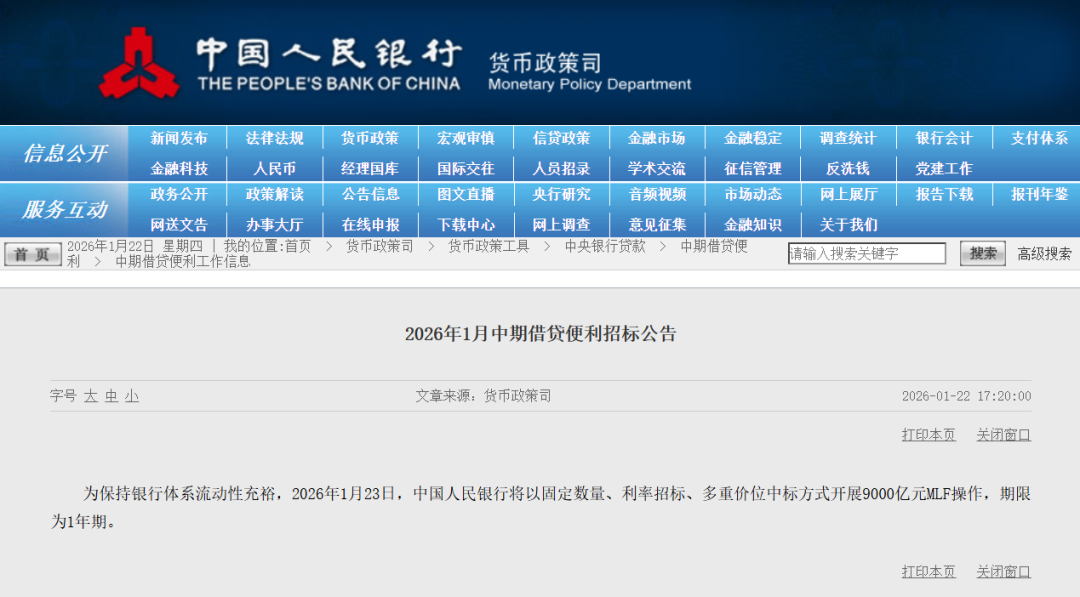
9000亿元!央行宣布将于23日开展MLF操作
Jin Rong Shi Bao· 2026-01-22 13:17
1月22日,中国官网宣布,为保持银行体系流动性充裕,1月23日,中国将以固定数量、利率招标、多重价位中标方式开展9000亿元中期借贷便利(MLF)操 作,期限为1年期。 | | | "政府债券发行节奏明显提前,实现了早发行、早使用、早见效。"有业内人士谈到,这也体现了货币政策、财政政策的协同发力。"当前,两者在政府债 券领域的协同,有效稳定了市场资金面,为重大项目提供了资金保障。"业内专家表示。 "央行的流动性护航,让财政发债'轻装上阵',有效稳定了市场预期。,央行通过逆回购、买断式逆回购等操作注入的流动性,为政府债券发行提供了坚 实支撑。"明明对《金融时报》记者表示。 数据显示,国债发行了16万亿元,全年净增6.6万亿元,年末余额大约是40万亿元,其中,银行、非银行金融机构、境外机构分别持有了27万亿元、5万亿 元和2万亿元,银行等市场机构为了改善资产配置、加强流动性管理,是持有国债的主力。在满足这些机构对国债资产配置需要的前提下,中国买卖国债 可以更好地保障国债以合理成本顺利发行。此外,,中国通过买断式回购操作的国债、债券余额接近7万亿元,这对提高政府债券的市场流动性也发挥了 重要作用。 而往后看,货币政 ...