
Jin Rong Shi Bao

Search documents
“十五五”时期中国粮食安全的战略展望
Jin Rong Shi Bao· 2026-01-19 01:40
Core Viewpoint - Food security is a crucial component of national security, essential for economic stability, social harmony, and people's well-being. The country has been continuously improving its policy framework and implementing strategic measures to establish a robust and sustainable food security system, particularly during the "14th Five-Year Plan" period [1][2]. Group 1: Achievements in Food Security - During the "14th Five-Year Plan" period, China's grain production has shown stable growth, with annual production consistently exceeding 1.3 trillion jin, and projected to surpass 1.4 trillion jin in 2024, marking a 2.1% year-on-year increase [3]. - The per capita grain production reached 501.68 kg, and per capita cereal production reached 463.18 kg, indicating self-sufficiency in grain supply [3]. - The national grain storage capacity exceeds 730 million tons, with high-standard storage facilities increasing to 220 million tons, ensuring the quality and safety of stored grain [3]. Group 2: Agricultural Modernization and Emergency Preparedness - Significant progress in agricultural modernization has been made, with over 100 million acres of high-standard farmland established and a mechanization rate exceeding 75% [4]. - The coverage rate of quality seeds has reached over 96%, enhancing crop yield and quality [4]. - A multi-level grain emergency response system has been established, increasing the number of national emergency grain processing enterprises from 5,448 to 6,872 [4]. Group 3: Risks and Challenges in Food Security - The main contradiction in food security has shifted from a tight balance of supply and demand to insufficient systemic resilience, influenced by global climate change, geopolitical conflicts, and trade frictions [2][5]. - External risks include fluctuations in international food markets due to extreme weather, political instability in exporting countries, and rising trade protectionism [5][6]. - Domestic challenges include ecological pressures on grain production, significant losses in supply chain links, and increasing consumer demand for diverse food products [2][7]. Group 4: Short-term Strategies for Food Security - Strengthening monitoring and early warning mechanisms for international food markets is essential to mitigate external risks [10]. - Diversifying food import sources and enhancing domestic production capabilities for crops with high external dependency, such as soybeans, is crucial [10]. - Improving the regulatory framework for core crop gene data protection is necessary to safeguard agricultural innovation and food security [11]. Group 5: Long-term Development Plans - Emphasizing the development of new agricultural productivity through digital transformation and technological innovation is vital for enhancing food production and supply capabilities [15]. - Strengthening the core competitiveness of the seed industry by integrating advanced biotechnologies and extending the agricultural industry chain is essential for sustainable growth [16]. - Enhancing the resilience of the food supply chain through the application of cutting-edge technologies across all stages of food production and distribution is a long-term goal [17].
黑龙江省旅游经济的机制驱动与路径突破
Jin Rong Shi Bao· 2026-01-19 01:40
Core Viewpoint - The high-quality development of the tourism economy in Heilongjiang Province is essential for the province's economic growth and aligns with the national strategy for sustainable development, despite facing challenges such as seasonal dependency and weak regional collaboration [1][3]. Group 1: Current Status and Driving Mechanisms - Heilongjiang Province has experienced rapid growth in its tourism economy, with 1.8 billion visitors and a tourism expenditure of 250.18 billion yuan in the first eight months of 2025, marking increases of 11.9% and 21.2% respectively compared to the previous year [3]. - The province boasts rich tourism resources, including 110 scenic spots rated 4A and above, and 27 S-level ski resorts, contributing to its reputation as a major tourist destination [3]. - The driving mechanism for tourism growth includes a collaborative framework of resource endowment, policy support, and market demand adaptation, creating a virtuous cycle of development [5][6]. Group 2: Challenges to High-Quality Development - The tourism industry in Heilongjiang faces significant seasonal dependency, with 81.1% of tourist spending concentrated in peak seasons, leading to underutilization of facilities during off-peak times [7]. - There is a lack of regional collaboration, with administrative barriers hindering resource integration and marketing efforts, limiting the potential for a cohesive tourism experience [8]. - Financial support for the tourism sector is inefficient, with traditional lending models failing to meet the unique needs of small and medium-sized tourism enterprises, exacerbating funding challenges [9]. Group 3: Recommendations for Improvement - To enhance tourism efficiency, it is recommended to develop a "year-round, all-region" product system that includes diverse seasonal offerings and a comprehensive tourism network [12]. - Strengthening regional collaboration through unified marketing platforms and cross-regional tourism projects can enhance the economic impact of tourism [13]. - Improving financial support mechanisms by creating specialized credit systems and innovative financial products tailored to the tourism sector can address funding gaps and support sustainable growth [14].
数据交易所的发展定位及创新方向
Jin Rong Shi Bao· 2026-01-19 01:40
Core Insights - China's data technology development has entered a new phase of systematic layout and collaborative promotion, with efforts to cultivate various data circulation service institutions and accelerate the construction of an open, shared, and secure national integrated data market [1][5] Group 1: Data Market Development - The marketization and efficient utilization of data are core paths to activate the multiplier effect of the digital economy, with data exchanges playing a crucial role in connecting data supply and demand [2] - The National Data Bureau has categorized data circulation service institutions into three types, marking a new stage in the construction of the data factor market [2][3] - Data exchanges are essential components of the national integrated data market, and their future development should focus on "three deep integrations" to clarify their functional positioning and innovation direction [2][6] Group 2: Types of Data Circulation Service Institutions - Data circulation service institutions are evolving, with a need to include platform enterprises and data merchants in the research scope beyond just data exchanges [3] - Data exchanges are exploring the establishment of a full-chain service system for data circulation transactions, but their current role and transaction scale are still limited [3] - Industry data integration and utilization models are being accelerated by data circulation service platform enterprises, which focus on value co-creation through data sharing and exchange [4] Group 3: Role of Data Merchants - Data merchants, as key players in data production and operation, are actively gathering data resources and developing data governance and trading practices [5] - They are innovating in exploring new data circulation transaction models, such as high-quality data sets and data-as-a-service models [5] Group 4: Policy Recommendations for Data Exchanges - Data exchanges should deeply integrate with the development of the real economy, assisting enterprises in data utilization and assetization [7][8] - They should also support public data transactions by providing compliance review and valuation services [8][9] - The construction of data circulation infrastructure is crucial for enhancing the efficiency of data market operations [10][11] Group 5: Innovation and Regulation - Safety, regulation, and innovation are essential for the sustainable development of the data market, with data exchanges needing to establish norms and promote innovative practices [11][12] - A systematic policy framework is necessary to support the long-term development of data exchanges, focusing on capability building and ecosystem cultivation [13][14]
政协第十三届贵阳市委员会第五次会议开幕
Jin Rong Shi Bao· 2026-01-18 23:06
Group 1 - The meeting of the 13th Guizhou Provincial Committee of the Chinese People's Political Consultative Conference opened on January 18 in Guiyang [1]
“坐高铁不用自己扛行李了”——评论区为啥炸锅?
Jin Rong Shi Bao· 2026-01-18 23:06
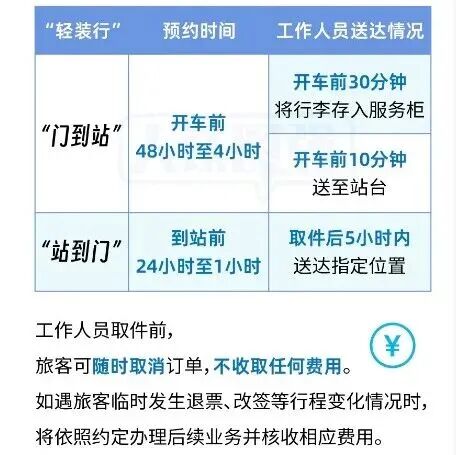
Core Viewpoint - The introduction of the "Light Travel" service by China Railway Express aims to ease the burden of carrying large luggage for travelers during the upcoming Spring Festival travel rush, expanding its coverage to 111 stations across major cities in China [1][18]. Group 1: Service Overview - The "Light Travel" service offers door-to-station and station-to-door luggage transportation within a 35-kilometer radius of the train station, allowing travelers to book services 48 hours to 4 hours before departure or 24 hours to 1 hour before arrival [1][2][8]. - The service is designed to provide a convenient and efficient luggage handling experience, enabling travelers to enjoy a hassle-free journey [8]. Group 2: Booking Process - Travelers can book the "Light Travel" service through the railway 12306 App or WeChat mini-program by selecting the service module and following the booking steps [6][12]. - The booking process includes entering travel details, specifying luggage information, and uploading photos for verification [14]. Group 3: Pricing Structure - The service charges are set at 68 yuan per piece for door-to-station and station-to-destination services, and 98 yuan per piece for door-to-platform and platform-to-destination services [18]. - For business class travelers at select stations, the service fee is also 98 yuan per piece for luggage delivery to the business waiting area [18]. Group 4: Coverage Areas - The service is available in various regions, including Northeast, North, East China, Central, South, Southwest, and Northwest, covering major cities such as Harbin, Beijing, Shanghai, Guangzhou, and Urumqi [18][19][20][21][22][23][24].

周末重磅!央行、金融监管总局下调商业用房购房贷款最低首付款比例
Jin Rong Shi Bao· 2026-01-18 02:41
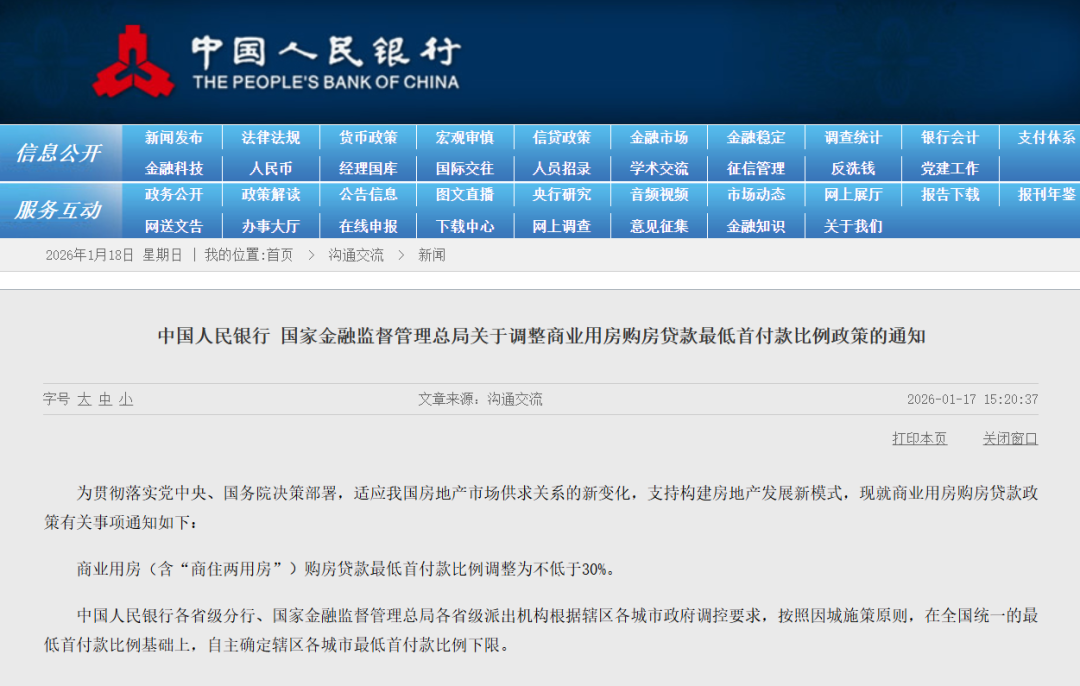
Core Viewpoint - The People's Bank of China and the National Financial Regulatory Administration have announced a policy adjustment to reduce the minimum down payment ratio for commercial property loans to 30%, aimed at stimulating the commercial real estate market and reducing inventory levels [3][4]. Group 1: Policy Changes - The minimum down payment ratio for commercial property loans, including "commercial-residential mixed-use properties," has been adjusted to no less than 30% from the previous 50% [3]. - Local branches of the People's Bank of China and the National Financial Regulatory Administration will determine the minimum down payment ratio based on local government regulations, adhering to the principle of "differentiated policies" [3]. Group 2: Market Context - As of November 2025, there are 52.34 million square meters of unsold office space and 141.05 million square meters of unsold commercial properties in China [3]. - The commercial property market, which includes shops, office buildings, hotels, and commercial complexes, has been experiencing a slower inventory reduction compared to the residential market [4]. Group 3: Expert Opinions - Experts believe that lowering the down payment ratio will significantly reduce the initial financial burden on buyers, particularly benefiting small and medium-sized enterprises and startups [4]. - The adjustment is seen as a coordinated effort with residential market policies and a targeted response to structural issues in the commercial real estate sector [4]. Group 4: Additional Support Measures - Various cities are providing subsidies for purchasing commercial properties, such as a 50% rebate on deed tax in Wuhan and a 10,000 yuan subsidy for purchases over 100 square meters in Nanning [5]. - The short-term effect of the policy is expected to stimulate demand in active commercial areas, while the long-term recovery of the commercial property market will depend on sustained growth in consumption and the service sector [5].
重要会议召开,释放明确信号→
Jin Rong Shi Bao· 2026-01-16 12:47
Core Viewpoint - The 2026 financial regulatory work meeting emphasizes a comprehensive deployment of financial regulation, focusing on risk prevention, strong regulation, and promoting high-quality development to support the "14th Five-Year Plan" [1] Group 1: Risk Prevention and Resolution - The meeting prioritizes the effective resolution of risks in small and medium-sized financial institutions, aiming to manage existing risks and prevent new ones, particularly in the real estate sector [2][3] - A systematic approach will be adopted for risk prevention, focusing on high-risk institutions through coordinated efforts between central and local authorities [2][3] - The regulatory focus will shift from mere scale expansion to substantive risk control, enhancing classification and tiered regulation [3] Group 2: Promoting High-Quality Development - The meeting calls for improving the capacity for high-quality development in the financial sector, emphasizing the need for orderly competition and optimizing institutional layout [4] - The strategy of "reducing quantity and improving quality" will guide the restructuring of financial institutions, focusing on eliminating inefficient and high-risk entities [4][5] - Regulatory measures will target disordered competition, ensuring financial institutions concentrate on their core businesses and adhere to capital constraints [4][5] Group 3: Strengthening Financial Regulation - The meeting outlines the need to enhance and perfect financial regulation, focusing on substantive risks and improving the capacity for lawful regulation [6][7] - The "Golden Supervision Project" will be accelerated, marking a shift towards digital and intelligent regulation to improve risk identification and oversight capabilities [6][7] - The regulatory framework will evolve towards precision, differentiation, and collaboration, ensuring effective consumer protection and preventing cross-market risks [7] Group 4: Enhancing Financial Services for Economic and Social Quality - The meeting emphasizes the need to improve financial services for the economy, focusing on major strategies and sectors, including support for consumer demand and small enterprises [8][9] - Financial institutions will be encouraged to develop integrated financial solutions that link investments in physical assets with human capital [9][10] - Internal mechanisms will be optimized to enhance service delivery, particularly for technology-driven and small enterprises, through improved credit evaluation and risk management [10]
“忽悠式重组”被证监会立案!股价跌停→
Jin Rong Shi Bao· 2026-01-16 07:15
Core Viewpoint - The company Sunflower is under investigation by the Zhejiang Securities Regulatory Bureau for allegedly misleading statements in its restructuring plan, which has raised market concerns regarding the actual production capacity and business model of the targeted assets [1][2]. Group 1: Investigation Details - On January 14, the company received a notice from the China Securities Regulatory Commission (CSRC) regarding the formal investigation due to suspected violations of information disclosure laws [2]. - The investigation is based on the restructuring plan disclosed by the company in September 2025, which involved acquiring 100% of the shares of Zhangzhou Xipu Materials Technology Co., Ltd. and 40% of the shares of Zhejiang Beid Pharmaceutical Co., Ltd. [3]. - The CSRC's investigation aims to maintain order in the mergers and acquisitions market following the discovery of misleading statements in the restructuring proposal [1]. Group 2: Restructuring Plan and Business Model - The restructuring plan aimed to expand the company's business into the high-end semiconductor materials sector, which was expected to create a new growth curve and accelerate the transition to new productive forces [3]. - The targeted company, Xipu Materials, is involved in the research, manufacturing, and sales of high-end semiconductor materials, with products used in key processes of semiconductor manufacturing [3]. - Concerns have been raised regarding the actual production capacity of Xipu Materials' factories, which reportedly do not possess operational capabilities [5]. Group 3: Financial Performance and Market Reaction - In the first three quarters of 2025, the company reported revenue of 19.952 million yuan, a year-on-year decline of 12.09%, and a net profit attributable to shareholders of 1.3062 million yuan, down 53.10% year-on-year [7]. - Following the announcement of the investigation, the company's stock price fell by 20% to 4.96 yuan per share, resulting in a total market capitalization of 6.385 billion yuan [7].
贵金属货币的底层逻辑: 效率、稀缺与制度选择
Jin Rong Shi Bao· 2026-01-16 06:36
Core Insights - The historical evolution of currency has been closely tied to physical commodities, particularly metals like gold, silver, and copper, which have served as the primary basis for monetary systems until the end of the Bretton Woods system [1] - The efficiency of currency as a medium of exchange, unit of account, and store of value is fundamentally linked to its ability to be accepted at face value without the need for due diligence on its actual worth [2][3] - The attributes of precious metals enhance the efficiency of transactions and have played a crucial role in the evolution of monetary systems, making them a preferred choice for currency [3][7] Group 1: Characteristics of Precious Metals - Precious metals fulfill the "no-question-asked" principle, allowing them to be accepted at face value in transactions, which is essential for their role as currency [2] - The properties of silver, such as stability, ease of delivery, and durability, have historically made it a more acceptable medium of exchange compared to other goods [2] - The efficiency of precious metals in fulfilling monetary functions is not merely a reflection of their commodity value but is also tied to their information efficiency in economic transactions [3] Group 2: Macroeconomic Stability and Monetary Policy - The stability of currency supply, particularly for commodity money like precious metals, has been critical for maintaining long-term monetary stability [4] - Historical perspectives, such as those from philosopher Nicole Oresme, emphasize the importance of maintaining the integrity of currency to prevent economic disruptions and loss of public trust [6] - Manipulating the metallic content of currency can lead to significant economic consequences, including reduced foreign trade and uncertainty in domestic transactions [6] Group 3: Historical Context and Market Dynamics - The dominance of metal currency for nearly three millennia is attributed to market forces and technological constraints, making it the optimal choice for exchange [7] - The evolution of currency systems has been driven by the need for efficiency in transactions, with precious metals providing a clear advantage in this regard [3][7]
推动党建与业务深度融合
Jin Rong Shi Bao· 2026-01-16 04:10
Core Viewpoint - The integration of party building work with business operations is a key strategy for the Dazhou branch of the People's Bank of China to lead high-quality business development through high-quality party building [1] Group 1: Mechanism Co-creation - The Dazhou branch focuses on political leadership by combining the spirit of the 20th National Congress with core work, detailing 383 learning items through lists and materials [2] - The branch has incorporated the deep integration of party building and business into key work and management systems, enhancing responsibility through various management methods [2] - In 2025, the Dazhou branch issued 77,000 "small change bags" totaling 28.5065 million yuan to meet residents' needs for small change [2] Group 2: Platform Co-construction - The Dazhou branch promotes 29 key projects under the "Party Building + Risk Tackling" initiative, creating a brand matrix with 11 sub-brands [3] - The branch has conducted 10 promotional activities related to foreign exchange policies, successfully addressing issues for local enterprises [3] - The branch has implemented a "green finance special action," with the national reserve forest project loan balance ranking first in Sichuan province [3] Group 3: Team Co-cultivation - The Dazhou branch has established a "dual mentor" system for talent development, selecting 27 young cadres to serve as party committee members or liaison officers [4] - The branch has organized 15 training sessions covering 223 party workers, emphasizing the importance of integrating party work into core business [4] - The branch has created 17 "Party Member Pioneer Posts" and conducted various activities to promote advanced models and their impact [4]