
Zhong Guo Huan Jing Bao

Search documents
中国环保力量出海要注意什么?
Zhong Guo Huan Jing Bao· 2025-07-11 01:43
Group 1 - The core viewpoint of the articles emphasizes the importance of international cooperation in environmental governance, particularly through the "Bangkok Clean Air" project between China and Thailand, which aims to provide comprehensive technical solutions for pollution management [1] - The articles highlight the necessity for Chinese environmental companies to understand local conditions and public opinions in the countries they operate in, ensuring that projects align with local environmental governance philosophies [1] - Compliance with local laws and regulations is crucial, as many countries have strict environmental protection laws that must be adhered to during project implementation [1] Group 2 - The objective of international projects is to promote Chinese technology, equipment, and standards in the environmental governance sector, contributing to global environmental solutions [2] - Companies are encouraged to maintain a long-term vision while balancing short-term goals, ensuring that social, environmental, and economic benefits are well-coordinated [2] - Flexibility and adaptability are essential, as technologies and models may need to be adjusted to fit new social environments, and collaboration with established local Chinese enterprises can enhance project success [2]
全国先进工作者丨赵雪:“身上装备的重量,远不及肩头的责任重”
Zhong Guo Huan Jing Bao· 2025-07-11 01:36
Core Viewpoint - Zhao Xue has been recognized as a national advanced worker for her exceptional contributions in the field of radiation monitoring and safety, showcasing advanced methods and a meticulous attitude in her work [1][6]. Group 1: Professional Background and Contributions - Zhao Xue graduated with a degree in applied chemistry in 2010 and joined the Chongqing Radiation Environment Supervision Station, where she has dedicated 15 years to radiation monitoring [4][7]. - She has been instrumental in providing precise scientific support for radiation environment management, emergency response, environmental planning, and public information [6][7]. - During the "14th Five-Year Plan" period, Zhao analyzed or reviewed over 20,000 manual monitoring data and more than 5 million automatic monitoring data [7]. Group 2: Innovative Problem-Solving - Zhao has a unique ability to draw inspiration from everyday life to solve laboratory challenges, exemplified by her innovative use of polishing strips from a nail salon to improve the preparation of silver sheets for experiments [5][6]. - Her interdisciplinary approach allows her to combine physical and chemical measurement techniques, enhancing the reliability of data in gamma nuclide identification [6]. Group 3: Emergency Response and Community Engagement - Zhao played a crucial role in emergency monitoring during the 2011 Fukushima nuclear accident, providing timely data on artificial radioactive nuclides that addressed public concerns [7]. - She actively engages in monitoring high-dose hazardous areas and has contributed to the development of radiation source regulatory systems to ensure safety [7]. Group 4: Mentorship and Knowledge Transfer - Zhao emphasizes the importance of mentorship, having been guided by her predecessor, Du Hengyan, and is committed to passing on knowledge to younger colleagues to maintain the tradition of "old teaching new" [7].


李青松:梁衡笔下的人文古树
Zhong Guo Huan Jing Bao· 2025-07-11 01:29
Core Concept - The article discusses the significance of cultural ancient trees in China, highlighting the efforts of Liang Heng in establishing the concept of "cultural ancient trees" and the discipline of "cultural forestry" [1][4][11] Group 1: Liang Heng's Contributions - Liang Heng is recognized as the first to propose the concept of cultural ancient trees and advocate for the establishment of a related academic discipline [1] - He aims to find one hundred cultural ancient trees and write one hundred articles about them, emphasizing the need to protect culture through forests and vice versa [1][4] - His work has led to the publication of "Trees on the Chinese Skyline," which includes 33 cultural ancient trees linked to significant historical figures and events [4][11] Group 2: Cultural and Ecological Significance - The concept of cultural ancient trees is defined as trees that are old, have stories, and are associated with major historical events [4][5] - Liang Heng's exploration of ancient trees serves as a means to understand the relationship between humans and nature, as well as the cultural identity of a nation [5][6] - The article emphasizes the ecological and cultural values of trees, which have often been overlooked in favor of material needs [5][6] Group 3: Development of the Discipline - The establishment of a major in ancient tree protection at Beijing Agricultural University marks a significant step in formalizing the study of cultural ancient trees [11] - The publication of the textbook "Ancient Tree History and Culture" reflects the integration of Liang Heng's concepts into academic curricula [11] - The introduction of specific regulations for the protection of ancient trees in China indicates a growing recognition of their importance in ecological and cultural contexts [11]

拒绝“一问三不知”!企业环境风险防范须做到“三清”
Zhong Guo Huan Jing Bao· 2025-07-11 00:08
Core Insights - Companies have established emergency response systems for environmental risks, but many lack clarity on key risk factors, indicating a need for improved management practices [1][2] - The identification of risk substances, risk units, and risk levels is crucial for effective environmental risk management [2][3] Group 1: Environmental Risk Management - Many companies have not implemented a regular risk assessment mechanism due to cost considerations, leading to a lack of understanding of the physical and chemical properties of risk substances [1][2] - Emergency plans are often created by copying templates without verifying the actual risk conditions, resulting in a disconnect between plans and real risks [1][2] Group 2: Risk Identification and Classification - "Risk substance clarity" involves identifying the characteristics and scale of risk substances, requiring professional teams or third-party organizations to conduct thorough assessments [2][3] - "Risk unit clarity" necessitates precise identification of risk units throughout the production process, with tailored monitoring and prevention strategies for different types of units [2][3] Group 3: Risk Level Assessment - "Risk level clarity" requires scientific classification of risk units based on established standards, ensuring that risk levels are matched with appropriate prevention measures and resources [3] - Companies must revise emergency plans to incorporate detailed risk characteristics and response standards, creating a refined risk prevention and emergency response system [3]
智慧工地、定向音箱让成都重归宁静
Zhong Guo Huan Jing Bao· 2025-07-11 00:06
Core Viewpoint - Chengdu has shifted its approach to noise pollution management from passive response to proactive prevention, effectively reducing noise complaints through enhanced industry regulation and community involvement [1] Group 1: Noise Pollution Management Strategies - Chengdu's ecological environment bureau has conducted a comprehensive analysis of noise pollution, identifying high-impact industries and developing management norms to promote self-regulation within these sectors [1] - The city has implemented a "100-day campaign" against noise pollution in 2025, resulting in an 11.9% year-on-year decrease in noise complaints, with specific reductions in social life noise (6.4%), construction noise (19.1%), transportation noise (28.3%), and industrial noise (43.9%) [1] Group 2: Smart Construction Sites - Construction noise, accounting for nearly 30% of total noise complaints, is being addressed through the installation of automatic noise monitoring devices at construction sites, with 2,236 units installed across 1,720 sites by the end of 2024 [2] - A "smart construction site" platform allows for real-time monitoring and quick response to noise complaints, ensuring compliance with regulations and minimizing disturbances [2][3] Group 3: School Noise Management - To address complaints about school broadcasting noise, Chengdu has installed 34 directional sound systems in 9 schools, significantly reducing noise complaints by 52.2% during the 2025 campaign [4] - The directional sound systems are designed to control sound propagation, balancing the needs of students and residents [4] Group 4: Collaborative Governance - Chengdu has enhanced its noise pollution management framework by issuing guidelines for various sectors, including education, sports, and dining, to ensure comprehensive noise control [6] - Collaborative efforts among local government departments have led to a 27.2% decrease in noise complaints from the dining sector in 2024, with a continued decline of 12.8% in 2025 [6] Group 5: Future Directions - Chengdu plans to further improve its noise management systems by adopting advanced technologies and best practices, aiming for a comprehensive noise governance framework that enhances the living environment for residents [7]
污染治理者为何变成污染肇事者?该如何遏制“污染治理者造假”的行为?
Zhong Guo Huan Jing Bao· 2025-07-10 23:19
Core Viewpoint - Environmental pollution control companies have been involved in pollution incidents, raising concerns about their role as polluters rather than protectors of the environment [1][2]. Group 1: Reasons for Violations - Weak legal awareness among small and micro enterprises leads to negligence of laws and regulations, resulting in unethical practices when handling projects [2]. - Limited technical capabilities of these companies often result in inadequate compliance with project requirements, prompting them to engage in illegal activities such as unauthorized wastewater discharge [2]. - The pursuit of maximum economic benefits drives some companies to cut corners, leading to substandard operations and environmental harm [2]. Group 2: External Pressures - Economic pressures and low bidding prices create a challenging environment for companies, pushing some to lower their environmental standards and engage in deceptive practices [3]. - The influence of clients (the "first party") can pressure environmental companies (the "second party") into falsifying data to maintain contracts, compromising environmental integrity [2][3]. Group 3: Regulatory Recommendations - Increased regulatory oversight by local ecological and environmental departments is necessary to address common violations such as illegal discharges and falsified environmental monitoring [3]. - There is a need for stricter penalties for intentional violations by environmental companies to deter future misconduct [3]. - Enhancing the connection between administrative enforcement and criminal justice is crucial for effectively addressing severe violations and ensuring accountability [3].
强化光催化技术应用,探索臭氧治理新路径
Zhong Guo Huan Jing Bao· 2025-07-10 03:14
Group 1 - The formation mechanism of ozone pollution is complex, influenced by the synergistic effects of volatile organic compounds (VOCs) and nitrogen oxides (NOx), with photochemical reactions regulated by meteorological conditions, making governance more challenging than particulate matter [1] - Current strategies in China focus on source reduction of VOCs and NOx to combat ozone pollution, facing challenges such as high prevention costs, long cycles, and a lack of end-of-pipe treatment technologies [1] - Innovative breakthroughs in end-of-pipe treatment technologies, such as the efficient catalytic materials developed by the Chinese Academy of Sciences, have shown potential in reducing ozone concentrations by 10%-20% in treated areas [1] Group 2 - There is a need for enhanced policy and financial support to promote the application of photocatalytic technology in urban ozone governance, including integrating pollutant self-purification technologies into urban renewal and green building standards [2] - Strengthening technology research and development, improving standardization, and enhancing application efficiency are essential, including the development of catalytic materials suitable for high humidity and complex environments [2] - The essence of end-of-pipe ozone governance is to enhance the self-repair capability of urban ecosystems through green and low-carbon means, embedding ozone control into urban life systems [2]
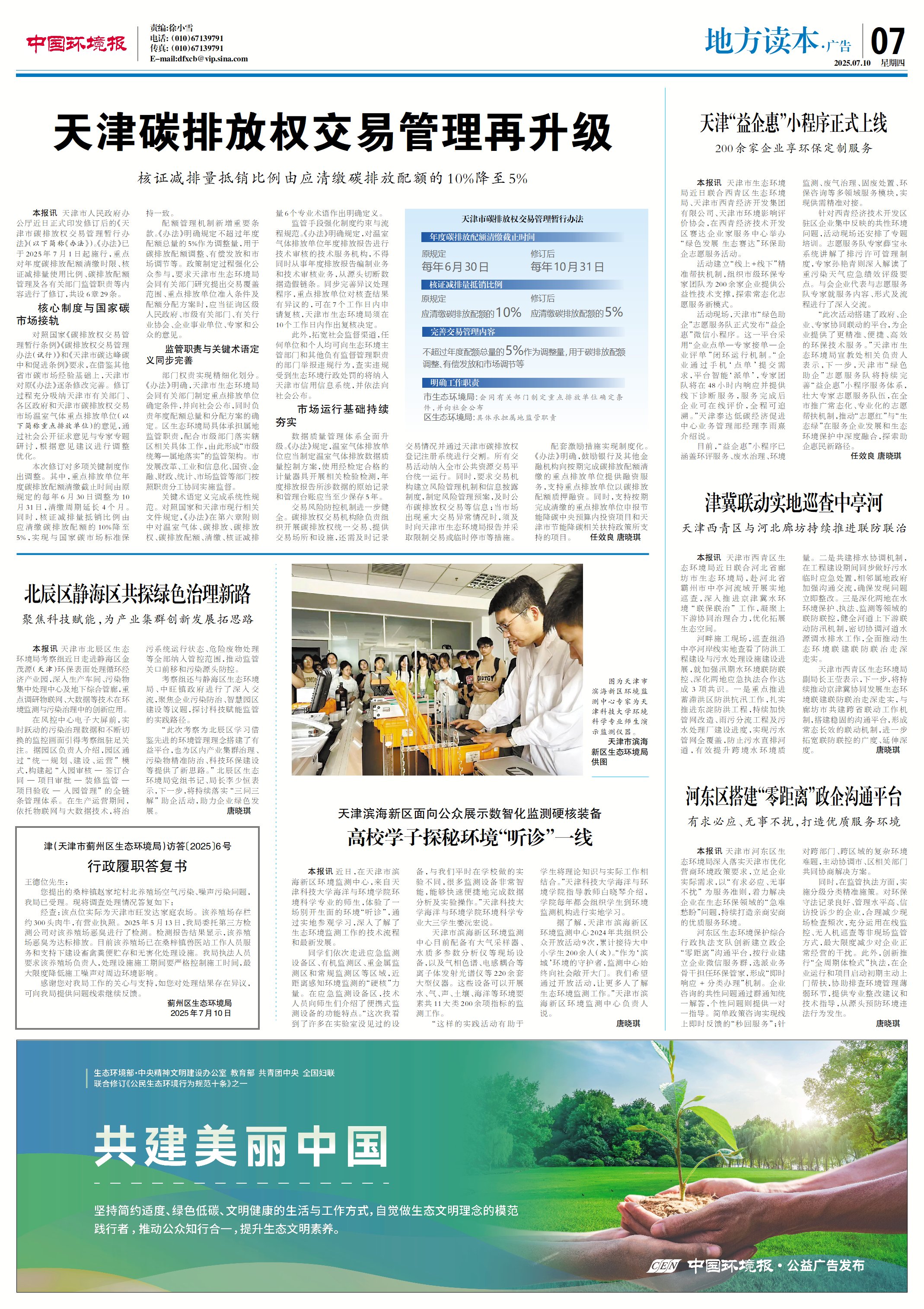
天津碳排放权交易管理再升级
Zhong Guo Huan Jing Bao· 2025-07-10 02:45
Core Viewpoint - The Tianjin Municipal Government has officially issued the revised "Interim Measures for the Management of Carbon Emission Rights Trading in Tianjin," which will take effect on July 1, 2025, focusing on adjustments to carbon emission quota compliance deadlines, the use ratio of certified emission reductions, and the management of carbon emission quotas, among other aspects [1][9]. Group 1: Key Adjustments in Regulations - The deadline for annual carbon emission quota compliance for key emission units has been extended from June 30 to October 31, increasing the compliance period by four months [2][11]. - The offset ratio for certified emission reductions has been reduced from 10% to 5% of the required carbon emission quotas, aligning with national carbon market standards [2][11]. - A new provision allows up to 5% of the total annual quota to be used for adjustments, paid issuance, and market regulation [2][11]. Group 2: Regulatory Responsibilities and Definitions - The Tianjin Municipal Ecology and Environment Bureau is responsible for determining the conditions for key emission units and the total annual quota and distribution plan [3][12]. - The regulatory framework has been refined to establish a "city-level coordination and local implementation" structure, with various departments collaborating on supervision [3][12]. - Key terms such as greenhouse gases, carbon emissions, and carbon emission rights have been clearly defined in the revised measures [3][12]. Group 3: Strengthening Oversight and Public Participation - The revised measures enhance public participation in policy formulation, requiring the Tianjin Municipal Ecology and Environment Bureau to consult with various stakeholders when proposing trading coverage and quota distribution plans [2][11]. - Any individual or organization can report violations to the relevant ecological environment authorities, with confirmed violations being recorded in the Tianjin credit information system [4][13]. Group 4: Market Operation and Risk Management - The measures mandate that greenhouse gas emission units develop data quality control plans and maintain original records for at least five years [5][14]. - Carbon emission trading institutions are required to establish risk management mechanisms and report significant trading anomalies to the Tianjin Municipal Ecology and Environment Bureau [5][14]. - Financial institutions are encouraged to provide financing services to key emission units that comply with carbon emission quota requirements [5][14].
以“无废城市”建设推动美丽城市建设
Zhong Guo Huan Jing Bao· 2025-07-10 01:44
Group 1: Core Concepts - The construction of beautiful cities and "waste-free cities" share a common pursuit for future urban development, focusing on high-quality living and sustainable development [1] - The "five beauties" goals of beautiful city construction—green and low-carbon, beautiful environment, ecological livability, safety and health, and smart efficiency—align closely with the principles of waste reduction, recycling, and safe disposal in waste-free cities [1] Group 2: Implementation Strategies - Emphasizing source reduction and green transformation is essential for solidifying the foundation of beautiful city construction, requiring collaboration among various departments to manage solid waste effectively [1][2] - The integration of resource recycling and facility fusion is crucial for enhancing the operational efficiency of beautiful cities, promoting a comprehensive approach to solid waste management [2] - The establishment of a "multi-network integration" system for urban solid waste collection and transportation is necessary to facilitate high-value utilization and clean regeneration of solid waste [2] Group 3: Safety and Regulation - Strengthening digital empowerment and information management is vital for enhancing the safety baseline of beautiful cities, particularly in the regulation of hazardous waste [3] - The development of new technologies for the comprehensive utilization of emerging solid waste types, such as retired batteries and solar panels, is a priority [3] Group 4: Value Creation and Community Engagement - The implementation of "waste-free cells" and the cultivation of demonstration models like "waste-free campuses" and "waste-free business circles" are key to enriching the development connotation of beautiful cities [4] - Establishing a green financial support system for waste-free city construction can enhance the availability of financial products for waste-free industries [4] - The focus on transforming solid waste recycling into a resource for green and low-carbon transitions is essential for realizing ecological and economic benefits in beautiful cities [4]
评估中心耿海清:我国CCUS技术面临哪些挑战?如何保障CCUS技术良性发展?
Zhong Guo Huan Jing Bao· 2025-07-10 00:16
Core Viewpoint - The article emphasizes the importance of Carbon Capture, Utilization, and Storage (CCUS) technology in achieving China's carbon peak and carbon neutrality goals, highlighting the need for sustainable development and policy support for CCUS implementation [1]. Summary by Sections Current Status of CCUS Technology - CCUS technology in China is categorized into three types: pre-combustion, oxy-fuel combustion, and post-combustion capture. Pre-combustion capture has high investment costs and complexity, with no industrial demonstration projects yet. Oxy-fuel combustion is still in the experimental stage, while post-combustion capture, particularly chemical absorption, is the most widely used method [2]. - Carbon storage technologies include deep saline aquifer storage, depleted oil and gas reservoir storage, and deep-sea storage. Deep saline aquifers have the highest potential due to their proximity to emission sources, with several projects in regions like Yulin and Ordos demonstrating a storage capacity of around 100,000 tons per year [2]. Utilization of CO2 - CO2 utilization methods are divided into geological, chemical, biological, and physical uses. Enhanced oil recovery and uranium in-situ leaching are the most mature geological utilization techniques in China, with several demonstration projects established [3]. - Chemical utilization includes mature technologies like urea and sodium bicarbonate production, while other methods, such as methanol production, are still in research stages. Biological utilization through microalgae cultivation is commercialized, while greenhouse gas fertilization is still in demonstration phases [3]. Challenges Facing CCUS Technology - High application costs are a significant barrier to the large-scale commercialization of CCUS technologies in China, with costs for various capture methods ranging from 70 to 400 yuan per ton. The mismatch between costs and benefits hampers the development of a mature business model, leading to reliance on state-owned enterprises for project implementation [4]. - Pollution risks exist in the carbon capture process, particularly with chemical absorbents that can release gases and create secondary pollution if not disposed of properly [4]. Policy Support and Standards - Despite over 100 CCUS-related policies in China, most are non-binding and lack incentives. There is a need for mandatory policies similar to those in other countries that require new coal power plants to implement CCUS technology [5]. - The absence of fiscal incentives, such as tax breaks or subsidies for companies implementing CCUS, and the lack of comprehensive energy efficiency and greenhouse gas emission standards hinder the development of CCUS technology [5]. Recommendations for CCUS Development - A comprehensive assessment of different CCUS technology routes is necessary to ensure sustainable development and minimize environmental risks. This includes evaluating resource and environmental impacts alongside economic and social benefits [6][7]. - Establishing clear ecological and environmental standards for CCUS technologies is crucial, including energy consumption limits and pollution prevention measures throughout the carbon capture, transport, and storage processes [8]. - A supportive management mechanism for CCUS technology should be developed, including expanding carbon emission control coverage, implementing carbon taxes with incentives for CCUS adopters, and enhancing financial support for CCUS projects [9].