Founder Park

Search documents
吴欣鸿内部分享,美图在 AI 时代的组织进化心得
Founder Park· 2025-10-12 02:04
Core Insights - The article discusses the evolution of Meitu in the AI era, highlighting the successful implementation of generative AI technology and its impact on the company's growth and organizational structure [4][6]. Group 1: Company Performance and Market Environment - Meitu's app, Meitu Xiuxiu, achieved the top position in the App Store across 14 European countries and ranked first in 28 countries in its category due to its AI photo features [4]. - The external environment is characterized by a competitive landscape in the imaging sector, with many AI startups emerging, capable of generating millions in annual recurring revenue with small teams [9][10]. Group 2: Internal Challenges and Organizational Evolution - The company faces internal challenges such as rigid workflows, excessive meetings, and a lack of global perspective, which hinder innovation speed [10][18]. - Meitu has initiated a project called RoboNeo, which adopted a "reverse inertia workflow" approach, allowing for rapid development and deployment, achieving over one million monthly active users in its first month without traditional marketing [22][30]. Group 3: Innovative Practices in Project Management - The RoboNeo project emphasized demand co-creation, simplified meetings, and the use of AI to enhance productivity across various roles, allowing team members to take on multiple responsibilities [25][28][39]. - The project also focused on building a Minimum Viable Product (MVP) quickly, enabling rapid iterations based on user feedback [30][34]. Group 4: AI Integration and Future Directions - Meitu aims to integrate AI across key areas such as coding, design, and marketing, with an 86% adoption rate of AI coding tools and a goal to develop AI full-stack engineers [43]. - The company has established AI innovation studios to encourage creative product development, providing resources and support for small teams to validate their ideas [45][47]. Group 5: Cultural and Organizational Values - Meitu has introduced an upgraded set of cultural values emphasizing passion for imaging, pursuit of excellence, global perspective, pragmatism, breaking inertia, and a spirit of competition [57][65]. - The cultural framework is designed to foster a stable yet agile organization, likened to a beehive structure that supports innovation while maintaining order and efficiency [58][59].


谁在赚钱,谁爱花钱,谁是草台班子,2025 年度最全面的 AI 报告
Founder Park· 2025-10-11 11:57
Core Insights - The AI industry is transitioning from hype to real business applications, with significant revenue growth observed among leading AI-first companies, reaching an annualized total revenue of $18.5 billion by August 2025 [3][42]. Group 1: AI Industry Overview - AI is becoming a crucial driver of economic growth, reshaping various sectors including energy markets and capital flows [3]. - The "State of AI Report (2025)" by Nathan Benaich connects numerous developments across research, industry, politics, and security, forming a comprehensive overview of the AI landscape [5]. - The report emphasizes the evolution of AI from a research focus to a transformative production system impacting societal structures and economic foundations [5]. Group 2: AI Model Developments - 2025 is defined as the "Year of Reasoning," highlighting advancements in reasoning models such as OpenAI's o1-preview and DeepSeek's R1-lite-preview [6][8]. - Major companies released reasoning-capable models from September 2024 to August 2025, including o1, Gemini 2.0, and Claude 3.7 [11]. - OpenAI and DeepMind continue to lead in model performance, but the gap is narrowing with competitors like DeepSeek and Gemini [17]. Group 3: Revenue and Growth Metrics - AI-first companies are experiencing rapid revenue growth, with median annual recurring revenue (ARR) for enterprise and consumer AI applications exceeding $2 million and $4 million, respectively [42][48]. - The growth rate of top AI companies from inception to achieving $5 million ARR is 1.5 times faster than traditional SaaS companies, with newer AI firms growing at an astonishing rate of 4.5 times [45]. - The adoption rate of paid AI solutions among U.S. enterprises surged from 5% in early 2023 to 43.8% by September 2025, indicating strong demand [48]. Group 4: Market Trends and Predictions - The report predicts that AI-generated games will become popular on platforms like Twitch, and a Chinese model may surpass several Silicon Valley models in rankings [5][75]. - The rise of open-source models in China is noted, with Alibaba's Qwen model gaining significant traction in the global developer community [24][26]. - AI is shifting from being a tool to a scientific collaborator, actively participating in the generation and validation of new scientific knowledge [34]. Group 5: Challenges and Issues - Traditional benchmark tests for AI models are becoming less reliable due to data contamination and variability, leading to a focus on practical utility as a measure of AI capability [21][22]. - Several major AI companies faced significant operational challenges and public scrutiny over technical failures and ethical concerns [39][40]. - The report highlights the financial pressures on AI coding companies, which face challenges in maintaining profitability despite high valuations [50][51].




智能体开发大赛、AI 项目月度路演,近期优质 AI 活动都在这里
Founder Park· 2025-10-11 11:57
Group 1 - The article highlights several upcoming AI events worth participating in, including the Bol Research Intelligent Agent Development Competition and the Yuan Chuang Camp AI Agent Innovation Competition [2][10] - The Bol Research Intelligent Agent Development Competition is organized by Deep Sense Technology, Beijing Science and Intelligence Research Institute, and Shanghai Jiao Tong University, with two phases scheduled from September 11 to October 10, 2025, and October to December 2025 [4] - The Yuan Chuang Camp AI Agent Innovation Competition focuses on AI and interactive entertainment, offering a total prize pool of 1 million yuan, with the first evaluation awarding 200,000 yuan and the second 800,000 yuan [9][10] Group 2 - The S Innovation Monthly Roadshow will take place on October 24, featuring 10 future intelligence projects, with the top two advancing to the S Innovation Shanghai 2026 Science and Technology Conference [11] - The EquatorQ AI Global Future Summit is scheduled for October 17-18, showcasing nearly a hundred industry experts and offering deep discussions on innovative projects and AI research reports [12] - NVIDIA is currently recruiting for its startup acceleration program, providing members with access to free deep learning training, SDKs, and business networking opportunities [14][15]

为什么 OpenAI 们都要搞 AI 基建?Groq 创始人把背后的逻辑讲透了
Founder Park· 2025-10-10 13:27
Core Insights - OpenAI is actively investing in chip development and collaborating with companies like NVIDIA, AMD, and Oracle to build next-generation AI infrastructure, highlighting the critical role of chips and data centers in AI advancement [2][3] - The growth of AI applications is currently limited by the availability of computing power, indicating that companies with greater access to this resource can serve more users and generate higher revenues [3][23] - A differentiated and efficient supply chain serves as a significant competitive advantage in a market with nearly unlimited demand for AI products [3] Group 1 - The difficulty of chip manufacturing is often underestimated, as it involves complex software ecosystems and continuous engineering optimization [7][15] - Major tech companies are pursuing chip development not just for performance but to gain control over their supply chains and bargaining power [7][30] - The current market for computing power is characterized by scarcity, with many companies still relying on older NVIDIA H100 GPUs, which generate revenue significantly higher than their operational costs [7][47] Group 2 - The investment landscape in AI is robust, with companies like Microsoft deploying large amounts of GPUs for internal use, generating more revenue than renting them out [13][21] - A small number of companies contribute to the majority of AI revenue, indicating a highly concentrated market where supply and demand dynamics play a crucial role [14][36] - The challenges of entering the chip market are significant, with many projects failing despite initial investments, underscoring the complexity of chip design and production [15][28] Group 3 - The return on investment for data centers is longer than for chips, with significant capital expenditures required for infrastructure development [37][39] - Companies are increasingly focused on shortening payback periods and minimizing operational costs to remain competitive in a rapidly evolving market [46][50] - The supply of computing power is a decisive factor in determining market winners, with companies that can secure more capacity gaining a competitive edge [51][52] Group 4 - The AI industry is experiencing a shift where the demand for computing power is expected to grow exponentially, leading to potential shortages [92][94] - The relationship between AI advancements and computing power is unique, as improvements in one area can lead to enhancements in the other, creating a feedback loop [96][97] - The future of AI may lead to significant changes in labor markets, with potential job shortages arising from increased automation and efficiency [97][99]

Sam Altman:我承认我之前错了,AI 超级系统才是 OpenAI 真正想要的
Founder Park· 2025-10-09 12:37
Core Insights - OpenAI aims to build a powerful AI super system rather than a "super app," integrating cutting-edge research, large-scale infrastructure, and consumer products [4][12] - The company is focused on creating a personal AI subscription service that users can access across various platforms and potentially through dedicated hardware in the future [8][12] - OpenAI is actively investing in AI infrastructure and forming partnerships with companies like AMD and Oracle to support its ambitious research and development goals [19][20] Group 1: Product Strategy and Vision - OpenAI's vision includes a ubiquitous ChatGPT that integrates products, infrastructure, and hardware, with a focus on user experience and interaction [5][12] - The company believes that the future of interaction may involve AI-rendered dynamic video worlds, unlocking new possibilities for user engagement [7][29] - OpenAI is exploring various business models for its products, particularly Sora, which may involve per-use charges due to high production costs [30][31] Group 2: AI Infrastructure and Industry Collaboration - OpenAI is committed to aggressive investments in AI infrastructure, recognizing the need for collaboration with key industry players to support its growth [20][21] - The company sees its infrastructure as essential for both research and product development, emphasizing a vertically integrated technology stack [11][19] - OpenAI's partnerships with companies like AMD and Oracle are part of a broader strategy to enhance its capabilities and market position [19][20] Group 3: Future of AI and AGI - OpenAI is focused on the long-term goal of achieving AGI (Artificial General Intelligence) and believes that advancements in AI will lead to significant societal benefits [8][23] - The company is exploring the potential of AI to discover new knowledge, which could redefine its role in scientific research and innovation [39][40] - OpenAI anticipates that AI will increasingly take on scientific research tasks, potentially leading to groundbreaking discoveries in various fields [40]

OpenAI年度发布会:ChatGPT里能直接用App、Sora 2 API开放、推出Agent开发工具包
Founder Park· 2025-10-07 00:31
Core Insights - The article discusses the key announcements from OpenAI's annual developer conference, OpenAI Dev Day 2025, focusing on enhancing AI interaction and developer engagement [5][6]. Group 1: New Features and Tools - OpenAI introduced an enhanced Plugin system called "App Inside ChatGPT," allowing third-party applications to provide not just data but also interfaces for user interaction [7][12]. - The "Agent Kit" was launched, which includes a visual workflow editor for creating complex interactions and outputs, significantly improving the development process [20][27]. - The "Codex" programming tool has been upgraded to a formal version, optimizing code writing and agentic coding, with significant productivity improvements for developers [41][46]. Group 2: API Updates - The release of the GPT-5 Pro API, which supports high-context applications in fields like finance and healthcare, was highlighted, with a processing capacity of over 400 trillion tokens [55][56]. - The Sora 2 API was introduced, offering two versions for different use cases, from quick iterations to high-quality visual outputs [57]. - A new image generation API, "gpt-image," was launched, providing competitive pricing for image creation [63][64]. Group 3: Developer Engagement and Growth - OpenAI reported a significant increase in developer engagement, with 4 million developers and 800 million weekly users of ChatGPT, marking a substantial growth from two years ago [65][67]. - The conference showcased success stories, including an 89-year-old retiree who developed 11 iPhone apps using ChatGPT, illustrating the accessibility and impact of AI tools [71].

硅谷资深工程师:不止是 AI 产品,Coding 也需要好的 taste
Founder Park· 2025-10-06 02:05
Core Viewpoint - A good "taste" in technology is crucial for developing AI products, and it is distinct from technical ability. Cultivating a good technical taste can lead to results that exceed one's technical capabilities [2][5]. Group 1: Importance of Engineering Taste - Engineering taste is defined as the ability to choose appropriate engineering values for current projects, as most decisions in software engineering involve trade-offs between different goals [6][11]. - The essence of technical taste lies in understanding that every decision in software engineering is a trade-off, and recognizing the balance between conflicting engineering values is a hallmark of maturity in the field [11][15]. Group 2: Characteristics of Good and Bad Taste - Good taste is difficult to identify compared to technical ability, as it involves selecting suitable engineering values for specific technical problems. Success in projects can indicate good taste [16][17]. - Bad taste often stems from rigidity, where engineers advocate for methods that worked in past projects without considering their suitability for current projects [13][15]. Group 3: Engineering Values - Key engineering values that define technical taste include resiliency, speed, readability, correctness, and flexibility. Each engineer prioritizes these values differently based on the project requirements [11][12]. - Other important values include portability, scalability, and development speed, which can influence preferences for programming languages and architectural decisions [14]. Group 4: Developing Good Taste - To cultivate good taste, it is recommended to try different types of work and observe which aspects of projects are easy or challenging. Flexibility in thinking about software development is also essential [17][18].

当下的 AI 产品:有 revenue,但不是 recurring 的
Founder Park· 2025-10-03 01:03
Core Insights - The article discusses the rapid growth of Annual Recurring Revenue (ARR) in AI startups, highlighting the pressure on founders to achieve significant revenue milestones quickly [4][6] - It critiques the distortion of the ARR metric, suggesting that it has been manipulated to fit unrealistic growth expectations in the AI sector [7][10] - The article emphasizes that traditional ARR metrics are no longer suitable for evaluating AI companies due to fundamental differences in business models and customer behavior [10][12] Group 1: ARR Growth and Distortion - ARR has seen rapid growth in AI startups, with examples like Midjourney reaching $200 million in less than three years and ElevenLabs nearing $100 million in 20 months [6] - Founders are under immense pressure to quickly scale ARR, leading to a redefinition of what constitutes "recurring" revenue [4][10] - The concept of "vibe revenue" has emerged, indicating that some reported revenues are not truly recurring but rather based on temporary or trial agreements [8][9] Group 2: Inadequacy of Traditional Metrics - The traditional ARR metric, which worked well in the SaaS era, is now deemed inadequate for AI companies due to their unique business dynamics [10][11] - AI customers often engage in short-term pilot projects rather than long-term commitments, resulting in high customer churn rates [12] - The pricing model for AI services is unpredictable, contrasting with the linear, predictable nature of SaaS pricing [12][13] Group 3: Systemic Issues in the Startup Ecosystem - The startup ecosystem has become somewhat closed and self-referential, with standardized methods of entrepreneurship leading to a focus on pleasing investors rather than genuine business health [17][18] - There exists a transactional loop where AI startups sell products to each other, reinforcing the acceptance of questionable metrics like "booked ARR" as industry standards [18][19] - The article suggests that the current focus on ARR is symptomatic of a larger issue, where inflated valuations are driven by the pursuit of potential breakthroughs in AI [19][20] Group 4: Future Directions - The consensus among industry observers is that ARR will not be the future metric for evaluating AI businesses, as investors seek more reliable indicators of user engagement and retention [20] - New metrics focusing on user retention, daily active usage, and unit economics are expected to emerge as more accurate measures of business health in the AI sector [20]

OpenAI Sora 2 登场!同步推出APP,Altman称这是创意领域的「ChatGPT 时刻」
Founder Park· 2025-10-01 04:07
Core Insights - OpenAI has officially announced the launch of Sora 2, a next-generation AI video model that aims to compete directly with Google's Veo 3 [3] - Sora 2 has achieved significant advancements in physical accuracy, realism, consistency, and controllability, marking a substantial leap in AI video generation technology [4][15] - The model introduces "audio-visual synchronization," enhancing the overall quality of generated content [5] Group 1: Technological Advancements - Sora 2 represents a breakthrough in AI video generation, moving from unrealistic outputs to more plausible and physically accurate representations [15] - The model has improved in simulating real-world physics, allowing for realistic actions such as basketball shots that can miss or bounce off the backboard [19] - Sora 2 can generate complex scenarios with high consistency, such as a gymnast performing with a cat on their head, showcasing its advanced capabilities [20][22] Group 2: User Interaction and Applications - The introduction of the Sora App allows users to project themselves into generated scenes, creating a new form of social interaction [48] - Users can easily integrate their likeness and voice into various scenarios, enhancing the personalization of content creation [48][50] - The app's recommendation system focuses on content with creative potential, encouraging user engagement and interaction [57] Group 3: Safety and Governance - Sora 2 incorporates multiple layers of safety measures, including content filtering and user verification to protect against misuse [68] - The platform emphasizes the importance of protecting minors and ensuring that users have control over their likeness in generated content [68] - OpenAI has implemented a transparent evaluation process for content moderation, achieving high interception rates for inappropriate content [68] Group 4: Future Directions - OpenAI plans to continue enhancing Sora 2 by feeding it more high-quality video data, aiming for even greater realism and detail in future iterations [89] - The advancements in Sora 2 are expected to impact various industries, including film, advertising, and education, by providing new tools for content creation [90] - The model's evolution signifies a shift from mere content consumption to active participation in content creation, allowing users to become the protagonists in their stories [92]

加量不加价,一篇说明白 Claude Sonnet 4.5 强在哪
Founder Park· 2025-09-30 03:46
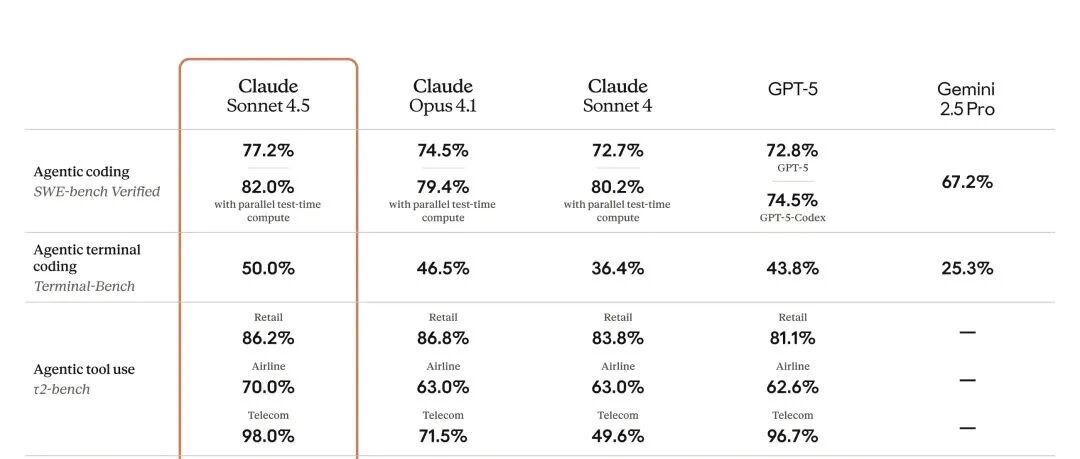
Core Viewpoint - Anthropic has launched the Claude Sonnet 4.5 model, claiming it to be the best coding model in the world, with a focus duration of over 30 hours for complex multi-step tasks, surpassing OpenAI's GPT-5 Codex [2][9]. Pricing and Cost Efficiency - The pricing for Claude Sonnet 4.5 remains the same as its predecessor, at $3 per million tokens for input and $15 per million tokens for output. Cost savings of up to 90% can be achieved through prompt caching, and batch processing can save 50% [2]. Developer Tools and Integration - Anthropic has introduced the Claude Agent SDK and an experimental feature called "Imagine with Claude" for developers, allowing integration with platforms like Amazon Bedrock and Google Cloud's Vertex AI [3][26]. Performance Metrics - In the SWE-bench Verified evaluation, Claude Sonnet 4.5 achieved industry-leading scores, with a 61.4% score in the OSWorld benchmark, significantly improving from the previous model's 42.2% [10][12]. Enhanced Features - The model includes new features such as a checkpoint function in Claude Code, context editing, and memory tools, enabling it to handle longer tasks and more complex operations [4][24]. Application and Usability - Users can interact with Claude Sonnet 4.5 through the Claude.ai website and mobile applications, with integrated functionalities for code execution and file creation directly within conversations [5][6]. Safety and Alignment - Claude Sonnet 4.5 is noted for its improved alignment and safety features, reducing undesirable behaviors such as deception and flattery, and making significant progress in defending against prompt injection attacks [24][25]. Experimental Features - The "Imagine with Claude" feature allows real-time software generation, showcasing the model's capabilities in adapting to user requests without pre-written code [31][33]. Recommendations - Anthropic recommends all users upgrade to Claude Sonnet 4.5 for enhanced performance across all applications, with updates available for both the Claude Code and developer platform [34].