国家能源局

Search documents
习近平在联合国气候变化峰会发表视频致辞
国家能源局· 2025-09-25 00:20
Core Points - The article emphasizes the importance of global climate governance and the need for countries to commit to their national contributions, especially in light of the 10th anniversary of the Paris Agreement [3][4] - It highlights China's new round of national contributions, aiming for a significant reduction in greenhouse gas emissions and an increase in non-fossil energy consumption by 2035 [4] Group 1: Key Messages from Xi Jinping's Speech - Xi Jinping calls for unwavering confidence in the green and low-carbon transition, urging the international community to maintain direction and momentum despite some countries' resistance [3] - The speech stresses the importance of fairness and justice, advocating for respect for developing countries' rights and responsibilities, and emphasizing that developed nations should lead in emission reductions and support developing nations with funding and technology [3] - There is a call for deepened international cooperation in green technology and industry to ensure the free flow of quality green products globally [3] Group 2: China's National Contributions - By 2035, China aims to reduce its total greenhouse gas emissions by 7%-10% from peak levels, with a target for non-fossil energy consumption to exceed 30% of total energy consumption [4] - The total installed capacity for wind and solar power is expected to reach over six times that of 2020, targeting 360 million kilowatts [4] - China plans to increase forest stock to over 24 billion cubic meters and make new energy vehicles the mainstream of new vehicle sales, alongside establishing a national carbon trading market covering major high-emission industries [4]


李强在全球发展倡议高级别会议上的讲话(全文)
国家能源局· 2025-09-24 08:19
Core Viewpoint - Development is a perpetual theme for human society, and the Global Development Initiative proposed by President Xi Jinping in 2021 aims to promote common development and has gained participation from over 130 countries and international organizations, becoming a widely accepted international public good [2] Group 1: Current Global Development Challenges - Historical evidence shows that global development progresses when countries unite and share benefits, while zero-sum thinking and increased division hinder development, affecting all parties [3] - The rise of unilateralism and protectionism has severely impacted international development cooperation, leading to weakened global economic growth and intensified competition for existing resources [3] Group 2: Proposed Solutions for Global Development - Create a stable and open international development environment, emphasizing that peace and stability are foundational for prosperity, and that economic globalization is an irreversible trend [4] - Build balanced and inclusive development partnerships, addressing the growing North-South development gap and ensuring that developed countries fulfill their commitments to support developing nations [4] - Foster future-oriented innovative development momentum by enhancing international cooperation in technology and innovation, while opposing barriers and promoting knowledge sharing [4] - Promote more sustainable green and low-carbon development to address climate change and environmental degradation, emphasizing the need for collaborative efforts in green transformation [4] Group 3: China's Commitment to Global Development - China has mobilized over $23 billion in funding for global southern development initiatives over the past four years, with plans to implement 2,000 "small but beautiful" livelihood projects in developing countries in the next five years [5] - China aims to strengthen technological cooperation to empower global development, including initiatives in artificial intelligence and digital capacity building for developing countries [6] - China has established the world's largest and most complete new energy industry chain, significantly reducing the costs of wind and solar power, and plans to continue supporting green development projects globally [7]

国家能源局综合司关于加强中秋国庆假期和第四季度电力安全生产工作的通知
国家能源局· 2025-09-24 08:19
Core Viewpoint - The article emphasizes the importance of ensuring electrical safety during the Mid-Autumn Festival and National Day holidays, as well as throughout the fourth quarter, in light of the increasing complexity and severity of safety risks in the power industry [3][4]. Group 1: Political Awareness and Responsibility - The article calls for heightened political awareness and responsibility regarding electrical safety during the extended holiday period, urging all units to implement safety measures and risk assessments thoroughly [4]. - It stresses the need for power companies to strengthen their safety management and ensure comprehensive coverage of safety protocols across all operations [4]. Group 2: Supply Assurance - The article highlights the anticipated increase in electricity demand due to winter heating needs and the potential for adverse weather conditions, urging proactive measures to ensure stable electricity supply [5]. - It recommends that power companies enhance equipment maintenance and operational reliability to prevent unplanned outages and ensure effective power distribution [5]. Group 3: Safety Measures - The article outlines the necessity of rigorous safety management in power construction projects, emphasizing the primary responsibility of construction units to manage safety effectively [6]. - It calls for thorough inspections and risk assessments before high-risk operations to prevent accidents and ensure safe construction practices [6]. Group 4: Emergency Preparedness - The article stresses the importance of emergency response readiness, including strict adherence to duty and reporting systems, and effective communication with relevant departments [7]. - It advocates for the development of comprehensive emergency plans and regular drills to enhance the capability to respond to unexpected events [7].
2025年1-8月全国电力市场交易电量同比增长7.0%
国家能源局· 2025-09-24 07:54
Core Viewpoint - The article highlights the growth in China's electricity market transactions, indicating a significant increase in both total transaction volume and the share of electricity traded in the market, reflecting a robust trend in the energy sector [2]. Group 1: Overall Market Performance - In August 2025, the total electricity market transaction volume reached 655 billion kilowatt-hours, representing a year-on-year growth of 11.6% [2] - From January to August 2025, the cumulative electricity market transaction volume was 4,344.2 billion kilowatt-hours, with a year-on-year increase of 7.0%, accounting for 63.2% of the total electricity consumption, an increase of 1.3 percentage points compared to the previous year [2] Group 2: Transaction Breakdown - Within the August 2025 transactions, the intra-provincial transaction volume was 485.9 billion kilowatt-hours, up 11.0% year-on-year, while the inter-provincial and inter-regional transaction volume was 169.1 billion kilowatt-hours, showing a growth of 13.4% [2] - For the January to August 2025 period, intra-provincial transactions totaled 3,314.8 billion kilowatt-hours, increasing by 6.3% year-on-year, and inter-provincial transactions reached 1,029.4 billion kilowatt-hours, with a growth of 9.4% [2] Group 3: Trading Types - In August 2025, the medium to long-term transaction volume was approximately 624.9 billion kilowatt-hours, while the spot transaction volume was about 30.2 billion kilowatt-hours [2] - For the January to August 2025 period, medium to long-term transactions amounted to 4,178.5 billion kilowatt-hours, and spot transactions were 165.7 billion kilowatt-hours [2] Group 4: Green Electricity Transactions - The green electricity transaction volume in August 2025 was 24.9 billion kilowatt-hours, reflecting a significant year-on-year growth of 47.2% [2] - From January to August 2025, the green electricity transaction volume was 205 billion kilowatt-hours, with a year-on-year increase of 43.3% [2]
专家解读丨以人工智能培育能源新质生产力 引领发电行业新变革
国家能源局· 2025-09-24 03:46
Core Viewpoint - The article emphasizes the importance of integrating artificial intelligence (AI) with the energy sector to enhance high-quality development and ensure energy security, as outlined in the recent implementation guidelines by the National Development and Reform Commission and the National Energy Administration [2]. Group 1: AI Integration in Power Generation - The implementation guidelines identify the power generation sector as a key area for AI application, promoting deep integration of AI technologies across various energy sources including thermal, hydro, and renewable energy [3]. - The guidelines focus on practical applications, addressing issues such as carbon reduction, safety, efficiency, and intelligent operations in traditional power generation, while also tackling the intermittency of renewable energy through advanced power forecasting and smart operations [4]. Group 2: Collaborative Industry Ecosystem - The guidelines propose the creation of an integrated smart production model that combines weather forecasting, power prediction, smart trading, and intelligent operations, aiming to transition the energy sector from "point intelligence" to "system intelligence" [5]. - The National Energy Group is exploring new energy service models that enhance the flexibility, safety, and efficiency of energy systems through multi-energy complementary scheduling and intelligent operations across the entire power production process [5]. Group 3: Addressing Challenges in AI Transformation - The guidelines highlight challenges such as data silos, fragmented computing power, and high energy consumption in AI applications within the energy sector, calling for collaborative efforts to tackle these common technical issues [6]. - The National Energy Group is committed to leveraging its role as a state-owned enterprise to drive technological innovation and establish a solid foundation for AI development in the energy sector [6]. Group 4: Data and Computational Power Enhancement - The guidelines stress the importance of establishing a comprehensive data management system that covers the entire lifecycle of data in power generation, ensuring high-quality data for AI applications [7]. - A multi-faceted intelligent computing center will be developed to support unified scheduling and task management, enhancing the synergy between power generation and computing resources [8][9]. Group 5: Model Capability Improvement - The guidelines call for optimizing model algorithms to address common issues in the power sector, aiming to enhance decision-making capabilities and transition from experience-driven to data-driven approaches [10]. Group 6: Systematic Support for AI in Energy - The guidelines outline measures to strengthen organizational implementation, promote collaborative innovation, and establish standards to ensure the high-quality development of AI in the energy sector [11]. - A comprehensive standard system covering data, computing power, models, and safety will be developed to guide the application of AI in the energy sector [12]. - The National Energy Group will focus on talent cultivation in AI, aiming to build a skilled workforce with expertise in both energy and AI technologies [14].

朝闻天下︱8月全社会用电量再破万亿千瓦时,制造业用电量同比增速创年内月度新高
国家能源局· 2025-09-24 02:28
Group 1 - The total electricity consumption in August exceeded 1 trillion kilowatt-hours, indicating a significant demand in the market [2] - The electricity consumption in the manufacturing sector reached a year-on-year growth rate, marking the highest monthly increase for the year [2]
人民日报丨8月全社会用电量再超万亿
国家能源局· 2025-09-24 02:28
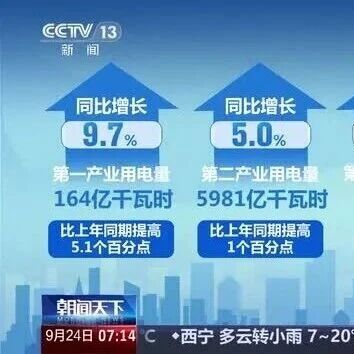
Core Insights - In August, the total electricity consumption in China exceeded 1 trillion kilowatt-hours for the second consecutive month, reaching 10154 billion kilowatt-hours, a year-on-year increase of 5.0% [3] - The growth in electricity consumption is attributed to high temperatures and humidity, which increased residential electricity usage, as well as the impact of national policies aimed at stabilizing and advancing the economy [3] Group 1: Electricity Consumption Breakdown - The first industry consumed 164 billion kilowatt-hours, with a year-on-year growth of 9.7% [3] - The second industry consumed 5981 billion kilowatt-hours, showing a year-on-year increase of 5.0% [3] - The third industry consumed 2046 billion kilowatt-hours, reflecting a year-on-year growth of 7.2% [3] - Urban and rural residential electricity consumption reached 1963 billion kilowatt-hours, with a year-on-year increase of 2.4% [3] - From January to August, total electricity consumption accumulated to 68788 billion kilowatt-hours, marking a year-on-year growth of 4.6% [3] Group 2: Manufacturing Sector Insights - In August, electricity consumption in the manufacturing sector grew by 5.5%, the highest monthly growth rate for the year [4] - Key industries such as steel, building materials, non-ferrous metals, and chemicals showed a significant recovery, with a combined electricity consumption growth of 4.2%, an increase of 3.7 percentage points from July [4] - High-tech and equipment manufacturing sectors demonstrated strong resilience, with all sub-industries achieving positive growth, resulting in a combined electricity consumption increase of 9.1%, surpassing the average growth rate of the manufacturing sector by approximately 4.6 percentage points [4] - The rapid growth in electricity consumption in sectors like new energy vehicle manufacturing and photovoltaic industry manufacturing indicates the emergence of new economic growth points [4]

署名文章丨国家能源局局长王宏志:以更大力度推动我国新能源高质量发展
国家能源局· 2025-09-24 00:15
Core Viewpoints - The development of renewable energy is crucial for improving energy structure, ensuring energy security, and promoting ecological civilization in China [2][3][4] - China has achieved historic accomplishments in renewable energy, becoming the largest and fastest-growing renewable energy system globally, with a complete industrial chain [3][5] - Renewable energy is a key driver for energy transition and economic development, contributing significantly to non-fossil energy consumption [3][4][5] Group 1: Achievements and Current Status - As of August this year, China's total installed capacity for wind and solar power exceeded 1.69 billion kilowatts, three times that of the end of the 13th Five-Year Plan, contributing 80% of new power installations since the beginning of the 14th Five-Year Plan [3][4] - The average cost of renewable energy has decreased significantly, with onshore wind power costs down by over 60% and solar power costs down by 80%, making renewable energy cheaper than coal power by 30% [4][5] Group 2: Future Development Strategies - The focus for the 14th Five-Year Plan is on expanding renewable energy supply and ensuring it plays a major role in achieving carbon peak goals [11][12] - Emphasis on non-electric utilization of renewable energy, such as biomass and geothermal energy, to diversify and scale up applications [12][13] - The integration of various energy sources and technologies is essential for enhancing efficiency and resource allocation in renewable energy development [8][12] Group 3: Market Dynamics and Challenges - The transition from resource-driven to benefit-driven development is necessary as the national unified electricity market progresses, with over half of renewable energy prices determined by the market [9][10] - The industry faces challenges such as price volatility and competition, necessitating a focus on cost control and operational efficiency [9][10] Group 4: Policy and Collaborative Efforts - A strong policy framework is needed to support the reliable replacement of traditional energy sources with renewable energy, ensuring a coordinated approach to energy supply and consumption [13] - Collaborative development across various sectors and technologies is vital for optimizing renewable energy utilization and enhancing overall system performance [13]
2025年8月份全社会用电量再破万亿,同比增长5.0%
国家能源局· 2025-09-23 07:03
1 - 8月,全社会用电量累计68788亿千瓦时,同比增长4.6%,其中规模以上工业发电量为64193亿千瓦时。从分产业用 电看,第一产业用电量1012亿千瓦时,同比增长10.6%;第二产业用电量43386亿千瓦时,同比增长3.1%;第三产业用 电量13297亿千瓦时,同比增长7.7%;城乡居民生活用电量11094亿千瓦时,同比增长6.6%。 8月份,全社会用电量10154亿千瓦时,同比增长5.0%。从分产业用电看,第一产业用电量164亿千瓦时,同比增长 9.7%;第二产业用电量5981亿千瓦时,同比增长5.0%;第三产业用电量2046亿千瓦时,同比增长7.2%;城乡居民生活 用电量1963亿千瓦时,同比增长2.4%。 9 月 23 日,国家能源局发布 8月份全社会用电量等数据。 ...
专家解读丨坚持创新驱动 激活发展新动能 努力打造“人工智能+”一流企业
国家能源局· 2025-09-23 01:59
一是坚持前瞻性谋划。《实施意见》面向 2027 年,提出人工智能赋能能源核心技术取得显著突破的阶段性目标,面向 2030 年,提出能源领域人工智能专用技术与应用总体达到世界领先水平的愿景目标。中国石油坚持把创新作为第一战略, 持续增强"看桅杆"的能力,勇做创新发展的探索者、组织者、引领者,聚焦"人工智能 + "能源,研究制定科技创新、产业 创新、管理创新等的重点举措重点任务。 二是坚持系统性布局。《实施意见》提出推动五个以上专业大模型在油气等行业深度应用,探索百个典型应用场景赋能路 径,能源领域人工智能技术实现跨业务场景赋能。中国石油将强化人工智能产业应用关键技术研发,以产业需求牵引创新 方向、打造人工智能科技创新策源地,以产业应用加速创新迭代、打造新模式新业态聚集地,加快构建开放、共享的人工 智能创新发展良好生态。 三是坚持体系化推进。 《实施意见》提出 以拓展人工智能与能源领域深度融合应用场景为重要依托,以提升能源领域人工 智能创新应用技术水平为主攻方向,加快培育新质生产力。中国石油将围绕持续推动能源生产、市场营销、经营管理、科 技研发、公司治理的变革升级,把人工智能广泛深度融合全产业链作为重点工作,着力 ...