新能源高质量发展

Search documents
全国人大代表钟宝申:多管齐下破除新能源“内卷”
中国能源报· 2026-03-05 12:23
Group 1 - The core focus of the article is on the development of the renewable energy sector, particularly in high-quality development, rural photovoltaic applications, and building-integrated photovoltaics [2] - The current capacity of China's photovoltaic industry chain is approximately 1,400 GW, significantly exceeding the global annual demand, leading to supply-demand imbalance and fierce price competition [3] - The article emphasizes the need for high standards to regulate competition in the photovoltaic industry, suggesting measures such as classifying policies by industry chain segments and establishing mandatory safety standards for components [3] Group 2 - Non-hydro renewable energy generation accounts for about 24% of China's total energy mix, with a need for a systematic policy to enhance green electricity consumption and address bottlenecks in photovoltaic utilization [4] - The article highlights the importance of rural photovoltaic development as a means to support rural revitalization and increase farmers' income, while addressing issues such as insufficient grid capacity and market risks for farmers [5] - The integration of photovoltaics with buildings and public facilities is crucial, with a call for improved safety management systems and policy incentives to promote quality over quantity in project development [7] Group 3 - The green hydrogen and ammonia industry is at an early stage but has significant potential for clean energy substitution and decarbonization, requiring national support for scaling and self-sufficiency [8] - The article suggests expanding domestic application scenarios for green hydrogen and ammonia, implementing minimum usage ratios in high-energy-consuming industries, and establishing a green value system for carbon reduction [8]


两会聚焦丨全国两会能源电力十大看点前瞻
中关村储能产业技术联盟· 2026-03-04 08:35
Core Viewpoint - The article emphasizes the importance of the energy and electricity sector in supporting economic growth and facilitating a green transition, highlighting key discussions expected at the upcoming National People's Congress and Chinese People's Political Consultative Conference [3]. Group 1: Energy Power Nation - The strategic goal of building an energy power nation has been outlined, with a focus on establishing a new energy system by the end of the 14th Five-Year Plan [4][5]. - Discussions will center on translating national strategies into actionable plans and the implementation of high-quality energy planning [5]. Group 2: Energy Investment - In 2025, national energy investments are projected to exceed 3.5 trillion yuan, with a focus on new energy systems, large-scale wind and solar bases, and clean coal utilization [6]. - The emphasis will be on optimizing investment structures and attracting private capital to key technologies and projects [6]. Group 3: High-Quality Development of New Energy - China has built the world's largest renewable energy system, but the focus is now shifting from quantity to quality, aiming to enhance the reliability of renewable energy [8]. - The goal is to increase the proportion of renewable energy supply while ensuring it can reliably replace fossil fuels [8]. Group 4: National Unified Electricity Market - The establishment of a national unified electricity market is a core task for energy system reform during the 14th Five-Year Plan, aimed at enhancing energy development vitality [10]. - The implementation of a unified market system will be a significant topic of discussion at the upcoming meetings [10]. Group 5: Future Energy Industries - The focus on innovation-driven development will lead to the growth of future energy industries, including hydrogen energy and nuclear fusion [12]. - Local governments are revealing plans to support green industries and advanced low-carbon technologies [12]. Group 6: Collaborative Energy Computing - The integration of digital technology with energy is being promoted, with several provinces establishing collaborative platforms for energy and computing [14]. - This collaboration is expected to enhance the efficiency and sustainability of energy systems [14]. Group 7: Carbon Emission Control - The transition from energy consumption control to carbon emission control is a key mechanism for promoting green development [15]. - The focus will be on ensuring smooth implementation and effective local management of carbon control measures [15]. Group 8: Combating Industry Overcapacity - The article highlights the need to address issues of homogeneous competition and overcapacity in the energy sector [17]. - Discussions will focus on promoting quality competition and preventing low-end capacity expansion [17]. Group 9: Expanding Green Electricity Consumption - The emphasis on expanding green electricity consumption is linked to broader economic strategies and environmental goals [19][20]. - Local governments are encouraged to promote green consumption practices and optimize pricing mechanisms for green electricity [20]. Group 10: Development of Private Economy in Energy - The implementation of the Private Economy Promotion Law is expected to enhance the role of private enterprises in the energy sector [21]. - Local governments are signaling support for private investment in new energy infrastructure and projects [21].

两会聚焦丨全国两会能源电力十大看点前瞻
国家能源局· 2026-03-04 03:42
Core Viewpoint - The article emphasizes the importance of the energy and electricity sector in supporting economic growth and facilitating a green transition, highlighting key discussions expected at the upcoming national conferences [2]. Group 1: Energy Power Nation - The strategic goal of building an energy power nation is outlined, with a focus on transforming national strategies into actionable plans [3]. - The 2025 national energy work conference aims to implement high-quality energy planning, with a new energy system and sector-specific plans expected by 2026 [3]. Group 2: Energy Investment - Energy investment is projected to maintain rapid growth, with key projects expected to exceed 3.5 trillion yuan in annual investment by 2025 [4]. - Investment priorities include new power systems, large-scale wind and solar bases, and clean coal utilization, among others [5]. Group 3: High-Quality Development of New Energy - Since the 14th Five-Year Plan, China has built the largest and fastest-growing renewable energy system globally, but now faces the challenge of enhancing quality alongside quantity [7]. - The focus is on increasing the proportion of renewable energy supply and improving its reliability as a substitute for fossil fuels [7]. Group 4: National Unified Electricity Market - The establishment of a national unified electricity market is a core task for energy system reform during the 14th Five-Year Plan, aimed at enhancing energy development vitality [9]. Group 5: Future Energy Industries - The emphasis on innovation-driven development highlights the need for new energy industries, with local governments proposing initiatives in hydrogen energy, energy storage, and green technologies [11][12]. Group 6: Collaborative Energy and Computing - The integration of digital technology and energy, termed "collaborative energy and computing," is emerging as a new trend, with various provinces initiating projects to optimize this integration [13]. Group 7: Dual Control of Carbon Emissions - The transition from energy consumption control to dual control of carbon emissions is a significant change, with a focus on establishing a comprehensive incentive and constraint system [15]. Group 8: Combating Internal Competition - The article addresses the issue of "internal competition" in the energy sector, advocating for a shift from quantity expansion to quality competition [17][18]. Group 9: Expanding Green Electricity Consumption - The push for green electricity consumption is highlighted, with policies aimed at promoting green production and lifestyle changes [19]. Group 10: Development of Private Economy in Energy - The role of the private economy in the energy sector is growing, with initiatives to support private enterprises in contributing to green and low-carbon transitions [21].

保障能源安全,中国做了一件大事!
中国能源报· 2026-03-03 12:13
Core Viewpoint - China is set to establish the world's largest and fastest-growing renewable energy system by the end of 2025, with total installed capacity reaching 2.34 billion kilowatts, increasing the share of renewable energy from 40% to approximately 60% during the 14th Five-Year Plan period [1][2]. Group 1: Development Speed and Capacity - By 2025, the combined installed capacity of wind and solar power will exceed that of thermal power for the first time, increasing from 530 million kilowatts in 2020 to 1.84 billion kilowatts, marking a historic leap across 13 billion-level milestones [2]. - New energy storage capacity will surpass 100 million kilowatts, accounting for over 40% of the global total, enhancing the stability of wind and solar power generation [2]. Group 2: Green Energy Consumption - The annual trading volume of renewable energy green certificates will exceed the total of previous years, accelerating the establishment of mechanisms for green energy consumption [2]. - Nearly 40% of the total electricity consumption in China is now green electricity, meaning that for every 10 kilowatt-hours consumed, nearly 4 kilowatt-hours are from renewable sources [2]. Group 3: Structural Optimization and Innovation - The optimization of energy supply structure is ongoing, with significant advancements in the renewable energy sector during the 14th Five-Year Plan period, including the establishment of large-scale wind and solar bases [2][3]. - The reform and innovation of energy systems and mechanisms, such as the improvement of green certificate trading mechanisms and market-oriented pricing for renewable energy, are effectively stimulating demand for green electricity [3]. - China has built the largest and fastest-growing renewable energy system globally, contributing significantly to the global low-carbon transition, with exports of wind and solar products helping to reduce carbon emissions by approximately 4.1 billion tons in other countries [3].
“风光”高质量发展,不可忽视用地需求
中国能源报· 2026-03-03 04:23
Core Viewpoint - The article emphasizes the significant growth of China's wind and solar energy sectors, highlighting that by 2025, new installed capacity will exceed 430 million kilowatts, accounting for over 80% of total new installations, and cumulative installed capacity will surpass 1.8 billion kilowatts, establishing itself as the largest power source in the system [1] Group 1: Development and Impact of Renewable Energy - The development of wind and solar energy is crucial for addressing climate change, fostering new economic growth, and reshaping the global development landscape, while also contributing to sustainable development [1] - China's achievements in the renewable energy sector enhance domestic energy security and play a vital role in the global transition to low-carbon energy [1] Group 2: Land Resource Challenges - Land is a critical factor for the development of wind and solar energy, with wind energy requiring significantly more land compared to traditional fossil fuels [2] - The average direct land use requirement for wind energy is approximately 7,539.64 square meters per megawatt, with the spatial land use demand being even greater [2] - The projected land use demand for new wind and solar projects during the 14th Five-Year Plan period is about 157,730 hectares, affecting an area of approximately 4.47 million hectares [2] Group 3: Land Availability and Distribution - Suitable land for wind and solar development is limited and unevenly distributed, often overlapping with ecologically sensitive areas and farmland [3] - Regions rich in wind and solar resources face restrictions due to ecological protection lines and urban development boundaries, leading to a scarcity of available land for development [3] Group 4: Policy and Future Directions - The National Development and Reform Commission and the National Energy Administration have previously set goals for renewable energy capacity, aiming for over 1.2 billion kilowatts by 2030, while the current capacity has already reached 1.206 billion kilowatts as of July 2024, six years ahead of schedule [4] - The rapid growth of the wind and solar sectors necessitates a reevaluation of land use requirements and proactive land resource management to ensure sustainable development [4] Group 5: Recommendations for Development - Conducting a comprehensive survey of land for wind and solar projects is essential for understanding the current development landscape and facilitating large-scale, sustainable growth [5] - A coordinated national approach is necessary to optimize project layouts and ensure compliance with land use regulations, preventing inefficient land use and project mismanagement [5] Group 6: Technological and Management Innovations - Enhancing technological innovation is vital for improving land use efficiency in the wind and solar sectors, including increasing the efficiency of solar cells and the capacity of wind turbines [6] - Establishing a cross-departmental coordination mechanism is crucial for streamlining land use standards and approval processes, addressing the complexities of land management in renewable energy projects [6]
人民日报丨我国建成全球最大的可再生能源体系 每用10度电就有近4度是绿电
国家能源局· 2026-03-02 02:38
Core Viewpoint - China aims to establish the world's largest and fastest-growing renewable energy system by the end of 2025, with total installed capacity reaching 2.34 billion kilowatts and renewable energy's share increasing from 40% to approximately 60% during the 14th Five-Year Plan period [2][4]. Group 1: Renewable Energy Development - By 2025, the combined installed capacity of wind and solar power is expected to exceed that of thermal power, increasing from 530 million kilowatts in 2020 to 1.84 billion kilowatts, marking a historic leap across 13 billion-level milestones [4]. - New energy storage capacity has surpassed 100 million kilowatts, accounting for over 40% of the global total, enhancing the stability of wind and solar power generation [5]. - The annual trading volume of renewable energy green power certificates has exceeded the total of previous years, indicating a rapid establishment of mechanisms to promote green energy consumption [6]. Group 2: Energy Consumption and Structure - The proportion of green electricity in China's total electricity consumption is approaching 40%, meaning that nearly 4 out of every 10 kilowatt-hours consumed are from green sources [6][13]. - The country is actively encouraging the use of electric vehicles and green electricity, having built the world's largest electric vehicle charging network [6]. - The green certificate trading mechanism is continuously improving, stimulating demand for green electricity consumption, while market-oriented reforms in renewable energy pricing are compelling power generation companies to optimize their output [6][13]. Group 3: Global Contribution - During the 14th Five-Year Plan period, China's exports of wind and solar products have cumulatively reduced carbon emissions by approximately 4.1 billion tons in other countries, contributing significantly to global low-carbon transitions [6].

国家电网发布服务新能源高质量发展十项举措
Jing Ji Guan Cha Wang· 2026-02-28 03:25
Group 1 - The article emphasizes the importance of the State Grid Corporation of China in accelerating the development of a new energy system and achieving national energy goals [1] - The company aims to enhance collaboration and planning with relevant departments and power generation enterprises to ensure the integration of renewable energy into the grid [1] - The company plans to increase its investment in power grid construction, aiming for a 35% improvement in cross-provincial transmission capacity and doubling the flexible interconnection capacity between regions [1][2] Group 2 - The company will ensure that the process for connecting renewable energy projects to the grid is fully transparent and conducted online, with a target of increasing repurchase investment by over 50% by 2026 [2] - The company is committed to expanding the capacity for distributed energy sources, with a goal of accommodating over 60 million kilowatts of new distributed grid connections annually [2] - The company will support the development of new business models and facilitate the establishment of zero-carbon parks, with the first batch of 40 parks expected to be completed on schedule [2] Group 3 - The company is accelerating the construction of pumped storage power stations, with new installations expected to exceed 30 million kilowatts, aiming for a total of over 120 million kilowatts in operation or under construction by 2030 [2][3] - The company plans to enhance the scheduling capabilities of the power system to ensure maximum utilization of renewable energy, targeting a 25% share of renewable energy generation in its operational area by 2026 and over 30% by 2030 [3] - The company aims to expand the consumption of green electricity and promote renewable energy trading, with a focus on meeting the electricity demand primarily through renewable sources by 2030 [3] Group 4 - The company will leverage technological innovation to support energy transition, collaborating with power generation and equipment enterprises to develop key technologies for renewable energy integration and enhance the digitalization of the power grid [3]

山西新能源发电量2025年首破千亿千瓦时
Xin Lang Cai Jing· 2026-02-24 23:26
Group 1 - The core viewpoint of the article highlights that by 2025, Shanxi's renewable energy generation is expected to reach 118 billion kilowatt-hours, marking a 26% year-on-year increase, equivalent to the annual electricity consumption of approximately 35 million households, while saving about 36 million tons of standard coal and reducing carbon dioxide emissions by around 88 million tons [1][2] - By the end of 2025, Shanxi's installed capacity of renewable energy is projected to reach 78.8 million kilowatts, accounting for nearly 50% of the province's total installed capacity, indicating a significant acceleration in the green and low-carbon transformation of the energy structure [1] - The State Grid Shanxi Electric Power Company has built and put into operation 26 renewable energy gathering stations since the 14th Five-Year Plan, effectively supporting the grid integration of over 40 million kilowatts of renewable energy [1] Group 2 - The company is leveraging its leading position in the Shanxi electricity market to promote the participation of renewable energy in market transactions, with 2025 expected to see 22.2 billion kilowatt-hours of renewable energy traded, representing 18.8% of the total renewable energy generation [2] - The company has innovated trading varieties, including the first multi-year hourly green electricity trading, with a transaction volume of 195 million kilowatt-hours, and established the first medium- and long-term standby auxiliary service market, cumulatively facilitating the consumption of 216 million kilowatt-hours of renewable energy [2]
山东35家央国企光伏项目“违约”,为新能源行业敲响警钟
3 6 Ke· 2026-02-02 02:35
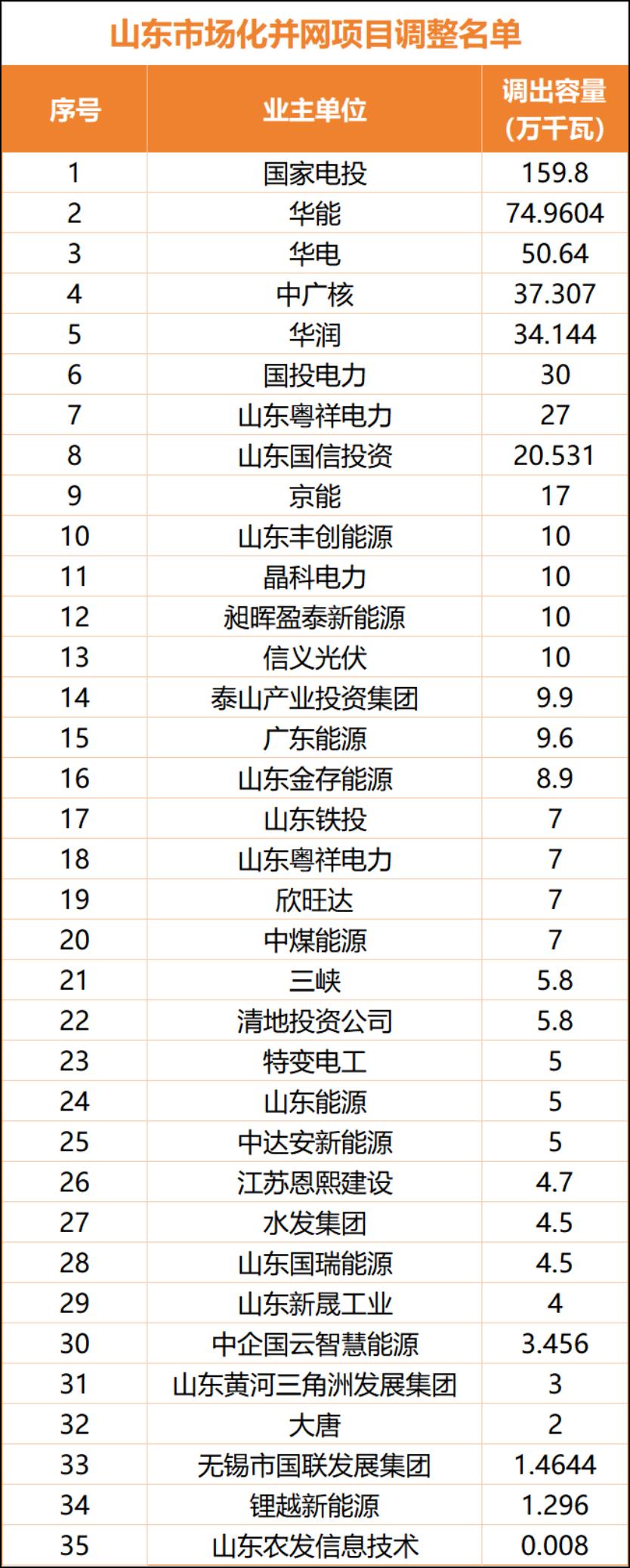
Core Viewpoint - The recent adjustment of the market-oriented grid connection project list in Shandong Province, which removed 63 photovoltaic power station projects with a total capacity of 5.839 million kilowatts, has raised significant concerns in the market due to the involvement of 35 central state-owned enterprises [1][4]. Group 1: Project Adjustments - The Shandong Provincial Energy Bureau has emphasized strict scrutiny for future new energy project applications following the removal of the delayed projects [1]. - The 63 projects removed include significant capacities from major state-owned enterprises, with China Power Investment Corporation losing 1.598 million kilowatts, and other companies like Huaneng and Huadian also facing substantial cuts [2][5]. - A total of 29 projects with a capacity of 2.978 million kilowatts have been granted a reprieve, allowing them to be included in the 2026 construction list, requiring completion by the end of 2026 [4][5]. Group 2: Broader Industry Trends - The trend of project cancellations is not limited to Shandong; various regions have seen similar phenomena, with significant withdrawals from projects by major state-owned enterprises across the country [6]. - In Yunnan, over 800,000 kilowatts of photovoltaic projects have been withdrawn, with some projects being offered for transfer at symbolic prices [6]. - A total of 143 wind and solar projects have been canceled across six provinces, amounting to 10.67 gigawatts, with 67 of those being solar projects totaling 546.81 megawatts [6][7]. Group 3: Financial Viability Concerns - The primary reason for the withdrawal of projects by state-owned enterprises is financial losses due to plummeting electricity prices and reduced generation capacity [9]. - The average market price for photovoltaic electricity has dropped significantly, with some regions reporting prices as low as a few cents per kilowatt-hour, which is far below the benchmark coal price [9][10]. - The phenomenon of electricity curtailment has also worsened, with some regions experiencing curtailment rates exceeding 30%, further impacting the financial viability of photovoltaic projects [10].

2025电力市场改革和新能源高质量发展
Sou Hu Cai Jing· 2025-12-07 02:43
Core Insights - The report highlights the challenges and opportunities in China's electricity market reform and the high-quality development of renewable energy amidst the global energy transition [1][6] - Balancing the "energy trilemma" of cleanliness, security, and economy is identified as a core issue in the transformation of the electricity system [1] Group 1: System Cost and Market Mechanism - The critical point for system costs is reached when the share of wind and solar power in the electricity system exceeds 15%, leading to a rapid increase in system costs [2] - The construction of a spot electricity market is essential for promoting the absorption of renewable energy and the development of ultra-high voltage transmission [2] - A pricing mechanism that reflects the temporal and spatial value of electricity is necessary to efficiently guide resource allocation [2] Group 2: National Unified Market and Safety Challenges - A national unified electricity market is required to efficiently absorb renewable energy, given the mismatch between resource-rich western regions and demand centers in the eastern coastal areas [3] - High penetration of renewable energy poses new safety risks, as evidenced by major blackout events in countries with over 30% solar power [3] - Upgrading the grid to incorporate flexible transmission technologies and enhancing cross-regional coordination are critical for maintaining grid safety [3] Group 3: Pressure on End-User Electricity Prices - End-user electricity prices are under pressure to rise due to increasing system costs and the inability to fully recover safety investments through existing pricing mechanisms [4] - The linkage between the electricity and carbon markets is seen as a potential breakthrough for reflecting the value of green electricity [4] - The integration of dynamic carbon pricing with the spot electricity market could clarify the environmental value of clean energy and guide consumption and investment behaviors [4] Group 4: Coal Power's Role in System Reliability - Despite the rapid development of renewable energy, there has been a recent increase in the approval and construction of coal power plants, reflecting the need for system reliability [5] - Coal power remains crucial for meeting peak load demands in the current stage where flexible resources like energy storage are not fully mature [5] - As the scale of flexible resources expands in the future, the role of coal power is expected to shift from being a primary energy source to a regulatory and backup power source [5] Group 5: Future Directions in Electricity Market Reform - China's electricity market reform has entered a new phase focused on the absorption of green electricity, safety as a baseline, and central-local collaboration as a driving force [6] - The construction of a national unified electricity market and the advancement of the spot market will be key to building a new type of electricity system [6] - Continuous exploration in optimizing system costs, enhancing grid safety, and designing pricing mechanisms is necessary to achieve the multi-dimensional goals of "clean, safe, and economical" energy transition [6]