国家能源局

Search documents
人民日报丨截至2月底全国累计发电装机容量同比增长15.9%
国家能源局· 2026-03-27 03:54
Core Viewpoint - The article highlights the rapid growth of renewable energy capacity in China, particularly in solar and wind power, indicating a significant shift towards clean energy sources in the country's energy mix [2] Group 1: Installed Capacity Data - As of the end of February, China's total installed power generation capacity reached 3.95 billion kilowatts, a year-on-year increase of 15.9% [2] - Solar power capacity reached 1.23 billion kilowatts, growing by 33.2% year-on-year, while wind power capacity reached 650 million kilowatts, with a year-on-year increase of 22.8% [2] - In the first two months, the newly added power generation capacity was 65.91 million kilowatts, with solar power contributing 32.48 million kilowatts and wind power adding 11.04 million kilowatts, together accounting for over 66% of the new capacity [2] Group 2: Future Projections and Goals - During the "14th Five-Year Plan" period, the annual average increase in installed capacity is expected to reach 26 million kilowatts, with a target of 1.84 billion kilowatts by the end of 2025, making up 47% of the total power generation capacity, surpassing thermal power [2] - The National Energy Administration emphasizes the need to expand renewable energy supply during the "15th Five-Year Plan" period, aiming for new clean energy generation to meet the growing electricity demand [2] - Major projects will include accelerating the construction of the "Shage Desert" renewable energy base, promoting orderly development of offshore wind power, and planning integrated water-wind-solar bases in key river basins [2]


媒体报道丨做好“开局之年”经济工作:加快构建新型电力系统
国家能源局· 2026-03-26 09:53
Core Viewpoint - The article emphasizes the importance of building a new power system to achieve carbon neutrality goals, highlighting the need for a low-carbon transition in the power industry while ensuring the stability of electricity supply and prices [2]. Group 1: Construction of Smart Grid - The new power system is characterized by an increasing proportion of renewable energy, necessitating the construction of ultra-high voltage lines and smart grids to ensure effective electricity distribution [4]. - Jiangsu province has undertaken four ultra-high voltage direct current transmission projects, contributing to the "West-to-East Power Transmission" initiative, with a cumulative electricity delivery of 1.08 trillion kilowatt-hours, over 50% of which comes from clean energy [4]. - The national "West-to-East Power Transmission" capacity has reached 340 million kilowatts, optimizing electricity resource allocation across the country [4]. Group 2: Development of New Energy Storage - Energy storage acts as a stabilizer in the new power system, with Shandong province achieving over 10 million kilowatts of new energy storage capacity [7]. - By the end of 2025, the installed capacity of new energy storage nationwide is expected to reach 136 million kilowatts/351 million kilowatt-hours, representing a growth of over 40 times compared to the end of the 13th Five-Year Plan [7]. - The flexibility of new energy storage is increasingly recognized for its role in enhancing the stability and security of the power system [8]. Group 3: Expansion of Green Electricity Applications - The consumption of green electricity is identified as a weaker link compared to its production and transmission, with the need for effective consumption to complete the energy transition [10]. - The rapid growth of electric vehicles (EVs) is driving the need for charging resources to participate in grid regulation, enhancing grid flexibility and renewable energy absorption [10]. - The implementation of the first national standard for vehicle-grid interaction microgrids aims to improve the operational efficiency and flexibility of charging stations, supporting the grid [10]. - New applications such as AI computing, green hydrogen, and zero-carbon parks are emerging, shifting green electricity consumption from "stock exploration" to "incremental expansion" [11].

媒体前沿︱算电协同,从“卖绿电”转向“卖Token” 推动算力出海?
国家能源局· 2026-03-26 06:13
Core Viewpoint - The article discusses China's shift from selling green electricity to selling tokens, transforming fluctuating renewable energy into stable computational power units, thereby establishing a unique advantage in the AI era [2][4]. Group 1: Transition from Energy to Computational Power - The transition from traditional electricity sales to token sales represents a significant value transformation, akin to refining crude oil into high-purity aviation fuel [14]. - In regions rich in renewable energy like Guizhou and Yunnan, the cost of electricity from wind and solar is around 0.3 RMB per kilowatt-hour, while the international market prices tokens at approximately 60-168 USD per million tokens, leading to a substantial increase in export value [15]. - The digital value generated from one kilowatt-hour of electricity in the "electricity to computational power" model can be several times greater than that of traditional high-energy-consuming industries like electrolytic aluminum [16]. Group 2: Infrastructure and Stability - China's interconnected power grid and the "East Data West Computing" strategy provide a solid foundation for computational power, significantly reducing energy loss and alleviating overload in the eastern grid [19][21]. - The "load following source" model allows for the efficient use of renewable energy during peak production times, converting unstable renewable energy into globally transferable digital currency [22]. - In contrast, North America's fragmented power infrastructure faces challenges in meeting the rising demand for computational power, leading to potential conflicts over electricity supply [23][24]. Group 3: Future Implications - The transformation from "selling electricity" to "selling tokens" signifies a shift from a utility-based model to a value-creating digital ecosystem, aligning with the digitalization needs of countries in the Global South [26]. - China's computational power services are aiding local enterprises in Southeast Asia, the Middle East, and Latin America in their digital transformation efforts, presenting a new approach to global digital civilization development [26]. - The article emphasizes that the ability to provide a stable energy foundation for global computational power will determine leadership in the future digital civilization [26].
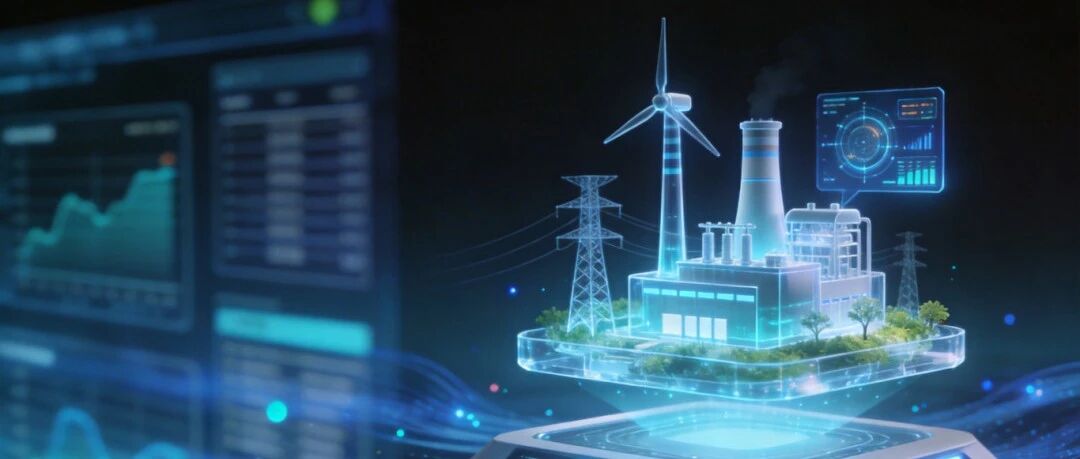
人民日报丨数说高质量发展:充足“满格电”,点燃“新引擎” ,加快建设能源强国
国家能源局· 2026-03-25 10:14
Group 1 - The National Energy Administration serves as an important platform for news dissemination, information transparency, and public service in the energy sector [3] - The agency focuses on publishing industry dynamics and providing public services related to energy [3] - The official WeChat account of the National Energy Administration is a key resource for staying updated on energy developments [3]
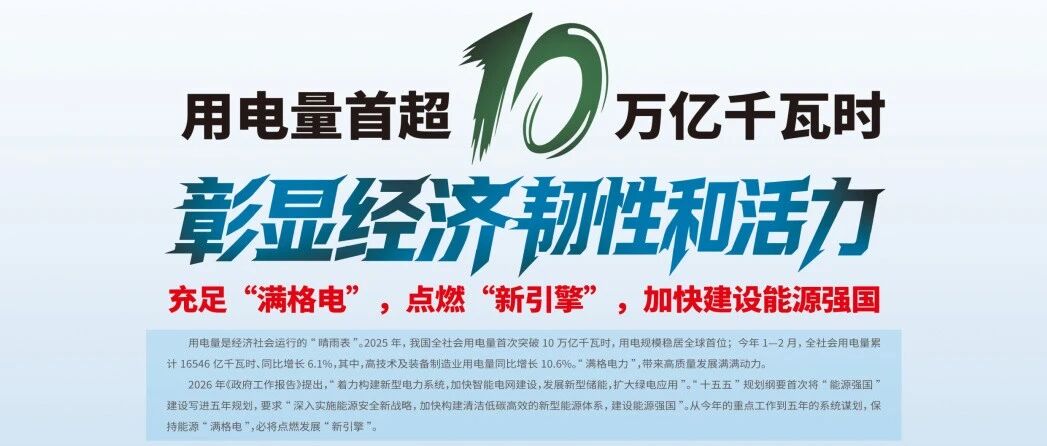
国家能源局发布2026年1-2月份全国电力统计数据
国家能源局· 2026-03-25 06:42
Core Insights - The National Energy Administration released national electricity statistics for January-February 2026, indicating a total installed power generation capacity of 3,950.3 million kilowatts, a year-on-year increase of 15.9% [2][4] - Solar power generation capacity reached 1,233.82 million kilowatts, growing by 33.2% year-on-year, while wind power capacity increased by 22.8% to 650.66 million kilowatts [2][4] Installed Capacity - Total installed power generation capacity: 3,948.03 million kilowatts, up 15.9% year-on-year [4] - Hydropower: 449.21 million kilowatts, up 2.7% [4] - Thermal power: 1,550.55 million kilowatts [4] - Nuclear power: 63.73 million kilowatts, up 4.8% [4] - Wind power: 650.66 million kilowatts, up 22.8% [4] - Solar power: 1,233.82 million kilowatts, up 33.2% [4] Utilization and Efficiency - Average utilization hours for power generation equipment: 466 hours, a decrease of 39 hours compared to the same period last year [3][4] - National coal consumption rate for power generation: 287.6 grams per kilowatt-hour, a slight decrease of 0.2% [4] - Total heating amount: 178,536 million kilojoules, an increase of 0.9% [4] - Total raw coal consumption for heating: 11,199 thousand tons, also up 0.9% [4] New Installed Capacity - New installed power generation capacity: 65.91 million kilowatts, an increase of 821% [4] - Breakdown of new capacity: - Hydropower: 1.22 million kilowatts [4] - Thermal power: 19.96 million kilowatts, up 1,337% [4] - Nuclear power: 1.21 million kilowatts [4] - Wind power: 11.04 million kilowatts, up 144% [4] - Solar power: 32.48 million kilowatts, a decrease of 712% [4]
国家能源局综合司关于印发《2026年能源行业标准计划立项指南》的通知
国家能源局· 2026-03-24 02:18
Core Viewpoint - The article outlines the "2026 Energy Industry Standard Project Initiation Guidelines," emphasizing the need for a structured approach to standardization in the energy sector to support energy security and green low-carbon transformation [4][6]. Group 1: Project Initiation Focus - The guidelines focus on building a new energy system, ensuring energy security, and promoting the development of new technologies, industries, and business models [6][7]. - It encourages participation from various entities, including private and foreign enterprises, in the standard formulation and revision process [7][8]. - The guidelines aim to align with international standards and enhance the compatibility of China's energy standards with global practices [7][9]. Group 2: Industry Standard Formulation and Revision Plan - The plan includes standards that support energy security and the achievement of carbon peak and carbon neutrality goals [8][9]. - It addresses the need for standards that facilitate the development of the energy industry and ensure safety in electricity production [9][10]. - The guidelines promote the enhancement of the overall technical level and quality of products and services in the energy sector [9][10]. Group 3: Internationalization of Standards - The guidelines aim to improve the international credibility and influence of Chinese standards by aligning with advanced international standards [9][10]. - It supports the simultaneous application for international standard projects alongside domestic standards [9][10]. Group 4: Application Materials - The application materials for standard formulation should include a project plan summary, project task book, draft standards, and meeting minutes with expert signatures [10][11]. - The project plan must be comprehensive and indicate the key direction code, while the task book should detail the project's support role for industry work [11][12]. Group 5: Submission and Management - The submission process involves centralized applications, categorized evaluations, and unified issuance of projects [12][13]. - The guidelines stipulate a standard project lifecycle management approach to enhance the quality of standards [13][14].
习近平:牢牢把握雄安新区功能定位 努力建设新时代创新高地和推动高质量发展样板
国家能源局· 2026-03-23 11:50
Core Viewpoint - The article emphasizes the importance of Xi Jinping's visit to Xiong'an New Area, highlighting the need for high-quality development and innovation as key components of the area's strategic positioning as a hub for non-capital functions of Beijing [2][4]. Group 1: Development Strategy - Xi Jinping stressed the need to firmly grasp the functional positioning of Xiong'an New Area as a concentrated carrier for the non-capital functions of Beijing, advocating for strategic determination and historical patience [2]. - The focus should be on reform and innovation to enhance endogenous development momentum and stimulate the vitality of the new area through the rational aggregation of resources [2][5]. - Continuous improvement of the comprehensive carrying capacity of Xiong'an New Area is essential, requiring systematic planning and effective governance to achieve high-quality construction [5][6]. Group 2: Innovation and Industry - Xi Jinping highlighted the importance of integrating technological and industrial innovation, encouraging the development of a modern industrial system that aligns with the new area's actual conditions [6]. - The establishment of the Xiong'an Zhongguancun Science and Technology Park is a priority, aimed at promoting the transformation of scientific and technological achievements [6]. - There is a call for bold exploration and the implementation of innovative policies in technology and finance to create a market-oriented, law-based, and international business environment [6]. Group 3: Education and Community Development - The Beijing Fourth Middle School Xiong'an Campus, which opened in August 2023, is part of the educational infrastructure aimed at ensuring the healthy development of children in the area [3][4]. - Xi Jinping encouraged the staff and students to take pride in their contributions to the development of Xiong'an and to grow alongside the new area [3][4]. Group 4: Leadership and Governance - The importance of strengthening the leadership and construction of the Party in the governance of Xiong'an New Area was emphasized, with a focus on fostering a clean political environment [6][7]. - Officials are urged to enhance their awareness of the overall situation and responsibilities to effectively implement the decisions of the Central Committee regarding the high-quality construction and development of Xiong'an New Area [6][7].

国家对成品油价格采取临时调控措施
国家能源局· 2026-03-23 07:30
Core Viewpoint - The article discusses the impact of escalating conflicts in the Middle East on international oil prices, leading to significant adjustments in domestic fuel prices in China to mitigate economic and social impacts [2]. Group 1: Price Adjustments - Since the adjustment of domestic refined oil prices on March 9, international crude oil prices have surged, particularly in the Middle East, reaching historical highs [2]. - According to the current pricing mechanism, the domestic prices for gasoline and diesel should increase by 2205 yuan and 2120 yuan per ton, respectively. However, the actual adjustments are 1160 yuan and 1115 yuan [2]. Group 2: Regulatory Measures - The National Development and Reform Commission (NDRC) will guide oil production and sales companies to ensure adequate supply and will enhance market supervision to enforce compliance with national pricing policies [2]. - The NDRC emphasizes the importance of maintaining market order and protecting consumer interests by addressing violations of pricing policies [2].

绿氢,为何成为未来产业和新兴能源载体?
国家能源局· 2026-03-22 03:27
Core Viewpoint - The article emphasizes the strategic importance of green hydrogen as a key component in the future energy landscape, highlighting its role in achieving carbon neutrality and its potential for widespread application across various industries [1][2][5]. Group 1: Future Industries and Green Hydrogen - The Chinese government is focusing on future industries, including hydrogen energy, as part of its development strategy, with green hydrogen being identified as a crucial energy carrier [1][2]. - Green hydrogen is derived from renewable energy sources and is essential for achieving carbon neutrality, serving as a zero-carbon fuel and raw material across multiple sectors [2][5]. Group 2: Advantages of Green Hydrogen - Green hydrogen offers significant advantages over hydrogen produced from fossil fuels, including lower costs, higher efficiency, and no carbon emissions during production [5][6]. - The storage costs for hydrogen are significantly lower than those for energy storage batteries, making it a viable option for large-scale renewable energy storage [5][6]. Group 3: Applications of Hydrogen Energy - Hydrogen can be utilized in various applications, including hydrogen storage, as a raw material in chemical and metallurgical industries, and in hydrogen-powered systems such as fuel cells for vehicles and machinery [6][7]. - The development of hydrogen fuel cells has advanced significantly, with applications expanding to various sectors, including transportation and industrial machinery [7][8]. Group 4: Technological Breakthroughs - The hydrogen energy technology chain includes multiple stages such as renewable energy generation, hydrogen production, storage, and application, requiring a comprehensive technological framework [8][10]. - China has made progress in developing alkaline electrolysis technology for hydrogen production, with plans to establish a complete industrial chain by 2025 [8][11]. Group 5: Commercialization Challenges - The commercialization of green hydrogen faces challenges due to the complexity of its production, transportation, storage, and utilization processes, necessitating technological advancements and integration across various energy forms [11][12]. - Strategies for large-scale commercialization include utilizing surplus renewable energy for hydrogen production and integrating hydrogen with electricity and thermal energy systems [11][12]. Group 6: Innovative Projects - Recent breakthroughs include the development of a pure hydrogen gas turbine that can operate stably, significantly reducing carbon emissions compared to traditional power generation methods [14]. - The "Hydrogen Teng" fuel cell developed for extreme environments demonstrates the versatility and reliability of hydrogen technology, with potential applications in various sectors [15].

媒体报道丨新型储能产业迎来关键政策支撑
国家能源局· 2026-03-20 09:22
Core Viewpoint - The recent issuance of the "Notice on Improving the Capacity Price Mechanism for Power Generation Side" establishes a new independent capacity price mechanism for energy storage at the national level, providing clear revenue rules and a market-oriented development path for the future of new energy storage [2][3]. Group 1: Policy Impact - The policy fills the institutional gap for national-level capacity pricing for new energy storage, activating investment vitality in the industry through stable revenue expectations [2]. - The new mechanism is crucial for the development of the new energy storage industry, ensuring its core role in peak supply and renewable energy consumption within the power system [2]. Group 2: Industry Growth - Since the introduction of the "dual carbon" goals, China's new energy storage has seen exponential growth, with installed capacity expected to reach 136 million kilowatts/351 million kilowatt-hours by the end of 2025, a more than 40-fold increase compared to the end of the 13th Five-Year Plan [2]. - The average storage duration is projected to increase to 2.58 hours by 2025, with an expected utilization of 1,195 hours for new energy storage, an increase of nearly 300 hours from 2024 [2]. Group 3: Market Dynamics - The cancellation of the mandatory storage policy for incremental renewable energy has created challenges for independent storage projects, necessitating clear capacity revenue policies to provide stable investment expectations [3]. - The new capacity pricing rules aim to match the capacity value and peak contribution of new energy storage with revenue levels, addressing systemic barriers to industry development [3][4]. Group 4: Future Outlook - The implementation of the new policy is seen as a new starting point for market-oriented development, with the industry expected to accelerate upgrades in long-duration, high-efficiency, and intelligent energy storage [4]. - New energy storage is anticipated to become a core force and foundational guarantee for China's energy transition and the construction of a new power system, supported by the capacity price mechanism and market incentives [4].