13个精算师

Search documents
又到一年分红险红利实现率披露期,理性看待红利实现率,做财富增长的长跑者!
13个精算师· 2025-06-23 03:24
Core Viewpoint - The article emphasizes the importance of long-termism and investment support in the management of participating insurance products, as mandated by the regulatory authority [1][17]. Summary by Sections Regulatory Requirements - The regulatory authority has issued guidelines requiring insurance companies to maintain stable operations and adhere to asset-liability management principles throughout the product lifecycle [1][17]. - Companies must not deviate from the actual asset-liability and investment income situations [1]. Dividend Realization Rate - The dividend realization rate reflects the actual benefits received by policyholders and enhances transparency in insurance company disclosures [1]. - Starting in 2023, insurance companies are required to disclose their dividend realization rates on their official websites [1]. Calculation of Dividend Realization Rate - The article provides a formula for calculating the customer yield, which includes both guaranteed and floating dividends [2]. - Factors influencing the dividend realization rate include the sales demonstration rate, which is based on long-term investment expectations [3][5]. Market Environment Impact - In the current low-interest-rate environment, major insurance companies have reduced their demonstration rates to 3.5% to reflect anticipated long-term returns [5]. - The article notes that lower demonstration rates can lead to higher dividend realization rates under certain conditions [5][6]. Long-term Perspective - A long-term view of the dividend realization rate is essential, as it better reflects an insurance company's ability to deliver on its promises over time [9]. - Many companies disclose multi-year dividend realization rates to provide a clearer picture of their long-term performance [9]. Customer Yield Analysis - The article discusses how to derive customer yield from the dividend realization rate, indicating that customer yield is expected to be between 3.0% and 3.2% for major insurers in 2024-2025 [15][16]. - The customer yield from participating insurance products has consistently outperformed bank wealth management products from 2020 to 2023 [16]. Future Outlook - The sustainability of dividend levels is tied to the long-term investment capabilities of insurance companies, which must be evaluated against their operational stability and risk ratings [19][20]. - The article concludes that the assessment of an insurance company's dividend strength should consider long-term yield, investment returns, solvency ratios, and overall operational health [19][20].


监管要求分红水平不得“内卷”;友邦人寿、荷兰全球人寿获批筹建保险资管公司;平安斥资6.05亿完成核心人员持股计划|13精周报
13个精算师· 2025-06-21 02:30
Regulatory Dynamics - The Financial Regulatory Bureau has issued guidelines to prevent excessive competition in dividend levels for insurance products, requiring justification for proposed dividend levels under certain conditions [7][8]. - The Financial Regulatory Bureau, in collaboration with the Shanghai Municipal Government, has released an action plan to support the construction of Shanghai as an international financial center [9]. - The Financial Regulatory Bureau has recognized China Reinsurance (Group) Corporation as an internationally active insurance group, aiming to enhance its risk management and international competitiveness [10]. - The Central Financial Committee has emphasized the need to innovate in shipping insurance and reinsurance businesses to align with the development of Shanghai as an international financial center [11]. - The Ministry of Human Resources and Social Security reported that the national enterprise annuity fund has surpassed 3.7 trillion, with a cumulative return rate of 7.46% over the past three years [12]. Company Dynamics - Ping An Life has increased its stake in Postal Savings Bank by acquiring 22.797 million shares, raising its holding to 12.07% [25]. - China Ping An has also increased its stake in Agricultural Bank of China by 2.58 billion HKD, bringing its holding to 13.12% [27]. - China Ping An announced a cash dividend of 1.62 CNY per share to be distributed on June 30 [32]. - Zhong Postal Insurance has been approved to increase its registered capital to 32.643 billion [29]. - China Life Insurance has launched its first guaranteed renewable 10-year medical insurance product [68]. Industry Dynamics - The Hong Kong insurance market is experiencing a surge in demand as customers rush to secure high-yield policies before new regulations take effect [56]. - New insurance products with a 1.5% guaranteed interest rate have been introduced, marking a shift in the market as companies adjust to lower interest rates [57]. - The proportion of newly launched dividend insurance products has increased to 37%, up 9 percentage points year-on-year [58]. - The IPE has released a list of the top 500 asset management companies for 2025, with 13 Chinese insurance institutions making the list [59]. - Over 90% of insurance asset management products have reported positive returns, with the highest returns exceeding 26% in the past six months [62].


近23年寿险行业险类结构变迁盘点:分红险已经在筑底阶段,未来或许应该爆发!泰康分红险已经拔得头筹!
13个精算师· 2025-06-20 08:35
Core Viewpoint - The life insurance industry is undergoing structural changes, with dividend insurance potentially entering a recovery phase after a period of decline, particularly highlighted by the performance of Taikang's dividend insurance products [1][20]. Group 1: Industry Overview - By the end of 2024, the life insurance industry is projected to have a total premium scale of 4.6 trillion yuan, with original premium income at 4.0 trillion yuan, policyholder investment contributions at 578.7 billion yuan, and new contributions to independent accounts of linked insurance at 16.8 billion yuan [12][16]. - In 2023, the original premium income of the life insurance industry reached 3.5 trillion yuan, with ordinary life insurance contributing 2.0 trillion yuan, dividend insurance at 714.2 billion yuan, health insurance at 72.1 billion yuan, accident insurance at 44.9 billion yuan, universal insurance at 9.7 billion yuan, and linked insurance at 0.4 billion yuan [3][16]. Group 2: Structural Changes - The share of dividend insurance premiums has decreased from 60% in 2005 to a historical low of 20.5% in 2023, indicating a significant structural shift in the industry [6][19]. - The industry is transitioning towards a "low guaranteed + high floating" model to address interest margin losses, facing challenges in consumer perception, sales channels, and product design [8][21]. Group 3: Future Outlook - The years 2023 and 2024 are seen as critical for the stabilization of dividend insurance, with expectations for a gradual recovery in its market share as the industry transforms and market conditions improve [20][21]. - The top ten companies in dividend insurance premium income for 2023 have been identified, with Taikang Life leading in the proportion of dividend insurance premiums [20][24]. Group 4: Company Performance - The analysis of major companies shows that China Life, Ping An Life, and Taiping Life have high proportions of ordinary life insurance, while Taikang Life has a significant share of 61.1% in dividend insurance [28]. - The new single premium income for the life insurance industry in 2023 was 1.3 trillion yuan, marking a 19-fold increase since 2001, although the proportion of new single premium income relative to total premium income has been declining, standing at 38.2% in 2023 [25][26].



【保险学术前沿】Journal of Risk and Uncertainty 2025年第1-2期目录与摘要
13个精算师· 2025-06-19 09:33
Core Insights - The article discusses various aspects of decision-making under risk and uncertainty, highlighting the importance of auxiliary assumptions in interpreting decisions and the implications of consumer behavior on welfare [3][7][13][16]. Group 1: Heuristic Assumptions - Interpreting decisions requires auxiliary assumptions about how decision-makers view their options and relate them to their lives, with theories constraining these assumptions [7][9]. - The article illustrates three methods to evaluate auxiliary assumptions: direct assessment, systematic manipulation, and archival analysis [9]. Group 2: (Dis)satisfaction with Risk Preferences - Approximately 50% of participants in surveys report dissatisfaction with their overall risk levels, with many believing they take insufficient risks rather than excessive ones [13][14]. - Internal factors, such as emotions, are more significant determinants of unsatisfactory risk-taking than external constraints [14]. Group 3: Consumer Misperceptions and Product Differentiation - Increasing product differentiation, often driven by big data and AI, can enhance welfare when consumers are informed but may reduce welfare when consumers have misperceptions [16][17]. - The implications of product differentiation depend on whether consumers overestimate or underestimate the benefits of products, with overestimation leading to potential welfare losses [17][18]. Group 4: Dynamic Decision-Making Under Ambiguity - Four types of dynamic decision-makers are identified: Resolute, Myopic, Sophisticated, and Expected Utility, each employing different strategies to solve dynamic problems [20][21]. - The type of decision-maker significantly influences the time taken to resolve ambiguity, with Expected Utility subjects spending more time on decisions [21]. Group 5: Cognitive Offloading in Risky Decisions - Providing external tools to reduce decision complexity can lower risk aversion and improve belief updating, but these tools are rarely utilized and do not significantly reduce irrational behavior [24][25]. Group 6: Evaluation of Intertemporal Streams - A study on intertemporal choice reveals that individuals may prefer receiving their salary in a way that violates standard economic models, suggesting a need for modifications to these models [26][27]. Group 7: Outcome Uncertainty Experiment - An experiment shows that subjects are risk-averse but prefer ambiguity, evaluating uncertain payoffs more optimistically than compound risks [30][31]. Group 8: True Overconfidence Revealed Through Actions - An experiment indicates that true overconfidence in relative ability can be inferred through actions rather than reported beliefs, with aggregate overconfidence observed only under minimal feedback conditions [32][33].

顺应医疗改革潮流,人保健康旗下两款百万医疗险迎来重磅升级
13个精算师· 2025-06-19 08:36
Core Viewpoint - The implementation of the DRG/DIP reform in China's healthcare system is expected to lead to a decline in overall medical expenses, creating new opportunities for the commercial health insurance market, particularly for million medical insurance products, which have significant growth potential [1][2]. Group 1: Market Overview - China's medical expenditure consists of three parts: basic medical insurance expenditure, personal expenditure, and commercial health insurance payouts. The commercial health insurance currently accounts for only about 5% of the total medical payment system, indicating substantial growth potential [3]. - In 2024, the commercial health insurance premium scale reached 977.3 billion yuan, with medical insurance premiums expected to exceed 400 billion yuan. Million medical insurance is projected to account for approximately 20% of this market [3][4]. Group 2: Product Upgrades - The "Good Medical Long-term Insurance" series by PICC Health has undergone significant upgrades, including the introduction of new coverage for purchased drugs and medical devices, advanced drug and device coverage, and expanded access to specific diseases and advanced medical facilities [8][9][12]. - The upgraded flagship version for 2025 includes coverage for over 1,500 advanced drugs and devices, significantly expanding the previous list of 199 special drugs and 3 CAR-T anti-cancer injections [9]. - The insurance product has also relaxed the age limit for policyholders from 55 to 60 years, allowing more older individuals to obtain coverage [12][17]. Group 3: Target Demographics - The elderly population (60 years and above) in China is projected to reach 310.31 million by the end of 2024, with a significant portion suffering from chronic diseases. This demographic represents a growing market for health insurance products [17][20]. - The "Good Medical Long-term Insurance for the Elderly" has been specifically designed to cater to this demographic, offering low entry barriers and a 20-year guarantee for renewal, making it appealing to older consumers [20][22]. Group 4: Company Performance - PICC Health reported a total insurance premium income of 48.7 billion yuan in 2024, a year-on-year increase of 7.7%. The company maintains a leading position in the industry with a customer base of 76 million [24][25]. - In the first quarter of 2025, PICC Health achieved an insurance business income of 28.1 billion yuan, with a net profit of 2.43 billion yuan, reflecting a significant growth rate compared to the industry [24][25].


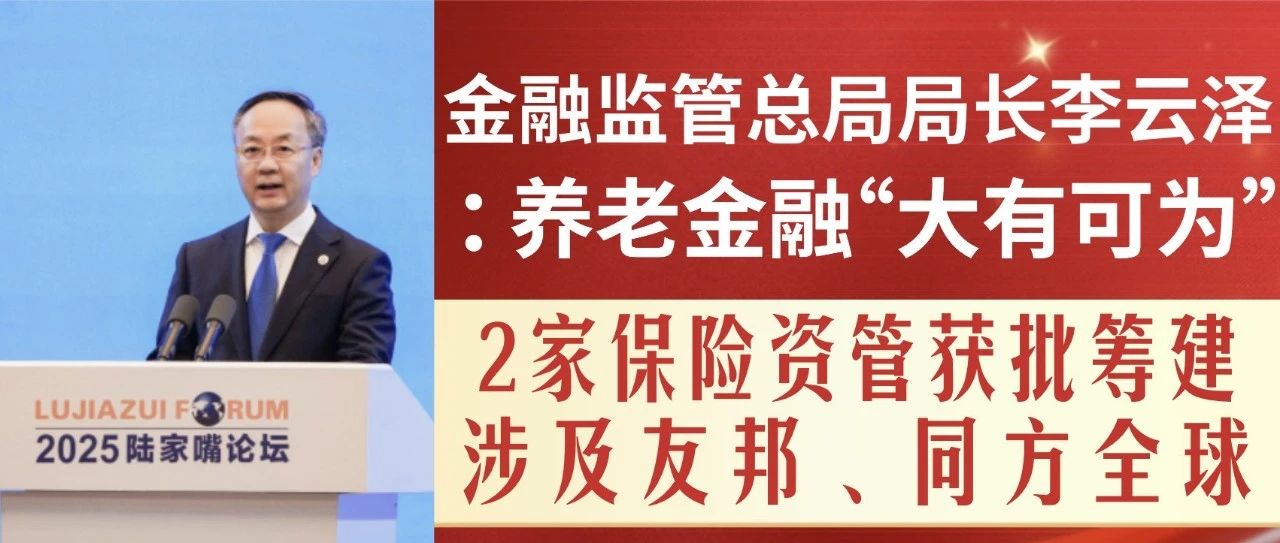
金融监管总局:批筹2家保险机构,涉及友邦、同方全球!李云泽局长提养老金融“大有可为”...
13个精算师· 2025-06-18 15:31
Core Viewpoint - The article emphasizes the significant opportunities in wealth management and pension finance in China, driven by the expanding middle-income group and the aging population, with a projected silver economy scale of 30 trillion yuan by 2035 [10][42]. Group 1: Wealth Management - Wealth management is entering a "golden period" due to the continuous expansion of the middle-income group, which provides a stable customer base for the industry [10][31]. - China's households have a cash and savings ratio exceeding 50%, significantly higher than the OECD average of about one-third, indicating a strong demand for diversified and professional wealth management solutions [31][32]. - The asset management scale of trust, wealth management, and insurance asset management in China has grown at an annual rate of approximately 8% over the past five years, making it the second-largest asset and wealth management market globally [31][37]. Group 2: Pension Finance - The aging population in China is accelerating, with projections indicating that the population aged 60 and above will exceed 400 million by 2035, creating substantial opportunities in pension finance [42][46]. - The silver economy is expected to reach a scale of 30 trillion yuan by 2035, highlighting the potential for growth in commercial pension insurance and pension products [47][48]. - The implementation of the personal pension system across the country is expected to enhance the development of third-pillar pensions, including exclusive commercial pension insurance [49][50]. Group 3: Insurance Asset Management - The approval of two foreign insurance asset management companies, AIA and Dutch Global Life, to establish operations in Shanghai marks a significant development in the insurance asset management sector [20][29]. - Currently, there are 34 insurance asset management companies in China, with a growing focus on enhancing investment management capabilities to meet consumer demands for better returns [16][18]. - The establishment of these foreign asset management companies is expected to strengthen the investment management landscape and improve the overall performance of insurance companies [20][29]. Group 4: Regulatory Support and Market Development - The Financial Regulatory Bureau has issued a plan to support Shanghai in becoming a new type of asset management service platform, promoting high-quality transformation and upgrading of asset management businesses [56][59]. - The plan emphasizes the importance of enhancing the competitiveness of Shanghai as an international financial center, encouraging foreign financial institutions to play a larger role in the market [56][58]. - The regulatory framework aims to facilitate the development of inclusive finance, pension finance, and digital finance, aligning with international standards [57][58].
2024年寿险公司重疾理赔报告:总赔付超693亿,最大赔案521万,新华、中英、招商的7大赔案超300万!
13个精算师· 2025-06-17 12:54
64家寿险公司 2024年 重疾理赔报告 ①重疾理赔 693亿 理赔金额、案均赔款"双升" ②7大赔案超300万 1个"平安福"的赔付超500万 ③重疾高发年龄段 40-50岁,50-60岁 7家险企最年长赔付100岁+ ④恶性肿瘤是 高发重疾 甲状腺癌、肺癌、乳腺癌高发 ⑤女性重疾理赔多 发病年龄也要比男性早 ⑥高发年龄段的案均赔款低 友邦等险企,高额重疾赔案多 1 64家 寿 险公司 2024年 重疾理赔693亿 理赔金额、案均赔款,均同比增长 | 序号 | 公司简称 | 理赔金额 | 理 赠 得 查 | 50 7 + 2 0 1 | | --- | --- | --- | --- | --- | | | | (亿元) | | 万元 | | 341 | 平安寿险 | 207.00 13 | 25.70 | 138.05 | | 2 | 大保寿险 | 10106.00 | 15.00 | 7.07 | | 3 3 | 新华保险 | 58.16 | 7.36 | 15 7.90 | | 4 | 泰康人寿 | 49.00 | = 6.43 | 7.62 | | 5 | 平安养老 | 27.18 | 138.33 ...


可简化!可延期!财政部发文:非上市险企执行“新准则”,可进行四方面简化,自2026年1月1日起执行,若有困难可申请延期...
13个精算师· 2025-06-12 13:25
Core Viewpoint - The Ministry of Finance has issued a notice to further implement the new insurance contract accounting standards, requiring all insurance companies to comply by January 1, 2026, with provisions for non-listed companies to simplify the execution process [1][3][8]. Summary by Relevant Sections Implementation Timeline - All insurance companies must execute the new standards by 2026, with the option to apply for a deferral if difficulties arise [3][10]. - Non-listed insurance companies can simplify the execution of the new standards to reduce complexity and costs [4][14]. Simplification Measures - The simplification of the new standards involves four main areas: grouping and recognition of insurance contracts, measurement, reporting, and transitional provisions [12][16]. - Non-listed companies can adopt simplified rules, which is beneficial for smaller firms facing implementation pressures [14][15]. Specific Simplification Details - Simplifications include: 1. Simplified assessment of insurance contract profitability, allowing companies to use observable market variables and reliable experience data for evaluations [20]. 2. Adjustments to the timing of recognition for reinsurance contracts and simplified accounting treatment for contracts terminated during the same accounting year due to policyholder withdrawal [22][23]. 3. Reduced disclosure requirements for certain financial metrics, such as amounts repayable to policyholders and adjustments related to financial assets [25][27]. Transitional Provisions - The notice outlines simplified methods for reporting comparative information and adjustments during the initial application of the new standards [28].

2024年33家保险资管公司经营业绩排行榜:国寿、泰康、平安位列三甲!
13个精算师· 2025-06-10 22:37
Core Viewpoint - The insurance asset management industry in 2024 shows significant growth in revenue and profit, with major players like China Life, Taikang, and Ping An leading in net profit rankings. The overall operating income increased by 14.6% year-on-year, while net profit rose by 17.4% [2][4][11]. Group 1: Industry Performance - In 2024, the total operating income of the insurance asset management sector reached 40.1 billion yuan, reflecting a year-on-year increase of 14.6% [4][11]. - The net profit for the insurance asset management companies was 18 billion yuan, which is a 17.4% increase compared to the previous year [4][11]. - The operating net profit margin was 45%, consistently exceeding 40% over the past eight years [6][13]. Group 2: Revenue Composition - Management fee income accounted for 79.4% of the total operating income, with an average management fee rate of 0.11% for entrusted assets [8][12][25]. - Taikang Asset Management has an entrusted asset management scale exceeding 4.2 trillion yuan, with a management fee rate estimated at 0.14% [9][26]. Group 3: Profitability Metrics - The return on equity (ROE) for insurance asset management companies was 17.6%, up by 1 percentage point year-on-year, indicating high profitability compared to life insurance, property insurance, and reinsurance companies [16][19]. - The total investment return rate for the associated insurance companies was 3.6%, an increase of 0.9 percentage points, while the comprehensive investment return rate was 7.9%, up by 4.1 percentage points [19][21]. Group 4: Company Rankings - The top three insurance asset management companies by net profit in 2024 were China Life Asset Management (3.86 billion yuan), Taikang Asset Management (2.84 billion yuan), and Ping An Asset Management (2.45 billion yuan) [28][29]. - The ROE for these companies was 19.7% for China Life, 33.6% for Taikang, and 25.9% for Ping An, showcasing their strong financial performance [28][29].



银行渠道的过去和未来(一):银保渠道不同发展阶段的行业年度保费
13个精算师· 2025-06-10 06:33
Core Viewpoint - The article discusses the evolution and future of the bancassurance channel in China, highlighting its historical development, current trends, and anticipated changes due to regulatory shifts and market dynamics. Group 1: Historical Development of Bancassurance - The bancassurance business in China began in 1996, with significant growth observed from 2001 onwards, where total premiums reached 47 billion, accounting for about 2% of total life insurance premiums [6][8]. - By 2007, new premiums from bancassurance surpassed those from all other channels combined, and from 2013 to 2016, bancassurance accounted for approximately 50% of the total life insurance premium market [6][8]. - The article outlines six stages of development for bancassurance, with a new phase starting in 2024 characterized by "reporting and operation integration" [5][20]. Group 2: Key Growth Phases - The initial phase (before 2004) saw bancassurance primarily offering five-year single premium products, with total premiums reaching 388 billion in 2002, representing 17% of the life insurance market [8][9]. - From 2005 to 2012, the industry experienced normal growth, with total premiums increasing from 952 billion in 2005 to 3,897 billion in 2012, while the period saw a significant rise in single premium products [9][10]. - The investment-driven era from 2013 to 2016 was marked by regulatory changes that allowed for higher investment returns, leading to a surge in single premium sales, with some companies reporting over 200% growth in 2013 [11][12]. Group 3: Recent Trends and Future Outlook - From 2020 to 2023, the market shifted towards traditional increasing death benefit products, with long-term premiums growing significantly, accounting for 84% of total premiums by 2021 [14][19]. - The bancassurance channel is expected to see its new business value (NBV) surpass that of individual insurance channels by 2026, driven by lower fixed costs and increased competition [20][21]. - The article predicts that by 2024, the market will witness a resurgence of short-term products, with a projected 10% share of total premiums, as companies adapt to regulatory changes and market demands [20][24]. Group 4: Market Dynamics and Competitive Landscape - The article categorizes life insurance companies into six groups, including the "Bancassurance Seven Heroes" and "Eight Kings," which dominate the market with a combined market share of 60% to 72% [16][43]. - In 2023, the bancassurance channel's competition intensified, with significant growth reported among leading companies, while smaller firms faced declines [25][30]. - The shift towards long-term participating insurance products is evident, with major players like Taiping Life and several foreign companies leading the charge in this segment [26][30].