
digihuman(835670)

Search documents
数据分析行业产教融合共同体在日照成立,赋能数字人才培育
Qi Lu Wan Bao· 2026-01-16 11:14
Core Viewpoint - The establishment of the Data Analysis Industry Education-Industry Integration Community marks a significant step towards addressing the structural contradictions in the supply and demand of digital talent, aiming to enhance the quality of development in the digital industry [1][4]. Group 1: Community Formation and Objectives - The Data Analysis Industry Education-Industry Integration Community was initiated by Shandong Kaichuang Group, Shandong University of Technology, and Rizhao Vocational College of Science and Technology, along with over a hundred industry units, to promote deep integration of education and industry [1][2]. - The community aims to address the challenges of digital talent cultivation by fostering a collaborative environment that integrates educational resources with industry needs, thereby enhancing the quality of digital talent training [3][4]. Group 2: Institutional Support and Resources - Rizhao Vocational College has established a professional cluster aligned with regional industry needs, with teaching equipment valued at over 90 million yuan, and has formed a high-level faculty team [2][3]. - The community's leadership includes Shandong Kaichuang Group, Shandong University of Technology, and Rizhao Vocational College, with Rizhao Vocational College serving as the first rotating chair [6]. Group 3: Industry and Educational Collaboration - The community emphasizes the importance of aligning educational practices with industry demands, focusing on practical training and real-world applications to ensure that talent development is relevant and effective [3][5]. - The establishment of the community is seen as a response to the urgent need for high-quality talent that meets the requirements of the digital economy and intelligent era, addressing the significant gap in innovative and composite talents [5][6]. Group 4: Future Directions and Initiatives - The community plans to implement various initiatives, including signing cooperation agreements with multiple enterprises and conducting research projects to enhance the integration of education and industry [6][7]. - Experts from various fields will collaborate to provide intellectual support for digital talent cultivation, focusing on the integration of AI and education, and the practical application of data analysis in industry [7].

数字人民币板块1月16日跌2.18%,神思电子领跌,主力资金净流出60.62亿元
Sou Hu Cai Jing· 2026-01-16 09:24
Group 1 - The digital renminbi sector experienced a decline of 2.18% compared to the previous trading day, with Shen Si Electronics leading the drop [1] - The Shanghai Composite Index closed at 4101.91, down 0.26%, while the Shenzhen Component Index closed at 14281.08, down 0.18% [1] - The net outflow of main funds in the digital renminbi sector was 6.062 billion yuan, while retail investors saw a net inflow of 4.079 billion yuan [1] Group 2 - The net inflow of speculative funds in the digital renminbi sector was 1.983 billion yuan [1] - Detailed fund flow data for individual stocks in the digital renminbi sector is available in the accompanying table [1]


数字人民币的出现对美元有啥影响?美联储印钱两年,大家怨声载道
Sou Hu Cai Jing· 2026-01-16 05:25
Group 1 - The article discusses the potential end of the US dollar's dominance and whether the Chinese yuan can rise to become a new global economic leader [1][3] - The US's superpower status relies on three pillars: a strong military, a dominant dollar system, and a democratic culture, all of which are interconnected [3] - The article raises questions about how the dollar's support structure might collapse and who could replace it, as well as how the dollar has helped the US recover from global crises [3] Group 2 - The COVID-19 pandemic significantly impacted the US, with over 65 million confirmed cases and nearly 870,000 deaths, yet there are claims of a return to normalcy [5][9] - The US government's response to the pandemic included a more relaxed approach, leading to severe economic challenges such as inflation and rising unemployment [9][10] - Quantitative easing was employed as a remedy, injecting money into the market, but it also raised concerns about inflation and wealth redistribution, particularly affecting the middle class [10][11] Group 3 - The wealth of US billionaires surged by $845 billion from March to September 2020, highlighting the disparity in economic recovery between the wealthy and the middle class [11] - The article notes that many countries, particularly Iran and Russia, are moving away from the dollar due to political opposition and the dollar's instability [13] - The introduction of digital yuan is seen as a strategic move by China to challenge the dollar's dominance, with its flexibility and central bank management being key advantages [13][14]

广发证券:数字人民币生态将带动“运营-技术-硬件-场景”全链条投资机会
Xin Lang Cai Jing· 2026-01-15 23:24
Core Viewpoint - The report from GF Securities highlights the investment opportunities across the entire digital RMB ecosystem, focusing on the "operation-technology-hardware-scenario" investment chain [1] Group 1: Banking and Operators - Core state-owned banks and key operational institutions will directly benefit from the liabilities generated by digital RMB deposits [1] Group 2: Technology and Hardware Suppliers - There will be a continuous demand for IT system upgrades in banks, as well as for payment terminals and security chips [1] Group 3: Payment and Scenario Service Providers - Acquiring institutions with rich merchant resources will play a crucial role in the implementation of digital RMB in various scenarios [1]
更好发挥数字人主播价值
Jing Ji Ri Bao· 2026-01-15 21:26
Core Viewpoint - The recent release of the "Live E-commerce Supervision Management Measures" by the State Administration for Market Regulation and the National Internet Information Office has brought digital human anchors and AI-generated content under regulatory scrutiny, highlighting both opportunities and challenges in the live e-commerce sector [1][2]. Group 1: Opportunities of Digital Human Anchors - Digital human anchors are seen as ideal workers for companies due to their controllable costs, ability to operate 24/7 without fatigue, and minimal risk of scandals [1]. - They can meet consumer demand for round-the-clock shopping, providing fresh and engaging shopping experiences that stimulate consumer activity [1]. Group 2: Challenges and Risks - Issues have emerged with digital human anchors, such as the use of misleading personas (e.g., portraying a "single mother" to elicit sympathy while selling substandard products), which can severely harm consumer rights [1]. - Technical shortcomings like lip-sync issues, audio-visual mismatches, and slow response times can lead to a lack of authenticity and interactivity, negatively impacting consumer experience [1][2]. Group 3: Regulatory and Operational Recommendations - The new regulations require that operators using AI-generated images and videos in live e-commerce must comply with relevant laws and standards, and continuously inform consumers about the AI nature of the content [2]. - It is essential to clarify the responsibilities of AI technology developers, operators, and users, ensuring that consumers know whom to approach in case of rights violations [2]. - The authenticity of human anchors, built on high-quality emotional content, is crucial, and the effective use of digital human anchors should focus on standardized products where experiential factors are less critical [2].
新开普:目前已为国内50余所院校、企业建设了数字人民币项目
Zheng Quan Ri Bao Wang· 2026-01-15 12:11
Core Viewpoint - The company is innovating a smart campus solution based on digital currency, aiming to implement digital RMB in educational settings and enhance its applications across various industries [1] Group 1: Company Initiatives - The company has developed a digital RMB project for over 50 educational institutions and enterprises in China [1] - It has established long-term stable partnerships with the People's Bank of China Digital Currency Research Institute, six major banks, and three major telecom operators [1] - The company plans to increase its R&D efforts to improve digital RMB applications in education, public transport, enterprises, electricity, gas, and water management sectors [1] Group 2: Future Plans - The company aims to explore new application scenarios and diversify payment methods to accelerate the implementation of digital RMB across various settings [1] - It is committed to supporting the rapid development of China's digital economy through these initiatives [1]

百度集团副总裁平晓黎:数字人要到4.0阶段,更多场景实现“超越真人”
Xin Lang Cai Jing· 2026-01-15 11:09
Core Viewpoint - The development of digital humans is at a pivotal point, transitioning from merely mimicking human characteristics to potentially surpassing them, driven by advancements in AI technology, including visual models and large language models [1][4]. Group 1: Evolution of Digital Humans - Digital humans have evolved through several stages: - Stage 1.0 featured basic virtual human effects with stiff expressions and mechanical voices [3][6]. - Stage 2.0 introduced hyper-realistic digital humans, achieving high-precision cloning of human images and enabling complex interactions [3][6]. - Stage 3.0, led by Baidu's advancements, includes digital humans that can think, make decisions, and coordinate multiple intelligent agents [3][6]. Group 2: Future Potential - The upcoming Stage 4.0 of digital humans is expected to feature continuous self-evolution, personalized emotional interactions, and enhanced productivity across various applications, positioning them to surpass real humans in certain contexts [3][6].


百度集团副总裁平晓黎:慧播星数字人是AI时代的生产力新引擎
Xin Lang Cai Jing· 2026-01-15 10:18
Core Insights - The event "2025 Technology Wind and Cloud List" was held in Beijing, where Baidu's Vice President, Ping Xiaoli, highlighted the validation of digital human applications and technology over the years, leading to a consensus in the industry regarding digital humans as a new productive force [1][2] Group 1: Digital Human Applications - Baidu's Huibo Star digital human has been widely applied across over 30 industries, including e-commerce, automotive, marketing, finance, law, and education, with more than 100,000 clients globally in countries such as Brazil, Thailand, and Vietnam [1][2] Group 2: Technology and Capabilities - The high persuasive digital human from Baidu is characterized by multi-modal integration and a multi-agent system capable of thinking, decision-making, and execution [3][5] - The Huibo Star digital human utilizes scripts to achieve a high match of language, voice, and actions, supported by master-level scriptwriting capabilities that ensure engaging content and expressive performance [3][5] - The AI core can dynamically think and make decisions based on real-time signals from the live broadcast environment, coordinating multiple intelligent agents to execute specific tasks [3][5] Group 3: Market Growth - Huibo Star has become a comprehensive digital human platform, covering various formats such as digital human live streaming, videos, and intelligent agents, addressing the core needs of commercial clients and professional content creation institutions, experiencing explosive growth in 2025 [5]

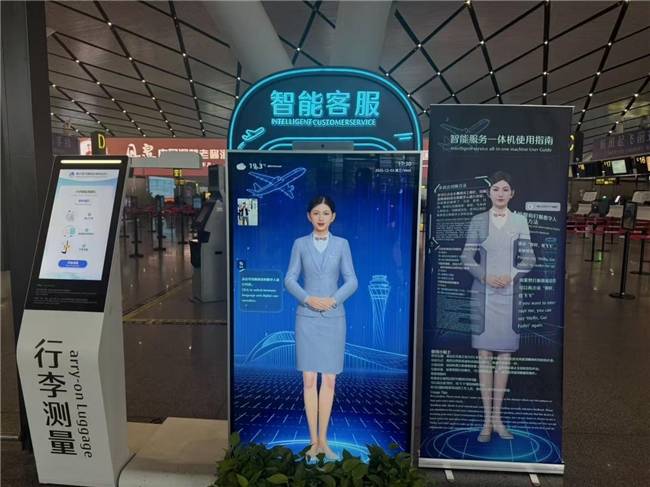
世优科技波塔AI数字人交互一体机助力南宁机场智慧出行服务升级
Sou Hu Cai Jing· 2026-01-15 08:03
Core Insights - The launch of the first 12 intelligent customer service agents "Gui Fei Fei" at Nanning Airport significantly enhances service efficiency and international traveler experience, particularly for ASEAN travelers [1] - The underlying technology supporting "Gui Fei Fei" is provided by Shiyou Technology, a digital human full-stack technology provider, which empowers the agent to exceed traditional customer service roles [2] Group 1: Technology and Capabilities - Shiyou Technology's multi-modal interaction engine enables "Gui Fei Fei" to support voice and text input/output, as well as real-time synchronization of expressions and actions, improving communication stability and accuracy in a noisy airport environment [4] - The agent's high-fidelity digital persona and real-time response capabilities are achieved through Shiyou Technology's proprietary algorithms, ensuring a visual affinity and a response time of under 3 seconds with a 96% accuracy rate in interactions [4][5] - "Gui Fei Fei" integrates various travel services seamlessly, including check-in, airport bus, and hotel booking, while also providing multi-language support, effectively breaking language barriers for ASEAN travelers [5] Group 2: Data Security and Service Reliability - Shiyou Technology's solution ensures full-link data encryption and privacy protection, automatically desensitizing interaction records after sessions to safeguard user data [6] - The technology supports rapid deployment and flexible adaptation, allowing "Gui Fei Fei" to operate independently at various locations within the airport without complex network modifications [10] Group 3: Industry Impact and Future Directions - The successful implementation of "Gui Fei Fei" at Nanning Airport serves as a benchmark for the intelligent transformation of physical services, showcasing how digital human technology can address real business challenges and enhance operational efficiency [11] - As part of the national digital economy strategy, Shiyou Technology aims to deepen technological innovation and collaborate with more industry partners to promote human-machine collaboration and intelligent inclusivity [11]
数字人民币利息怎么算
Jing Ji Ri Bao· 2026-01-14 22:06
Core Viewpoint - The introduction of interest on digital renminbi marks the transition from "digital cash era" to "digital deposit currency era," with banks now able to utilize digital renminbi deposits as a funding source [1][2]. Group 1: Digital Renminbi Interest Calculation - Digital renminbi wallets can earn interest starting January 1, with interest calculation rules aligned with those of demand deposits, currently set at an interest rate of 0.05% [1]. - Interest is credited on specific dates: March 20, June 20, September 20, and December 20, and users can check their interest amounts in the digital renminbi app after these dates [1]. Group 2: Authentication and Product Development - Users must complete real-name authentication for their digital renminbi wallets to earn interest, as wallets opened with just a phone number cannot accurately verify account information [2]. - The digital deposit currency era is expected to motivate banks to develop more deposit, wealth management, and credit products around interest-bearing digital wallets, enhancing the "payment + finance" ecosystem [2]. Group 3: Security and Compliance - Commercial banks are responsible for the security of digital renminbi wallets, providing payment services and ensuring compliance with anti-money laundering regulations, with deposits insured up to 500,000 yuan [3]. - Non-bank payment institutions must convert customer digital renminbi into their bank deposits, adhering to 100% digital renminbi reserve requirements to ensure safety [3].