
CHINA UNICOM(00762)

Search documents
中国联通(00762) - 截至2025年10月31日止之股份发行人的证券变动月报表
2025-11-04 00:46
股份發行人及根據《上市規則》第十九B章上市的香港預託證券發行人的證券變動月報表 截至月份: 2025年10月31日 狀態: 新提交 致:香港交易及結算所有限公司 公司名稱: 中國聯合網絡通信 (香港) 股份有限公司 呈交日期: 2025年11月4日 I. 法定/註冊股本變動 不適用 FF301 第 1 頁 共 10 頁 v 1.1.1 (A). 股份期權(根據發行人的股份期權計劃) 不適用 第 3 頁 共 10 頁 v 1.1.1 FF301 II. 已發行股份及/或庫存股份變動 | 1. 股份分類 | 普通股 | 股份類別 | 不適用 | | 於香港聯交所上市 (註1) | 是 | | | --- | --- | --- | --- | --- | --- | --- | --- | | 證券代號 (如上市) | 00762 | 說明 | | | | | | | | | 已發行股份(不包括庫存股份)數目 | | 庫存股份數目 | | 已發行股份總數 | | | 上月底結存 | | | 30,598,124,345 | | 0 | | 30,598,124,345 | | 增加 / 減少 (-) | | | ...

港股通央企红利ETF天弘(159281)涨0.88%,成交额4945.57万元
Xin Lang Cai Jing· 2025-11-03 17:55
Core Points - The Tianhong CSI Hong Kong Stock Connect Central State-Owned Enterprises Dividend ETF (159281) closed up 0.88% on November 3, with a trading volume of 49.4557 million yuan [1] - The fund was established on August 20, 2025, with an annual management fee of 0.50% and a custody fee of 0.10% [1] - As of October 31, the fund had 225 million shares outstanding and a total size of 228 million yuan [1] - Over the last 20 trading days, the fund's cumulative trading amount reached 1.129 billion yuan, with an average daily trading amount of 56.4648 million yuan [1] - The current fund manager is He Yuxuan, who has managed the fund since its inception, achieving a return of 1.18% during the tenure [1] Holdings Summary - The top holdings of the Tianhong CSI Hong Kong Stock Connect Central State-Owned Enterprises Dividend ETF include: - COSCO Shipping Holdings (0.85% holding, 218,000 shares, market value of 2.9175 million yuan) [2] - Orient Overseas International (0.40% holding, 10,500 shares, market value of 1.3717 million yuan) [2] - China Foreign Transport (0.33% holding, 270,000 shares, market value of 1.1396 million yuan) [2] - China National Petroleum (0.32% holding, 162,000 shares, market value of 1.0973 million yuan) [2] - CITIC Bank (0.32% holding, 175,000 shares, market value of 1.1136 million yuan) [2] - CNOOC (0.29% holding, 58,000 shares, market value of 1.0041 million yuan) [2] - China Shenhua Energy (0.29% holding, 30,500 shares, market value of 982,600 yuan) [2] - China Pacific Insurance (0.29% holding, 164,000 shares, market value of 1.0107 million yuan) [2] - China Unicom (0.28% holding, 104,000 shares, market value of 952,800 yuan) [2] - Agricultural Bank of China (0.27% holding, 189,000 shares, market value of 933,900 yuan) [2]


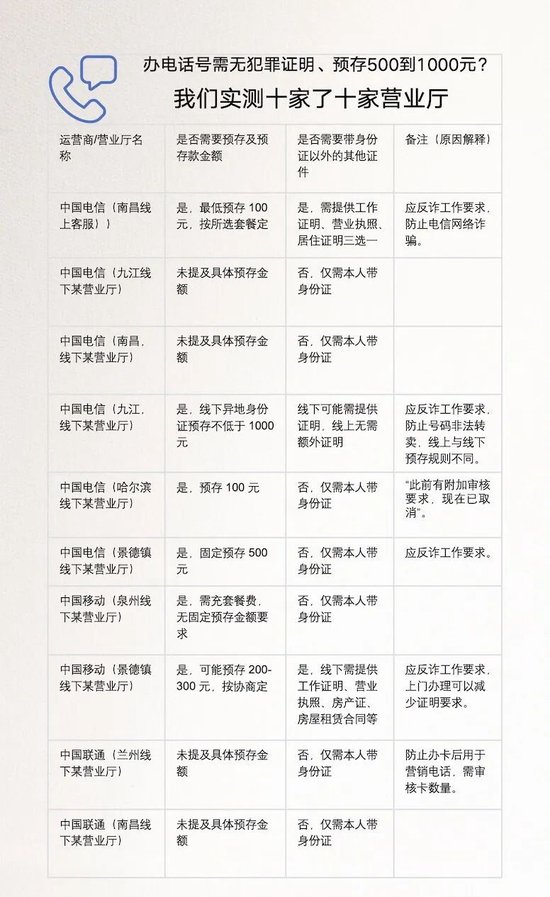
离谱!多地办电话卡要工作证明、无犯罪证明、银行流水
Xin Lang Cai Jing· 2025-11-03 14:12
Core Viewpoint - The article discusses the discrepancies in requirements for obtaining a phone card across different regions in China, particularly focusing on the additional documentation and prepayment requirements imposed by telecom operators in Jiangxi province, which are not uniformly mandated by national regulations [1][6][9]. Group 1: Requirements for Obtaining Phone Cards - Telecom operators in Jiangxi have implemented stricter requirements for obtaining phone cards, including the need for documents such as a "no criminal record" certificate, work proof, or property documents, along with a prepayment of 500 to 1000 yuan [1][4][6]. - In contrast, regions like Fujian, Gansu, and Heilongjiang have more lenient requirements, often only requiring an ID and no additional documentation or prepayment [5][6][9]. - The inconsistency in requirements has led to confusion among consumers, with some operators providing conflicting information regarding what is necessary to obtain a phone card [6][8]. Group 2: Justification and Legality of Requirements - Operators justify the additional requirements as measures to combat telecom fraud, but the specific regulations backing these requirements are unclear and not uniformly enforced [1][6][9]. - Experts have pointed out that there is currently no national regulation that explicitly authorizes telecom operators to impose such additional conditions for obtaining phone cards, raising questions about the legality of these practices [1][7][9]. - The lack of a unified standard for phone card applications across different regions has been criticized, with suggestions for regulatory bodies to establish basic standards to streamline the process and reduce unnecessary burdens on consumers [9].



电信运营商增长逻辑已变!
Zhong Guo Jing Ying Bao· 2025-11-03 03:53
Core Insights - The financial performance of China's three major telecom operators shows a mixed outlook, with revenue growth slowing down while profit growth remains positive [2][3][4] Revenue Performance - For the first three quarters of 2025, China Mobile, China Telecom, and China Unicom reported revenues of 794.7 billion, 394.3 billion, and 293 billion yuan respectively, with growth rates declining from 2.0%, 2.9%, and 3.0% in 2024 to 0.4%, 0.6%, and 1.0% [2] - Only China Mobile achieved a 2.5% year-on-year revenue growth in Q3 2025, while China Unicom's revenue remained flat and China Telecom's revenue decreased by 0.91% [2] Profitability - Net profits for the three operators reached 115.4 billion, 30.8 billion, and 20 billion yuan respectively, with growth rates of 4.0%, 5.0%, and 5.1%, although these rates have slowed compared to the previous year's figures [2][3] - The telecom industry as a whole saw a 0.9% year-on-year increase in telecom business revenue, totaling 1,327 billion yuan for the first three quarters of 2025 [2] Traditional Business Challenges - The decline in revenue growth is attributed to the weakness in traditional business segments, which have seen their revenue share drop from 92% in 2020 to 78% in Q3 2025 [3][4] - China Mobile has 1.009 billion mobile users, but its average revenue per user (ARPU) fell to 48 yuan, a 3% decrease from 49.5 yuan in 2024 [3] Emerging Business Growth - AI-related emerging businesses have become a significant profit driver, with China Unicom's AI-related revenue contributing over 60% to its "smart network" business, and its cloud revenue reaching 52.9 billion yuan, a 20.6% increase [6][7] - China Telecom's smart revenue surged by 62.3%, significantly outpacing its overall revenue growth of 0.59% [7] Investment in AI and R&D - The three operators have shifted their focus from traditional "pipeline thinking" to "computing power and service thinking," with R&D expenditures exceeding 22 billion yuan in the first three quarters of 2025, of which over 40% is allocated to AI-related investments [10][11] - The operators are expected to see long-term returns from these investments, despite short-term pressures on cash flow and profitability [10] Industry Transformation - The growth logic of the telecom industry is changing, with AI and computing power becoming central to future growth strategies [10][11] - The operators are forming a sustainable payment loop around "bandwidth + computing power + data + models," indicating a significant shift in the industry's revenue generation model [11]

十五运会火炬手周立松:传递大湾区硬联通、软联通、心联通的圣火
2 1 Shi Ji Jing Ji Bao Dao· 2025-11-02 07:46
Core Viewpoint - The 15th National Games torch relay symbolizes not only the spirit of the event but also the hard, soft, and emotional connectivity of the Greater Bay Area, highlighting the importance of regional economic collaboration and cultural integration [2]. Group 1: Event Overview - The torch relay took place simultaneously in Guangzhou, Shenzhen, Hong Kong, and Macau, with the Guangzhou route starting at Zhenhai Tower and concluding at Haixinsha Asian Games Park [2]. - Zhou Lisong, the General Manager of Guangdong Unicom, served as the torchbearer for the Guangzhou leg, expressing both excitement and a sense of responsibility [2]. Group 2: Significance of the Event - The event is seen as a significant opportunity to promote economic collaboration and cultural integration within the Greater Bay Area, beyond just a sports event [2]. - Guangdong Unicom aims to leverage technology to support the event, ensuring the operation of key systems such as command, information technology, and broadcasting networks [2]. Group 3: Future Implications - The company plans to extend its technological and innovative capabilities to urban governance and cultural tourism, enhancing economic cooperation and cultural exchange among the three regions [2]. - The goal is to create a digital channel that facilitates long-term benefits from the National Games, contributing to the integrated development of the Greater Bay Area [2].

通信行业周报:海外AI财报总结:巨头加大资本开支,云业务表现亮眼,海外AI发展提速-20251102
KAIYUAN SECURITIES· 2025-11-02 02:27
Investment Rating - The industry investment rating is "Positive" (maintained) [1] Core Views - The report highlights that major overseas AI companies are continuously increasing capital expenditures, focusing on AI infrastructure development, with significant growth in cloud business performance [5][6][19] - The report emphasizes a strong outlook for the "optical, liquid cooling, and domestic computing power" sectors, recommending specific stocks within these areas [7][25] Summary by Sections 1. Overseas AI Financial Summary - Google raised its capital expenditure guidance for 2025 to $91-93 billion, with Q3 capital expenditure reaching $23.953 billion, a year-on-year increase of 83% [5][15] - Meta's Q3 revenue was $51.24 billion, exceeding expectations, with a projected annual expenditure of $70-72 billion for 2025 [16] - Microsoft's Q1 FY2026 revenue reached $77.67 billion, a year-on-year increase of 18%, with significant growth in its cloud segment [17][18] - Amazon's Q3 revenue was $180.2 billion, with AWS net sales of $33.006 billion, a 20% year-on-year increase [19][20] - Celestica's Q3 revenue was $3.19 billion, a 28% increase year-on-year, leading to an upward revision of its annual guidance [21] 2. Communication Data Tracking - As of August 2025, the total number of 5G base stations in China reached 4.646 million, with 5G mobile phone users totaling 1.154 billion, a year-on-year increase of 19.46% [34][12] - The report notes that 5G mobile phone shipments reached 19.992 million units in August 2025, accounting for 88.4% of total shipments, with a slight year-on-year increase of 1.2% [41] - The three major telecom operators showed strong growth in innovative business development, with significant revenue increases in their cloud services [45][50]




LP圈发生了什么
投资界· 2025-11-01 07:54
Core Insights - The article highlights the establishment of various investment funds across different regions in China, focusing on strategic industries and innovation-driven sectors. Group 1: Fund Establishments - A central enterprise strategic emerging industry development fund was launched in Beijing with an initial scale of 510 billion RMB, involving major state-owned enterprises as contributors [2] - The Zhejiang Social Security Science and Technology Innovation Fund was established with an initial scale of 500 billion RMB, aimed at supporting key areas of technological innovation [3] - The first biomanufacturing industry fund in Shanghai was initiated, combining resources from industry leaders and venture capital to drive technological breakthroughs [4] Group 2: Regional Funds - Chengdu established a high-level talent innovation and entrepreneurship fund, focusing on early-stage investments to support talent and technology transfer [5][6] - Dongguan's Songshan Lake completed the registration of a 100 billion RMB mother fund to promote technological finance and regional industrial upgrades [7] - Wuhan launched its first concept verification fund group with an annual funding pool of 112.5 million RMB to support startup projects [8] Group 3: Sector-Specific Funds - The Hebei Xiong'an concept verification fund was set up with a focus on aerospace information and biotechnology, with an initial scale of 20 million RMB [9] - The Jilin Province Ice and Snow Economy Fund was established with a total scale of 500 million RMB, targeting the ice and snow tourism and technology sectors [11] - The Zhuhai Zuguang New Intelligence Fund was launched to support high-end intelligent manufacturing, marking a significant step in the region's industrial investment [12] Group 4: Investment Strategies - The Chengdu fund emphasizes market-oriented operations to facilitate talent and technology commercialization [6] - The Dongguan fund aims to create a comprehensive fund system covering the entire lifecycle of enterprises through collaboration with various investment institutions [7] - The Jiangsu Yangzhou Aerospace Industry Fund focuses on strategic emerging industries, leveraging a significant capital structure to enhance investment capabilities [14]



联通流量卡用户运营方法,2025联通流量卡运营趋势
Sou Hu Cai Jing· 2025-11-01 01:17
Core Insights - The article emphasizes the importance of user operations in transforming casual users of Unicom data cards into loyal customers by enhancing their overall experience and emotional connection with the brand [3][4]. User Operations - User operations involve strategies and interactions that make users feel satisfied with their data card, encouraging long-term use and recommendations to others [3]. - The primary goal of user operations is not just to sell more cards but to reduce user churn, increase user activity, and enhance the lifetime value of users [4]. Trends in 2025 - The article outlines three major trends for Unicom data card operations in 2025: 1. Transitioning from a "price war" to a "service value war," where companies focus on improving service experiences rather than competing solely on price [9]. 2. Emphasizing "localization" and "scenario-based" operations to cater to specific user needs, such as those of students or gig workers [9]. 3. Utilizing digital tools and data-driven decision-making to anticipate user needs and provide proactive services [9]. Practical Strategies - Several actionable strategies are suggested to enhance user satisfaction and retention: - Create an exceptional onboarding experience for new users [7]. - Establish a transparent communication system to build trust [7]. - Develop a sense of community among users to increase brand loyalty [8]. - Implement effective wake-up and recall mechanisms for inactive users [11][14]. Insights on User Retention - Data indicates that focusing on long-term value rather than short-term gains can significantly improve user retention rates, with a 45% higher retention rate in the 13th month for companies prioritizing user operations [13]. - The average referral rate for users engaged in effective operations can reach 31%, highlighting the value of genuine user experiences [13].
电信运营商增长逻辑已变
Zhong Guo Jing Ying Bao· 2025-10-31 20:16
Core Insights - The latest financial reports of China's three major telecom operators reveal a mixed performance, with revenue growth slowing down while profit growth remains positive [3][4][5] - The traditional business segments are underperforming, leading to a shift towards AI and digital innovation as new growth engines for the operators [4][5][7] Revenue and Profit Performance - For the first three quarters of 2025, China Mobile, China Telecom, and China Unicom reported revenues of 794.7 billion, 394.3 billion, and 293 billion yuan respectively, with growth rates declining to 0.4%, 0.6%, and 1.0% compared to the same period in 2024 [3] - In terms of net profit, the three operators achieved 115.4 billion, 30.8 billion, and 20 billion yuan respectively, with growth rates of 4.0%, 5.0%, and 5.1%, although these figures also reflect a slowdown from the previous year [3] Traditional Business Challenges - The revenue from traditional business has decreased from 92% in 2020 to 78% in the third quarter of 2025, indicating a significant decline in growth potential [5] - China Mobile's average revenue per user (ARPU) fell to 48 yuan, a 3% decrease from 49.5 yuan in 2024, highlighting the saturation in the mobile user market [5][6] Emerging AI Business Growth - AI-related businesses have emerged as a key profit driver, with significant revenue growth outpacing traditional segments [8][9] - China Unicom reported that AI-related revenue accounted for over 60% of its "smart network" business, with cloud revenue reaching 52.9 billion yuan, a 20.6% increase year-on-year [8][10] Industry Transformation - The telecom industry is shifting from a "pipeline thinking" model to a "computing power and service thinking" model, with increased capital expenditure on AI and data center upgrades [12] - R&D expenditures for the three operators exceeded 22 billion yuan in the first three quarters, with over 40% allocated to AI-related projects [12][13] Market Dynamics - The saturation of the telecom market and price elasticity limits the growth potential of traditional services, necessitating a focus on innovative AI solutions [7][9] - The overall telecom revenue growth is expected to be driven by the successful monetization of AI and computing services, indicating a fundamental change in the industry's growth logic [12][13]

规模510亿元战略基金启动,投早、小、长期、硬科技
Sou Hu Cai Jing· 2025-10-30 10:38
Core Insights - The establishment of the Central Enterprise Strategic Emerging Industry Development Special Fund (referred to as "Central Enterprise Emerging Fund") aims to enhance investment in strategic emerging industries, with a total fundraising of 51 billion yuan [3][4] - The fund has a total duration of 15 years, including a 5-year investment period and an 8-year management exit period, with a possible 2-year extension [3][4] - The fund's primary investment focus includes artificial intelligence, high-end equipment, quantum technology, and future industries such as future energy, future information, and future manufacturing [3] Fund Structure and Contributions - The fund has 15 contributors, with China Reform Holdings Corporation Limited (China Reform) being the largest shareholder, contributing 15 billion yuan and holding a 29.4% stake [3] - Other contributors include state-owned enterprises such as China Mobile (6 billion yuan), Sinopec (5 billion yuan), and China National Offshore Oil Corporation (3 billion yuan), among others [3] - The total scale of various central enterprise venture capital funds established this year is approaching 100 billion yuan, focusing on technology attributes and emerging fields [4] Policy and Investment Strategy - The fund is part of a broader initiative to support the development of strategic emerging industries as mandated by the central government [4] - The investment strategy emphasizes early-stage, small-scale, long-term investments in hard technology, creating a new model of integration between industry and finance [4][6] - Recent policy measures aim to address concerns regarding state-owned capital's risk tolerance and investment willingness, establishing a lifecycle assessment mechanism for venture capital funds [7][8] Market Impact and Collaboration - State-owned capital is expected to stimulate market-oriented funds' investment enthusiasm, particularly in larger financing projects where state capital can lead the investment [8] - Central enterprises possess rich application scenarios for collaboration, as evidenced by recent procurement orders in the robotics sector [8]

